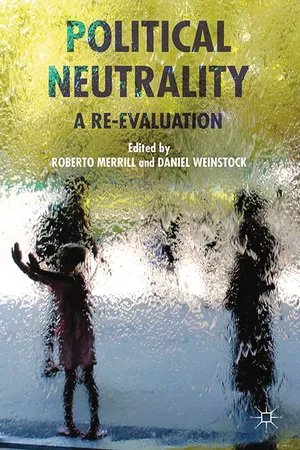
The topic of neutrality on the good is linked rather closely to the ideal of political liberalism as formulated by John Rawls. Here internationally renowned authors, in several cases among the most prominent names to be found in contemporary political theory, present a collection of ten essays on the idea of liberal neutrality.
- English
- ePUB (mobile friendly)
- Available on iOS & Android
eBook - ePub
About this book
Information
Topic
PhilosophySubtopic
Political PhilosophyPart I
General Approaches
1
Neutrality and Political Liberalism
Richard J. Arneson
Is neutrality on the good in some sense an ideal that a just society must embrace? A flagrantly non-neutral policy such as a state establishment of religion would surely merit condemnation. Such a policy would be non-neutral on the good, but would also run afoul of other principles of right that might have independent appeal for many of us, whatever our views on state neutrality. On the other hand, we might imagine a society in which human friendship is deteriorating according to a variety of social science measures. An alarmed government institutes laws and policies to promote friendship, consisting of a pro-friendship advertising campaign, attention to friendship in the public school curriculum, and subsidized psychotherapy and anger management classes for people who see themselves as lacking capacities for forming and sustaining friendships and are unhappy about that. Such policies would qualify as non-neutral, if the neutrality norm rules out state action that advances some controversial conception of good, and if it is controversial that friendship is good. (Maybe some theorists celebrate the hermit’s life.) Here non-neutrality does not strike me as bad policy.
Neutrality on the good is a thesis in the theory of moral right, the theory of what we morally owe to one another.1 More specifically, neutrality is a suggested moral constraint on justifiable state policies. Neutrality is opposed to perfectionism, regarded as (inter alia) a norm for the guidance of state policy. However, both neutrality and perfectionism come in different versions, and one might wonder whether plausible, moderate versions of each view might tend to convergence, that is, to recommendation of similar practical policies. The first part of this essay argues that the opposition is robust and the prospects for convergence are dim.
Political liberalism as affirmed by John Rawls might seem to provide strong arguments in favor of a version of pluralism on the good. The second part of this essay argues that this appearance is deceptive. Thinking through the political liberalism approach to social justice issues yields no support for neutrality on the good.
1 Clarification
First, some clarification of the neutrality ideal is needed. I shall distinguish three notions of neutrality and identify the neutrality norm with two of them. Here I am following the practice of neutrality advocates, not claiming to do any original analytical work. The three notions are:
1.Neutrality of aim requires that no action or policy pursued by the state should aim to promote one controversial way of life or conception of the good over another.
2.Neutrality of justification requires that any policies pursued by the state should be justified independently of any appeal to the supposed superiority of one way of life or conception of the good over another.
3.Neutrality of effect requires that policies pursued by the state should not bring it about that any controversial way of life or conception of the good is advantaged over others. Nor should state policy bring it about that any adherents of some controversial conception of the good or way of life are advantaged over adherents of other ways or conceptions.
The neutrality norm as I shall understand it in this essay combines neutrality of aim and neutrality of justification. Both requirements must be satisfied.2
The right, independent of the good. As so far described, the neutrality doctrine holds that what is morally right for the state to do is fixed independently of controversial claims regarding what is good (what is worth seeking in human life, what adds to the well-being of a person).
Viewed in the light of this contrast between the concepts of the good and the right, the doctrine of neutrality reveals an odd asymmetry. Neutrality insists that state power not be deployed on behalf of controversial ideas of the good. The appropriate justifications for the use of state power must be sought elsewhere, and in part, in the doctrine of neutrality itself. The doctrine of neutrality is doubtless itself a controversial position, but this is a controversial doctrine within the domain of the morally right, so its being controversial does not rule out its being acceptable, part of the doctrine of justice that determines what uses of state power ought and ought not to be made.
The evident odd asymmetry here is that conceptions of the good that are controversial are ipso facto unsuited to be determiners or partial determiners of what is just, whereas controversial conceptions of right are not barred from functioning in just this way. Presumably the background assumption is that a conception of what is morally right can be controversial, accepted by some intelligent and thoughtful people and rejected by others, yet still be correct for all that, singled out as uniquely best by the all things considered balance of moral reasons that bear on the issue. Why this epistemic asymmetry? Something approaching skepticism about the rational determination of what is good is assumed, along with robust non-skepticism about the rational determination of what is right.3 One wonders whether the bar of rational acceptability is being raised and lowered arbitrarily when one moves from the domain of the right to the domain of the good, so the standard cannot be met when we are debating what is good but can be met when we are debating what is right. The suspicion is naturally raised that whatever skeptical considerations are thought to defeat the project of figuring out what makes a life good for the person who lives it, those same skeptical considerations applied evenhandedly to the project of figuring out what we morally owe to one another will bring about a similar defeat. This is just a suspicion, and one that could be defeated by presentation of arguments that warrant skepticism about the good and fideism about the right. I confess that in my own mind the suspicion rankles. I have yet to see the arguments that amount to a plausible defense of asymmetry.
However, it should be noted that neutrality might be defended without appeal to asymmetry. For example, one might adhere to a theory of moral right whose central components simply do not hinge on claims about the good. If Lockean libertarianism ultimately proves to be the correct theory of moral right, then what we owe to one another does not depend in any way on conceptions of what goals are most worthy of pursuit and what ways of life are most fulfilling.4 The Lockean libertarian holds that each person has the right to do whatever she chooses with whatever she legitimately owns provided she does not thereby harm others in certain ways that count as violating their natural rights. A state would at most be justified in acting to protect people’s natural moral rights. No state policies that run afoul of the neutrality norm could be justified. Lockeanism embraces neutrality without reliance on any epistemic asymmetry claims to the effect that knowledge of the good is unavailable whereas knowledge of the right is available. Knowledge of the good, if such there be, would be simply an idle wheel in the Lockean libertarian political morality.
However, to sustain neutrality by his line of thought, one must be able to justify a conception of what rights we have, Lockean or some other, without appeal to what is good or worth seeking in human life. This is, to say the least, a tall order.
Neutrality regarding controversial conceptions of good. The neutrality norm requires the state to be neutral only between controversial claims about what is good. Which are these? A conception of the good might be controversial in a purely descriptive sense. In this sense, if something is actually disputed, it is controversial. I suppose a friendly interpretation of the neutrality norm takes a claim about the content of human good to be controversial if it is normatively controversial. There are reasons for and against the claim, so it makes sense that the claim is controversial.5 The claim has features that make it apt for controversy. I suppose also that a claim about good can be controversial in this normative sense even when it is the case that it is ultimately ascertainable whether or not the claim is true or best supported by moral reasons, all things considered. There is a truth of the matter that in some sense, maybe with difficulty, maybe only in the long run, is amenable to discovery. That can be so, yet the claim is controversial, and given our epistemic situation, should be controversial, to a degree, for now.
There is a puzzle here, however, to which I keep recurring in this essay. If there are some reasons in favor of a view, say Buddhism, and some reasons in favor of an opposed view, say Hinduism, and no compelling reasons on either side, how does the choice between these doctrines get to be legitimately controversial? If the situation is as described, shouldn’t we all agree there is something to be said for each side and no decisive reason to favor either one? Perhaps we should say that an issue is descriptively controversial if actually disputed and normatively controversial if there is some rational basis for controversy, even if not a decisive basis. Being normatively controversial then admits of degree. At the limit, all reasoners responding fully to the reasons there are will agree (even if just to say there is no superior merit in any contending position). Just shy of that limit, there may still be controversy among pretty good reasoners, and as one raises the standard of normative controversiality, one gets closer to the limit.
The neutrality norm advocate would render her position implausible if she held that anything actually disputed is genuinely controversial and would be gutting her position if she insisted on raising the standard for normative controversiality to the limit where nothing would actually be disputed. There is as it were a Goldilocks issue here; a plausible neutrality norm will insist neither on too much reasonableness nor too little in setting the bar for being normatively controversial.
What neutrality comes to in practice will depend on what counts as a controversial conception of good or claim about the good. I assume that advocates of the neutrality norm would agree that it is a controversial claim about the good that the goods of sexual pleasure, sexual intimacy, and sexual friendship that we suppose are available in heterosexual relationships and heterosexual sexual activity are equally available in non-heterosexual relationships and sexual activity. These important human goods that a man and a woman can gain from sexual encounters can equally be gained from same-sex sexual encounters.
This claim is clearly controversial in the descriptive sense. Many Christians and others as a matter of fact reject it. More to the point, the claim is normatively controversial; it is a claim that is controversial among ordinary, reasonable people who are not substandard in cognitive abilities. People offer substantial arguments in its support. People who find the idea of gay sex degrading or evil sometimes appeal to Divine Command to justify this response, so the issue is then entangled in further controversial issues. Intelligent people can be found on opposed sides in such disputes.
Despite its controversiality, I find it incredible that the claim that same-sex sex is good is false. It strikes me as evidently true and a suitable basis for public policy in a diverse democracy. I don’t propose to argue for the goodness of same-sex sex here; I just invite the reader to consider the issue and ponder whether neutrality regarding controversial conceptions of good in its application to this question looks like a stance that justice allows. I think not.
One might resist this plea for non-neutrality on the ground that what is required is that the state protect the rights of all persons to conduct their lives as they see fit according to their own values and norms so long as they don’t harm others (in certain ways that violate their rights). Taking a stand for or against the goodness of sexual activity of any sort is neither here nor there, one might hold. So the claimed requirement that the just state should take a stand on this matter does not put any pressure on the advocate of the liberal neutrality. What the just state does is keep its mouth shut on this issue, and that’s consistent with a strict neutrality policy.
We should not buy this line of thought. Merely allowing people the freedom to pursue their good as they see fit may not give them a fair opportunity actually to lead good lives because they lack the resources necessary to achieve the reasonable goods they seek. Nor is this problem remedied by adding to one’s theory of the right a provision that ensures that people will have a fair opportunity to gain resources or even a guarantee that they will have access to some threshold amount of multi-purpose resources suitable for gaining diverse goods. The problem is that the resource share that is fair for an individual to have cannot be settled independently of considering the individual’s particular traits and how those traits would interact with given resources in the individual’s actual circumstances to generate opportunities to achieve a good quality of life. What counts as a good quality of life depends on what is valuable in human life, not merely on what is currently fashionable or revered. On this view, what we owe to one another depends inter alia on what is objectively valuable and what it would take for each of us to get a fair amount of it.
Reverting to the example of same-sex sex, I claim that merely ensuring that each man and woman has the freedom to pursue romantic partners who are either men or women does not guarantee adequate opportunity for romantic fulfillment to all regardless of their sexual orientation. Perhaps instruction to all school children is needed to bring about a social atmosphere that promotes real as opposed to merely formal freedom in this sphere. A society that passes laws forbidding racial discrimination does not merely aim to prevent racially discriminatory behavior. The larger aim is to change the hearts and minds of men and women, so they come to be no longer prone to racial animus and prejudice. To achieve the larger aim might require additional policies whereby the state declares itself for a racially harmonious society. In much the same way, bringing it about that – ...
Table of contents
- Cover
- Title
- Introduction
- Part I General Approaches
- Part II Specific Issues
- Bibliography
- Index
Trusted by 375,005 students
Access to over 1.5 million titles for a fair monthly price.
Study more efficiently using our study tools.
Frequently asked questions
Yes, you can cancel anytime from the Subscription tab in your account settings on the Perlego website. Your subscription will stay active until the end of your current billing period. Learn how to cancel your subscription
No, books cannot be downloaded as external files, such as PDFs, for use outside of Perlego. However, you can download books within the Perlego app for offline reading on mobile or tablet. Learn how to download books offline
Perlego offers two plans: Essential and Complete
- Essential is ideal for learners and professionals who enjoy exploring a wide range of subjects. Access the Essential Library with 800,000+ trusted titles and best-sellers across business, personal growth, and the humanities. Includes unlimited reading time and Standard Read Aloud voice.
- Complete: Perfect for advanced learners and researchers needing full, unrestricted access. Unlock 1.5M+ books across hundreds of subjects, including academic and specialized titles. The Complete Plan also includes advanced features like Premium Read Aloud and Research Assistant.
We are an online textbook subscription service, where you can get access to an entire online library for less than the price of a single book per month. With over 1.5 million books across 990+ topics, we’ve got you covered! Learn about our mission
Look out for the read-aloud symbol on your next book to see if you can listen to it. The read-aloud tool reads text aloud for you, highlighting the text as it is being read. You can pause it, speed it up and slow it down. Learn more about Read Aloud
Yes! You can use the Perlego app on both iOS and Android devices to read anytime, anywhere — even offline. Perfect for commutes or when you’re on the go.
Please note we cannot support devices running on iOS 13 and Android 7 or earlier. Learn more about using the app
Please note we cannot support devices running on iOS 13 and Android 7 or earlier. Learn more about using the app
Yes, you can access Political Neutrality by Roberto Merrill,Daniel Weinstock in PDF and/or ePUB format, as well as other popular books in Philosophy & Political Philosophy. We have over 1.5 million books available in our catalogue for you to explore.