eBook - ePub
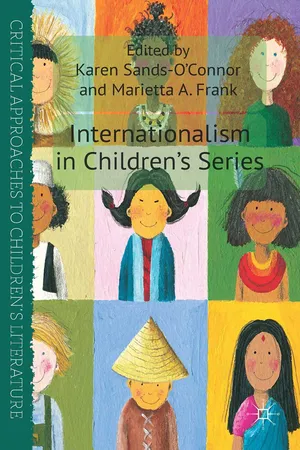
Internationalism in Children's Series
- English
- ePUB (mobile friendly)
- Available on iOS & Android
eBook - ePub
Internationalism in Children's Series
About this book
Internationalism in Children's Series brings together international children's literature scholars who interpret 'internationalism' through various cultural, historical and theoretical lenses. From imperialism to transnationalism, from Tom Swift to Harry Potter, this book addresses the unique ability of series to introduce children to the world.
Information
Topic
LiteraturSubtopic
Literaturkritik1
Introduction: Stepping Out into the World: Series and Internationalism
What does it mean to be a part of a nation? What does it mean to be international? And why should children, whose world often is comprised only of their family and school communities, care about either nations or borders? The answers to these questions have changed over time, but there has been increased focus on the questions over the last century and a half. During the same century and a half, series books for children have become a regular part of the child’s reading landscape. Internationalism in Children’s Series examines the ways in which ideas about cultural exchange and global interaction are portrayed in series for children and what these portrayals signify. In this volume we bring together cross-cultural perspectives on series and on the idea of internationalism to offer some insights into the complex interactions between readers, books, and global power and participation.
The earliest series that this collection discusses is Jacob Abbott’s Rollo series, which began publication in 1835; but the first books in that series were concerned with the main character’s scholarly education. It was not until 1853 that the series took an international turn, when Rollo embarked upon a grand tour of Europe with his uncle. The mid-nineteenth century was, in fact, an important point in time for internationalism. Improvements in technology meant that not only was publishing cheaper,1 transatlantic travel was faster and easier than ever in steamships, and transcontinental or transnational (whether North American or European – or, eventually, Asian, Australian, South American, and African) travel by train was becoming the norm. The tour operator Thomas Cook conducted his first European tour (from England) in 1855. An 1858 British law established passports for the first time as legal international identity documents.2 Additionally, many governments were increasingly focused on the global rather than the local. British imperial holdings were increasing (the 1840s brought New Zealand and Africa’s Gold Coast under British control, for example), and other European countries, such as France (who took control of Algeria in 1840), were also expanding territorial interest throughout the world. Immigration to America was on the rise as the US government expanded its territory to the western half of North America (the Gadsden Purchase of 1853 enlarged the nation to what is known today as ‘the lower forty-eight states,’ including everything except Alaska and Hawaii). Internationalism at this point in time centered on American and European expansion and thus, competing ideologies about what was ‘best’ for the world. Child readers in America and Europe, where most publishing for children took place, needed to be educated about their role as future leaders of far-flung regions, and the burgeoning market for book and magazine serials took an interest in this education.
By the 1920s, the focus of internationalism had shifted. Although colonialism was far from dead (the British Empire was at its peak size following the end of World War I;3 the United States was heavily involved in trying to manipulate the governmental politics of the Caribbean and Central and South America4), there was growing criticism about imperialism from within the imperial nations as well as from growing independence movements. Within the United States, immigration was being restricted in new ways (the 1917 act restricted immigration on the basis of education level, race, and mental disability, and the 1924 act legally established immigration quotas based on national origin). The newly established League of Nations held a conference on international passports in 1920, and many countries who had not previously established passport offices began to do so. National identities were becoming more important and more restrictive.
At the same time, series books were enjoying a new heyday in Europe and North America, where most publishing for children was still concentrated. While a literary tradition of outfitting young imperialists to run their empires continued – and series from the Stratemeyer Syndicate exemplify this type of series book – there was increasing unease about interaction with people of other nations. Political imperialism was no longer celebrated the way that it had been in the nineteenth century, and this led to a change in series fiction. The change manifested itself in two major ways: an increase in economic rather than (or in addition to) political interaction between characters of different nations; and an attempt at increasing international understanding through the highlighting of similarities between characters of different nations. Internationalism during this period implied some kind of acknowledgement that nations were different in unique ways; global stability depended on consigning that difference to economics (‘products’ that Europeans and Americans could buy or exploit) or by overcoming difference through an appeal to ‘universal’ ideas about humanity. Thus, books in the Stratemeyer series (among others) focused on, as Kent Baxter puts it, ‘the desire to own, and the object of that desire, the property’ (174–5); and books such as Lucy Fitch Perkins’s Twins series, as Claudia Mills points out, ‘strove in their way to make the world one community’ (8). The notion that childhood was even more universal than adulthood5 made the children’s book an ideal place to expound such notions; the series through its repetition of ideas, values, and characters, could cement new ideas of economic internationalism and world friendship in the minds of its child readers.
Since the mid-twentieth century, global politics, international mobility, and children’s publishing have gone through major changes. The majority of former European and American colonies are now independent nations of their own. The airline industry has, in most places, taken over from cruise liners and trains as the primary way of moving people across large distances. Global migration, whether by choice (for economic reasons, for example) or force (war or famine, for example) has steadily increased in the last three decades.6 Internationalism is increasingly focused on global movement, multiple voices, and the clash of ideologies between groups that might or might not be tied to a particular nationality.
Children’s publishing has also changed, becoming at once more global7 and more local.8 International organizations such as the International Board on Books for Youth (IBBY) were organized after World War II, and slowly began to recognize authors and illustrators outside of Europe and North America (IBBY’s Hans Christian Andersen Award, established in 1956, recognized its first non-European, non-American author, Brazilian Lygia Bojunga Nunes, in 1982). Efforts to promote local children’s publishing on an international stage have also been helped by technology through websites like the International Children’s Digital Library, established in 2002. Internationalism in series during this period questions the idea of nationality and belonging. Authors of series are no longer tied to publishing syndicates like the Stratemeyer Syndicate, and increasingly come from outside the traditional publishing hubs of Europe and North America; more books are published that highlight alternate voices or multiple versions of historical events; characters themselves become international through migration or through the book’s translation. The series, more than the individual book publication for children, offers opportunities for multiplicity in terms of different voices and different venues.
The appeal of series to children has been discussed by many critics (both those in favor of and those who disparage series), although many critical studies have focused on particular series or individual characters.9 Victor Watson, in Reading Series Fiction (2000), argues that series fiction offers ‘a complex variety of profoundly private pleasures, and […] these pleasures are repeatable and entirely within the reader’s control’ (1). Series for children have long relied on familiarity (through character or sometimes, as in magazine serials, regular features or formats) as a tool to bring readers in and keep them reading through several volumes. Recent scholarship on series has extended Victor Watson’s argument about children’s need for control in the reading process by examining the notion of child citizenship through consumerism. The series – whether book or periodical, fiction or nonfiction – requires multiple investments (of at least time, and, given the fact that many libraries have traditionally refused to stock series in their children’s departments, money).10 Children thus become, not just occasional, but regular, predictable consumers of these books and the other products they promote. Joe Sutliff Sanders, discussing the late nineteenth-century American periodical, St. Nicholas, writes that the editors ‘used sympathetic pleas to influence [children’s] spending patterns, urging them not just to buy the magazine itself, which it certainly did, but to buy the products advertised in its pages as well’ (158). Michelle Beissel Heath says that the same is true of book series: ‘the commercialism and consumerism inherent in these texts converge with notions of child citizenship today’ (38). Children, who cannot vote, become citizens through purchasing power.
A very similar argument is being advanced by critics and scholars concerning children and international citizenship. Stephanie Hemelryk Donald examines the idea of cosmopolitanism,11 writing about Chinese children interacting with the global literary and media markets remarks,
The cosmopolitan consumer is an emerging category of competent who manages without physical access to the whole world. S/he may well be a child. … This cosmopolitan makes real demands … through their consumption of local and international cultural goods, forcing a relationship with the imagined outside world from the comfort of home and the nation space.
(51)
In the same way that a child can buy a stake in the nation through reading, the child can just as easily purchase global citizenship. Children, whose purchasing power has risen throughout the past century and a half, are voyaging out into the imagined world through books – but publishers and authors are doing their best (as they always have) to shape that experience through promotion of specific ideologies and ideas about self and nation. Thus, national and international citizenship through consumerism are linked together; and the effect of the lessons that book producers are trying to teach is multiplied through series.
But when a child becomes a consumer of national and international ideologies through series, what do they get in return? Are they buying a bill of rights, or a bill of goods? Do they own, or owe, the world? Of course there is no simple, or single, answer to this question, and a great deal depends on what kind of internationalism is on offer. In terms of narrative patterns, series for children historically moved from individual, often factually-based travel narratives (such as the Rollo series), to fantastic or mysterious adventures in ‘exotic’ lands by characters like Nancy Drew, to migration stories; these narratives mirrored trends in international politics and publishing. Ideologically, series narratives constantly shift between an imperial- or colonial-based internationalism, an internationalism that values ideals of ‘world friendship’ or ‘the family of man,’ and the idea of transnationalism or multiple national affinities. Whereas formal, narrative patterns of series listed above seem to be more or less chronological (providing an obvious organization for the chapters contained in the volume), shifts in ideology are not. Series published in the same decade might have radically different views of what it means to be internationally-minded. An author of a single series might move from portraying world friendship to an imperial internationalism, depending on the countries discussed. Some adult authors focus on economic internationalism or on globalization, while some child magazine correspondents (and, potentially, other readers of series as well) discuss world friendship or the value of transnationalism. Before discussing the individual chapters that make up this volume, it may be useful to consider each of these definitions of internationalism, and where/when/how they can be found within series.
Defining internationalism through or as imperialism is both familiar and foreign to children’s literature critics. Colonialism and imperialism were at their zenith in many countries, including Britain and America, when publishing for children was becoming a distinct and important market and books more readily available due to industrial advances in those countries. Children’s literature and imperialism are very much linked: one feeds the other, in a continuing cycle of book production to imperial indoctrination and back again, as is shown (in our volume) in the reading and writing of prolific children’s authors and publishers Jacob Abbott (1803–1879) and Edward Stratemeyer (1860–1930). Imperialism led to a particular way of approaching internationalism; as Roderick McGillis writes, it involves a ‘colonial mentality [that] assumes that the colonizer represents a more advanced state of civilization than the colonized does, and therefore that the colonizer has a right to assume a position of dominance’ (xxii). Thus, as Janis Dawson discusses, British magazine serials of the late nineteenth century suggest that the ‘far-flung empire … was an ideal proving ground for the New Girl adventurer’ (p. 42); and Stratemeyer Syndicate characters from the early twentieth century teach ‘generations of American children the tenets of “friendly imperialism”’ (Sands-O’Connor p. 61). While series might suggest a world order with Europeans and Americans on top, they also frequently indicate gaps between the ‘ideal’ of world domination and actual attitudes, concerns, and actions of both colonizer and colonized. Michael G. Cornelius writes about how international travel ‘often creates the environment for a breakdown of the social conditions that maintain the rigid generic conventions’ (p. 109) of the series. Looking outward allowed writers and readers to look inward; as Chris Nesmith puts it in his chapter, ‘travel and travel writing in the United States corresponded to the general cultural obsession with understanding its [own sense of] national identity’ (p. 21). And David Rudd argues that the literary creation of the foreigner can reveal how ‘ambivalent when it comes to establishing identity’ (p. 134) any writer may be.
Constructions of internationalism through imperialism and/or colonialism did not end with the demise of ‘imperial projects’ discussed in earlier series in this collection. Hilary Brewster suggests that identity creation and nationalism are not merely in an author’s mind, but in the reader’s – and translator’s – interpretation of a text as well. Charlotte Beyer discusses how historical series fiction ‘is grounded in complex historical realities’ and has the potential to reflect ‘the darker sides of life’ (p. 180). Postcolonial texts are not divorced from their imperial forerunners, but often highlight what was hidden or only subtly suggested in prior series.
The devastating effects and after-effects of World War I caused a number of educators, artists and politicians to call for a change in international relations, which were frequently conducted on the basis of ‘tribal prejudice’ (205) according to Hugh Lofting, author of the Doctor Dolittle series (1920–52). While for some, the League of Nations was the answer, Lofting advocated instead ‘a new Literature of World Friendship for Children’ (207) which would promote racial tolerance, peaceful conflict resolution, and cooperation. Several series, like Our Little Cousins (1901–33) and Twins of the World (1911–37) focus on one or two specific children, integrating details of their daily lives and country’s customs in story form. But these books are not exclusively international; in fact, Jani L. Barker explores in her chapter how series often advocate for both internationalism ...
Table of contents
- Cover
- Title
- Copyright
- Contents
- Series Editors’ Preface
- Acknowledgements
- Notes on Contributors
- 1 Introduction: Stepping Out into the World: Series and Internationalism
- Part I Nineteenth-Century Series Go Abroad
- Part II Syndicates, Empires, and Politics
- Part III Translating Histories and Cultures
- Index
Trusted by 375,005 students
Access to over 1.5 million titles for a fair monthly price.
Study more efficiently using our study tools.
Frequently asked questions
Yes, you can cancel anytime from the Subscription tab in your account settings on the Perlego website. Your subscription will stay active until the end of your current billing period. Learn how to cancel your subscription
No, books cannot be downloaded as external files, such as PDFs, for use outside of Perlego. However, you can download books within the Perlego app for offline reading on mobile or tablet. Learn how to download books offline
Perlego offers two plans: Essential and Complete
- Essential is ideal for learners and professionals who enjoy exploring a wide range of subjects. Access the Essential Library with 800,000+ trusted titles and best-sellers across business, personal growth, and the humanities. Includes unlimited reading time and Standard Read Aloud voice.
- Complete: Perfect for advanced learners and researchers needing full, unrestricted access. Unlock 1.5M+ books across hundreds of subjects, including academic and specialized titles. The Complete Plan also includes advanced features like Premium Read Aloud and Research Assistant.
We are an online textbook subscription service, where you can get access to an entire online library for less than the price of a single book per month. With over 1.5 million books across 990+ topics, we’ve got you covered! Learn about our mission
Look out for the read-aloud symbol on your next book to see if you can listen to it. The read-aloud tool reads text aloud for you, highlighting the text as it is being read. You can pause it, speed it up and slow it down. Learn more about Read Aloud
Yes! You can use the Perlego app on both iOS and Android devices to read anytime, anywhere — even offline. Perfect for commutes or when you’re on the go.
Please note we cannot support devices running on iOS 13 and Android 7 or earlier. Learn more about using the app
Please note we cannot support devices running on iOS 13 and Android 7 or earlier. Learn more about using the app
Yes, you can access Internationalism in Children's Series by K. Sands-O'Connor, M. Frank, K. Sands-O'Connor,M. Frank in PDF and/or ePUB format, as well as other popular books in Literatur & Literaturkritik. We have over 1.5 million books available in our catalogue for you to explore.