- English
- ePUB (mobile friendly)
- Available on iOS & Android
eBook - ePub
About this book
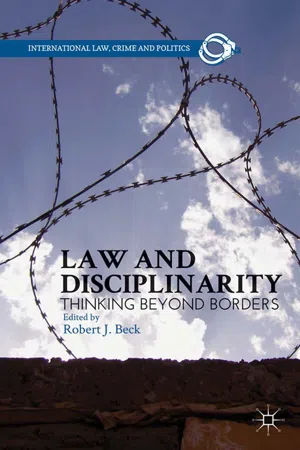
Traditional legal borders are increasingly contested in the present day. This book explores the nature, implications, and future of legal 'borders' - geographic and intellectual - in the twenty-first century's dramatically changing global context.
Information
PART I
INTRODUCTION
1
THINKING BEYOND BORDERS: REFLECTIONS ON LAW AND DISCIPLINARITY
Robert J. Beck
There are no clear borders,
Only merging invisible to the sight.
—Dejan Stojanović, “Awakening of a Flower”1
In the twenty-first century, traditional legal borders—both geographic and intellectual—have been increasingly contested. Many observers have questioned whether the long-held conceptions of sovereign state boundaries remain salient in a world of technology-accelerated transnational flows of people, capital, and information.2 Meanwhile, in unprecedented ways, scholars with training in anthropology, art, communication, critical theory, economics, ethics, history, information sciences, literature, media studies, political science, sociology, and law have begun crossing disciplinary borders to use one another’s methods and to engage in meaningful and sustained dialogue about “law” in its dramatically changing global context.3 What are the nature and implications of these two shifting legal borders? What does the future hold for them? And what role do new technologies play in this evolving story? These are some of the central questions explored by Law and Disciplinarity: Thinking beyond Borders.
Since at least the emergence of the Westphalian state system in the mid-seventeenth century, international law has viewed territorial borders through a global and legal lens. Especially since the end of the cold war, the disciplinary borders between international law (IL) and other fields, particularly international relations (IR), have been challenged, with calls made for interdisciplinary collaboration.4 What are we to make of scholarly pleas to cross the disciplinary border? And how are the descriptive norms upon which international law has been built, including territorial ones, to be understood? The contributors to this volume address these and related legal questions through a variety of approaches, the major thematics of which revolve around theoretical claims about discipline and method, the relationship of art to international politics, the transformations wrought by the Internet era, and the creation and continuation of the state system.
In “The Relative Autonomy of International Law or The Forgotten Politics of Interdisciplinarity,” Jan Klabbers introduces the theoretical stakes of international law with nuance and irreverence. Himself a professor of international law, Klabbers alerts would-be international legal interdisciplinarians to the potential dangers of their enterprise, arguing that “appeals for interdisciplinarity, however laudable in the abstract, carry a serious risk of reproducing, or even strengthening, existing power configurations.” Accordingly, “[f]or that reason alone, international lawyers should jealously guard the relative autonomy of their discipline.” Klabbers does not contend that interdisciplinarity is “flawed at the root.” Rather, he cautions that his fellow international lawyers should not “immediately heed to the siren song of interdisciplinarity.” Full-fledged interdisciplinary projects, he warns, whether law and economics, law and history, law and ethics, or international law and international relations, “will not always and automatically enable [international law scholars] to come to a better understanding of international law,” which he suggests, should be their priority.5 Despite a healthy degree of skepticism, Klabbers concedes that interdisciplinarity has value and proposes stimulating “cross-fertilization by means of joint seminars, interdisciplinary discussion groups, and that sort of thing.” This volume was inspired by such thinking.
In chapter 3, political theorist Kennan Ferguson seeks to illumine the role and nature of international law’s rules in his provocative “Speed Limits and Speed Bumps: The Fictions and Functions of International Law.” Drawing upon the works of philosophers (Arendt, Bourdieu, Burke, Foucault, Marx, Schmitt), legal theorists (Austin, Hart), scholars of international relations (Ashley, Bull, Polat, Weiss) and international law (Falk, Franck, Glennon, Henkin, Weil), and IL-IR interdisciplinary advocate Slaughter, Ferguson contends that “the descriptive norms upon which law are built are not only fictional but reinscribed in their fictionality.” Observes Ferguson, “the promise of law is predictability and standardization” and yet, ironically, the “practice of law depends upon unpredictability and specification.” His chapter begins by describing “the mythos of law” as sovereign rule-enforcer, contrasting this with the actual function of domestic laws, as illustrated by traffic control. In fact, argues Ferguson, “law in this circumscribed realm operates through overpenalization,” and traffic control also has “a vital, physical-structural component.” Next, Ferguson applies the insights gleaned from traffic law to the “seeming contradictions” between the formal immigration laws in the United States and Europe and the realities of state practice. Ferguson closes his chapter by exploring international law’s “overpunitive” and “geostructural” modalities in an effort to make sense of international law’s use. “If the functions of international law operate in the same primary way as do the functions of domestic law,” Ferguson concludes, “then the debates over the existence or non-existence of transnational sources for law are irrelevant at best, and likely a distraction from the violences those laws encourage.”
Occasions of such violence, lamentably, often transcend territorial boundaries, whether initiated through conventional weapons or cyber ones. While the borders between states seem readily breached, or even almost irrelevant, in the face of cyberwarfare,6 those of “failed states,” counterintuitively, have proven remarkably stable against external predation, if still violated by neighbors.7 So we learn from the chapters, respectively, of international law scholar Catherine Lotrionte and international relations scholar Tanisha Fazal.
In “Building a Normative and Legal-Based Approach for Cyberdeterrence,” Lotrionte explores the implications of a quintessentially twenty-first-century threat to states’ security and their borders: cyberwarfare. Her “basic proposition” is that understanding how and when norms develop and their potential to evolve into binding international law is “essential to the study of cyberdeterrence.” Many of the fundamental assumptions upon which traditional strategic deterrence strategies are grounded, she notes, are challenged in cyberspace.8 Some observers contend that “cyberdeterrence”9 has been discredited as a US strategic option and that it should be discarded altogether, replaced by a more traditional “war-fighting” posture. Lotrionte speaks to one dimension of recent cyberdeterrence debates by surveying innovations in the study of international norms. Her chapter considers how IR and IL scholars can contribute to an enhanced understanding of the role of norms and law in developing a more flexible deterrence strategy for cyberspace. Building upon insights from international relations’ “constructivist” approach10 and international legal theory,11 Lotrionte considers how “norms-based” approaches may prove more successful than “interests-based”12 approaches alone in developing “rules of the road”13 for governing behavior in cyber conflict.
Tanisha Fazal turns to quantitative methodology to address a fascinating and timely question. “Why,” she asks, “given incentives to take over either part or the entirety of failed states, have neighboring powers resisted temptation in the face of relatively easy targets?” Why, in short, have the borders of failed states stubbornly persisted, resisting cartographic alterations? Fazal argues that since the mid-twentieth century, a global norm against territorial conquest has prevented their “external predation.” Fazal proposes a novel measure of “state failure” to test, and to support, her claim. A state has “failed,” she suggests, when it proves unable to provide basic public goods to its citizenry, as indicated specifically by the inefficacy of its postal service.14 For all cases of state failure from 1875 to 1995, Fazal analyzes the territorial change of failed states’ borders dyadically, where the failed state constitutes one member of the dyad and a neighbor of the failed state the other. Fazal’s sophisticated empirical scrutiny yields a number of striking findings, including “system-wide membership in international organizations subscribing to the norm against conquest plays a statistically and substantively significant role in limiting external predation of failed states’ borders and in decreasing territorial claims against failed states”; and “each new era of the norm against conquest is accompanied by a major decline in the probability of external predation of failed states’ borders.” Fazal supplements her thoughtful quantitative analysis with a “hard” qualitative case: Libya’s efforts in the 1970s and 1980s to annex the territory of its impoverished southern neighbor, Chad. Here, too, she finds the norm against conquest operating, particularly in other states’ responses to Libyan actions. Fazal concludes her chapter by reflecting thoughtfully on the future value of the anticonquest norm, given that it may, unfortunately, produce and extend incidences of state failure. Her discussion of international law’s sometimes infelicitous consequences echoes some of Ferguson’s concerns.
Even if it is the most dramatic, violence is not the only location upon which law’s curious contradictions emerge. Law seeks to govern not only matters of conflict and conquest, but also those of “art,” broadly construed as including all intellectual property, cultural creation, and knowledge transfer. And as it does for cyberwar, technology raises for art novel, provocative questions while permitting new forms and suggesting new strategies. Art in the twenty-first century has the capacity, arguably to an unprecedented extent, to transcend, to challenge, and to problematize intellectual, disciplinary, and geographic borders. The contributions to this volume of economist/legal scholar Shubha Ghosh and artists Scott Kildall and Nathaniel Stern vividly illustrate these themes. Ghosh explores art in terms of knowledge’s transborder movement and the associated movement of skilled labor. Kildall and Stern, meanwhile, discuss the nature and implications of Wikipedia Art: their own “art intervention,” a subversive “boundary project” that plays at Wikipedia’s limits.
In a strikingly balanced treatment of the subject, intellectual property (IP) expert Shubha Ghosh contributes to the twenty-first-century debate on the transborder movement of knowledge and skilled laborers. He begins by contrasting the contemporary “hierarchical” landscape, as embodied by the Trade Related Intellectual Property System (TRIPS) Agreement, with various approaches from the past, including the laissez-faire regime of international movement in the nineteenth century. Ghosh next situates these contrasting landscapes within a normative framework that takes into ...
Table of contents
- Cover
- Title
- Part I Introduction
- Part II The Nature of International Law as Subject and Discipline
- Part III Law, Warfare, and Territorial Borders
- Part IV Law and Art in the Global Realm
- Part V Law and the Construction of the State
- Part VI Law, the Internet, and Communication
- Part VII Law in a Globalized World: A Theoretical Exploration
- Notes on Contributors
- Index
Trusted by 375,005 students
Access to over 1.5 million titles for a fair monthly price.
Study more efficiently using our study tools.
Frequently asked questions
Yes, you can cancel anytime from the Subscription tab in your account settings on the Perlego website. Your subscription will stay active until the end of your current billing period. Learn how to cancel your subscription
No, books cannot be downloaded as external files, such as PDFs, for use outside of Perlego. However, you can download books within the Perlego app for offline reading on mobile or tablet. Learn how to download books offline
Perlego offers two plans: Essential and Complete
- Essential is ideal for learners and professionals who enjoy exploring a wide range of subjects. Access the Essential Library with 800,000+ trusted titles and best-sellers across business, personal growth, and the humanities. Includes unlimited reading time and Standard Read Aloud voice.
- Complete: Perfect for advanced learners and researchers needing full, unrestricted access. Unlock 1.5M+ books across hundreds of subjects, including academic and specialized titles. The Complete Plan also includes advanced features like Premium Read Aloud and Research Assistant.
We are an online textbook subscription service, where you can get access to an entire online library for less than the price of a single book per month. With over 1.5 million books across 990+ topics, we’ve got you covered! Learn about our mission
Look out for the read-aloud symbol on your next book to see if you can listen to it. The read-aloud tool reads text aloud for you, highlighting the text as it is being read. You can pause it, speed it up and slow it down. Learn more about Read Aloud
Yes! You can use the Perlego app on both iOS and Android devices to read anytime, anywhere — even offline. Perfect for commutes or when you’re on the go.
Please note we cannot support devices running on iOS 13 and Android 7 or earlier. Learn more about using the app
Please note we cannot support devices running on iOS 13 and Android 7 or earlier. Learn more about using the app
Yes, you can access Law and Disciplinarity by R. Beck in PDF and/or ePUB format, as well as other popular books in Politics & International Relations & Comparative Law. We have over 1.5 million books available in our catalogue for you to explore.