eBook - ePub
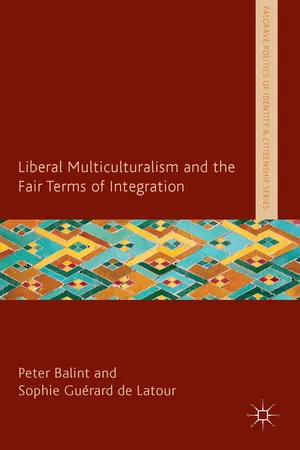
Liberal Multiculturalism and the Fair Terms of Integration
- English
- ePUB (mobile friendly)
- Available on iOS & Android
eBook - ePub
Liberal Multiculturalism and the Fair Terms of Integration
About this book
Multiculturalism has come under considerable attack in political practice, yet the fact of diversity remains, and with it the need to establish fair terms of integration. This book defends multiculturalism as the most coherent and practicable approach to liberal integration, but one that is not without the need for crucial reformulation.
Information
1
The Fair Terms of Integration: Liberal Multiculturalism Reconsidered
The question of what are the fair terms of integration in contemporary diverse societies arises out of two opposed tendencies. One, towards diversity, is driven by several factors, including the global movement of people, the existence of settler societies and the mismatch between state and nation. The other is the apparent need for some sort of unity within a polity. Liberal multiculturalism offers a particular framework for addressing this central and pressing question. At its most basic, liberal multiculturalism upholds the importance of individual freedom while recognising that culture cannot simply be a ‘private’ matter if this freedom is to be at all meaningful. This means that at least some of the diversity that exists within a polity must be recognised and actions taken that alleviate at least some of the potential disadvantages that would otherwise occur. Liberal multiculturalism thus rejects two extremes: the state should not be entirely difference-blind, and neither should group identities take priority. Accordingly, it rejects two corresponding models of integration: an assimilationist one that grounds civic membership on the internalisation of a common culture (for example, the classical model of republicanism with its holistic emphasis on the ‘people’); and a localised communitarian model that gives precedence to local community allegiances over shared political principles and identity (for example, Kukathas’s ‘archipelago’ with its maximalist account of liberal toleration) (Kukathas, 2003). It is between these two extremes that liberal multiculturalism locates the fair terms of integration: equal respect for individual freedom is combined with consideration for the cultural conditions required by its exercise. Such a broad description of liberal multiculturalism no doubt raises at least as many questions as it answers, but this general depiction is now dominant among contemporary supporters of multiculturalism in both theory and practice.
Yet despite this current level of agreement, multicultural theory and multicultural practice have rarely marched in step. While formal policies of multiculturalism were announced in the early 1970s in Canada and Australia (practices of multiculturalism already existed in liberal democracies such as Belgium and Switzerland), it took some 20 years for theorists to provide the ex post justifications for multicultural state practice (Young, 1990; Taylor, 1994b; Kymlicka, 1995; Parekh, 2000). Likewise, at what must be considered a key turning point for multiculturalism – 2001 – many theorists remained focused on the question of whether differentiated citizenship rights were justified or not, while state agencies had instead switched their concern to social cohesion and the requirements, rather than the rights, of citizenship.
Nevertheless, over the past ten years liberal multicultural theory has gradually become focused on similar questions to liberal political practice. It too has undergone a ‘civic turn’ in which the integrative nature of multiculturalism has become central. In political practice, this has been expressed in terms of citizenship testing, clear statements of national values (commonly highly generic liberal democratic values) and a concern over citizens leading ‘separate and parallel lives’. In political theory, although not always expressed in these terms, the central question has generally been ‘what are the fair terms of integration’, with most, if not all, now accepting the two-way nature of multiculturalism (Kymlicka, 2001; Modood, 2007).
Even with this refocusing of liberal multiculturalism on citizenship and integration, multiculturalism in both theory and practice has certainly not fended off its critics, and there is now a strong sense among many that multiculturalism is at best in crisis and at worst utterly redundant. In political practice, multiculturalism has been unfavourably associated with supporting the divergent practices of visible immigrant groups, which, together with a growing Islamophobia – partially fuelled by the ‘war on terror’ – and a revival of some xenophobic nationalisms, have led to a significant political backlash (Joppke, 2004; Vertovec and Wessendorf, 2009). In Europe, this has recently involved a succession of political leaders lining up to explicitly reject the practice: David Cameron in the United Kingdom, Angela Merkel in Germany and Nicholas Sarkozy in France. We need to be careful here of conflating political discourse with political practice, and while the United Kingdom did actually have institutionalised multicultural policies to back away from, this was certainly not true of France, and to a lesser extent Germany. Nor is the political backlash a general phenomenon. Canada and Australia, for example, have maintained both the language and the policies of multiculturalism – even if in Australia’s case there were significant breaks at the Federal, if not the State, level during John Howard’s conservative government.
It would also be misleading to simply focus on the immigrant experience in this apparent political backlash. While it is the immigration–multiculturalism nexus that has received the most heat, there has not been any significant regression from the political and cultural rights already granted to indigenous people and national minorities. There has been, for example, very little contestation of the political autonomy that multicultural policies have warranted to the Quebecers in Canada or to the Catalans in Spain (Kymlicka, 2007b). So while multiculturalism is certainly not the most popular political label in many parts of the world, its policies and, in many cases, its language remain.
Even so, declarations about the crisis of multiculturalism do reveal growing doubts over multicultural models of immigrant integration. Both Cameron and Merkel insisted on the need to emphasise commonness rather than difference and to acknowledge the importance of integrating newcomers in the liberal culture of their host countries. Even if such liberal cultures appear to be thinner than traditional ones, they nevertheless risk reactivating more assimilationist tendencies, which may place more emphasis on integration than fairness.
At roughly the same time as the political practice of multiculturalism was starting to be challenged, the political theory of multiculturalism was also being subjected to several lines of sustained critique. From within liberalism, critics attacked multiculturalism precisely on its two normative justifications: freedom and equality. Some contested the ability of multicultural policies to promote individual freedom and argued that cultural rights as collective rights are potentially oppressive for some members – in particular, the ‘minorities within minorities’, such as women and children, who can be disadvantaged by the preservation of traditional cultures (Okin, 1999; Shachar, 2001; Spinner-Halev and Eisenberg, 2005). Others denounced the general tendency of cultural rights to essentialise cultures – that is, to impose upon all members of a minority an alleged authentic form of life that encourages a reified treatment of cultural identities in contradiction of their fluid and dynamic nature (Fraser, 2001; Benhabib, 2002; Appiah, 2005; Phillips, 2007). And finally, others challenged the egalitarian inspiration of multicultural policies, alleging that they undermine the liberal importance of equal treatment – that culture is not in itself a ground for differentiated treatment – as well as undermining support for redistributive policies (Barry, 2001; Michaels, 2007). This last criticism was not helped by the apparent popularity of multicultural policies coinciding with the significant shrinking of the welfare state.
Yet despite these attacks, few liberal political theorists have rejected multiculturalism entirely, and certainly none has called for a reintroduction of highly unitary and assimilationist models of citizenship. Indeed several of these critics have contested the legitimacy of multicultural policies while at the same time continuing to denounce the myth of ‘blind/false universalism’ that inspired the original multicultural critique (Fraser, 2001; Benhabib, 2002; Appiah, 2005; Phillips, 2007). In political theory, it seems that any apparent backlash against multiculturalism might be better described as the emergence of ‘post-multiculturalism’, rather than the victory of ‘anti-multiculturalism’. That is, there is a reworking of the multicultural ideal and its policies rather than the assertion that multiculturalism is essentially illiberal and undemocratic (Alibhai-Brown, 2000; Vertovec, 2005; Hollinger, 2006; Kymlicka, 2010). If this is true then liberal multiculturalism still occupies a central place in the debate, inasmuch as the defence of ethno-cultural minorities is still considered an achievement of a democratic and liberal historical process and has even gained wider credibility through the recent development of a ‘new international politics of diversity’ (Kymlicka, 2007a).
It is thus too quick to say that multiculturalism, particularly in liberal form, has been rejected. Despite clear problems and political controversy, some form of liberal multiculturalism still seems relevant in both contemporary practice and theory. Nor should the rejection of multicultural policies in some jurisdictions and in public opinion imply its rejection in the philosophical field; indeed given the dynamic and nonlinear interaction between the theory and the practice of multiculturalism, this would be an odd result. Thus, instead of accepting that the partial political backlash and theoretical critique mean that multiculturalism has failed, we propose a different way of viewing these debates.
First, we claim that the debate over multiculturalism is not obsolete. The fact that what now prevails in political theory is not anti-multiculturalism, but some sort of reworking of the multicultural ideal strongly suggests that the interaction between the political backlash and the theoretical critique of multiculturalism is complex; it is one of reformulation, correction and amendment of a liberal multicultural ideal, rather than an outright rejection. The theoretical realisation of the limits of liberal multiculturalism, when combined with the often hostile political climate of contemporary liberal states, has led to a process that can be described as various forms of dynamic resistance and, with it, a rethink, if only defensively, of the multicultural project.
Second, this debate has brought to the fore the crucial issue of liberal multiculturalism’s potential as a tool for integration. This is both the sharp end of liberal multiculturalism and a potential reason for its rejection. On the one hand, pressing issues of social cohesion and individual welfare seem to require the clear framework that liberalism can provide. On the other hand, this framework may satisfy neither of these demands. Social cohesion may require something much stronger than the more ‘civic’ identities seemingly offered by liberal multiculturalism, and insisting on a particular framework for integration may seem to undermine any genuine claim to multiculturalism.
But if a liberal framework is rejected, what is the alternative – especially, but not only, if political theory is to connect with practical policy issues? Those who argue for more communitarian frameworks – either of the subgroup or of the nation-state – have not satisfactorily answered their critics. Unless one wishes to forgo the importance of individual freedom, liberalism must provide at least one frame. The question though is whether it can provide the only frame, and it is here that the difference-sensitive nature of liberal multiculturalism can play a role. The challenge is to find a form of multiculturalism that is liberal and can speak to the empirical contexts in which it is to be practised.
If we are not rejecting this political ideal, several questions need to be addressed in a much more detailed way. For example, what kind of political values, institutional practices and historical identities should remain common or shared if a wide range of cultural differences is to be publicly acknowledged and promoted in diverse societies? And how should we define the fair terms of integration for cultural minorities if integration cannot be purely political or civic and if it always carries some cultural or ethnic components? While it is true that these questions were present in earlier multicultural debates, the recent context has given them a new centrality.
This new focus requires addressing the core of the multicultural project. The key insight of the original multicultural critique was to demystify the natural character of national identities. This first wave of multiculturalism showed how these identities were socially constructed through a state-sponsored process of nation-building, and how they could have a dominating effect on cultural minorities. To some extent, once this description of nation-building processes was accepted, the case of indigenous peoples and national minorities was not as difficult. Inasmuch as these peoples possess a societal culture of their own and wish not to be integrated in the dominant culture, they can legitimately ask for political autonomy in order to be protected from the dominant national culture (though the difficult question remains how much political autonomy they should obtain). In the case of immigrant minorities, however, the issue cannot be solved by the mere separation of territorially distinct societal cultures. It is this type of minority that makes the central question of multicultural citizenship most pressing: if no political integration can be culturally neutral, how should we draw the limit between the fair and the unfair common culture, between a hospitable and an assimilationist national identity? Or, to put it differently, how can the nation-building process be reformed in a democratic and liberal way, not outside the dominant nation but inside it?
Those who insist on the immigrants’ duty to integrate need to be more specific about what they mean by integration. Anthropological and sociological theories of integration cast doubt on any political or philosophical discourse about the ‘will to integrate’ and about the very idea of the terms of integration that immigrants should agree with. The observation, developed in the social sciences about the nation-building process, is that integration is progressive and complex and generally exceeds the scope of individual voluntary action (Gellner, 1983; Anderson, 1991; Noiriel, 1996; Schnapper, 1998, 2003). While this seems a direct challenge to those pushing hardest at the forefront of the civic turn, it also raises questions for liberal frameworks, especially the contractual ones that emphasise individual projects and free will. This does not mean that the question of the fair terms of integration is irrelevant, but rather that its complexity and potential mischaracterisations should be remembered.
Third and finally, we argue that to properly understand this theoretical issue, attention needs to be paid to the empirical context in which liberal multiculturalism is practised. If we accept that liberal multiculturalism is not obsolete and that its primary focus is on the question of the fair terms of integration, how should we proceed? Here we suggest the importance of a variety of focuses, approaches and contexts, with a firm grounding not only in sound theory but also in political practice. Liberal multiculturalism is not just a theoretical ideal but also one that is rooted in, and informed by, liberal political practice – practices that now include national models of integration, statements of national identity, citizenship tests, anti-racism policies, cultural exemptions and so forth. Taken as a whole, the contributions presented in this book aim to bring out the challenges liberal multiculturalism faces and the modifications it is undergoing, with the authors exposing both the tensions and the compatibilities between forms of multiculturalism and liberalism, and suggesting either pathways forward or defences of what they see as a coherent position. Each chapter can thus be read as a contribution to the problem of the fair terms of integration and the framework of liberal multiculturalism.
In this sense, this volume is genuinely philosophical; it is interested in normative principles and the theoretical consistency of the multicultural project. But at the same time, the volume does not simply reflect on principles and norms in a purely analytical manner, instead acknowledging that they cannot be correctly grasped without connection to real contexts. The fair terms of integration are not just a matter of deducing fair principles of intercultural justice, but also a matter of thinking about political implementation, thus raising complex questions about the way in which common values and shared identities can still be found in the historical and institutional contexts of multicultural democracies.
The book is organised in three parts. The first explores the resistance to liberal multiculturalism and its potential reformulations. The aim here is to understand the extent to which resistance to liberal multiculturalism necessarily entails its rejection. Indeed, as the multiculturalist critic has usually been inspired by the liberal values of freedom and equality (Raz, 1994; Kymlicka, 2007a), it is not clear that this line of critique can exceed the liberal framework. Likewise, it is not clear that an explicitly liberal critique ultimately takes us away from multiculturalism either, or whether it simply tempers some of its potential excesses.
There are two symmetrical forms of criticism of liberal multiculturalism: one that multicultural policies should go beyond liberalism, by asserting more radically the diversity and plurality of cultural identities rather than is the case with liberal multiculturalism (Parekh, 2000, 2008; Modood, 2007); and the other, which calls for coming back to an integrationist model, in line with the civic turn (Brubacker, 2001). The chapters in Part I of the book offer critical analyses of these two possibilities.
The opening two chapters, by George Crowder and Sune Lægaard, both argue that the tension between multiculturalism and liberalism is overstated, and thus the contrast between multiculturalism and liberalism – which allows multiculturalism to be a challenge to liberalism – is not particularly significant. For Crowder (Chapter 2), this is couched in an argument against Bikhu Parekh’s multicultural critique of liberalism, and in favour of a value pluralism that can be accommodated within liberal thought and practice. In response to Parekh’s charge of ethnocentrism against liberalism, Crowder argues that value pluralism does not require rejecting liberalism as a ‘historically biased’ form of respect for difference (that is, one that only operates with liberal-type differences). Thus for Crowder, there is no need to adopt the more radical version of multiculturalism that Parekh advocates.
In his chapter, Lægaard (Chapter 3) focuses instead on liberal institutions. He questions the strength of the distinction between ‘respect for difference’ and ‘respect for dignity’, by paying attention to what it means for institutions to respect difference. He concludes that, at least from this perspective, the conceptual distinction between the two forms of respect – a distinction that is generally considered a defining feature of multicultural citizenship – misconstrues the relation between liberalism and multiculturalism. These first two chapters temper the opposition between multiculturalism and liberalism and help show how multiculturalism remains deeply connected to liberal values, even in its apparently more radical versions.
The next two chapters, by Tim Soutphommasane and Peter Balint, shift to the issue of national identity. Here again, suspicion about multiculturalism can be seen as a result of an overstated opposition between multiculturalism and national identity in liberal democracies. As a movement critical of the nation-building process, multiculturalism tends to be identified as a political dynamic that works against national solidarity and undermines the political ties between citizens. In their contributions, Soutphommasane and Balint offer contrasting views on the imperative of integration and its compatibility with diversity. A key part of the civic turn in liberal multiculturalism has been the focus on deliberative democracy and the demands of citizenship (Laden, 2001). Tim Soutphommasane (Chapter 4) argues that liberal multiculturalism must take the need for a ‘national conversation’ seriously, and that multicultural recognition can be achieved through open dialogue. For Soutphommasane, a national dialogue held among an ...
Table of contents
- Cover
- Title Page
- Copyright
- Contents
- Acknowledgements
- Notes on Contributors
- 1. The Fair Terms of Integration: Liberal Multiculturalism Reconsidered
- Part I: Resistances and Reformulations of Liberal Multiculturalism
- Part II: National Experiences of Liberal Multiculturalism
- Part III: Practising Liberal Multiculturalism
- Bibliography
- Index
Trusted by 375,005 students
Access to over 1.5 million titles for a fair monthly price.
Study more efficiently using our study tools.
Frequently asked questions
Yes, you can cancel anytime from the Subscription tab in your account settings on the Perlego website. Your subscription will stay active until the end of your current billing period. Learn how to cancel your subscription
No, books cannot be downloaded as external files, such as PDFs, for use outside of Perlego. However, you can download books within the Perlego app for offline reading on mobile or tablet. Learn how to download books offline
Perlego offers two plans: Essential and Complete
- Essential is ideal for learners and professionals who enjoy exploring a wide range of subjects. Access the Essential Library with 800,000+ trusted titles and best-sellers across business, personal growth, and the humanities. Includes unlimited reading time and Standard Read Aloud voice.
- Complete: Perfect for advanced learners and researchers needing full, unrestricted access. Unlock 1.5M+ books across hundreds of subjects, including academic and specialized titles. The Complete Plan also includes advanced features like Premium Read Aloud and Research Assistant.
We are an online textbook subscription service, where you can get access to an entire online library for less than the price of a single book per month. With over 1.5 million books across 990+ topics, we’ve got you covered! Learn about our mission
Look out for the read-aloud symbol on your next book to see if you can listen to it. The read-aloud tool reads text aloud for you, highlighting the text as it is being read. You can pause it, speed it up and slow it down. Learn more about Read Aloud
Yes! You can use the Perlego app on both iOS and Android devices to read anytime, anywhere — even offline. Perfect for commutes or when you’re on the go.
Please note we cannot support devices running on iOS 13 and Android 7 or earlier. Learn more about using the app
Please note we cannot support devices running on iOS 13 and Android 7 or earlier. Learn more about using the app
Yes, you can access Liberal Multiculturalism and the Fair Terms of Integration by P. Balint, S. Guérard de Latour, P. Balint,S. Guérard de Latour,Kenneth A. Loparo,Sophie Guérard de Latour, P. Balint, S. Guérard de Latour, Sophie Guérard de Latour in PDF and/or ePUB format, as well as other popular books in Politics & International Relations & Civil Rights in Law. We have over 1.5 million books available in our catalogue for you to explore.