- English
- ePUB (mobile friendly)
- Available on iOS & Android
eBook - ePub
About this book
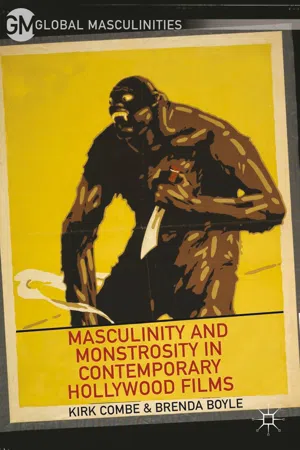
In film, Men are good and Monsters are bad. In this book, Combe and Boyle consider the monstrous body as a metaphor for the cultural body and regard gendered behavior as a matter of performativity. Taken together, these two identity positions, manliness and monsterliness, offer a window into the workings of current American society.
Information
Subtopic
Art GeneralC H A P T E R 1
Tossing Blondes in Peter Jackson’s King Kong
When the mighty Kong breaks loose from those chrome-steel chains, when that giant ape bursts through the façade of the swanky Broadway theater to leap into a crowded Times Square—the beating heart of New York City, go-go capital of the modern world—it’s an undeniable moment of thrilling terror. Now comes the rampage, the wanton destruction. We’ve come to that moment of truth in all monster stories when the mysterious savage runs riot on our dear, familiar civilization. We clutch the armrests of our theater seats in anticipation of the full horrors of the Beast. The original Kong, from Merian Cooper’s 1933 film, does not disappoint. That ape derails an elevated train, bites off a man’s head, and casually drops a woman some 20 stories to her death. Granted, Cooper’s Kong is seeking after his prize, that is, Beauty in the form of Ann Darrow. But his search seems distinctly secondary to his mayhem. In the 1933 King Kong, there’s no doubt that the Beast has come to town. Such is not the case in Peter Jackson’s 2005 King Kong.
Jackson’s Kong is on a single and singular mission, one of locating Ann, his comrade and soul mate. From the moment this monster frees himself, Kong picks up and inspects blondes, specifically, platinum blondes—women who, at first glance, match the Hollywood ideal for Beauty. Kong obsessively pursues no fewer than five such women in the first minutes after his escape. Finding none of them to be Ann, the giant ape tosses these blondes aside—comically, dismissively, shockingly if you imagine the landings these poor women are going to have. Yet none plunges to death; none is decapitated for snack food; Kong rifles the trolley car only because there is a blonde inside it. His destruction is not wanton. It’s incidental. The fact is that Jackson’s Kong behaves distinctly unhell-bent on wreaking havoc on New York City. Most of the collateral damage occurs when Kong gets sidetracked chasing Jack Driscoll, his rival for Ann’s love, or when the military chases Kong once he has Ann. Otherwise, the Beast simply wants to find his cherished companion and be left in peace. Even more peculiar, Ann is the one who locates, eventually, the huge gorilla. She appears, backlit and angel-like, walking toward him down a deserted city street. Once he sees her, Kong instantly drops what he’s doing (trying to kill Jack in a taxicab) and locks simian with human eyes. Magic fills the cold night air along with the minor chords of the Ann–Kong love theme. Soon Ann is back, willingly this time, in the giant hairy grasp. Obviously, none of this is the scenario for thrilling terror. A different moment of truth is taking place. Jackson’s movie is not a remake of King Kong, but a thoroughgoing retelling of that Hollywood classic.1
In this chapter, we argue that Kong tosses blondes aside because Jackson pits two powerful concepts against one another: Beauty versus Beautiful. By Beauty we mean that persistent Hollywood illusion of the platinum blonde bombshell as a signifier of all that is desirable, not only in a woman but in life itself. By Beautiful we mean a genuine connection between two sentient beings grounded in the realities of this world. Jackson creates a dichotomy between these conceptions in his film, and, in doing so, effectively inverts the meaning of Cooper’s original. Where the 1933 King Kong gives us Carl Denham as the focal and driving character of the narrative, the 2005 version gives us Ann Darrow. Where the original movie promotes colonialism, capitalism, and American dynamism as the essence of modern civilization, Jackson’s new vision proposes postcolonial, post-Marxist, and environmental readings of the tale. Where Cooper’s Kong is a brute likely to incite in contemporary 1930s’ audiences both fear of the African-American man as a rapist of Caucasian women and apprehension of the Depression working poor rising up against their economic oppressors, Jackson’s Kong is figured as a champion of the colonized Other, of the exploited worker-slave, and even of Nature itself. That is to say, Kong becomes, in Jackson’s hands, a complex and multilayered signifier in opposition to the hegemonic forces of imperialism, neoliberal economics, euro-centrism, and dominant masculinity. This Beast initially may have been ensnared by the charms of Beauty, but by the time he’s survived kidnapping, the Middle Passage to America, and being put on the auction block of popular entertainment, his one concern when breaking free in New York City is reestablishing what he’s come to know as the communitarianism of Beautiful.
Peter Jackson’s re-visioning of King Kong, then, brings to audiences a tragic and, particularly in its final images, dizzying story where monsters are heroes, heroes are monsters, and damsels-in-distress are protagonists—in short, the overthrow of modern normal. For the viewer willing to puzzle through the array of emotion-packed objective correlatives on offer, Jackson’s film delivers a cautionary tale about how our world violently has been colonized, materially and ideologically, by exploitative forces. All that’s needed to appreciate the radical implications of King Kong is an attentive inspection of how the filmmaker twists the conventions of the traditional monster movie. To accomplish such a reading, we look first at Jackson’s depiction of Beauty, next at its antithesis of Beautiful, and finally at how modern exploitation in Jackson’s film, to include the monsterization of Kong, is the product and the pursuit of hegemonic masculinity.
UNDERMINING THE ALLURE OF BEAUTY
In both Cooper’s and Jackson’s films, there’s no doubt that Ann Darrow is the prize. Virtually everyone and everything clamor after her. Her primary allure, of course, is her looks. She’s that size-4, platinum blonde movie idol devised to be craved. How Cooper and Jackson use this iconic figure in their films, however, couldn’t be more different. One critic of Cooper’s film notes, “Ann’s role as its obsessive object is designated in the film as not merely representing a generalized mass desire for prosperity but rather serves as an emblem of the specific articulation of that desire effected by the Hollywood spectacle” (Torry 67). As the blonde bombshell, Ann is no less than the signifier of the American Dream itself. To possess her equates to success within American capitalism. The overreaching Kong, then, in his brutish obsession to have Ann, becomes the interloper. He is the monstrous gatecrasher of the white bourgeois patriarchal party. Most scholars of the 1933 King Kong, in fact, read that film in such classist and racist terms. Situated in its early-twentieth-century cultural context, Cooper’s movie is seen as a conservative and disciplinary work warning both the Depression-era working poor and the Jim Crow–era blacks to stay in their place at the bottom of the economic and social ladder.2 Carroll in particular sees the original King Kong as a remarkably arrogant and self-congratulatory film; it functions as “a popular illustration of Social Darwinist metaphors which, in turn, were and to some extent still are generally held articles of faith of the American weltanschauung, shared by every class” (213). If the American economy is a jungle, as Cooper’s movie strongly signals, then it is telling that the survival of the fittest goes to Carl Denham, first in his gun-and-camera, jungle film adventurism on Skull Island and then in his entrepreneurial gambit on Manhattan Island. As the dominant male of the American domain, Cooper’s Denham necessarily suppresses Kong’s one-ape uprising.
Everything in Jackson’s King Kong makes the opposite impression. Jackson’s platinum blonde isn’t just a pair of screaming lungs, but has brains, courage, compassion, and agency. His Carl Denham isn’t a megalomaniac blowhard, but an endearing dodger who comes to see the error of his greed. Jackson’s Kong is not an infantile ogre wanting back his toy, but a creature of maturing understanding and developing language. Moreover, in his retelling of the Kong story, Jackson shifts the fundamental point of view of the film. Where in Cooper’s movie we see things through the eyes of the dominant class, in Jackson’s movie, our perspective is basically that of the underclass. Where Cooper glosses over the Depression, Jackson rubs our noses in it. Where Cooper makes a goddess of Beauty, Jackson exposes it as an instrument of oppression.
Jackson’s first step is not to affirm the law of the jungle, as does Cooper’s film, but to present us with the pathos of the zoo. His opening montage begins with a scrawny monkey scratching, followed by a series of listless animals trapped in a dilapidated Central Park Zoo. The shot widens to Central Park itself, looking like a garbage dump and filled with listless people trapped in Shanty Towns. The equation is simple: The captured poor are the same as the captured animals. Al Jolson’s brassy version of “I’m Sitting on Top of the World” ironically plays over intercuts of Depression-era New York. Beneath the bustle of the city streets, we focus on moments of despair: an old man or a mother and children rifling through garbage cans for food, people being evicted from their homes, long soup lines, the indigent asleep on benches or huddled in doorways. We see as well civil unrest in prohibition raids on stills or large street protests with angry mobs carrying signs reading “We Demand Evictions Are Stopped” and “Land To The People.” Meanwhile, in the face of this joblessness and expropriation, American flags flutter from skyscrapers still rising over Manhattan. Obviously, the rich and the powerful ignore the ugly underbelly of 1930s’ America; they continue their joyride despite the current economic bust.3 For the working class, however, capitalism just as obviously equals captivity and exploitation. Hoovervilles are zoos. Short of returning to nature, the poor have no other social-economic system available to them. Setting this Marxist table, then, Jackson ponders in some detail, over the first part of the movie, the plight of two groups of working-class people. The first is an ensemble of Vaudeville performers whose dwindling audiences lead to their not getting paid and finally losing their jobs. Out of this hapless bunch emerges our plucky heroine, Ann Darrow (Naomi Watts). The second, more extended, and more telling group examined by Jackson is the crew of the trap steamer Venture, the ship carrying the main characters to Skull Island. Here Jackson makes major changes and additions to the original version of King Kong, all of which seem designed to undercut the classism of Cooper’s 1933 film. Examining a few of these characters reveals Jackson’s very different ideological orientation.
Cooper’s film invests little human interest in the crew of the Venture. They are more or less props, faceless sailors at sea and spectacular dinosaur bait on Skull Island. Jackson, on the other hand, goes out of his way to focus on them as individuals, even if they are not all named. The camera lingers on close-ups of their faces to register their reaction to events. Special emphasis is given to watching the crew below deck. During the voyage, we see shots of burly, sweaty, grimy-faced men tending to the steaming machinery or shoveling coal into the blazing engine furnaces. Clearly, we are meant to realize that Denham’s film and financial venture is kept afloat by the little guy, the worker at the bottom of the capitalistic ladder. More than just thoughtfully presenting the little guy, though, Jackson inserts into the story two working-class friendships that foreground a number of social issues.
In the original film, Charlie is a stereotypical Chinese cook played by bit-actor Victor Wong. Despite having a fair number of lines, this part goes uncredited in Cooper’s production, making Charlie little more than seafaring window dressing. Charlie’s big moment comes when he discovers that the natives of Skull Island have been aboard the Venture to steal Ann. In his pidgin English he calls all hands on deck while running to the Captain the evidence of the incursion, a native bracelet left behind. There he declares: “Crazy black man been here!” Racial stereotype upon racial stereotype. In the 2005 DVD restored edition of the original King Kong, the second disc is a documentary produced by Jackson about the making of the 1933 film. Here Victor Wong is named in the cast list. However, Wong’s character is identified as “Lumpy,” not “Charlie.” There is no character named Lumpy in Cooper’s film. In Jackson’s version, though, Lumpy is the ship’s cook, and he’s a telling character played by Andy Serkis. In a nod to the original Charlie character, Lumpy’s sidekick, and apparently number-two cook, is Choy (Lobo Chan). Lumpy and Choy share a deep bond, one of working class and mixed ethnic solidarity. Lumpy is always watching out for Choy, so much so that he tosses aside his machine gun when Kong is trying to shake the rescue party off the giant log and desperately tries to prevent Choy from falling to his death. In contrast, Carl Denham (Jack Black) desperately tries to rescue his camera from falling off that log. Preserving the footage he’s shot that eventually can be turned into a smash hit movie is all that’s on Denham’s mind—even as members of his film crew are killed on the island. Thus, Jackson goes out of his way to underscore a working-class ethos of we’re-all-in-this-together versus a bourgeois fetish for material wealth. In the Deluxe Extended Edition of the movie, Lumpy delivers the best line in this vein. When emerging from the swamp after the attack by a gigantic, primitive fish, Denham anxiously tests the camera to see if it’s still operational. Accidently, he films the monster snatching and dragging under one last crewman as the man struggles ashore. When the crewman’s screams subside, Lumpy, standing nearby, asks Denham bitterly, “Did ya get that did ya?” It should not be lost on us, either, that Andy Serkis plays two parts in Jackson’s film, Lumpy and Kong. In a film thick with meta-references (to the original movie, to the entertainment industry), Serkis’s double casting seems a deliberate move to link Kong with the modern worker. Only, symbolized by Kong, the little guy suddenly ain’t so little anymore. Instead, similar to Shelley’s Frankenstein monster, Jackson’s monster can be seen to represent a proletarian revolt against the bourgeoisie.4
An even bigger addition to Jackson’s Kong story is the friendship between Mr. Hayes (Evan Parke) and Jimmy (Jamie Bell). Some critics of Jackson’s film thoroughly dislike this Huck-and-Jim duo that passes time discussing Conrad’s Heart of Darkness.5 However, their relationship could be viewed as an important corrective to the racism of Cooper’s film and as a device by which Jackson tells us how to view his remake. Not only are Hayes and Jimmy another pair of mixed-race, working-class friends enacting solidarity, but they also are characters that overturn racial stereotypes. Read in its historical context of early-twentieth-century American culture, the original King Kong can’t avoid being seen as a profoundly racist film. As Bellin argues:
Rather than being connected to issues of race only incidentally, Kong is deeply, inextricably, indeed indistinguishably involved in a pervasive and urgent early-twentieth-century cultural project to define and defend whiteness, a project that ritualistically found its fulfillment in the conjuring to life, and condemning to death, of a fantasized scapegoat: the black ravisher of white womanhood. (24)
In an era of lynching and black migration from the rural south to the urban north, it would have been impossible for 1933 audiences not to view Kong as a symbol of all dangerous black males rolled into a one-ape race riot quelled only by modern (white) technology (Rice 195–196). Cooper’s film conforms to this cultural project underway at the time, particularly in the popular media, to affirm white superiority via the negative portrayal of blacks.6 Through Hayes and Jimmy, Jackson disrupts any such racist holdovers from the original movie. Mr. Hayes, the first mate of the ship, is nothing less than the anti-Stepin Fetchit. He is an intelligent, well-spoken, industrious, worldly, and honorable male who happens to have dark skin. What is more, Hayes has assumed the role of father figure to Jimmy, a white orphan lad he discovered on board, stowed away and feral, several years ago. Now working as a deckhand, Jimmy is the mischievous and undisciplined adolescent. Hayes’s project is to see to the young man’s education and social rise. Among all the crew members of the Venture, Hayes emerges in Jackson’s film as a working-class hero. When Jimmy puts on Mr. Hayes’s cap after the first mate has been killed, it’s clear that Jimmy will try to live up to his mentor’s high ideals. Jackson gives Hayes too many admirable qualities for audiences to see in him merely the stereotype of a black caretaker for a white child.
Equally significant in Jackson’s King Kong is Hayes’s erudition with regard to Joseph Conrad’s famous and provoking novel about colonization. Obviously, the passage from Heart of Darkness that Hayes recites, and that we hear as a voiceover while Denham and his film crew enter the native ruins on Skull Island, is far more than a book club discussion he’s having with young, naive Jimmy. This moment in the movie represents, arguably, Jackson as a filmmaker speaking directly to his primary audience—that is, a bourgeois American audience not unlike immature, white Jimmy. That audience has come into the multiplex to enjoy a good holiday-release blockbuster, a rousing tale—featuring big-name stars and spectacular special effects—of Beauty saved from the Beast. What they get instead, not unlike the Broadway audience come to see Denham’s “Eighth Wonder of the World” on stage, is Kong unshackled from such naive conceptions of what a monster is and foolish expectations that monsters can be kept conveniently under control for the sake of mindless entertainment. When Jimmy asks why Marlow keeps going up the river, and while Hayes replies that despite Marlow’s inner dread he has a more compelling need to know, we see intercuts of both Ann and Denham entering the same kind of feral world as Conrad’s steamboat captain. The implication is that both characters are on a voyage of awful discovery similar to Marlow’s. When Hayes quotes from Conrad’s novel, “We could not understand, because we were too far . . . and could not remember, because we were travelling in the night of First Ages . . . of those Ages that are gone, leaving hardly a sign and no memories . . . We are accustomed to look upon the shackled form of a conquered monster, but there, there you could look at a thing monstrous and free,” we watch Denham arrogantly leading his expedition into the same heart of darkness, not in the Congo, but on Skull Island. Jackson’s signal to his viewer is that what is about to unfold is the polar opposite of the 1933 King Kong: not an action-film celebration of white civilization over black savagery, but an exposé of the sentimental veneer of European “civilization” thinly masking the brute forces of imperialism and capitalism. Jimmy’s realization that, “It’s not an adventure story—is it, Mr. Hayes,” must be our realization as well. We’re getting more than we bargained for in watching Jackson’s monster movie. Mr. Hayes’s frank reply, “No, Jimmy, it’s not,” confirms the warning: We need to pay attention to this story with our active and analytical minds, not just passively consume it with our thrill-seeking guts. Nor does it seem a coincidence that Jackson chooses to deliver this caveat through a pair of characters...
Table of contents
- Cover
- Title
- Introduction: Of Masculine, Monstrous, and Me
- 1 Tossing Blondes in Peter Jackson’s King Kong
- 2 Hooah! We . . . Are . . . Sparta!
- 3 Love and Violence in V for Vendetta
- 4 Going “Full Retard” in Tropic Thunder
- 5 The New Millennium Manliness
- Coda: The Monster’s Suit
- Notes
- Works Cited
- Index
Trusted by 375,005 students
Access to over 1.5 million titles for a fair monthly price.
Study more efficiently using our study tools.
Frequently asked questions
Yes, you can cancel anytime from the Subscription tab in your account settings on the Perlego website. Your subscription will stay active until the end of your current billing period. Learn how to cancel your subscription
No, books cannot be downloaded as external files, such as PDFs, for use outside of Perlego. However, you can download books within the Perlego app for offline reading on mobile or tablet. Learn how to download books offline
Perlego offers two plans: Essential and Complete
- Essential is ideal for learners and professionals who enjoy exploring a wide range of subjects. Access the Essential Library with 800,000+ trusted titles and best-sellers across business, personal growth, and the humanities. Includes unlimited reading time and Standard Read Aloud voice.
- Complete: Perfect for advanced learners and researchers needing full, unrestricted access. Unlock 1.5M+ books across hundreds of subjects, including academic and specialized titles. The Complete Plan also includes advanced features like Premium Read Aloud and Research Assistant.
We are an online textbook subscription service, where you can get access to an entire online library for less than the price of a single book per month. With over 1.5 million books across 990+ topics, we’ve got you covered! Learn about our mission
Look out for the read-aloud symbol on your next book to see if you can listen to it. The read-aloud tool reads text aloud for you, highlighting the text as it is being read. You can pause it, speed it up and slow it down. Learn more about Read Aloud
Yes! You can use the Perlego app on both iOS and Android devices to read anytime, anywhere — even offline. Perfect for commutes or when you’re on the go.
Please note we cannot support devices running on iOS 13 and Android 7 or earlier. Learn more about using the app
Please note we cannot support devices running on iOS 13 and Android 7 or earlier. Learn more about using the app
Yes, you can access Masculinity and Monstrosity in Contemporary Hollywood Films by K. Combe,B. Boyle in PDF and/or ePUB format, as well as other popular books in Media & Performing Arts & Art General. We have over 1.5 million books available in our catalogue for you to explore.