- English
- ePUB (mobile friendly)
- Available on iOS & Android
eBook - ePub
About this book
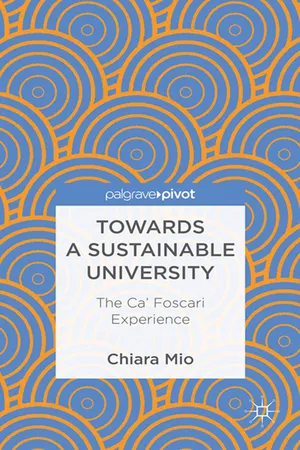
Towards a Sustainable University tackles the challenge of sustainability in universities. Universities are also a working environment and an organization in which sustainability can be experienced. This book shows how a sustainable university can shape future citizens and future managers following the sustainable paradigm.
Information
1
Sustainability: The New Paradigm
Abstract: Chapter 1 deals with the critical environmental and social themes that characterize the present scenario, generated and intensified by a development model characterized by a high growth rate, which has contributed to stressing the difference between conditions of ‘wealth’, to the advantage of the few, and conditions of ‘poverty’, which are progressively expanding, with alarming environmental repercussions in particular on the climate change front. Illustrated below are the main initiatives activated by countries, institutions and other organisms with the purpose of producing cultural change oriented towards sustainability and a review of the current development model, which takes shape in the endorsement of declarations and definitions of agreements with which commitments to sustainability are formalized. In this context, the universities have a very important role in the creation both of knowledge and of educational models that support this new sustainability paradigm.
Mio, Chiara. Towards a Sustainable University: The Ca’ Foscari Experience. Basingstoke: Palgrave Macmillan, 2013. DOI: 10.1057/9781137351937.
1.1The scenario: the critical environmental and social themes
‘Sustainable development is development that meets the needs of the present without compromising the ability of future generations to meet their own needs. It contains within it two key concepts:

This, quoted in the Brundtland Report, is the best-known definition of sustainable development, which should constitute the reference perspective in the affirmation of new production and consumption models, in the light of the world situation and of its criticalities at the economic, environmental and social level, destined to worsen in the absence of a different orientation of behaviour on the part of all the actors, from governments, institutions and organizations to individual citizens.
The principle of growth, which for decades has guided their actions, has led to a situation of over-production and over-consumption, with extremely negative consequences in environmental and social terms, in addition to economic ones.
At the environmental level, one of the issues with the highest criticality in the present context is climate change. The climate has always undergone changes due to natural causes, including solar radiation, volcanic eruptions and natural fluctuations of the climatic system in itself, but such phenomena can explain the increase of global warming only in part. A significant cause of global warming is represented by human activities, which have contributed significantly to generating a greater concentration of the greenhouse gases (GHG), such as carbon dioxide, methane and nitrous oxide, which intensify the natural greenhouse effect causing the warming of the planet. Among the consequences of climate change, in addition to global warming, is the raising of sea levels due to the melting of the polar icecaps, and an increase in floods and hurricanes, with repercussions on human life.
It is estimated that, in the absence of strong intervention on the matter, the total costs and the consequences stemming from non-sustainable behaviour will amount to losses equal to 5% of global per capita consumption an estimated damage that will increase to 20% considering the broader range of risks and impacts, while the cost of the reduction of the ex ante emissions could be limited to only 1% of global annual GDP (Stern, 2006). The economic commitment necessary to rectify a phenomenon so devastating would therefore prove to be definitely less than the damages and the loss associated with it. The estimated increase in per capita GDP at a global level between 2001 and 2030 could be on average equal to 2.23% yearly (Maddison, 2005), but the fear is that this will be compromised by the shortage of energy sources and by the economic implications associated with global climate change, connected to the increase in emissions of carbon dioxide (CO2) and of other GHGs, for example, in sectors such as agriculture, tourism and transportation. It appears extremely urgent for the various countries to reconcile the hoped-for economic recovery with a strong commitment towards energy efficiency, moreover favouring renewable sources over fossil fuels (Musu, 2009).
The present development model, like no other in the past, has been characterized by high growth rates that have contextually and dichotomously affected both the levels of wealth and the levels of poverty. Just over 14% of the earth’s population accounts for almost 80% of the world consumption, entailing the production of over 50% of the total carbon dioxide and three times as much waste as the poorer 86% (Gesualdi, 2005). Therefore, the acceptance and integration of ethical aspects – in addition to the economic ones that have guided the decision-making process up to now – appear to be unavoidable. Also the public pressure on governments and decision makers is inspired by environmental and social issues.
A cultural change oriented towards sustainability in the relationships between man and the environment proves to be crucial (Schwarz J., Beloff B. and Beaver E., 2002), with a re-examination of the current development model, up to now supported by interpretative criteria of the cultural reality that are merely economic or quantitative. It appears necessary to drastically reduce the negative effects of economic growth, even going down a ‘decrease strategy’, concentrated on moderation, on the consideration of the existing limits and on the ‘8Rs’ (recycle, reuse, reduce, redistribute, relocate, restructure, re-contextualize, re-evaluate), to attempt to respond to the serious current emergencies in environmental, social and economic fields (Latouche, 2007).
It is already obvious that developing a new way of living, producing and consuming, rethinking the relationships between men, and between men and nature, aiming to reconcile or at least balance the diverging interests of all the actors and stakeholders, is a fundamental condition for obtaining socially and ecologically responsible relationships and ties.
In the following chapter the main commitments and declarations endorsed by countries and institutions for the spreading and adoption of behaviour coherent with the sustainability paradigm are presented.
1.2The commitments of countries and institutions
‘The long-term maintenance of systems according to environmental, economic and social considerations’ (Crane and Matten, 2004) requires a synergetic action concerted among the various countries, as well as among the various institutions, to support the process of cultural and educational transformation towards sustainable development.
Since the 1970s, several initiatives have followed one another, which have seen countries, institutions and other bodies involved with the endorsement of declarations and the definition of agreements formalizing precise commitments towards sustainability. At the institutional level, particularly significant is the role that universities have and are recognized to have (the subject of the present work) as fundamental actors in innovating knowledge, work methods and behaviour models, for effective development action and the promotion of a sustainable development culture.
Awareness of the educational role of the universities on the topic of sustainability is growing and to testify to it is the lively stream of international statements, the most important of which will be illustrated later on.
Becoming aware of the close link between development and the environment is the goal of a long path that started at the United Nations Conference on the Human Environment, held in Stockholm in 1972. The great changes which in that era disrupted the history of the world built a particular sensibility towards social and environmental themes. In the course of this meeting, important recommendations were formalized. Even if not mandatory, they aimed to inspire and guide people towards conservation and improvement of the context of reference, with a growing interest in the role of higher education in fostering a sustainable future.
An important stage along the path was the UNESCO Intergovernmental Conference on Environmental Education of 1977, held in Tbilisi in Georgia, organized by the United Nations Educational, Scientific and Cultural Organization (UNESCO) in collaboration with the United Nations Environmental Programme (UNEP). On this occasion an appeal was launched to the member states to introduce a series of measures with the aim of fostering and intensifying reflection, research and innovation concerning environmental education, partly through teaching and research and training courses.
In 1988, in Bologna, Italy, the Magna Charta Universitatum was signed by the representatives of the major European countries, a document that outlines the ideal characteristics of the university institution and identifyies as the purpose of such institutes the elaboration and preservation of knowledge and its transmission to subsequent generations, with the intention of broadening the limits of the expression of human potential (Rebora, 2007, p. 5).
The official start of the university ‘sustainability movement’ is marked by the Talloires Declaration of 1990. ‘This is the first official statement made by university administrators of a commitment to environmental sustainability in higher education. The Talloires Declaration is a ten-point action plan for incorporating sustainability and environmental literacy in teaching, research, operations and outreach at colleges and universities. It has been signed by over 350 university presidents and chancellors in over 40 countries’ (ULSF, 2013).
The ten points of the declaration were:
1Increase awareness of environmentally sustainable development.
2Create an institutional culture of sustainability.
3Educate for environmentally responsible citizenship.
4Foster environmental literacy for all.
5Practice institutional ecology.
6Involve all stakeholders.
7Collaborate for interdisciplinary approaches.
8Enhance capacity of primary and secondary schools.
9Broaden service and outreach nationally and internationally.
10Maintain the movement.
The main limitation of the Talloires Declaration is the almost exclusive consideration of the environmental dimension of sustainability, neglecting the social dimension and the economic dimension.
The 1991 Halifax Declaration is considered to be the first declaration that endorses the commitment of universities to sustainability development, intended in its tridimensional meaning: social, environmental and economic. With this document the importance of university actions in the spreading and implementation of sustainable development logics is confirmed. At the Halifax Conference, which was attended by presidents of universities from Brazil, Canada, Indonesia, Zimbabwe and elsewhere, as well as senior representatives of the International Association of Universities, the United Nations University and the Association of Universities and Colleges of Canada, the universities invited each other to commit themselves to the teaching of the principles and practices of sustainable development and of environmental literacy through a clear policy, apolitical and without compromises, to spread understanding of the environmental dangers and of the social inequalities that threaten the planet, pushing the new generations to better use of its meagre resources and to greater co-operation for a sustainable future.
The subsequent stage was in the following year, 1992, in Rio, with the United Nations Conference on Environment and Development (UNCED), the first world conference of the heads of states on the environment, an unprecedented event in terms of impact on policy choices and subsequent development, as well as in media terms. The main official documents it produced were the Rio Declaration on Environment and Development, and Agenda 21, a plan of action on sustainable development, to be carried out on a global scale by governments and by administrations of every kind, with the broadest possible involvement of stakeholders. In chapter 36 of Agenda 21 (‘Education, training and public awareness’), it is declared that education has the essential role of fostering sustainable development and of improving the capability of people to relate with issues tied to development and to the environment (Calder and Clugston, 2003; Jones et al., 2010).
Also in 1992 the United Nations Framework Convention on Climate Change (UNFCCC) was approved, which intended to stabilize the concentrations of greenhouse gases in the atmosphere at a level that would prevent human activities from interfering negatively with the climate. The Convention iterates the “common but differentiated responsibilities” principle among industrialized and developing countries, establishing that the former are the first have to adopt concrete initiatives against climate change and its consequences, since they are primary people responsible for the present concentration of the greenhouse gases and current holders of the means, both financial and technological, to reduce emissions. The signatories of the broad convention were obliged to establish national programmes for the reduction of emissions and to present regular reports regarding the implementation of the same.
In 1993, at the conclusion of the Association of Commonwealth Universities’ Fifteenth Quinquennial Conference, held at the University of Wales, over 400 participants from 47 countries approved the Swansea Declaration, supporting the co-operation of all actors towards a common objective of sustainable development.
In the same year, with the Kyoto Declaration, promoted by the International Association of Universities (IAU) and adopted by 90 universities, the moral obligation of universities to carry out a reform was underlined, recommending specific plans of action at an institutional level with a view to sustainable development. It is one of the most important documents regarding the roles of the universities in achieving sustainability and sets out precise commitments and duties of these institutions, outlining for the first time in a formal way an ethical and social perspective of sustainability and identifying the appropriate lines of action.
Another important step was the CRE-Copernicus Charter of 1994, with which the signatory universities (312 universities of 37 countries) collectively undertook to foster better comprehension of the interaction between man and the environment, in addition to collaborating on commom environmental themes.
The Thessaloniki Declaration ‘Environment and Society: education and public awareness for viability’ was approved in 1997 in Salonicco, Greece, at the conclusion of the International Conference organized by UNESCO. In the declaration, signed by 90 countries, governments wo...
Table of contents
- Cover
- Title
- 1 Sustainability: The New Paradigm
- 2 New Responsibilities for Universities
- 3 Ca Foscari Case Study
- Appendix: Guidelines for Carbon Management in Italian Universities
- Bibliography
- Index
Trusted by 375,005 students
Access to over 1.5 million titles for a fair monthly price.
Study more efficiently using our study tools.
Frequently asked questions
Yes, you can cancel anytime from the Subscription tab in your account settings on the Perlego website. Your subscription will stay active until the end of your current billing period. Learn how to cancel your subscription
No, books cannot be downloaded as external files, such as PDFs, for use outside of Perlego. However, you can download books within the Perlego app for offline reading on mobile or tablet. Learn how to download books offline
Perlego offers two plans: Essential and Complete
- Essential is ideal for learners and professionals who enjoy exploring a wide range of subjects. Access the Essential Library with 800,000+ trusted titles and best-sellers across business, personal growth, and the humanities. Includes unlimited reading time and Standard Read Aloud voice.
- Complete: Perfect for advanced learners and researchers needing full, unrestricted access. Unlock 1.5M+ books across hundreds of subjects, including academic and specialized titles. The Complete Plan also includes advanced features like Premium Read Aloud and Research Assistant.
We are an online textbook subscription service, where you can get access to an entire online library for less than the price of a single book per month. With over 1.5 million books across 990+ topics, we’ve got you covered! Learn about our mission
Look out for the read-aloud symbol on your next book to see if you can listen to it. The read-aloud tool reads text aloud for you, highlighting the text as it is being read. You can pause it, speed it up and slow it down. Learn more about Read Aloud
Yes! You can use the Perlego app on both iOS and Android devices to read anytime, anywhere — even offline. Perfect for commutes or when you’re on the go.
Please note we cannot support devices running on iOS 13 and Android 7 or earlier. Learn more about using the app
Please note we cannot support devices running on iOS 13 and Android 7 or earlier. Learn more about using the app
Yes, you can access Towards a Sustainable University by C. Mio in PDF and/or ePUB format, as well as other popular books in Business & Business Ethics. We have over 1.5 million books available in our catalogue for you to explore.