eBook - ePub
Infrastructure and Poverty in Sub-Saharan Africa
- English
- ePUB (mobile friendly)
- Available on iOS & Android
eBook - ePub
Infrastructure and Poverty in Sub-Saharan Africa
About this book
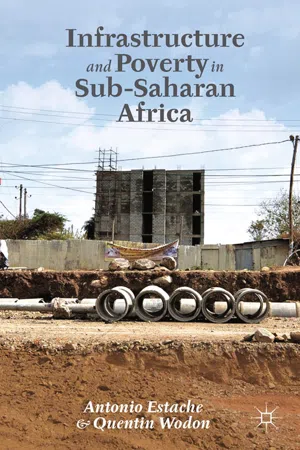
Infrastructure and Poverty in Sub-Saharan Africa analyzes the extent to which, how, and how fast the infrastructure needs of the poor have been met in Sub-Saharan Africa. Estache and Wodon explore the extent to which some key policies have hurt or helped progress in trying to speed the expansions of coverage so clearly needed in the region. They focus on electricity, water, sanitation, and other services at the core of the day-to-day needs of the population, examining the extent to which reforms of the last 15-20 years have managed to reduce the infrastructure gap. They anchor their analysis on the evidence available about the macroeconomic importance of infrastructure for the region, the policies that have been adopted to accelerate coverage, and a detailed assessment of the poverty dimensions of infrastructure.
Information
CHAPTER 1
Introduction
The main objective of this book is to analyze the extent to which, how, and how fast the infrastructure needs of the poor have been met in Sub-Saharan Africa (SSA). The book also documents the extent to which some key policies have hurt or helped progress in trying to speed up the coverage expansion so clearly needed in the region.1 Whenever possible, we also point to changes that are needed to speed up the processes.
Our focus is on basic energy, telecom, transport, and water and sanitation services at the core of the day-to-day needs of a large majority of the population.2 We tried to deal with what can be learned from the Sub-Saharan region as a whole and from individual countries in the region. We cannot address the issues specific to each country with the care each country deserves but clearly some of the issues we raise will be relevant to many of the countries in the region.
Our approach should also allow individual countries to benchmark their performance, at least roughly, in terms of some of the basic policy issues such as the accessibility and affordability of the services for users of various income groups. As much as possible, we provide country-specific examples when it helps us make a clearer argument and the analysis has been able to rely on good data available for that country.
This introductory chapter sets the stage for the more detailed discussions of the following chapters. To do so, it offers a brief overview of the sequence of events that have driven SSA’s infrastructure to become an impediment to growth and progress toward the Millennium Development Goals (MDGs), and hence to poverty alleviation for many countries in the region. It concludes by explaining why and how the stock taking exercise of success and failures in Africa’s infrastructure policies provided in this book can be used to improve accountability of all actors involved in the region, while also providing a road map to the structure of the book.
A Bit of History and a Glimpse of the Future
Right after a majority of countries achieved political independence the infrastructure designed fitted Africa’s economic structure, which was at that time oriented for exports of commodities and minerals. This infrastructure supported reasonably strong economic growth from the early 1960s until the 1970s oil shocks.3 Between then and the mid-1990s, the economic situation became rather gloomy. This long economic slowdown combined with growing interest in regional trade or other economic agreements4 and increased urbanization of the continent catalyzed change—albeit slow—in Africa’s economic structure.5 These changes led to a growing mismatch between the demand and the supply for infrastructure in the region. By the end of the 1990s, the gap grew significantly in spite of the good economic recovery achieved since the middle of the decade, which has for the most part continued in the last decade. This is probably why infrastructure is likely to be at the top of the region’s reform agenda for the foreseeable future. Indeed, to achieve higher growth and meet the MDGs, the first part of the book shows that, in the short to medium term the average annual infrastructure expenditures (the sum of investment and maintenance expenditures) would need to be around 15 percent of Gross domestic product (GDP), more than twice what Africa has spent on the infrastructure sectors over the last 40 years or so.6
How the Infrastructure Gap in Terms of Access to Basic Services Came About
The household demand for infrastructure never stopped growing throughout the various economic cycles but the corresponding supply only grew very modestly on average, as shown in the second part of the book. This gap was not simple to deal with politically but neither was the gap associated with the evolution of the demand from the agricultural, industrial, and services activities in increasingly open economies. After independence, the progressive changes in the economic structure of the continent were instrumental in fueling not only the quantitative but also the qualitative mismatch between the supply and the demand for infrastructure. For instance, as early as the mid-1980s, there was a generalized sense that there was too much emphasis on the paving of roads in sparse networks. The view was that the demand had switched to denser networks of lower-quality but better-maintained roads. Adjusting to this evolving demand, the rate of investment in paved roads dropped but the necessary improvements in network quality and coverage, including cross-country, did not follow in equivalent proportions. Similarly, in energy, the demand for cross-country transmission lines as engines of collective growth for various parts of Africa has long been recognized. The coordination of investment decisions in these networks has, however, proven to be much more complex than in other developing regions of the world and as a result, demand continues to be rationed in many countries.
Why the Affordability Issue Was Not Solved by Existing Subsidies Badly Targeted to the Poor
The household demand for infrastructure services was not met in part due to supply-side deficiencies but also because of an affordability problem best illustrated through the case of network-based services for water and electricity. First, even though the share of household expenditure devoted to infrastructure services, including utilities is only slightly higher in SSA than in other regions, the fact that households are so much poorer in Africa than elsewhere makes it more difficult for the population to deal with current costs of service. This is especially the case among those who are not connected to modern networks and have to rely on alternative less reliable service sources, because they tend to pay more for their services than connected households do. The cost advantage for connected households is due itself in part to existing subsidies (services are often billed at prices below full-cost-recovery levels), which are very badly targeted again simply because access rates to modern services are so low among the poor.
The recurring fiscal crisis and the “one size fits all” cuts did not help infrastructure. The mismatch between demand and supply has been amplified by the recurrent fiscal crises that accompanied the various economic crises. The policy responses to these fiscal crises, in particular from the mid-1980s onward, were often based on public expenditure adjustments set to address short-term fiscal concerns. This may not have been the optimal policy in a continent in which the long-term growth requirements needed a much more careful look at the relevance of the fiscal composition. These adjustments were too often blind to the sectoral allocations needed to support growth. They were also blind to the complementarity between expenditure categories within sectors—the commitment to maintenance is a condition to ensure the cost effectiveness of most investment decisions in infrastructure—which is characterized by potentially much longer lived assets than other sectors.7 The upshot is that fiscal shortfalls and/or cuts led to undermaintenance and underinvestment across infrastructure subsectors.
The inefficiency of many of the public enterprises responsible for the delivery of infrastructure services did nothing to help the fiscal situation. Instead, they contributed to inflate costs, hence increasing the severity of the budget constraints and ultimately the infrastructure gaps. The excessively mistargeted and contractionary policies aimed at addressing the infrastructure sectors’ problems were counterproductive in many more ways—too many to cover here. Some of these actually further fueled the fiscal problem they were trying to address and contributed to the erosion of a potential tax base expansion much needed to finance the increasing capital and recurrent expenditure required by infrastructure sectors and others.
Infrastructure-specific policy choices did not help either. Africa’s fiscal space problem was compounded by the unfulfilled hope that private sector financing would replace public sector financing—while addressing the public sector inefficiency problem. As discussed later in the book, at most 10–15 percent of the investments made in more recent years can be credited to private investors. This is not negligible but it is not significant enough to cover the reductions associated with the fiscal adjustments.
More importantly maybe, what the low level of private participation in infrastructure (PPI) reveals is that the way reforms were designed and implemented was also part of the problem since it did not manage to attract private capital in infrastructure—although the energy sector, and energy generation in particular, and the telecom sector did proportionately well. In many of the reforming countries, the restructuring intended to facilitate private sector participation also resulted in some degree of “cream skimming,” with large urban zones considered the cream of the utilities’ business, thereby increasing the gap between rural and urban access rates for public services. In some others, it increased the fiscal costs of the infrastructure sectors when the profit centers used historically to finance cross-subsidies were concessioned. This was done without significant fiscal compensation to the state, at least not enough to replace the cross-subsidies lost through the restructuring processes by direct subsidies when full cost recovery was not an option.
The main lesson so far may be that working with the private sector is a necessity for Africa but that a menu of cost effective solutions for public-private partnerships adapted to the continent has not yet been identified. From the perspective of a large share of the population and for many potential investors, the last two decades may have been somewhat of a lost decade. Indeed, the evidence presented later in this book shows that unrealized policy hopes have unfortunately contributed to ration infrastructure investment and quality, with often dramatic distributional consequences.
Where Do We Go from Here?
The fact that today Africa is enjoying a high profile of its infrastructure activities as a result of various international initiatives provides a unique opportunity to try to get a better quantitative sense of what has been achieved so far, of what went wrong and what went right in the last two decades.8 Without quantitative evidence, the history of policy effectiveness tends to be rewritten to suit the needs of the various stakeholders. The debates on the achievements in the last two decades are likely to be long and occasionally futile because few are likely to be grounded in solid evidence. The strong international political commitment to address Africa’s needs for efficient, equitable, and fiscally sustainable infrastructure services demands the definition of a quantitative baseline of the needs, of the initial policy conditions, and of the relevance of institutional factors that may have been underestimated.
In recent years, the international community has recognized that without a much better analytical assessment of the needs, the policy issues, and the options to address them, there is a risk that many of the new solutions to Africa’s infrastructure problems would be ad hoc and uncoordinated across donors, as they have sometimes been in the past. Moreover, the investment needs are so large that it may seem to some that there can be no bad project. However, the uneven performance of Africa’s infrastructure in comparison to other regions, the increasing fiscal costs of the infrastructure sectors, the political frustration with the reforms (or lack thereof), and the strong impression that the poor have been left out of many of these reforms all argue against that vision. Too many mistakes have plagued the implementation of many of Africa’s infrastructure reforms in the past. And the lack of a serious baseline has been detrimental to establishing clear benchmarks for measuring progress.
A baseline needs to be defined to increase accountability of all the actors. This was recognized as essential by the international community after a series of follow up meetings to the Commission for Africa. It led to an enormous collective effort managed by the World Bank on behalf and in close collaboration with all the main international agencies committed to the development of Africa: the Africa Infrastructure Country Diagnostic (AICD).9 This may be the largest study to date of Africa’s infrastructure situation intended to generate new detailed information on it. It provides a baseline for monitoring progress and has triggered an effort to maintain its close monitoring as illustrated by the Africa Infrastructure Development Index (AIDI) now generated annually by the African Development Bank (AfDB) since 2011.10
What This Book Is All About
Part of the material in this book was actually prepared for the AICD study, although some of the material has been updated to reflect more recent developments. Our aim has been to set up an initial quantitative baseline performance and policy assessment, and to complement some of the work done for the AICD study. Thus, part of the objective of this book is to complement the AICD study on some of the key policy issues with a strong emphasis on the needs of populations rather than the needs of various sectors of the economy. More precisely, the book is structured as follows.
Part I covers the macroeconomics dimensions of infrastructure. This part of the book argues that the MDGs and the targets to be set in the post-MDGs agenda will not be achieved without achieving at least a 7 percent annual growth rate for the region. In turn, this 7 percent target will not be achieved without a significant increase in infrastructure investment. The evidence of the relevance of infrastructure for growth must be part of many of the strategic discussions in the region, including those concerned with the needs of the large shares of population living in poverty. Part I of the book also provides estimates of infrastructure needs that have been regularly updated since the Commission for Africa report and now include some types of infrastructures initially excluded (i.e., energy transmission and distribution, irrigation, ports, airports, and a minimum number of cross-country regional projects in power, energy, and information and communication technologies [ICT]). The surprisingly large size of these needs, their fiscal consequences, the macroeconomic capacity of countries to absorb these fiscal consequences, and the explicit accounting of these concerns in country development strategies including Poverty Reduction Strategy Papers (PRSPs) are also part of the focus of Part I of the book.
Part II elaborates on the poverty dimensions of infrastructure. This part gives a more detailed sense of the demand for and supply of infrastructure on the household side. On the demand side, this second part of the book documents the extent to which progress achieved in expanding access to services for the population has been slow. It also shows how wide the disparity in meeting the demand is across income groups and how ensuring the affordability of the services for the poorest continues to be a challenge for policymakers in Africa. As a consequence, the poorest are often not in a position to use modern infrastructure services such as piped water and electricity. On the supply side, we show how quality continues to be very significant sources of concern in the region. We also show the extent to which cost levels should be a significant source of concern for policymakers in the region. Unfortunately, costs, including those of monopolies, are seldom monitored in the region. One of the main purposes of this discussion of quality and costs is to show that they are crucial for a continent concerned both with its ability to finance its needs and with tariff levels inconsistent with the poorest users’ ability to pay. In other words, the needs of the population, in terms of access and affordability, are th...
Table of contents
- Cover
- Title
- 1 Introduction
- Part I Infrastructure, Growth, and the MDGs
- Part II Are Household Needs Being Met?
- Part III What Did Past Reforms Achieve and What’s Next?
- Notes
- References
- Index
Trusted by 375,005 students
Access to over 1.5 million titles for a fair monthly price.
Study more efficiently using our study tools.
Frequently asked questions
Yes, you can cancel anytime from the Subscription tab in your account settings on the Perlego website. Your subscription will stay active until the end of your current billing period. Learn how to cancel your subscription
No, books cannot be downloaded as external files, such as PDFs, for use outside of Perlego. However, you can download books within the Perlego app for offline reading on mobile or tablet. Learn how to download books offline
We are an online textbook subscription service, where you can get access to an entire online library for less than the price of a single book per month. With over 1.5 million books across 990+ topics, we’ve got you covered! Learn about our mission
Look out for the read-aloud symbol on your next book to see if you can listen to it. The read-aloud tool reads text aloud for you, highlighting the text as it is being read. You can pause it, speed it up and slow it down. Learn more about Read Aloud
Yes! You can use the Perlego app on both iOS and Android devices to read anytime, anywhere — even offline. Perfect for commutes or when you’re on the go.
Please note we cannot support devices running on iOS 13 and Android 7 or earlier. Learn more about using the app
Please note we cannot support devices running on iOS 13 and Android 7 or earlier. Learn more about using the app
Yes, you can access Infrastructure and Poverty in Sub-Saharan Africa by A. Estache,Q. Wodon,Kenneth A. Loparo,KATHRYN LOMAS in PDF and/or ePUB format, as well as other popular books in Economics & Development Economics. We have over 1.5 million books available in our catalogue for you to explore.