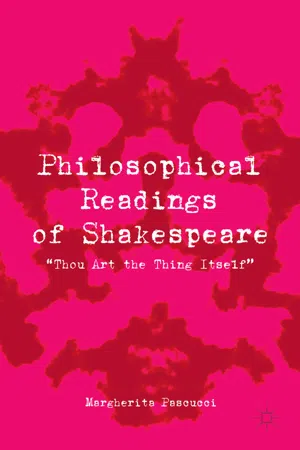
- English
- ePUB (mobile friendly)
- Available on iOS & Android
eBook - ePub
About this book
This book offers a close philosophical reading of King Lear and Timon of Athens which provides insights into the groundbreaking ontological discourse on poverty and money. Analysis of the discourse of poverty and the critique of money helps to read Shakespeare philosophically and opens new reflections on central questions of our own time.
Information
Chapter 1
Allegory and the Combustion of Representation
To grasp a Shakespeare play as fully as possible at any point in time is to recognize that its gaze is bent upon a vanishing point at which no reader or spectator can hope to arrive. Like the hat that the circus clown kicks out of reach every time he steps forward to pick it up, final comprehension of the play is indefinitely postponed by each act of interpretation. Built into Shakespeare’s plays, as into his poems, is the expectation that whatever eyes are viewing them at a given moment, other “eyes not yet created” will one day view them in another light.
Ryan, 1989, p. 175
Walter Benjamin and the Theoretical Framework of the Book
The references that you will find in this text are precise: there is a main theoretical setting, somewhat external to Shakespeare, given to us by Walter Benjamin, at the beginning of the twentieth century, with his figure of the allegory, and that given by Gilles Deleuze, at the end of the same century, with the concept of the “crystal of time.”
In the figure of the allegory, we read history encroached on by nature. In this sense allegory serves the first chapters on the self (Chapters 1–3), while later its fruit, the combustion of representation, will serve the chapters on money, value, and poverty (Chapters 4–6). So allegory is the conceptual reference for this first part, as the crisis of representation will be the conceptual reference for the second part of this text. Combustion of representation and crisis of representation will be the two modalities of knowledge that you will find.
Walter Benjamin’s “Epistemological Foreword” to the Origin of the German Baroque Drama
The three main features of the allegory, useful for our discourse, are that it expresses the relation between history and nature; that it dilates transcendence into immanence (or rather, that it let transcendence burst into immanence), being therefore both the political figure of the state of exception and the literary figure of the drama; and that it is a suspended crystal of time ante litteram, a mode of space that enlarges itself in the “inner” of the infinity of time. This mode of space modulates the infinity of time and renders it a human creation; furthermore, it makes it an interiority, a content. This interiority becomes the theatrical scene, a constant action of defining creation itself in concretions of time and space.
In a more general view, the Origin draws for us the theoretical reversal of Platonism and how to trace it in Shakespeare’s work. It indicates what this can mean for us—that is, our reading of history at the encounter with nature and our action in it. This is what the allegory and the crystal of time used as theoretical instruments can show us.1
Let us play briefly with the concepts that Benjamin presents us in the Foreword: ideas, phenomena, concepts, truth, beauty, representation, philosophy, knowledge. All are requisites for the making of a knowledge made of material traces and bodily ideas. It is this knowledge that constitutes an inner reversal of Platonism. Ideas are constellations (Benjamin, p. 34) in that they are the images of material bodies. Ideas are a discourse, a bridge: they coordinate phenomena, they interpret these objects, which are the events. Ideas are knowledge, knowledge, again, of a material net, a material happening. Phenomena, in their turn, alienate their false unity to participate, divided, in the authentic unity of truth.
Concepts mediate between phenomena and the participation in the being of the ideas. Philosophy, in its original task, is the representation of the ideas. Truth is an unintentional being, not determined by the conceptual intention.2 (ibid., p. 35) Inasmuch as it participates in ideal order, the being of truth is different from the kind of being of apparitions. So truth is not of the same matter as apparitions. (We will see how this is conjugated in Hamlet.)
Representation. Ideas do not represent themselves through themselves but through a coordination of thing-like elements in the image. (Is the coordination of thing-like elements the image?) They can represent themselves in that they are configurations of these elements.
Knowledge. The object of knowledge is not truth (ibid., p. 36). Truth consists of not so much an intention determining itself in the empiria, but of the potency that molds the essence of this same empiria (ibid.). Truth is a potency that molds the essence of the act.
The idea is “something linguistic,” “something which, in the essence of the word, coincides with the moment in which this is symbol” (ibid.).3 To belong to language entails having the body of an image: its essence is coincident with the reference to something else—it brings within, it collects, something else—an arrow thrown out from its same womb.
Philosophy. It is the task of the philosopher to restore to its primacy, through representation, the symbolic character of the word, with which the idea comes to self-transparency, an agreement, which is the exact opposite of each communication turned to the outside (ibid.). The philosopher looks for resonances, for inner correspondences, to let things illuminate themselves from the inside. These resonances, or correspondences, are echoes from the inside, are tensors of intensities.
The baroque drama (Trauerspiel) is an idea (ibid., p. 38). It is the image of a material body, of history at the encounter with nature, and as such it is something linguistic, something symbolic, something that contains in itself something else, which entails reference to something else, and this entailment (symbolikon) is a womb, is a resonance of intensities. For the philosophy of art, extremes are necessary, while the historic course is virtual because it is an objective assemblage of phenomena. Benjaminian ideas are like Deleuzean concepts: bridges, ensembles, and aggregations of different matters that find in their virtual coordination a further life. In this sense I see in the fruit of the allegory, the combustion of representation, a contracted crystal of time: both contain virtuality as that knowledge of time (be it an understood past or imagined future) brought to the presence in a counterfigure to anticipation. The representation of an idea cannot, in any event, be considered successful until we virtually examine the circle of the extremes possible in it. This review remains virtual (ibid.). We have to exhaust all possibilities of relation before the idea represents “something.” “The presence of prehistory as well as of future history, inauthentic and that is, natural, is virtual.”4 This insight will be fundamental to our understanding of Shakespeare. Presence is no longer pragmatically real but only traceable as natural historicity in the fulfilled state and comes to quietness, in essentiality. It determines itself anew: “The tendency to establish in its being the becoming of the phenomena” (ibid.).
What happens in the Fool’s speech in King Lear, and in Hamlet’s mumbling too, is exactly this movement, this tendency: the establishment of the becoming of the phenomena in the being of the present. Both prehistory and future history compose themselves in it: “The concept of being of the philosophical science does not become saturated by the phenomenon, but only through a consumption of its history” (ibid.).5 This is the aspect of the figure of the allegory as self-combustion: it burns the history that is in itself, transforming transcendence into immanence, thus exceeding representation as such, as a system of knowledge. For the allegory, the phenomenon is not exhaustive: it needs more, it needs combustion, it needs eating it up and leaving ruins, which makes space, and time, after its passage. The allegory leaves space and time to the new: we hear a music inside, the word that composes itself in the silence that is left behind.
The idea is a monad (ibid., p. 47): in it, as in the objective interpretation of the phenomena, rests, pre-established, the phenomena’s representation.6 So the idea is a monad in that its body is virtual. Its body is an image, an image where past and future compose themselves in a fluctuating presence, in a fluctuating present, which is their being made by the becoming of the phenomena. The idea is a monad in that it is the image of a relation, of a multitude of relations. The pre-establishment is simply the tuning, the coordination. Ideas are made to compose themselves (in that they are symbols and they contain the other of themselves within). Our task is to penetrate the real so deeply as to teem it with infinity. The thinker of the monadology, writes Benjamin, was in fact also the founder of the infinitesimal calculus since each idea contains the image of the world and the task of its representation is to foreshorten this image of the world. The crisis of Western metaphysics made its first appearance during the baroque period, where the dramatic form refers to the historic posterity. The crisis of Western metaphysics, whose ruins and dust fully cover us now, was looked into in the baroque, in this continuous somersaulting inscription of history into nature and nature into history, of which the allegory is the bodily image.7 The allegory and its combustion of representation offer us a very particular way of reading history and the phenomena, the events, in it. It is something that, once understood, can be used as lens ustoria, as a principle of burning false systems of relations, of thought, of all false knowledge, and making space for the new. In this sense allegory is the cipher, for me, of a revolution that literature, as the people’s concern,8 often brings.
How does it all serve us for our reading of Shakespeare? The three main features of the allegory are (1) its being the expression of the relation between history and nature; (2) that allegory lets transcendence burst into immanence; and (3) that it is a mode of space that enlarges itself in the “inner” of the infinity of time, thus making of time an interiority, a content. The interiority becomes the theatrical scene, operating in it a constant action of concretions of time and space into the molding of something new.
The “Epistemological Foreword” draws for us what we call, in philosophical terms, the theoretical reversal of Platonism: a new knowledge no longer abstract, no longer falling into line with metaphysics, with abstract thought, but which constitutes the reversal of it. A material knowledge made of bodily ideas. This tells us Hamlet and his knowledge of himself and his story; this produces in us the multitudinous imaginary of Macbeth; this cries out in Lear and Timon. Benjamin’s allegory is a magnificent example of the baroque subjectivity that textures Hamlet and somehow virtually answers the problem of the “cogito” posed twenty years later by Descartes. Allegory, in its political facet, is a valid element for reading Macbeth, trapped in a grammar of power, which his imagination answers with a grammar of potentia. And it is Spinoza who will give us the philosophical syntax of it.
Michel Foucault and the Crisis of Value
In the introduction to the Order of Things, Foucault provides us with an important insight. There are two major epistemological breaks, he writes, concerning knowledge: one occurs during the Renaissance, when representation takes the place of symbolic relation, and the other during the nineteenth century, when the crisis of representation corresponds to the birth of the analysis of production.
Foucault’s insight into the epistemological break embodied by representation that occurs during the Renaissance coincides with the crisis of value that was prevalent in England at the time. This epistemological break was producing more than representation: it was already burning representation itself—value being one of its main faces—and making a bonfire of it.
I believe that Benjamin’s figure of the allegory should be substituted for representation in this paradigm. Yet, Foucault’s scheme is very important because it is a fruitful index for our analysis of money and value. What allegory as combustion of representation is for the reflection on the self in Hamlet, so is the epistemological break embodied by the poor, in our case a king becoming poor, in the system of poor laws in King Lear. This will bring me to broaden the discourse, following the trail of money and the crisis of representation in Timon of Athens as the play where the actual reversal of Platonism occurs, then delving deeper into the same aspect of the combustion of representation in connection with the discourse on the poor and the solving of the crystal of time as new ontological perspectives.
Literature and Revolution: Kiernan Ryan and Walter Benjamin on Shakespeare
Let me here set out three sets of coordinates that will be useful in understanding my perspective and configuring the methodology with which I read Shakespeare. The first set of coordinates comes from my reading of Kiernan Ryan’s work in the light of my own research interests: that is, the way in which Shakespeare opens up in us another way of reading poverty, wealth, the value of money, and the nature of humanity, which is beyond any form of equivalence.
The second set of coordinates explains how a particular aspect of Walter Benjamin’s thought, namely Benjamin’s theory of allegory and his unwritten theory of the political, is furthered.9 There is a theory of knowledge in Benjamin’s work that has not yet been considered fully because he did not make it explicit. But it can be traced in all his works, from The Program of the Coming Philosophy of his youth to the Arcades Project. It is a theory of knowledge impregnated with a theory of the image—to which belong the concepts of allegory and phantasmagoria—as well as with a theory of language. This theory of language moves directly from the linguistic realm into the ontological—from Destiny and Character to Critique of Violence, from On the Mimetic Faculty to the Origin of the German Baroque Drama—jettisoning any theory of meaning and bringing on to the stage a completely different relationship between the word, the sound, and what the word and sound embody: the sense that they convey as a whole. In this Benjamin belongs to a rooted Jewish culture, especially Baruch Spinoza, whose work he knew.
The third set of coordinates is made up of my close reading of King Lear, Hamlet, Macbeth, Timon of Athens and the concept of the ontological revolution into which they allow us insight. King Lear brings us to experience poverty and power in a completely different and subversive way compared to the power paradigm of knowledge based on representation.10 Hamlet brings us into a field of bodily ideas against the abstract knowledge that covers falseness. Macbeth is an exploration into the field of forces, which guilt, consciousness, and the feeling of the self in action bring to each of us. Timon is the reversal of Platonism, for what concerns knowledge but mainly money as idea.11
Throughout the book I advance the hypothesis that the theory of knowledge during the Renaissance and baroque periods is marked by a rupture of representation, which I call “combustion” of representation. This is what we experience in Lear concerning the idea of power and in Timon concerning the idea of money. This corresponds ultimately, in theoretical terms, to the insurgency of the concept of creation at the place of representation. This is also what defines the ontological revolution that comes about when creation irrupts as a mode of our being. It is a revolution within ourselves to which Lear brings us: after Lear we are not the same. Poverty is the thing itself, the humanity at the heart of each of us, the very fabric of which we are made, just as dust is of the stars. Another alternative way of being, described in Timon, is offered to us by Timon as his own experience: the essence of money is burnt together with the idea of representation that money embodies.
First Set of Coordinates: Prolepsis, Anachronism, and Subversive Imagination
Kiernan Ryan’s reading of Shakespeare is important from a philosophical perspective. Ryan furthers Benjamin’s insight into the concept of history and takes it in an unforeseeable direction: walking on the tightrope, our gaze raises over a present full of ruins and sees the horizon opening...
Table of contents
- Title Page
- Copyright
- Contents
- Acknowledgments
- Introduction: Shakespeare and Philosophy
- 1. Allegory and the Combustion of Representation
- 2. This is I, Hamlet the Dane
- 3. Macbeth, Multitudinous Seas Incarnadine: A Grammar of Power, a Grammar of Potentia
- 4. The Bloody Legislation
- 5. Four Ounces of Sterling Silver
- 6. Timon of Athens: “Thou the common whore”
- 7. Conclusion: Shakespeare and Us
- Notes
- Glossary of Terms
- Selected References
Trusted by 375,005 students
Access to over 1.5 million titles for a fair monthly price.
Study more efficiently using our study tools.
Frequently asked questions
Yes, you can cancel anytime from the Subscription tab in your account settings on the Perlego website. Your subscription will stay active until the end of your current billing period. Learn how to cancel your subscription
No, books cannot be downloaded as external files, such as PDFs, for use outside of Perlego. However, you can download books within the Perlego app for offline reading on mobile or tablet. Learn how to download books offline
Perlego offers two plans: Essential and Complete
- Essential is ideal for learners and professionals who enjoy exploring a wide range of subjects. Access the Essential Library with 800,000+ trusted titles and best-sellers across business, personal growth, and the humanities. Includes unlimited reading time and Standard Read Aloud voice.
- Complete: Perfect for advanced learners and researchers needing full, unrestricted access. Unlock 1.5M+ books across hundreds of subjects, including academic and specialized titles. The Complete Plan also includes advanced features like Premium Read Aloud and Research Assistant.
We are an online textbook subscription service, where you can get access to an entire online library for less than the price of a single book per month. With over 1.5 million books across 990+ topics, we’ve got you covered! Learn about our mission
Look out for the read-aloud symbol on your next book to see if you can listen to it. The read-aloud tool reads text aloud for you, highlighting the text as it is being read. You can pause it, speed it up and slow it down. Learn more about Read Aloud
Yes! You can use the Perlego app on both iOS and Android devices to read anytime, anywhere — even offline. Perfect for commutes or when you’re on the go.
Please note we cannot support devices running on iOS 13 and Android 7 or earlier. Learn more about using the app
Please note we cannot support devices running on iOS 13 and Android 7 or earlier. Learn more about using the app
Yes, you can access Philosophical Readings of Shakespeare by Margherita Pascucci in PDF and/or ePUB format, as well as other popular books in Literature & European Literary Criticism. We have over 1.5 million books available in our catalogue for you to explore.