- English
- ePUB (mobile friendly)
- Available on iOS & Android
eBook - ePub
About this book
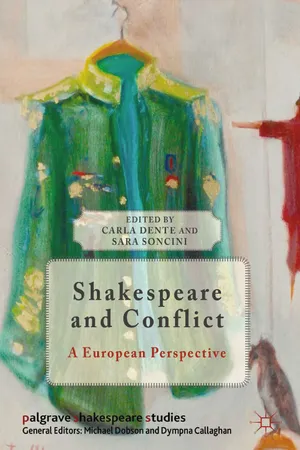
What has been the role played by principles, patterns and situations of conflict in the construction of Shakespeare's myth, and in its European and then global spread? The fascinatingly complex picture that emerges from this collection provides new insight into Shakespeare's unique position in world literature and culture.
Information
PartI
Conflict in Shakespeare
1
Introduction
Paola Pugliatti
Conflict in words
Roget’s Thesaurus (1987) gives two options for ‘conflict’: ‘contrariety’ and ‘quarrel’. The first term gives a list of near synonyms which range from words illustrating differences in opinion, such as ‘disagreement’, and those referring to situations in which some kind of value clash or personal hostility is present, such as ‘antagonism’ or ‘irreconcilability’, to those illustrating linguistic, semantic and rhetorical contraposition, such as ‘inconsistency’, ‘antonym’ or ‘antithesis’. The second term, concentrating more specifically on the semantic field of ‘quarrel’, obviously includes, alongside other close synonyms, ‘war’ and ‘warfare’.
When applied to the literary experience, therefore, the idea of ‘conflict’ provides ample ground for discussion, mainly owing to its metaphorical exploitation in different fields over time: to name only a few in the humanities area, linguistics, rhetoric, sociology, anthropology and psychology. As applied to Shakespeare’s work, it merely commits the analyst to a point of view, an angle – that of discrepancy and contradiction – from which to observe one of the most unconformable scenarios ever produced in the kind of discourse we call ‘literature’. Indeed, it outlines a region of infinite opportunities.
Some of the many possible perspectives that this region offers are pertinently developed in the section that follows. But the basic, etymological meaning of the word ‘conflict’, which is also prevalent in early modern English, is that which refers to the ‘visible bullets’ of war. War is ubiquitous in Shakespeare, not only as a staged event but also as the objective correlative of diverse experiences related to warfare, such as attack, defence, siege, opposition, resistance and so on. It is, therefore, an apt cue to start reflecting on conflict in Shakespeare.
War versus peace
Onstage as well as off, war was fashionable in the 1590s when Shakespeare started his London career, and theatre audiences enjoyed the loud noise of war which resounds in his early plays. They were excited by the clash of arms and gratified by the revival of untainted national heroes and their unworthy or imperfect rivals. They were thrilled by the turmoil of battle and the dangers of single combat. They shared emotions over the uncertain outcome of sieges, enjoyed stratagems and ambushes, plans to surprise the enemy, conspiracies and truce-breakings and, most of all, they applauded heroism and despised cowardice. In short, they were mesmerized by the magic charm of bloodshed and violence. They appreciated mercy when mercy was required but they were also able to decide when justice should prevail over mercy; and deprecated (as we still do) the ‘unjust’ aspects of violence: unjustified casualties involving innocent people, disproportionate brutality, fratricide, infanticide, rape, unmerciful butchery and unnecessary cruelty – when aptly presented as such – were strongly disapproved of.
Shakespeare gave his audience remarkably contradictory views of war, encompassing both the charm and horror of armed conflict. He staged war both as necessity and as scandal, painted it both as a scourge and a desired condition and even gave voice to an attractive side of cowardice. He penned powerful portraits of military leaders, but also revealed their human weaknesses and their nervous fragility. Some of Shakespeare’s common soldiers are conscious of the conflicting issues of responsibility and obedience and capable of challenging them, while others simply see war as an exciting experience. Some are satirically depicted as the prototypes of absurd, ridiculous soldiers or they are criminals who, as was current practice, were recruited in prison; others still are war-manual maniacs; some are worthy of praise and some others deserve utter blame; all of them are indeed ‘food for powder’.
The condition of peace is implied in the discourse of war. In Shakespeare’s plays peace is seen as a temporary reprieve from the heat of warlike activities, as a preparation for war, as an unattainable goal and even, in a Machiavellian mood, as a situation in which unforeseeable dangers may loom behind an apparently smooth surface. Indeed, it is even argued that an excess of security may endanger the public weal. That Shakespeare has been described as both a warmonger and as a ‘pacifist’ ultimately means that his texts enable both these conflicting readings.
Conflict and/or polyphony
Starting from the subject (war) which best shows Shakespeare’s tendency to represent conflicting views of reality, we have reached the core of a much-disputed problem in Shakespeare criticism: his perspectivism or, if you like, the many ways in which he staged polyphony.
This is by no means a new issue, but it is probably worth retrieving. It originates in the insightful critical statement by John Keats who, writing about Shakespeare’s achievement, but generalizing the idea to achievement in the field of literature, created the famous formula of ‘negative capability’, defining it as the capacity of ‘being in uncertainties, mysteries, doubts, without any irritable reaching after fact and reason’.1 Keats’s description of the state of mind of ‘being in uncertainties’ is one which may be easily found in a dictionary definition of ‘conflict’, especially when the term is used in either the cognitive or the psychological sphere. What Keats offers the interpretative community, however, is not a negative definition of conflict as carrying the frustration of insolubility, but a positive ability to open up or abandon oneself to a plurality of visions and therefore to a creative and imaginative view of uncertainty.
One of the most interesting twentieth-century developments of Keats’s ‘negative capability’ is Bakhtin’s idea of ‘polyphony’. In 1929, Bakhtin published the first edition of his book on Dostoevsky. In the same year an article by A.V. Lunacharsky, entitled ‘The “Plurality of Voices” in Dostoevsky’, appeared. In the largely revised 1963 edition of his book, Bakhtin acknowledges Lunacharsky’s contribution to the development of the concept of ‘polyphony’. Bakhtin’s idea of polyphony also appears in his later ‘Discourse in the Novel’. Here, although not mentioning the word ‘polyphony’, he gives a clear definition of the notion, stating that Dostoevsky’s novels constitute ‘an arena of never-ending struggle with others’ words, in all realms of life and creative ideological activity’.2
It is interesting to note that Lunacharsky’s passages about Shakespeare appear as a development of Keats’s idea of ‘negative capability’. Shakespeare, Lunacharsky says, is ‘an untendentious writer’; he has created ‘an incredible variety of personages who are all independent of him’ and, he adds, ‘one cannot say of Shakespeare that his plays sought to prove a certain thesis, nor that the “voices” introduced into the great polyphony of the Shakespearean dramatic world sacrificed their autonomy for the sake of the dramatic intention or the structure as such’.3 Surprisingly, Bakhtin and his group were not interested in the study of drama, although drama would seem to be the genre best suited to analysis as ‘an arena of never-ending struggles with others’ words’. Instead, in his 1963 book, Bakhtin argues against Lunacharsky’s idea that Shakespeare’s dramatic works constitute an unparalleled example of polyphony, and even affirms that ‘the drama is by nature alien to genuine polyphony’.4
In a different area, Keats’s idea of ‘negative capability’ has often been evoked in connection with Heidegger’s notion of Gelassenheit, which has been explained as the ‘spirit of disponibilité before What-Is which permits us simply to let things be in whatever may be their uncertainty and their mystery’.5 Heidegger elaborated the idea of Gelassenheit in 1959, in a brief text entitled ‘Zur Erörterung der Gelassenheit: Aus einem Feldweggespräch über das Denken’ (published in English in 1966 as ‘Conversation on a Country Path about Thinking’).6 Unsurprisingly, he does not quote Keats as his source but the mystic thought of Meister Eckart.7 Gelassenheit illustrates a speculative attitude which rejects the assurance of technical thinking (what, mutatis mutandis, Keats defines as ‘the irritable reaching after fact and reason’). In it, Heidegger draws a difference between ‘calculative’ and ‘meditative’ thinking. In the ‘Memorial Address’ which precedes the ‘Conversation’ in the 1959 German edition, he defines ‘meditative thinking’ by saying that it ‘demands of us not to cling one-sidedly to a single idea, nor to run down a one-track course of ideas’.8 He suggests an attitude of detachment, releasement and receptivity as the essence of thinking, for ‘releasement toward things and openness to the mystery belong together. They grant us the possibility of dwelling in the world in a totally different way.’9 The textual form in which Heidegger chose to expound the notion of Gelassenheit is that of a dialogue between a scientist, a scholar and a teacher. The dialogue form allows, more than any other kind of discourse, illustration of a polyphony of points of view or, as linguists in the Bakhtin circle would say, presentation of words reacting upon others’ words. Uncertainties, in a dialogue, take the form of statements that are contrasted by, or even conflict with, other statements, presenting a plurality of voices and viewpoints, thereby allowing doubts to be highlighted instead of being dispersed or resolved.
Keats’s ‘negative capability’ and Bakhtin’s ‘polyphony’, especially as formulated by Heidegger within an inquiry into the nature of thinking, are, I believe, still intriguing and indeed they appear, more or less latently, at the core of much postmodern theoretical and critical elaboration.
A new radicalism?
Appropriationism, the critical approach now largely dominant in Shakespeare Studies, is in part a revision of the New Historicist approach. The critical efforts of New Historicists, it is argued, ‘most frequently concentrate on rehistoricising Shakespeare within the political context of the Renaissance’, while appropriationism ‘delve[s] into the topic of reception’. It examines the many ways in which, through history, the cultural symbol ‘Shakespeare’ has been used, that is, it suggests ‘a view of Shakespeare embedded not only in his own culture but in ours, forcing us to consider both the impact we have on the plays and the impact they have on us’.10 Appropriation has also been described as dialogue, evoking Bakhtin’s definition of dialogism as interaction with an alien word.11 Such an approach is obviously a radical challenge to bardolatry and also tends to deal a serious blow to the idea of authorship, even by enacting gestures of text obliteration. At the same time, however, it strongly confirms the view of an ‘adaptable’, ‘flexible’ and ‘impressible’ Shakespeare, a Shakespeare impregnated with ‘negative capability’ or with Gelassenheit; which, in the final analysis, may appear as a new version of a Shakespeare ‘for all times’. Thus, it appears that appropriationism is confined within a paradoxical space, embodying both a historicization and a (new?) form of universalism. Here, it never really succeeds in resolving the conflict between the local and the universal, nor does it provide satisfactory answers to questions such as: what is it that makes the ‘adaptability’ of Shakespeare’s texts? To the question ‘why Shakespeare?’, Ivo Kamps replies that we do not remove Shakespeare from university curricula because ‘Shakespeare serves radical critics just as well as he serves conservative ones. Shakespeare has accrued so much cultural capital over the years that all sides have equal need of him – professionally, politically and financially.’12 In other words, Shakespeare’s readiness to be appropriated largely depends on the fact that he has been appropriated through time. But where does the adaptability of these texts reside? How is their anac...
Table of contents
- Cover
- title
- Copyright
- Contents
- List of Illustration
- Notes on Contributors
- Foreword
- Acknowledgements
- List of Abbreviations
- General Introduction
- Part I Conflict in Shakespeare
- 1 Introduction
- 2 'What country, friends, is this?' The Performance of Conflict in Shakespeare's Drama of Migration
- 3 Killing by the Book: Scenes from the Duel Ritual
- 4 The War of 'Nothings' in The Tragedy of King Lear
- 5 Conflict and Convergence in Shakespeare's Wordplay
- 6 Stage and Conflict in 'The Phoenix and the Turtle'
- Part II Conflict through Shakespeare
- 7 Introduction
- 8 Translating Shakespeare in Sociolinguistic Conflicts: A Preliminary European Study
- 9 Shakespeare and the Continental Avant-Garde through García Lorca's El público (1930)
- 10 Negotiating the Memory of the 'People's War': Hamlet and the Ghosts of Welfare in A Diary for Timothy by Humphrey Jennings (1944–45)
- 11 'IN THE FEARFUL ARMOUR': Shakespeare, Heiner Müller and the Wall
- 12 From Individual Conflict to Interlocking Conflicts: Performing The Merchant of Venice for New European Audiences
- 13 Cut'n'mix King Lear: Second Generation and Asian-British Identities
- Part III Shakespeare in Times of Conflict
- 14 Introduction
- 15 Work of National Importance: Shakespeare in Dartmoor
- 16 'The play's the thing': Hamlet in a Romanian Wartime Political Prison
- 17 'A tongue in every wound of Caesar': Performing Julius Caesar behind Barbed Wire during the Second World War
- 18 'And, by opposing, end them': The Rhetoric of Translators' Polemics
- 19 Shakespeare's Sonnets
- Select Bibliography
- Name Index
- Subject Index
Trusted by 375,005 students
Access to over 1.5 million titles for a fair monthly price.
Study more efficiently using our study tools.
Frequently asked questions
Yes, you can cancel anytime from the Subscription tab in your account settings on the Perlego website. Your subscription will stay active until the end of your current billing period. Learn how to cancel your subscription
No, books cannot be downloaded as external files, such as PDFs, for use outside of Perlego. However, you can download books within the Perlego app for offline reading on mobile or tablet. Learn how to download books offline
Perlego offers two plans: Essential and Complete
- Essential is ideal for learners and professionals who enjoy exploring a wide range of subjects. Access the Essential Library with 800,000+ trusted titles and best-sellers across business, personal growth, and the humanities. Includes unlimited reading time and Standard Read Aloud voice.
- Complete: Perfect for advanced learners and researchers needing full, unrestricted access. Unlock 1.5M+ books across hundreds of subjects, including academic and specialized titles. The Complete Plan also includes advanced features like Premium Read Aloud and Research Assistant.
We are an online textbook subscription service, where you can get access to an entire online library for less than the price of a single book per month. With over 1.5 million books across 990+ topics, we’ve got you covered! Learn about our mission
Look out for the read-aloud symbol on your next book to see if you can listen to it. The read-aloud tool reads text aloud for you, highlighting the text as it is being read. You can pause it, speed it up and slow it down. Learn more about Read Aloud
Yes! You can use the Perlego app on both iOS and Android devices to read anytime, anywhere — even offline. Perfect for commutes or when you’re on the go.
Please note we cannot support devices running on iOS 13 and Android 7 or earlier. Learn more about using the app
Please note we cannot support devices running on iOS 13 and Android 7 or earlier. Learn more about using the app
Yes, you can access Shakespeare and Conflict by C. Dente, S. Soncini, C. Dente,S. Soncini in PDF and/or ePUB format, as well as other popular books in Literature & European Literary Criticism. We have over 1.5 million books available in our catalogue for you to explore.