- English
- ePUB (mobile friendly)
- Available on iOS & Android
eBook - ePub
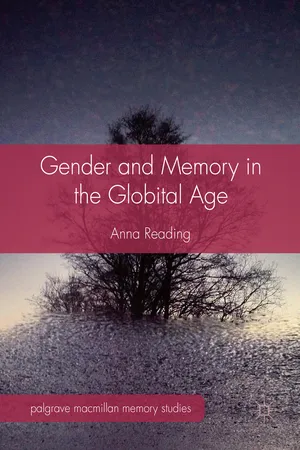
Gender and Memory in the Globital Age
About this book
This book asks how 21st century technologies such as the Internet, mobile phones and social media are transforming human memory and its relationship to gender. Each epoch brings with it new media technologies that have transformed human memory. Anna Reading examines the ways in which globalised digital cultures are changing the gender of memory and memories of gender through a lively set of original case studies in the 'globital age'. The study analyses imaginaries of gender, memory and technology in utopian literature; it provides an examination of how foetal scanning alters the gendered memories of the human being. Reading draws on original research on women's use of mobile phones to capture and share personal and family memories as well as analysing changes to journalism and gendered memories, focusing on the mobile witnessing of terrorism and state terror. The book concludes with a critical reflection on Anna Reading's work as a playwright mobilising feminist memories as part of a digital theatre project 'Phenomenal Women with Fuel Theatre' which created live and digital memories of inspirational women. The book explains in depth Reading's original concept of digitised and globalised memory - 'globital memory' - and suggests how the scholar may use mobile methodologies to understand how memories travel and change in the globital age.
Information
© The Author(s) 2016
Anna ReadingGender and Memory in the Globital AgePalgrave Macmillan Memory Studies10.1057/978-1-137-35263-7_11. Introduction
Anna Reading1, 2
(1)
King’s College London Strand Campus, The Strand, London, UK
(2)
Western Sydney University Sydney Parramatta Campus, Sydney, Australia
For tens of thousands of years human beings have sought to give present and future generations access to the past by making records of events and genealogies. Men and women have made cultural and mediated memories of everyday life as well as major events by using many kinds of media technologies, from the scored and painted marks on the walls of rocks to the creation of trackways between burial sites, from the handing down of orally transmitted songs, stories and poems to the figuring of rituals and dances. Technologies for making and preserving cultural and media memories have transformed, from hand-crafted manuscripts to the printing of books, from the crafted singular image to the mass production of photography and films. The advent of computer technologies has led to media and cultural memories being transformed again with the capturing and sharing of everyday memories through mobile devices and social network sites.
Communication and media technologies are, as Marshall McLuhan (1964) observed, extensions of the body: the car extends the feet, the hammer the hand. Technologies also extend human memory: from the technology of shaped flint for making visual reminders, to the technology of the internet as an extension of the human nervous system.
These technologies are not gender-neutral, and neither is memory: as N. Katherine Hayles in My Mother Was a Computer (2005) suggests, gender is transformed through the digital text. This book explores this proposition further and seeks to address a lacuna in research through thinking about how digitisation and digital cultures might transform the gendering of memory and memories of gender.
However, rather than a general exploration of gender and memory in ‘internet cultures’, ‘big data’, or, ‘archives’ the chosen focus of this study is how mediated memories are transforming memory and gendered memory through and with mobile and social technologies. It would have been possible to give emphasis to many other media or approaches to digital cultures, such as digital games, virtual memorials or the living archive, but the emphasis here is on the transformation of the gendering of memory through new affordances of mobilisation enabled by the mobile phone and social networks in unevenly globalised internet cultures.
The rationale for this is that mobile and social technologies are at the heart of everyday digital connectivities. The mobile phone has impacted more and had a greater take-up per capita worldwide than the personal computer, especially in developing countries, often leapfrogging legacy technologies or acting as an alternative to other kinds of digital technologies that may be difficult to access in poorer communities (Horst and Miller 2006). There is also very little specific research around mobile technologies and memory, and even less that gives an emphasis to the implications for gender.
Understanding mobilities or ‘mediated mobilities’ (Keightley and Reading 2014) is key to understanding transformations in the mobilisation of mediated memories in the 21st century. Cultural and mediated memories have, of course, always been circulated and mobilised by individuals and stakeholders. Jan Assman has shown how in ancient Egyptian cultures memories moved and changed (2010). Research on cultural memory in South American cultures has shown how memories were mobilised through walking between grave sites (Abercrombie 1999). Memories, as Astrid Erll, has argued, are always in a sense ‘travelling’ (2011): memories move, and indeed are moving in both the spatial and affective senses of the word.
The research for this book evidences how mobile and social technologies enable mobilities of mediated memories in new ways with complex implications for gender and the gendering of memory. This needs to be addressed within media and memory studies because, as I shall show in Chap. 3, historically ‘new’ technologies in previous epochs have changed mediated mnemonic practices. Connective cultures—the ability to mobilise data through mobile phones and via the internet—enable personal memories to become public rapidly; mobile media facilitate in new ways the capture, storage and sharing of messages, images and sounds that are records of events. Digitisation combined with globalisation enable humans to mobilise memories that cut across the individual and the collective, the institutional and the corporate, the local and the global in ways that disrupt conventional binaries of the public and private, of the body and other. Studies have shown that earlier media and communication technologies consistently implicate memory in ways that are gendered (Yonkers 1995; Weber 2008). Thus, this book asks how digital technologies and digital practices are not only changing memory but changing the relationships between gender and memory. Do digital technologies create new possibilities in terms of cultures of production? Are men and women using mobile and social technologies in different ways to record their autobiographies or share their lives? Is the mobile witnessing and archiving of events reconfiguring how the stories of men and women are told? This book argues that the combined dynamics of digitisation and globalisation are having profound and polylogical implications for the gendering of memory.
The study challenges current thinking in media, memory and gender studies by taking a gendered approach to memory and digital media, developing in more depth and from a feminist perspective memory in the ‘Globital Age’ through the concepts of ‘globital memory’ and the ‘globital memory field’. The book examines how gendered memory domains and trajectories work within a digitally mediated globalised economy.
Book Rationale
The transdisciplinary academic study of memory over the past 20 years has grown to the extent that it now constitutes its own academic interdisciplinary field, with a number of book series addressing undergraduate and postgraduate modules on the subject in the UK, US, Australia and internationally within a range of disciplines, as well as the successful journal Memory Studies, and regular conferences on aspects of memory. Over the course of my own career I have been transformed from a scholar who had no special disciplinary home and who readily moved between and drew on insights from the disciplines of English, theatre, politics, sociology, women’s studies, media, culture and communication studies in order to try and understand cultural and media memory. Two decades on, I am a scholar clearly situated within media memory studies. I call myself a mnemologist, just as scholars at the beginning of the 20th century who sought to enquire into society began to call themselves sociologists.
Within this interdisciplinary field, there have been significant developments in the understanding and analysis of cultural memory (Erll 2011) as well as more recently the recognition and growth of work within ‘media memory’ (Neiger et al. 2011). Over this period research and studies on gender and memory have also grown, although there is still much less research and published material available that focuses on gender and memory transnationally, and virtually no work that considers how the articulations of gender and memory are changing through the combined dynamics of digital media technologies and globalisation.
Earlier work on gender and memory tended to examine memory within specific national and historic periods with an emphasis on literary memory and oral memory, such as Lucy Noakes (1997) War and the British: Gender, Memory and National Identity, 1939–91, Lynne Hanley’s (1991) Writing War, Fiction, Gender and Memory, or Faith Beasley’s Revising Memory: Women’s Fiction and Memoirs in Seventeenth-Century France. There was also in the 1990s a growth in research on women and the memory of the Holocaust, with a particular emphasis on individual memoirs and collections of memoirs by women (see De Silva 1996; Eibeshitz and Eilenberg-Eibeshitz 1994; Gurewitsch 1998; Laska 1983; Rittner and Roth 1993). This was part of a broader epistemological shift that was arising from the foregrounding of oral history and memory within the study of history and with it the oral history of women. Hence, in 1996, a seminal edition of the International Yearbook of Oral History and Life Stories devoted an issue edited by Selma Leydesdorff, Luisa Passerini and Paul Thompson to oral history research that considered gender differences.
The past ten years has witnessed a discernible increase in published materials that focus on gender and memory. These have extended out of disciplines other than history and literature to include psychology, such as Janice Haaken’s Pillar of Salt (1998), as well as cultural studies and sociology. However, studies are largely configured around ideas of the nation, as well as situated within a particular historic period. Thus Sylvia Paletschek’s (2008) edited collection, The Gender of Memory: Cultures of Remembrance in Nineteenth- and Twentieth-Century Europe examines women’s cultures of memory in the context of the development of nation states.
There are also several studies that bring into the public realm lesser-known memories of women in non-Western contexts of repression. These include, Fatma Kassem’s Palestinian Women: Narrative Histories and Gendered Memory (2011) Nefissa Neguib’s beautifully written and researched Women, Water and Memory: Recasting Lives in Palestine (2009) as well as C. Sarah Soh’s (2008) The Comfort Women: Sexual Violence and Post-colonial Memory in Korea and Japan and Susana Rotka’s Captive Women: Oblivion and Memory in Argentina. We have also seen the development of new work on gender and memory in other national contexts such as ‘Gendered Memories, the Heroine’s Journey in Time’ in Dialogics of the Self: The Mahabarata and Culture (2010) by Lakshmi Bandlmudi, and Uneasy Warriors: Gender, Memory and Popular Culture in Japan (2007) by Sabine Fruhstuck, as well as Jill Didur’s Unsettling Partition: Literature, Gender and Memory (2006) and Mammy: A Century of Gender, Race and Southern Memory (2007) by Kimberley Wallace-Sanders.
At the same time, there was a continuation of work from the 1990s on gender and memory in relation to the Holocaust with books such as Birgit Maier-Katkin’s (2007) Silence and Acts of Memory: A Post-war Discourse on Literature, Anna Seghers, and Women in the Third Reich, and Vera Apfelthaler’s (2007) Gendered Memories: Transgressions in German and Israeli Film, which moves the analysis of gender into mediated memory.
What is missing, however, is significant critical engagement with digital communication and media technologies and the ways in which these rearticulate relationships between gender and memory through reconfiguring mediated and cultural memory in new ways. This lacuna is noticeable given that communication and technology studies have evidenced how new media technologies in earlier epochs reconfigured gender and memory, as with Harold Weber’s Memory, Print and Gender in England (2008). Significantly, Weber examines the ways in which print technology in the 17th and 18th centuries made the distinction of gender central to processes of literary memorialisation, marginalising through the advent of the mass printed book the work of women authors and writers. His research, as I explore in more detail in Chap. 3, ‘The Globital: Concept and Method’, signals the need for a study such as this, specifically addressing gender and memory within the similar but different technological mnemonic revolution taking place through globalisation in combination with digitisation and digitality.
At the same time, although there is little work in this area, there is clearly recognition of the perspective that gender brings to the study of memory and media memory in particular. Michael Rothberg’s (2009) Multidirectional Memory includes recognition of the significance of gender as well as ‘race’ as part of its main argument. Several studies have also suggested the importance of rethinking time in relation to questions of sexual politics and gender. Kath Weston’s (2002) Gender in Real Time: Power and Transience in a Visual Age begins to address questions of globalisation and capitalism in relation to time and memory from a gendered perspective. Likewise, Susanna Radstone’s (2007) The Sexual Politics of Time: Confession, Nostalgia and Memory, examines questions of sexual difference in relation to temporality within modernity and postmodernity. A number of key conferences and symposia have been significant, including one on ‘Gender and Memory’ at Birkbeck College, University of London (September 2010) and a workshop on Gender and Memory at the Institute for Advanced Studies, London, (December 2010); an international conference on ‘Gender and Memories of War, Conflict and Genocide’ in Istanbul in 2012 and a symposium at Kings College, London in July 2015, ‘Gender Re-Called’, which brought together new ideas around gender, memory and the arts.
Thus, the themes and concerns of this book are set in the context of an increase in interest in memory studies and its extension into memory studies, gender studies, and media and cultural studies, particularly research into digital cultures. In terms of my own work this book brings together and develops interest and research on gender and memory that began in the late 1980s with research in Poland. Originally, I was going to take the reader through these earlier arguments and studies but instead I provide a genealogy in Chap. 9, ‘Epilogue: Gender Recalled’. This reflexive mode is part of the critical work of the feminist mnemologist to consciously mobilise feminist intellectual history, which will otherwise be buried and lost within patriarchal mnemonic cultures. The aetiology of this study lies in that earlier work but this book seeks to bring a gendered perspective to the development of an epistemology around what I have termed in various essays ‘the globital’ and ‘the globital memory field’ as well as the idea of ‘globital time’ arising from the synergetic processes and practices of digitisation and globalisation.
My wider argument is that the synergetic practices and processes of digitisation and globalisation confound the specificity of media, enabling transmedia story telling as well as what Colin B. Harvey has noted as ‘transmedial’ and ‘intramedial’ memory (2015). Men and women are required to practice mnemonic skills through a globalised digital interface which may build on but also change established gendered patterns and mnemonic practices. For both men and women, the mnemonic ‘home’ is no longer where the heart is, nor is it merely the place of family and hearth. One’s mnemomic home is also where women’s and men’s digital assets are, which is seemingly both nowhere and everywhere.
Yet, a critical reader will note that a substantial strand of my earlier work on developing what I have termed the ‘globital memory field’ does not treat gender as the main lens through which to examine digitisation and globalisation in relation to memory. Hence, in part, this book seeks to build on the overall scope of work that had these themes and trajectories in relation to gender and memory and bring these together with work on digital media a...
Table of contents
- Cover
- Frontmatter
- 1. Introduction
- 1. Concepts
- 2. Domains
- 3. Actions
- Backmatter
Trusted by 375,005 students
Access to over 1.5 million titles for a fair monthly price.
Study more efficiently using our study tools.
Frequently asked questions
Yes, you can cancel anytime from the Subscription tab in your account settings on the Perlego website. Your subscription will stay active until the end of your current billing period. Learn how to cancel your subscription
No, books cannot be downloaded as external files, such as PDFs, for use outside of Perlego. However, you can download books within the Perlego app for offline reading on mobile or tablet. Learn how to download books offline
Perlego offers two plans: Essential and Complete
- Essential is ideal for learners and professionals who enjoy exploring a wide range of subjects. Access the Essential Library with 800,000+ trusted titles and best-sellers across business, personal growth, and the humanities. Includes unlimited reading time and Standard Read Aloud voice.
- Complete: Perfect for advanced learners and researchers needing full, unrestricted access. Unlock 1.5M+ books across hundreds of subjects, including academic and specialized titles. The Complete Plan also includes advanced features like Premium Read Aloud and Research Assistant.
We are an online textbook subscription service, where you can get access to an entire online library for less than the price of a single book per month. With over 1.5 million books across 990+ topics, we’ve got you covered! Learn about our mission
Look out for the read-aloud symbol on your next book to see if you can listen to it. The read-aloud tool reads text aloud for you, highlighting the text as it is being read. You can pause it, speed it up and slow it down. Learn more about Read Aloud
Yes! You can use the Perlego app on both iOS and Android devices to read anytime, anywhere — even offline. Perfect for commutes or when you’re on the go.
Please note we cannot support devices running on iOS 13 and Android 7 or earlier. Learn more about using the app
Please note we cannot support devices running on iOS 13 and Android 7 or earlier. Learn more about using the app
Yes, you can access Gender and Memory in the Globital Age by Anna Reading in PDF and/or ePUB format, as well as other popular books in History & Historiography. We have over 1.5 million books available in our catalogue for you to explore.