eBook - ePub
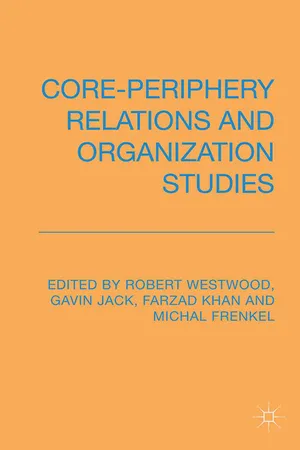
Core-Periphery Relations and Organization Studies
- English
- ePUB (mobile friendly)
- Available on iOS & Android
eBook - ePub
Core-Periphery Relations and Organization Studies
About this book
Core-Periphery Relations and Organization Studies draws together postcolonial and indigenous thinking through the conceptual lens of core-periphery relations to advance debate in organization studies. A particular aim of this book is to broaden, deepen and critically reassert a postcolonial imagination in this domain.
Information
1
Situating Core-Peripheral Knowledge in Management and Organisation Studies
Robert Westwood, Gavin Jack, Farzad Rafi Khan and Michal Frenkel
Introduction
Since its emergence in the early 1900s, the discipline of management and organisation studies (MOS) has predominantly relied upon a Euro-American epistemology, presenting managerial and organisational forms developed in the West, or Global North, as exemplars on a path towards modernity for the rest of the world to follow (Calás & Smircich, 1999; Frenkel & Shenhav, 2006; Westwood, 2001). With few (but growing) exceptions, scholars in MOS have adopted this Euro-American outlook in both the centre and the periphery of the system of global management knowledge (Tsui, 2004). In this book, we intend to flip this outlook in order to explore what management and organisation might look like from a peripheral perspective, and how the periphery might write back to the centre of the discipline of MOS. How different would the world of management and organisational theory and practice become when studied from the periphery?
Academic notions of core, or centre (terms used interchangeably in this book), and periphery are associated with world-systems analysis and dependency theory (Frank, 1967, 1978; Prebisch, 1950; Wallerstein, 1974, 1979). They form part of a descriptive and explanatory framework for the rise and evolution of the capitalist world-economy, with an analytical focus on the system (rather than a single state) and the international division(s) of labour that constitute it. In its starkest terms, a world-system analysis structures the globe into two unequal parts: the core, which comprises the (over-)developed countries of Europe, North America and some others; and the periphery, which comprises all the developing and under-developed countries of the world in Latin America, Asia and Africa (Mabogunje, 1980).1 Scholars from these theoretical traditions identify imperialism and colonialism as key features in the historical development of capitalism, with the antecedents of modern-day core-periphery structures residing in European imperial expansionism from the sixteenth century. ‘As a result of penetration by colonial capital’, Hoogvelt (2001, p. 38) writes, ‘a distorted structure of economy and society had been created in the colonial countries which would reproduce overall economic stagnation and extreme pauperization of the masses for all time’.2
The effects of such core-periphery relations have been and continue to be problematic, sometimes devastating, for many individuals, groups, tribes, clans and societies in peripheral locations, and for subaltern groups residing in today’s megacities and imperial centres. The effects are multiple, and pertain to the interconnected social, economic, political, cultural, linguistic, physical and psychological domains of human life. They are also differentially experienced depending on a host of factors including location, gender, race and class. Government mortality and health indicators, for instance, demonstrate striking disparities in the life chances and well-being of social groups within peripheral locations. In Australia the adult mortality rates as well as children’s health outcomes (Eades & Stanley, 2013) for Indigenous communities are far worse than for other Australians for a variety of complex reasons connected to the social and cultural alienation and low economic status experienced by many at the periphery of a white settler society. In global megacities, especially in so-called ‘First-World’ locations, domestic work and childcare in affluent households are often provided by female migrants (legal and illegal) from locations that stand in a dependent or subservient relation to the First-World, or former or current imperial centres. Often sending remittances back home, domestic migrant workers can be separated from their own families and children, and sometimes face abuse and social isolation within their working environment (Ehrenreich & Hochschild, 2003; Sassen, 2000). These outcomes, and many others, can all be understood as economic, social and cultural legacies of a colonial world-system.
In this book, the collective focus is less on the economic basis, workings and outcomes of core-periphery relations. Instead, we use the core-periphery frame in order to analyse and critique structures, practices and outcomes of knowledge production within management and organisation studies in particular, and the global social sciences more generally. It is recognised that the global social sciences reflect their provenance in colonial Europe and imperial America, and are based on a system of dependency between different national scholarly systems (Alatas, 2000, 2003; Connell, 2007). As Connell (2007, p. vii) notes: ‘Its [social science’s] dominant genres picture the world as it is seen by men, by capitalists, by the educated and affluent. Most important, they picture the world as seen from the rich capital-exporting countries of Europe and North America’. A key result of such ‘world-picturings’ is the delegitimisation, marginalisation, distortion or silencing of local/Indigenous (non-centre) epistemologies and worldviews. In exploring knowledge from the periphery of MOS and the global social sciences, this book attempts to reconfigure such Eurocentric pictures of the world, and to redress the ‘legitimacy gap’ between knowledge produced in the centre, and knowledge produced in peripheral locations within our discipline.
In colonial history, the attempted imposition of colonial ideology and colonisers’ belief in the superiority of their own knowledge provided the foundation for various forms and practices of cultural imperialism (Said, 1993) that set out to civilise and to bring modernity, order and progress to the natives (McClintock, 1995). A Eurocentric teleology in which Europe/Western civilisation considered itself more advanced and evolved than other societies placed a mobile West at the vanguard of history and trapped an immobile colonial Other into tradition and non-modernity (Chakrabarty, 2000). Akena (2012) illustrates how such cultural imperialism worked in the historical context of formal education and schooling in Uganda (a former British colony). Akena’s historical study describes and critiques the beliefs and practices of indoctrination and evangelisation of the first Christian missionaries who arrived in Uganda from Britain in 1877. Convinced that local Ugandan knowledge, spirituality and religious values were inferior, Akena details how the missionaries built elementary and industrial schools and churches that would serve to
create an institutional environment that was conducive to imparting Western culture, initially to sons and relatives of chiefs from the kingdoms of Buganada, Ankole, Bunyoro, and Toro. The graduates from these schools would then be used to impart Western cultures, knowledge, and religion in their communities. (p. 609)
Within this environment, missionaries encouraged their pupils to abandon their African beliefs and practices (denigrated as primitive and brutal) and to submit to a pious Christian life. Akena reports that pupils were strictly monitored and controlled (e.g., by discouraging them from returning home during school breaks), and cleaved from their own cultures and knowledge systems with the co-operation of local Bugandan chiefs (e.g., by sending students to live with chiefs, and by going to missionary camps). They were also to encourage other Africans to disavow their traditional religions and beliefs. The effects of such cultural imperialism on these graduates is described by Akena as follows:
( ... ) they were confused whether they belonged to the African or the European world, which did not quite fully accept them. Cut off from the mass of the African population but always looking to their newly acquired colonial masters for instruction and guidance, the disoriented and alienated African pupils from their traditional cultures were left without proper anchors. (p. 610)
Akena’s analysis highlights not only the vital role played by schooling and education in the propagation and transmission of colonial ideology, but also the psychological damage inter alia caused by the simultaneous internalisation of the coloniser’s knowledge systems and the denigration of one’s own.
If we move from nineteenth-century missionaries and the emergence of formal education in Uganda, to twentieth and twenty-first-century writers and educators of management and organisation, a similar story could be told, even if the actors and the locations are different. As a site for the production and regulation of legitimate knowledge, the management academy is certainly not exempt from the propagation and ensuing effects of core-periphery dynamics. It is well accepted that MOS is dominated by centres of knowledge and Eurocentric theoretical frameworks from the Global North (specifically the United States and to a lesser extent Western Europe) (Alcadipani and Reis, 2011; Frenkel & Shenhav, 2006) and reflective of the development of Western modernist narratives of science and progress (Calás & Smircich, 2003). Ibarra-Colado (2008), for example, describes the workings of core-periphery in MOS in the context of Latin America. He writes that:
Until now and dominantly, most of the Latin American researchers have been copying and pasting syllabus, theories, methodologies and other management fads and fashions manufactured in the Anglo-Saxon countries, it doesn’t matter if the appropriation is on mainstream theories or in those produced by critters or pomos [critical management scholars or postmodernists].
( ... ) we can recognize some mechanisms that stimulate these copy-paste practices. For example, most of the Latin American scholars in the field do not recognize the colonial condition of the region and, consequently, they systematically deny the structural differences and asymmetries with the centre. The problem is seen as one of development and the solution is reduced to the appropriate application of those management and organizational knowledges produced in the most developed countries. This uncritical acceptance of Anglo-Saxon theories conditions the type of explanation of the problems of the region and the type of solutions to confront them, producing in this way a certain kind of self-imposed coloniality. (p. 933; italics added)
Ibarra-Colado’s critique of Latin American management resonates strongly with wider critiques of ‘global’ social sciences, in which institutions of higher education have become ‘key sites of cultural and epistemological invasion, where inappropriate and irrelevant forms of Western culture and knowledge are thrust upon an unwitting student population’ (Pennycook, 1994, p. 64). Alvares (2002) describes an ensuing ‘distorted structure’ in which the intellectual centres of the West ‘supply the categories and terms for all intellectual debates. We play along. They remain the centre, while we keep ourselves at the periphery. They create; we copy and apply’. Some caution with an overgeneralisation like this should be noted. Colonial history teaches us of the active and passive resistance of colonised groups, as well as the ambiguity and ambivalence inherent in the colonial encounter (Bhabha, 1994; Prakash, 1999). It would be wrong (perhaps logically impossible) to consider the imposition of colonial ideology as always and necessarily successful (for if it had been, there would have been no more justification for further colonisation). This sentiment is echoed by Connell (2007) in relation to the social sciences:
The hegemony of metropolitan knowledge does not obliterate all others. Alternative ways of thinking about the world certainly persist. But they are readily marginalised, as African discussions of indigenous knowledge have shown, intellectually discredited, dropped from the curricula of schools and universities, or ripped off by corporations pursuing intellectual property rights. (p. xi)
In MOS, we note how the development of other regional and national academies of management research (for instance, in Brazil, Scandinavia, Asia-Pacific) has created a fragmented field for organisational inquiry with equivocal implications for the development of autonomous non-centre fields of research and novel/Indigenous concepts (Kipping et al., 2008; March, 2004).
This book should be conceived as a collective, critical endeavour to interrogate and reconfigure from a peripheral perspective certain concepts and theoretical perspectives from the core of MOS. To this end, the book has three main aims. First, the book aims to defamiliarise and to decolonise MOS concepts from the centre. Second, it aims to recover alternative conceptions and knowledges that have been submerged or silenced. Finally, it aims to re-voice Indigenous knowledge and practices that constitute alternative conceptualisations within MOS. Broadly speaking, these aims are inspired by critical perspectives from postcolonial theory and Indigenous knowledge systems. Such perspectives recognise, challenge and offer alternatives to the continuing presence and evolving forms of economic and cultural imperialism and colonisation of life-forms that attend the projection of Western modernities (and newly emerging non-Western forms) into different discursive spaces. This approach offers different possibilities for engagement, disengagement and the expression of independence from dominant knowledge systems, and thus different potentials for critiquing and changing core-periphery thinking.
In this chapter, we take stock of the current influence of postcolonial theory and Indigenous perspectives in MOS. We do so by first turning to an overview of the emergence of a critically reflexive perspective in MOS informed by postcolonial theory. We thus give due recognition to work that has already begun in re-historicising and decolonising...
Table of contents
- Cover
- Title
- 1 Situating Core-Peripheral Knowledge in Management and Organisation Studies
- 2 Can the Periphery Write Back? Periphery-to-Centre Knowledge Flows in Multinationals Based in Developing and Emerging Economies
- 3 De-centring Management and Organisation Studies: On the Eccentricity of US-Based Management and Organisation Theory and Practice
- 4 Recontextualising the New Institutional Conception of the State to the Turkish Case
- 5 The Historical Trajectory of a Peripheral National Business System
- 6 Governing the Global Periphery: Socio-economic Development in Service of the Global Core
- 7 Transforming the Institutional Logic of the Centre through Indigenous Wisdom
- 8 ‘He Apiti Hono, He Tātai Hono’: Ancestral Leadership, Cyclical Learning and the Eternal Continuity of Leadership
- 9 Voices that Matter: Speaking Up for the ‘Indigenous’ in Business Education
- 10 Sorry, the Network Society has Already been Invented: Why Management Education Needs Indigenous Input
- 11 Carrying across the Line
- Index
Trusted by 375,005 students
Access to over 1.5 million titles for a fair monthly price.
Study more efficiently using our study tools.
Frequently asked questions
Yes, you can cancel anytime from the Subscription tab in your account settings on the Perlego website. Your subscription will stay active until the end of your current billing period. Learn how to cancel your subscription
No, books cannot be downloaded as external files, such as PDFs, for use outside of Perlego. However, you can download books within the Perlego app for offline reading on mobile or tablet. Learn how to download books offline
Perlego offers two plans: Essential and Complete
- Essential is ideal for learners and professionals who enjoy exploring a wide range of subjects. Access the Essential Library with 800,000+ trusted titles and best-sellers across business, personal growth, and the humanities. Includes unlimited reading time and Standard Read Aloud voice.
- Complete: Perfect for advanced learners and researchers needing full, unrestricted access. Unlock 1.5M+ books across hundreds of subjects, including academic and specialized titles. The Complete Plan also includes advanced features like Premium Read Aloud and Research Assistant.
We are an online textbook subscription service, where you can get access to an entire online library for less than the price of a single book per month. With over 1.5 million books across 990+ topics, we’ve got you covered! Learn about our mission
Look out for the read-aloud symbol on your next book to see if you can listen to it. The read-aloud tool reads text aloud for you, highlighting the text as it is being read. You can pause it, speed it up and slow it down. Learn more about Read Aloud
Yes! You can use the Perlego app on both iOS and Android devices to read anytime, anywhere — even offline. Perfect for commutes or when you’re on the go.
Please note we cannot support devices running on iOS 13 and Android 7 or earlier. Learn more about using the app
Please note we cannot support devices running on iOS 13 and Android 7 or earlier. Learn more about using the app
Yes, you can access Core-Periphery Relations and Organization Studies by R. Westwood, G. Jack, F. Khan, M. Frenkel, R. Westwood,G. Jack,F. Khan,M. Frenkel in PDF and/or ePUB format, as well as other popular books in Business & Business Strategy. We have over 1.5 million books available in our catalogue for you to explore.