- English
- ePUB (mobile friendly)
- Available on iOS & Android
eBook - ePub
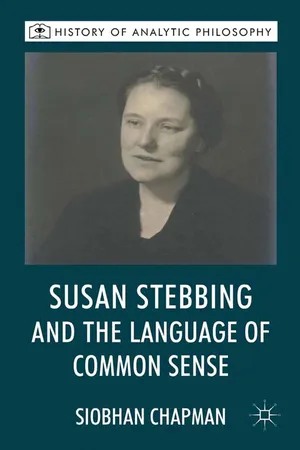
Susan Stebbing and the Language of Common Sense
About this book
This first book-length study of the work and life of L. Susan Stebbing relates the development of her thought to the philosophical, social and political background of her life. It also assesses Stebbing's contribution in the light of developments both in analytic philosophy and in linguistics in the decade since her death.
Information
Topic
PhilosophySubtopic
Social History1
The Analyst in Training
The evidence concerning Stebbing’s early life is meagre and fragmentary. In keeping with her reticent nature, she produced no memoir or autobiographical sketch. It was left to others to outline the major events of her life and such accounts do not always accord with each other or with independent documentary evidence. An obituary published in Mind shortly after Stebbing’s death seems to have provided a template for a number of subsequent biographical summaries, but unfortunately includes a number of errors.1 To begin with, it records Stebbing as having been the daughter of a barrister. In fact, it seems that although Alfred Charles Stebbing did undergo legal training he never went into practice. He was born in 1852 in Islington, Middlesex, the third son of Thomas Stebbing, a ‘General Merchant’ and his wife Susan. The 1871 census records the family living not far away in Finsbury; Alfred’s two older brothers are described as clerks to their father and Alfred as an ‘Articled Law Student’. However, established in his own house and with his own family, he was described as ‘Merchant Continental Produce’ in 1881 and in 1891 as simply ‘General Merchant’, as his father had been. His business was importing tinned fish from Portugal.2
In the summer of 1877 Alfred Stebbing married Elizabeth Elstob, the third daughter of William Elstob, a merchant tailor, and his wife Catherine. Elizabeth was born in St Pancras and the census taken in 1871 when, like Charles, she was 19, describes her as a ‘Music Teacher’. Alfred and Elizabeth set up home in Finchley, North London and it was here (not in Wimbledon in South London as the Mind obituary claims) that the children were born. There were six children, or at least six who lived long enough to appear on census returns: Edith (born 1879), Harry (1880), Bertram (1882), Helen (1883), George (1884) and Lizzie (1885). Stebbing family legend has it that the youngest child was to have been named Elizabeth (her mother’s name) Susan (the name of her paternal grandmother) but that Alfred, for some reason flustered at the christening, gave her name as ‘Lizzie Sue’. Her birth was registered in Barnet under the name ‘Lizzie Susan’. Stebbing disliked the ‘Lizzie’ and never used it, preferring the full version of her middle name for both professional and personal purposes.3 For some of the family the shorter version stayed; after Stebbing’s death, Edith wrote movingly of ‘Sue ... my dearly loved “little” sister’.4
Alfred Stebbing’s death was registered, also in Barnet, in 1891. Elizabeth Stebbing moved the family from North to South London, settling in Streatham in Wandsworth. In 1901 she is recorded as ‘Head of Family’ and as ‘Living on own means’ with her six children, one widowed sister and one domestic servant. This is also the end of Elizabeth Stebbing’s story. According to the obituary in Mind, Susan Stebbing lost her mother when she was 16, which would put her death very soon after this last census record, probably in 1902 at the age of 50. This has to be treated with some caution, because the same account claims that Alfred Stebbing died when Susan Stebbing was two rather than five. However, it does seem to be the case that Susan was left without either of her parents before she reached adulthood and that responsibility for her care passed to a guardian.
The young Susan Stebbing was said to be ‘a delicate child, not at first expected to live’, and the rather intermittent nature of her education was attributed to this.5 Such claims cannot necessarily be taken at face value since Victorian families were generally rather quick to identify children, particularly daughters, as ‘delicate’ and to limit their activities and prospects accordingly. However, in Stebbing’s case the ill health and periods of enforced inactivity continued into and throughout her adult life. She suffered from Menière’s Disease, a disorder of the inner ear which causes intermittent attacks of vertigo and hearing problems including tinnitus and even deafness. Understanding and treatment of the disease developed to any significant extent only in the second half of the twentieth century,6 and it seems that for much of her life Stebbing simply had to endure and as far as possible to accommodate the symptoms.
Stebbing was not considered strong enough for full-time schooling, and such early education as she received was conducted privately at home. In September 1900 she was admitted to James Allen’s Girl’s School in Dulwich, where she stayed until July 1904. During her years at Dulwich, presumably in the aftermath of her mother’s death, the record of her address was changed from one in Streatham to one in West Kensington, which must have made for an arduous daily commute. Stebbing matriculated with First Division Honours and went to Cambridge as a student at Girton College, but even then her health dictated what she was to study. She began her university career at a time when the debate was still active in society over whether academic study was inimical to women’s health, even in the case of robust women.7 The version of her story based on the Mind obituary has it that she wanted to read Classics, but that this was considered to be too physically demanding a subject for her. A different claim is made in an obituary in the Girton Review. A friend of Stebbing who appears to be drawing on personal communication records that ‘she often said that, if her health had permitted, she would have preferred to read for a science degree’.8 It does seem more likely that a young woman at the beginning of the twentieth century who was considered to be in poor health might be discouraged from pursuing an interest in the physical sciences. In any case, it was not Classics or Science that Stebbing went to Girton to study, but History.
Girton College was founded in 1869, and when Stebbing went up to Cambridge, it was still one of only two institutions where women could study, not yet fully recognised as colleges of the University in their own right, Newnham having joined it in 1871. The early years of the twentieth century were a time of change at Girton, in ways which made it an excellent training ground for a woman who was to take part in the wider academic and intellectual community on her own terms. The philosopher Constance Jones was appointed as Mistress in 1903, and a new emphasis on the importance to the college of academic research has been dated from then.9 These years saw the start of a process in which, as a later Mistress of Girton described, ‘self-government developed, advanced study and research began. This new movement – largely due to the influence and shaping policy of former students – also reflected the growing power and independence of the teaching body, who reached out beyond the college to link it with university teaching and with the world outside’.10
Women who studied at Girton when Stebbing did would not be able to graduate with a degree from the University of Cambridge and therefore to become full members of the University. British universities other than Oxford and Cambridge were by this time awarding degrees to women, but as recently as 1897 there had been riots in Cambridge when the senate of the University had held a vote on whether to allow women to take degrees. In fact, Cambridge was the last university in Britain to award degrees to women; the first women did not graduate from Cambridge until 1948. Since 1881, Cambridge examinations had been open to women as well as men; women were able to take the parts of the Tripos (the two separate components that go to make up an honours degree) and to be awarded classifications for these, just as the male students were, but they could not proceed from there to graduation.
Stebbing’s career as an historian was successful but not distinguished. She took the Historical Tripos Part I in 1906 and Part II in 1907, obtaining a second class result on each occasion. Much later, her former postgraduate supervisor claimed that Stebbing remained ‘deeply interested in the problems of the present and the past’.11 But in 1907 an event occurred which, in the received version of the Stebbing story, has been identified as a turning point, or a decisive moment in which her future path was settled. It is typical of the story that the epiphany was a quiet and cerebral event that took place in a library. She was presumably supposed to be reading works on History in preparation for Part II of the Tripos, but she happened to pick up Appearance and Reality by F. H. Bradley. Stebbing was hooked. She decided to stay on at Cambridge after she had finished her History Tripos and to switch her studies to philosophy.
Appearance and Reality is not an obviously inspirational book for a nonphilosopher. Published in 1893, it is written in the most convoluted and elaborate tradition of Victorian prose. It engages in debate with the details of a number of past philosophies that would not be familiar to the novice, without anything approaching explanation or exegesis. And it is full of dogmatic but apparently unsupported statements about entities such as ‘the Real’ and ‘the Absolute’. It is perhaps a particularly surprising inspirational text for Stebbing herself, given the course of her future thinking and her own philosophy. Stebbing was to be closely involved in developments in analytic philosophy that emphasised the importance of rigorous precision in philosophical discussion and a scientific respect for empirical evidence. She placed increasing importance on attending to everyday ways of understanding the world around us and of expressing that understanding in language. Yet Bradley’s book is a metaphysical treatise on the preeminence of what is real over what is merely apparent. Its dogmas depend for their credibility on the authority of the metaphysician rather than on the observation of the scientist. And the central entities on which its philosophy depends are incorrigibly inaccessible to scrutiny. It is, in fact, the type of philosophical writing that was to be targeted by the logical positivists when they argued that metaphysical philosophy, because it did not observe the requirements of objectivity and empiricism that were present in the sciences, was full of meaningless statements and pseudo propositions. But in the early years of the twentieth century, Bradley was a highly respected thinker with a profound influence on the terms within which philosophy was being conducted. He was seen by many as having made British philosophy once again respectable, serious, and on a par with the philosophy of the Continent. It is necessary to understand Stebbing as having been impressed by these terms of philosophical debate, the types of subject matter that they opened up to serious scrutiny and the possibilities of a discipline concerned with human understanding of self and of the world, rather than by the specifics of Bradley’s own system.
In Appearance and Reality Bradley defends a version of idealism: the philosophy that reality consists of our ideas or experiences, not of anything that lies beyond or causes those ideas or experiences. He in fact spends much of the book attacking realist views, particularly from Enlightenment philosophers who argued that the information we receive through our senses enables us to understand something of the nature of a reality that is external to us. For Bradley, everyday understandings of the world are misleading and need to be challenged. For instance, he rejects the idea that reality consists of different objects, independently available to experience through the senses. What is in fact real, the Absolute, is a spiritual existence that is not amenable to empirical knowledge. The Absolute is a single unity, rather than being composed of many separate parts, meaning that whatever is real must be seen as belonging to this single reality; everything that is real is ultimately one thing, not many. Our sense that there are many separate real things in the world is imposed on reality by our own conceptions. Entities can for Bradley be more or less real, depending on the extent to which they partake of the ultimate reality, and ‘it costs little to find that in the end Reality is inscrutable. It is easy to perceive that any appearance, not being the Reality, is in a sense fallacious’.12 Although Bradley’s work is undoubtedly mystical in its approach to concepts such as ‘the Absolute’ and ‘the Real’, it is not conventionally religious, unlike for instance the work of the earlier proponent of idealism, George Berkeley. Bradley’s ‘Absolute’ certainly cannot be straightforwardly equated with a deity.
Philosophy was taught at Cambridge under the title of ‘Moral Science’. Once she had completed her Historical Tripos, Stebbing began work on the Moral Sciences Tripos, completing Part I in one year. Although she had been inspired to study philosophy by reading a work on metaphysics, the teaching she received in preparation for the Tripos, and the other influences on her at the time, would have steered her more towards formal approaches to philosophy. Both the head of her college and the philosophy tutor to whom she was assigned were practising logicians. Constance Jones had published both Elements of Logic (1890) and A Primer of Logic (1905). William Ernest Johnson was based in Kings College. He worked to some extent in economics and had recently taught Stebbing’s near contemporary John Maynard Keynes. But his main interest was in logic, albeit of the old school of logic that was soon to be challenged by the publication of Whitehead and Russell’s Principia Mathematica. Stebbing’s new found enthusiasm for philosophy and these two influences were a successful combination. She took the Moral Science Tripos Part I in 1908, achieving a second class result in the upper division.
Although she did not know it then, by the time Stebbing was beginning her enthusiastic reading of Bradley in the college library in 1907, his idealism had already come under sustained attack from G. E. Moore, an attack that was to prove decisive. It was the more rigorous, analytic style that Moore brought to bear on Bradley’s metaphysics that was to dominate British philosophy for the rest of the twentieth century. Stebbing did not encounter Moore at all during her time as a student at Cambridge. Moore was based in Cambridge for most of his working life, but between 1904, when his Fellowship at Trinity College ended, and 1911, when he returned to take up a University Lectureship in Moral Science, he was living independently in Edinburgh and then in Richmond. He was therefore away from Cambridge during the years in which Stebbing was studying first History and then Moral Science. But he was to become a strong and lasting influence on her soon afterwards, and it is worth spending a little time on Moore’s response to Bradley’s idealism, on his defence of common sense and on his ethics, all of which were to be recurrent themes in Stebbing’s work.
Moore had himself been a student at Cambridge during the 1890s, and one of his most influential lecturers was John McTaggart, an idealist and admirer of Bradley. McTaggart dogmatically valued metaphysical inquiry over empirical scie...
Table of contents
- Cover
- Title
- Introduction
- 1 The Analyst in Training
- 2 Becoming a Philosopher
- 3 Science, Logic and Language
- 4 Cambridge Analysis
- 5 Logical Positivism and Philosophy of Language
- 6 A Wider Audience
- 7 Politics and Critical Thinking
- 8 Logic and Ideals
- 9 Stebbing, Philosophy and Linguistics
- Notes
- Bibliography of Stebbing’s Published Writings
- References
- Index
Trusted by 375,005 students
Access to over 1.5 million titles for a fair monthly price.
Study more efficiently using our study tools.
Frequently asked questions
Yes, you can cancel anytime from the Subscription tab in your account settings on the Perlego website. Your subscription will stay active until the end of your current billing period. Learn how to cancel your subscription
No, books cannot be downloaded as external files, such as PDFs, for use outside of Perlego. However, you can download books within the Perlego app for offline reading on mobile or tablet. Learn how to download books offline
Perlego offers two plans: Essential and Complete
- Essential is ideal for learners and professionals who enjoy exploring a wide range of subjects. Access the Essential Library with 800,000+ trusted titles and best-sellers across business, personal growth, and the humanities. Includes unlimited reading time and Standard Read Aloud voice.
- Complete: Perfect for advanced learners and researchers needing full, unrestricted access. Unlock 1.5M+ books across hundreds of subjects, including academic and specialized titles. The Complete Plan also includes advanced features like Premium Read Aloud and Research Assistant.
We are an online textbook subscription service, where you can get access to an entire online library for less than the price of a single book per month. With over 1.5 million books across 990+ topics, we’ve got you covered! Learn about our mission
Look out for the read-aloud symbol on your next book to see if you can listen to it. The read-aloud tool reads text aloud for you, highlighting the text as it is being read. You can pause it, speed it up and slow it down. Learn more about Read Aloud
Yes! You can use the Perlego app on both iOS and Android devices to read anytime, anywhere — even offline. Perfect for commutes or when you’re on the go.
Please note we cannot support devices running on iOS 13 and Android 7 or earlier. Learn more about using the app
Please note we cannot support devices running on iOS 13 and Android 7 or earlier. Learn more about using the app
Yes, you can access Susan Stebbing and the Language of Common Sense by S. Chapman in PDF and/or ePUB format, as well as other popular books in Philosophy & Social History. We have over 1.5 million books available in our catalogue for you to explore.