eBook - ePub
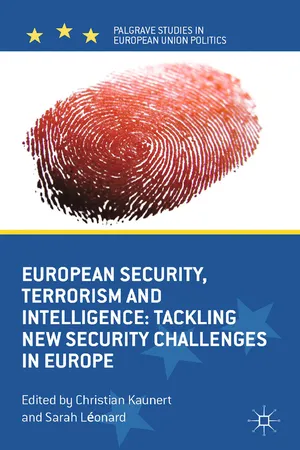
European Security, Terrorism and Intelligence
Tackling New Security Challenges in Europe
- English
- ePUB (mobile friendly)
- Available on iOS & Android
eBook - ePub
European Security, Terrorism and Intelligence
Tackling New Security Challenges in Europe
About this book
The EU has long been seen as confederation that has failed to assert itself effectively on the international stage. In this collection, a series of experts discuss how the EU has shed its reputation as a weak international actor in light of its policies on police cooperation and intelligence-sharing as part of the global effort to combat terrorism
Information
1
Introduction – Beyond EU Counter-terrorism Cooperation: European Security, Terrorism and Intelligence
In March 2012, three French soldiers and four Jewish members of the public were killed in a series of gun attacks in the Midi-Pyrénées region of France. The perpetrator of these terrorist attacks, Mohamed Merah, was eventually killed during an armed siege. The official investigation revealed that he had become radicalised while in prison and had also travelled to Afghanistan and Pakistan (BBC News, 2012a). However, Islamist terrorism is not the only type of terrorism with which European countries have to contend. On 22 July 2011, Anders Breivik set off a car bomb in Oslo, which resulted in eight deaths. He subsequently carried out a mass shooting at a Labour Party youth camp on the island of Utøya, killing another 69 people, mostly teenagers. During his trial, he described his actions as ‘preventive attacks to defend the indigenous Norwegian people’ and accused the ruling Labour Party of turning Norway into what he called a ‘multiculturalist hell’ by allowing too many Muslim immigrants to enter the country (Guardian, 2012). Thus, and although some signs of ‘counter-terrorism fatigue’ are visible in Europe according to the European Union (EU) Counter-Terrorism Coordinator (Council of the European Union, 2009, p. 2), the threat of terrorist attacks in European countries can be viewed as significant, diverse and fast evolving, as notably confirmed by the annual EU Terrorism Situation and Trend Reports compiled by Europol (see Europol, 2011) and the regular updates and discussion papers relating to the EU Counter-Terrorism Strategy issued by the Counter-terrorism Coordinator (see Council of the European Union, 2011a–c, 2012). Against this backdrop, this book mainly focuses on the development of EU cooperation against terrorism, highlighting both its achievements and the challenges that it has encountered. In addition, as further explained later in this chapter, it locates the evolution of the EU counter-terrorism policy in its broader context. It considers both the debates on the EU as an international security actor and the policy developments in the related policy areas of policing and intelligence, which partly overlap with counter-terrorism – hence, the title of this book, European Security, Terrorism and Intelligence.
Europe and the terrorist threat
Before proceeding further, it is important to specify the definition of terrorism that underpins this book. As evidenced by the protracted debates on the subject at the United Nations, there is no universally agreed definition of terrorism among governments (Whittaker, 2007). Neither is there any academic agreement in this respect, as notably evidenced by the rise of a ‘critical terrorism studies research agenda’ and the debates on the concept of ‘state terrorism’ (Jackson et al., 2009, 2011a,b; Jackson and Sinclair, 2012). This is arguably not surprising, as defining terrorism is an inherently political process – the same person may be seen as a terrorist or a freedom fighter depending on one’s political viewpoint (Hoffman, 2006). With these caveats in mind, the present book is based on the common definition of terrorism that was adopted by the EU in its Council Framework Decision of 13 June 2002 on combating terrorism (2002/475/JHA). This definition has both an objective and a subjective dimension. The objective dimension refers to the adoption of a list of nine categories of serious criminal conduct, such as hostage-taking, extortion, murder and bodily injuries. In contrast, the subjective dimension concerns the aim of these acts – the specific acts that are listed are deemed to be terrorist acts when committed with a specific aim, namely (1) ‘seriously intimidating a population’, (2) ‘unduly compelling a Government or international organisation to perform or abstain from performing any act’ or (3) ‘seriously destabilising or destroying the fundamental political, constitutional, economic or social structures of a country or an international organisation’ (Article 1 of the Council Framework Decision 2002/475/JHA). Related to the fact that there is no common definition of terrorism, there are also various ways of categorising terrorists and terrorist acts. As observed by Johnson (1978, quoted in Schmid and Jongman, 2005, p. 40), ‘[t]here are almost as many typologies of terrorism as there are analysts’. In their seminal study, Schmid and Jongman have identified ten categories of typologies, including the actor-based, political orientation-based, and purpose-based typologies (Schmid and Jongman, 1988, pp. 39–59). In its EU Terrorism Situation and Trend Reports, Europol distinguishes between Islamist, separatist, left-wing and anarchist, right-wing, and single-issue terrorist acts.
For the first years of the new millennium, Al Qaeda was generally considered by far the most dangerous terrorist threat to the EU Member States, following the terrorist attacks in the United States (US) on 11 September 2001, in Spain on 11 March 2004 and in the United Kingdom (UK) on 7 July 2005. This is not to say that some EU Member States were not also affected by the activities of other terrorist groups at the same time, such as ETA in Spain and Corsican terrorist groups in France. However, Al Qaeda was considered to be particularly dangerous because of several of its characteristics (Hoffman, 2006). First of all, it aims to perpetrate attacks causing mass casualties. Moreover, the aims of Al Qaeda are generally perceived to be ultimately incorrigible. It has been pursuing five main aims, namely (1) to establish the Shari’a religious law across Muslim lands in order to facilitate the arrival of the ‘Messiah’; (2) to expel the US and ‘infidels’ from Middle East and Muslim lands; (3) to topple Muslim regimes that ‘betray’ true Islam; (4) to lead a Jihad (‘holy war’) against the US and its allies, including European states, and set up a ‘World Islamic Front for Jihad’; and (5) to ultimately establish a Pan-Islamist ‘Caliphate’ (Hoffman, 2006; Wilkinson, 2011). In addition, Al Qaeda is structured as a large transnational movement or network, rather than a traditional, more hierarchical organisation. In the aftermath of 9/11, it was perceived to be the most widely dispersed terrorist movement in history, with a reported presence in more than 60 countries. While Osama bin Laden (now replaced by Ayman al Zawahiri since bin Laden’s death in 2011) provided ideological and strategic leadership, assisted by a ‘Shura’ (Council of Advisors), the networks of cells and affiliated organisations have been in charge of their own terrorist operations. This has made intelligence gathering particularly challenging and dependent on strong international cooperation.
In the last few years, the core of Al Qaeda has come under significant military pressure, most notably from the US. Eventually, in May 2011, bin Laden was killed in a raid by US Special Forces in Pakistan (Council of the European Union, 2011a, p. 1). This was a further blow to what the EU Counter-terrorism Coordinator has called ‘Al Qaeda central’ (Council of the European Union, 2009, p. 3), which had already been significantly weakened by then. However, bin Laden’s death did not spell the end of Al Qaeda, whose affiliates notably in the Sahel region and in Yemen have considerably grown in recent years. For this reason, terrorism inspired by Al Qaeda still tends to be considered the most important terrorist threat faced by Europe. This is notably because Al Qaeda propaganda can inspire ‘self-radicalising’ individuals, who may also have opportunities to travel to training camps in conflict areas, as shown by the case of Mohamed Merah (BBC News, 2012b). Nevertheless, Al Qaeda does not have a monopoly on the terrorist threat in Europe, as shown by Breivik’s attacks in summer 2011 and the continued terrorist campaigns of some ethno-nationalist groups in several EU Member States (Europol, 2011).
The development of EU counter-terrorism cooperation
EU cooperation on counter-terrorism is a relatively recent phenomenon. Although operational cooperation on issues of internal security, such as terrorism, already began in the 1970s among European states within the TREVI Group, it is only in 1993 that cooperation on terrorism was formally included in the EU framework with the adoption of the Treaty of Maastricht (Mitsilegas, 2009, p. 10). However, for a few years, EU achievements in this policy area remained modest. It can therefore be argued that EU counter-terrorism cooperation began in earnest in 2001, as a direct response to the terrorist attacks in the US on 11 September 2001 (Zimmermann, 2006; Kaunert, 2007, 2010; Argomaniz, 2011; Bures, 2011). As early as 21 September 2001, the European Council met in an extraordinary session ‘in order to analyse the international situation following the terrorist attacks in the United States and to impart the necessary impetus to the actions of the European Union’ (European Council, 2001a, p. 1). It adopted Conclusions and a Plan of Action, which identified the priorities for the development of the EU counter-terrorism policy as follows: (1) enhancing police and judicial cooperation; (2) developing international legal instruments; (3) ending the funding of terrorism; (4) strengthening air security; and (5) coordinating the EU’s global action. An EU Anti-terrorism Roadmap listing 46 measures was also adopted on 26 September 2001 (European Council, 2001b). As a result, in the first months following 9/11, the EU focused on enhancing police and judicial cooperation on counter-terrorism among EU Member States, with the adoption of important instruments such as the Framework Decision on Combating Terrorism and the European Arrest Warrant, as well as tackling the financing of terrorism (see Kaunert, 2007, 2010).
However, policy developments gradually slowed down as the urgency of the terrorist threat appeared to subside. This period of relative ‘inertia’ ended when the EU counter-terrorism policy received a new impetus in the wake of the terrorist attacks in Madrid in March 2004 (Argomaniz, 2009). Those prompted the adoption of the Declaration on Combating Terrorism on 25 March 2004 (European Council, 2004), as well as the decision to create the post of EU Counter-terrorism Coordinator. A Revised EU Plan of Action on Combating Terrorism was also adopted in June 2004 (Council of the European Union, 2004). It highlights the seven ‘EU strategic objectives to combat terrorism’ that had been endorsed by the European Council in March, namely to (1) ‘deepen the international consensus and enhance international efforts to combat terrorism; (2) reduce the access of terrorists to financial and economic resources; (3) maximise the capacity within EU bodies and Member States to detect, investigate and prosecute terrorists and to prevent terrorist attacks; (4) protect the security of international transport and ensure effective systems of border control; (5) enhance the capability of the European Union and of Member States to deal with the consequences of a terrorist attack; (6) address the factors which contribute to support for, and recruitment into, terrorism; (7) target actions under EU external relations towards priority Third Countries where counter-terrorist capacity or commitment to combating terrorism needs to be enhanced’. In addition to this Plan of Action on Combating Terrorism, which was to be updated every six months, the EU subsequently adopted a Counter-Terrorism Strategy in December 2005. It is based on four pillars: ‘prevent’, ‘protect’, ‘pursue’ and ‘respond’. ‘Prevent’ refers to activities aiming to tackle the root causes of terrorism, while ‘protect’ concerns activities aiming to decrease the vulnerability of people and infrastructures to terrorist attacks. ‘Pursue’ refers to the investigation of terrorist activities, while ‘respond’ concerns the reaction to terrorist attacks (Council of the European Union, 2005a). Moreover, the EU has adopted strategies on specific aspects of its counter-terrorism efforts, such as the EU Strategy for Combating Radicalisation and Recruitment in 2005 (Council of the European Union, 2005b) and the Revised Strategy on Terrorist Financing in 2008 (Council of the European Union, 2008).
The EU’s role in countering terrorism has been the object of heated debates in the last decade. There have been diverging assessments in the literature as to the success of EU counter-terrorism cooperation. Some scholars have been rather reserved in their assessment of the EU counter-terrorism policy. In particular, Bures (2006, 2011), who has famously branded this policy a ‘paper tiger’, has argued that the EU’s activities have only generated little added value to the activities of the Member States (Bures, 2006, 2011). In his contribution to this volume, he develops this argument in relation to the role of Europol in counter-terrorism. Others, such as Bossong and Coolsaet (Bossong, 2008; Coolsaet, 2010), have argued that the development of the EU counter-terrorism policy has been haphazard and characterised by a lack of overall strategic vision – a criticism sometimes levelled at EU internal security policies more broadly (Kaunert et al., 2012b). In contrast, other scholars have been more positive and have emphasised all the progress already accomplished since 9/11 in enhancing cooperation in this very sensitive policy area (Mahncke and Monar, 2006; Spence, 2007; Argomaniz, 2009, 2011; Kaunert, 2010). The very swift adoption of the European Arrest Warrant in the aftermath of 9/11 (Kaunert, 2007) and the signing of a range of international agreements, most notably with the US (Kaunert and Léonard, 2011), are of particular note. Although the content of these measures has been criticised in some respects (Ripoll Servent and MacKenzie, 2011; Kaunert et al., 2012a), their very existence signals that significant progress, even if it has been uneven over the years (Argomaniz, 2009), has been accomplished in fostering cooperation on counter-terrorism among the EU Member States. A closer examination of the successes of the EU in this policy area, as well as the challenges that it continues to face, is therefore in order a little more than a decade after EU cooperation on terrorism began in earnest.
About this book
It is important to start by explaining why this book is not entitled The European Union Counter-terrorism Policy, but rather European Security, Terrorism and Intelligence. In addition to being the title of a seminar series and a workshop that both editors organised with another colleague at the University of Salford - and where earlier versions of several chapters in this book were presented -, the choice of this title was motivated by various factors and aims to highlight several important points. First of all, the book does not only consider the EU in its analysis of counter-terrorism cooperation in Europe. It complements existing literature on this topic (see notably Coolsaet, 2010; Kaunert, 2010; Argomaniz, 2011; Bures, 2011; Bossong, 2012) by adopting a broader approach. It does not only consider the EU, but also analyses regional cooperation arrangements in Europe (see, in particular, Svendsen’s chapter) and contrasts policy developments in the EU with those in a key country in the fight against terrorism, namely the US (see Occhipinti’s chapter). The important role of some EU Member States, such as the UK (see, in particular, Ortiz’s chapter) and of some national actors, such as national parliaments (see Hillebrand’s chapter), is also highlighted. It is argued here that analysing the development of European cooperation on counter-terrorism by considering the role of the EU in relation to its broader context, at both the global and national levels, generates original and more nuanced research findings. Moreover, this book particularly focuses on two important dimensions of counter-terrorism, namely intelligence-sharing and police cooperation. However, it is noteworthy that cooperation on intelligence and that on law enforcement are not only dimensions of counter-terrorism. They are part of counter-terrorism, while, at the same time, being broader than it. In that sense, European cooperation on counter-terrorism is both an outcome of and a catalyst for cooperation on intelligence and on law enforcement.
In addition, the book seeks to locate the analysis of European counter-terrorism cooperation in the broader context of the debates on international security. It makes two specific contributions in that respect. Firstly, the book contributes to the literature on the evolution of the security agenda in the last decades, since terrorism is one of the main security threats ‘on the radar screen...
Table of contents
- Cover
- Title Page
- Copyright
- Contents
- Acknowledgements
- Notes on Contributors
- 1. Introduction – Beyond EU Counter-terrorism Cooperation: European Security, Terrorism and Intelligence
- Part I: The European Union as a Security Actor
- Part II: Counter-terrorism and Policing in Europe
- Part III: Counter-terrorism and Intelligence in Europe
- Index
Trusted by 375,005 students
Access to over 1.5 million titles for a fair monthly price.
Study more efficiently using our study tools.
Frequently asked questions
Yes, you can cancel anytime from the Subscription tab in your account settings on the Perlego website. Your subscription will stay active until the end of your current billing period. Learn how to cancel your subscription
No, books cannot be downloaded as external files, such as PDFs, for use outside of Perlego. However, you can download books within the Perlego app for offline reading on mobile or tablet. Learn how to download books offline
Perlego offers two plans: Essential and Complete
- Essential is ideal for learners and professionals who enjoy exploring a wide range of subjects. Access the Essential Library with 800,000+ trusted titles and best-sellers across business, personal growth, and the humanities. Includes unlimited reading time and Standard Read Aloud voice.
- Complete: Perfect for advanced learners and researchers needing full, unrestricted access. Unlock 1.5M+ books across hundreds of subjects, including academic and specialized titles. The Complete Plan also includes advanced features like Premium Read Aloud and Research Assistant.
We are an online textbook subscription service, where you can get access to an entire online library for less than the price of a single book per month. With over 1.5 million books across 990+ topics, we’ve got you covered! Learn about our mission
Look out for the read-aloud symbol on your next book to see if you can listen to it. The read-aloud tool reads text aloud for you, highlighting the text as it is being read. You can pause it, speed it up and slow it down. Learn more about Read Aloud
Yes! You can use the Perlego app on both iOS and Android devices to read anytime, anywhere — even offline. Perfect for commutes or when you’re on the go.
Please note we cannot support devices running on iOS 13 and Android 7 or earlier. Learn more about using the app
Please note we cannot support devices running on iOS 13 and Android 7 or earlier. Learn more about using the app
Yes, you can access European Security, Terrorism and Intelligence by C. Kaunert, S. Leonard, C. Kaunert,S. Leonard in PDF and/or ePUB format, as well as other popular books in Politics & International Relations & European Politics. We have over 1.5 million books available in our catalogue for you to explore.