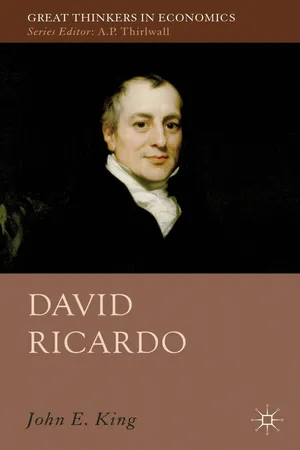
eBook - ePub
David Ricardo
About this book
This book offers a new account of David Ricardo's political economy that is both scholarly and accessible. It provides a detailed overview of the secondary literature on Ricardo down to 2012, and discusses alternative perspectives on his work, including those of Marxians, neoclassicals and Sraffians.
Information
1
The Life and Times of
David Ricardo
David Ricardo
1.1 The Importance of Ricardo
My previous contribution to this series was devoted to Nicholas Kaldor (1908–1986), a man with a very high opinion of David Ricardo as an economic theorist, even though he was never himself in any sense a Ricardian. Kaldor once described Ricardo’s Principles as being ‘generally regarded as the basis of modern economics’ (Kaldor 1978, p. 183). As he wrote in 1982, with reference to Keynes’s General Theory: ‘It will rank as one of the top 5 classics in the field – of comparable importance to Adam Smith’s Wealth of Nations, Ricardo’s Principles, Marx’s Das Kapital and Alfred Marshall’s Principles of Economics’ (Kaldor 1982, p. 259). Half a century earlier, Claud Guillebaud (1927, p. 16) went even further, describing Ricardo as ‘perhaps the greatest intellect which has turned to economic science’. If this is a contentious assessment, it is probably more generally accepted that ‘no figure in the history of economics has been more controversial than Ricardo’ (Whitaker 1989, p. 492).1
Ironically, one area of controversy concerning Ricardo is precisely the extent of his influence. According to the most authoritative recent history of classical political economy, by Dennis O’Brien, ‘the full Ricardian apparatus attracted hardly any disciples … By 1830–1 Ricardian value theory had effectively disappeared … Only in the case of Ricardo’s treatment of comparative advantage do we really find an unbroken continuation, development, and refinement of his work’. And then he continues:
But having said all this it is vital to be clear about one thing. Though the influence of Ricardo has been shown to have been extremely limited, it was, for the further development of Classical economics, entirely necessary to discuss his system. For his tremendous intellectual vitality had burnt deep scars onto the Classical-economic consciousness. It simply is not possible to read the Classical economic literature and understand it unless we know the system in which those scars originated. (O’Brien 2004, pp. 49, 52; original stress deleted)
These ‘Ricardian scars’ continue to generate great interest.2 There have been two new editions of the Principles in the twenty-first century, one published in the United States and one in India (Wright 2005; Ghosh 2010). Articles on Ricardo’s work appear almost every year in the leading journals of the history of economic thought, and his name is taken in vain more frequently than that of any other economist with the possible exception of Keynes. The intellectual followers of Ricardo’s great editor, Piero Sraffa (1899–1983), are often described (to their displeasure) as ‘neo-Ricardians’. And in the year 2000 a Ricardo Society was established in Tokyo; a great deal of work on Ricardo had already been carried out in Japan since 1945 (Sato 2013). In September 2012 the Society sponsored an international conference in Lyon on ‘New Developments on Ricardo and the Ricardian Tradition’. (http://www.ricardosociety.com/english/english).
1.2 Ricardo’s Life
David Ricardo was born on 18 April 1772 in the City of London, where his family lived before moving to Bow in the East End in 1792. The third son of devout Sephardic Jewish parents, he was circumcised at the age of one week (Heertje 2004, p. 285). Ricardo’s Jewish heritage can be traced back through five generations. The family came from Portugal, probably around 1593, when Jews were invited by the Grand Duke of Tuscany to settle in the free port of Leghorn, or Livorno (ibid., p. 281). In 1680 David Ricardo’s great-great-grandfather moved to Amsterdam, joining the large Sephardic community there. His grandfather, Joseph Israel Ricardo (1699–1762), was a stockbroker and a man of some substance, although he was not especially wealthy. His second son, Abraham Israel Ricardo, was David’s father.
Born in Amsterdam in 1733, Abraham moved to London in 1760 for business reasons; he was an agent representing Dutch firms that had invested large sums in English funds during the Seven Years War. In 1769 he married Abigail Delvalle, the daughter of a Sephardic family long established in England. Three years later he became a British subject, and shortly thereafter he was appointed to one of the twelve brokerships allotted to Jews in the City of London. By the time of David Ricardo’s birth his father was already a prominent member of the Sephardic community in London, and well on his way to considerable financial success. Abraham Ricardo died on 21 March 1812, eleven years after his wife, leaving a fortune of about £45,000 ( Heertje 2004, p. 285).
To put this sum in perspective, in 1820 a farm labourer in southern England might earn 9s.4d. (= 46.7p) a week, or a little over £24 per annum if he was in the unusually fortunate position of being fully employed throughout the year (Burnett 1969, p. 250). Thus Abraham Ricardo’s fortune would have bought the services of approximately 1,800 labourers for a year. Two hundred years later, with a minimum wage of about £6 per hour, it would be equivalent to £23 million, more or less.
When Ricardo’s father arrived in England in 1760 there were between 6,000 and 8,000 Jews in England, the great majority of whom lived in London. They were divided into two groups: the Sephardim, of ‘Spanish-Mediterranean Levantine’ descent, and the Ashkenazim, who were ‘Franco-German-Polish’ in origin (Roth 1964, p. 136 n1). About a quarter of them, including ‘a majority of the more anglicized as well as of the well-to-do’, were Sephardic (ibid., p. 225).
At this time the Jews were better treated in England than anywhere else in Europe. They ‘were under the protection of the law, could settle anywhere they pleased, and enjoyed virtual social equality’ (ibid., p. 204), although there were a few remaining disabilities. Those who chose to give up their faith and move into the wider community were able to ‘lose touch with their co-religionists and enter English life as playwrights, authors, physicians, and even naval officers’ (ibid., p. 226).
Abraham and Abigail Ricardo, however, remained entirely unassimilated. They had at least seventeen children, of whom it seems that all but three were still alive when David died in 1823 (X, pp. 54–61; the family records are incomplete). They were a healthy brood. Only two died in infancy, and two of David’s brothers lived to the ripe old age of 89: Raphael or Ralph (1785–1875) and Moses (1776–1866), the latter being the author of the well-known ‘Memoir’ of his illustrious brother (X, pp. 3–15). There are some gaps in the young David’s early biography: ‘[a]bout Ricardo’s youth very little is known’ (Heertje 2004, p. 285).
He seems to have attended a local school in the City until, in 1783, his father sent him to Amsterdam. As he told the novelist Maria Edgeworth, two years before his death:
My father gave me but little education. He thought reading, writing and arithmetic sufficient because he doomed me to be nothing but a man of business, he sent me at eleven to Amsterdam to learn Dutch, French and Spanish. But I was so unhappy at being separated from my brothers and sisters and family that I learned nothing in two years but Dutch which I could not help learning. (Heertje 2004, p. 286)
There is no evidence that he attended the great Amsterdam Talmud Torah, as is sometimes claimed (ibid., p. 287).
On his return to London, Moses reported in his ‘Memoir’, the young David ‘continued the common school-education till his father took him into business. At his intervals of leisure he was allowed any masters for private instruction whom he chose to have; but he had not the benefit of what is called a classical education’ (X, p. 3). Moses recalled that their father:
was a man of good intellect, but uncultivated. His prejudices were exceedingly strong; and they induced him to take the opinions of his forefathers in points of religion, politics, education, &c., upon faith, and without investigation. Not only did he adopt this rule for himself, but he insisted on its being followed by his children. (X, p. 5)
The young David, Moses recalled, was quite different from his father in this respect:
he never yielded his assent on any important subject, until after he had thoroughly investigated it. It was perhaps in opposing these strong prejudices, that he was first led to that freedom and independence of thought for which he was so remarkable, and which has indeed extended itself to the other branches of the family. (X, p. 5)
Ricardo’s marriage in December 1793 to Priscilla Ann Wilkinson, a Quaker, precipitated a break with his parents that had probably been coming for some time. He was never reconciled with his mother, who died in 1801. There is a poignant contrast here with Adam Smith, who seems to have concealed his true (irreligious) beliefs well into middle age in order to avoid distressing his own mother (Kennedy 2011).
David’s relations with his father were later repaired, so that in 1807 he became executor of Abraham’s will (Heertje 2004, pp. 288–9), and he seems to have remained on good terms with his siblings. His brothers Daniel and Ralph served as his clerks on the Stock Exchange in the early years of the nineteenth century (X, p. 58). David himself became a Unitarian, and thus joined a small but distinguished community of free-thinking liberals whose profound influence on his own intellectual development will be considered in chapter 2.
Full details of Ricardo’s business activities are provided by Sraffa (X, pp. 65–104). They can be briefly summarized. ‘Ricardo, at the time of his marriage, was a poor man’, Max Hartwell notes; ‘at the time of his death, thirty years later, his total estate was worth between £675,000 and £775,000. How did he make such a large fortune? In three ways: as a Stock Exchange jobber, as a loan contractor, as an investor in land and French bonds’ (Hartwell 1971, p. 40). Ricardo had a remarkable talent for buying and selling stocks. He was said, one J.L. Mallet recalled, ‘to have possessed an extraordinary quickness in perceiving in the turns of the market any accidental difference which might arise between the relative price of different stocks, and to have availed himself of this advantage, so as to realise as much as £200 or £300 in one day, by selling out of one, and buying into another stock, or vice versa’ (X, p. 73).
As Moses Ricardo reported, ‘perhaps in nothing did Mr. Ricardo more evince his extraordinary powers than he did in his business’. Moses praised ‘[h]is complete knowledge of all its intricacies; his surprising quickness at figures and calculation … his coolness and judgement’, and some good luck, which made his reputation and his fortune (X, p. 6). And Sraffa reports ‘a tradition that Ricardo’s successful dealings rested upon a scrupulous attention to what he called his own “golden rules”, namely: “Cut short your losses” and “Let your profits run on”’ (X, p. 73).
He took full advantage of the financial system in which he found himself. ‘If Ricardo laid the foundation of his fortune by stock jobbing’, Hartwell continues, ‘he greatly increased it as a loan contractor. During the war [against Napoleon’s France] Ricardo was the principal member of a syndicate which contracted for Government War Loans, corresponding to what today is known as “underwriting”’ (Hartwell 1971, p. 41).
He was a successful contractor every year from 1811 to 1815, doing especially well in the latter year, when his bet on an English victory over the French at the battle of Waterloo really made his fortune: ‘At one blow he became one of the richest men in England’ (Kurz 2008a, p. 121). ‘This was Ricardo’s last great speculation’, Hartwell notes, apart from a final unsuccessful bid in 1819. It marked the end of his business career, and at the end of 1819 he ceased to be a member of the Stock Exchange (Hartwell 1971, p. 42).
Timothy Davis emphasizes that ‘his business prowess derived from a comprehensive knowledge of monetary fluctuations, tax revenues, government expenditures, commercial credit, foreign trade and domestic commerce’, facts which he used to very good effect in deriving and defending his principles of economics (Davis 2002, pp. 1–2), and also in deciding on the course of his own life. Ricardo’s decision to move to the country was strongly influenced by his theory of the rising share of rent in total output, which implied that becoming a landlord was a very good business proposition. ‘There is nothing so practical as a good theory’ (Kurz 2008a, p. 122).
Of course, this was not solely a business decision. Unlike his eminent contemporary, Nathan Mayer Rothschild, Ricardo was not devoted to the world of finance. ‘There could hardly have been two more contrasting types’, says Sraffa:
It was in the making of money that Rothschild found the main enjoyment of life … Ricardo, however, brought up his sons to be country gentlemen, and as for himself he had no craving for the bustle of the City and viewed financial success as a means of retirement into the country, to the quiet pursuit of his ‘favourite science’. When he first went to Gatcomb he wrote to Malthus [in July 1814]: ‘I believe that in this sweet place I shall not sigh after the Stock Exchange and its enjoyments.’ (X, p. 90, citing VI, p. 115)
This is a reference to the 5,000-acre estate and gentlemen’s residence that he bought in July 1814. Gatcombe Park in Gloucestershire – the ‘e’ was added later – remained in the Ricardo family until 1940, when it was acquired by Samuel Courtauld. Since 1976 it has been owned by Princess Anne, the daughter of Queen Elizabeth II, and has become a well-known venue for equestrian events. Ricardo later bought large estates near Tonbridge and Ledbury, and by 1819 he had about £275,000 invested in land and another £200,000 lent to landowners on mortgage. He also invested £140,000 in French stocks.
This gave him an annual income, between 1819 and 1823, of some £28,000: £10,000 from his estates, £10,000 from mortgages and £8,000 from French stock (Hartwell 1971, p. 42). By the standards of the day he was an extremely wealthy man. Using the same procedure as for his father Abraham, we can estimate the 2013 value of David Ricardo’s estate as between £350 million and £400 million, and his annual income as roughly £15 million.
Before his purchase of Gatcomb Park, Ricardo had lived in several districts of London. He first moved south of the river, to Lambeth, in 1793, shortly before his marriage. Four or five years later the family moved back north of the Thames, to New Grove, Mile End, ‘well within the sound of Bow Bells’, but none the less ‘pleasantly situated in rural surroundings’ (X, p. 47).
After a decade in the East End they moved up West at the prompting of Mrs Ricardo, ‘who, now that her daughters were growing up, was anxious to live in town’. They found a ‘handsome building’, 56 Upper Brook Street, Grosvenor Square, and settled there in the spring of 1812. ‘For the rest of his life this remained Ricardo’s London home’, Sraffa reports, ‘and from 1814 he divided his time about equally between it and Gatcomb Park’ (X, p. 48).
He was very happy as a country squire. ‘Indeed the picture that has come down to us of the rural Ricardo, with his family and friends, is a charming one; that of a gracious and kindly father and neighbour, living well, entertaining with pleasure, and devoting his spare time to the reading and writing of political economy’ (Hartwell 1971, p. 38). He was sufficiently well regarded by the local gentry to be elected High Sheriff of Gloucestershire in 1818. Although this was a purely ceremonial position it carried considerable prestige, and Ricardo’s appointment confirms his acceptance as a distinguished member of the county’s propertied establishment.
David and Priscilla Ricardo had three sons and five daughters. Curiously, while none of their daughters survived beyond their forties, the three sons all enjoyed long and comfortable lives as country gentlemen. Two of them – Osman (1795–1881) and David (1803–64) – followed their father into Parliament, while Osman and Mortimer (1807–76) served as Lord-Lieutenants of the counties of Worcestershire and Oxfordshire, respectively (X, pp. 61–4).
Ricardo’s own brief political career began in 1819, when he effectively bought the Irish seat of Portarlington, an archetypal ‘rotten borough’ that was owned by, or ‘in the pocket of’, Lord Portarlington, who negotiated a loan of £25,000 at 6%, secured by a mortgage on his estates, and an upfront payment of £4,000. A rumour that Ricardo was planning to give up his seat to contest the County of Gloucester in the general election of 1820 proved to be ill-founded (V, pp. xv–xix).
Despite the questionable way in which he entered Parliament, Ricardo performed well as an MP. As Moses recalled: ‘He was of no party; and at all times advocated such principles as he held to be sound and true, whether on the ministerial or the opposition side, or at variance with both’. He was also hard-working and conscientious: ‘During the session, Mr. Ric...
Table of contents
- Cover
- Title
- Copyright
- Contents
- Preface and Acknowledgements
- 1 The Life and Times of David Ricardo
- 2 Ricardo’s Vision
- 3 Value and Distribution
- 4 International Trade
- 5 Ricardo’s Macroeconomics
- 6 Ricardo on Economic Policy
- 7 Editors and Critics
- 8 The Three Ricardos
- Notes
- Bibliography
- Name Index
- Subject Index
Trusted by 375,005 students
Access to over 1.5 million titles for a fair monthly price.
Study more efficiently using our study tools.
Frequently asked questions
Yes, you can cancel anytime from the Subscription tab in your account settings on the Perlego website. Your subscription will stay active until the end of your current billing period. Learn how to cancel your subscription
No, books cannot be downloaded as external files, such as PDFs, for use outside of Perlego. However, you can download books within the Perlego app for offline reading on mobile or tablet. Learn how to download books offline
Perlego offers two plans: Essential and Complete
- Essential is ideal for learners and professionals who enjoy exploring a wide range of subjects. Access the Essential Library with 800,000+ trusted titles and best-sellers across business, personal growth, and the humanities. Includes unlimited reading time and Standard Read Aloud voice.
- Complete: Perfect for advanced learners and researchers needing full, unrestricted access. Unlock 1.5M+ books across hundreds of subjects, including academic and specialized titles. The Complete Plan also includes advanced features like Premium Read Aloud and Research Assistant.
We are an online textbook subscription service, where you can get access to an entire online library for less than the price of a single book per month. With over 1.5 million books across 990+ topics, we’ve got you covered! Learn about our mission
Look out for the read-aloud symbol on your next book to see if you can listen to it. The read-aloud tool reads text aloud for you, highlighting the text as it is being read. You can pause it, speed it up and slow it down. Learn more about Read Aloud
Yes! You can use the Perlego app on both iOS and Android devices to read anytime, anywhere — even offline. Perfect for commutes or when you’re on the go.
Please note we cannot support devices running on iOS 13 and Android 7 or earlier. Learn more about using the app
Please note we cannot support devices running on iOS 13 and Android 7 or earlier. Learn more about using the app
Yes, you can access David Ricardo by J. King in PDF and/or ePUB format, as well as other popular books in History & Econometrics. We have over 1.5 million books available in our catalogue for you to explore.