- English
- ePUB (mobile friendly)
- Available on iOS & Android
eBook - ePub
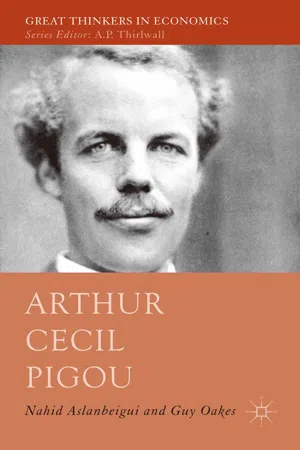
Arthur Cecil Pigou
About this book
The British economist Arthur Cecil Pigou (1877-59) reconceptualized economics as a theory of economic welfare and a logic of policy analysis. Misconceptions of his work abound. This book, an essay in demystification and the first reading of the entire Pigouvian oeuvre, stresses his pragmatic and historicist premises.
Information
1
Pigou in the Foreground
Cambridge professor of political economy Soviet spy?
On 29 May 1979, The Guardian published excerpts from a forthcoming book by Richard Deacon, a pen name used by Donald McCormick. His most sensational revelation was the accusation that Arthur Cecil Pigou (18 November 1877–7 March 1959), Alfred Marshall’s successor in the Chair of Political Economy at Cambridge University, was the mysterious ‘Fourth Man’ in the Cambridge spy ring operated by the KGB. The first three were Guy Burgess, Donald Maclean, and Kim Philby, all of whom had studied at Cambridge in the early 1930s. Working as agents at the same time that they held important posts in the Foreign Office or the intelligence services – for a time, Philby was a leading candidate for chief of MI6 – they passed secret British and American intelligence to the Soviets in the early years of the Cold War. Burgess and Maclean escaped to Moscow in 1951, when they realized they faced imminent exposure. Philby, although compromised and forced to resign from MI6, continued to flourish in the British journalistic and intelligence establishment, living by his considerable charm and wits. He finally made his way to Moscow in 1963. In McCormick’s imagination, however, Pigou was the master spy of the KGB Cambridge stable. He had proven to be not only ‘an astonishingly deceptive character’, but, for some 50 years, ‘the most secret and in many respects one of the most effective Russian agents in Britain’ (Deacon 1979). The apparent recluse residing in his ‘ivory tower’ – his rooms at King’s College – had established contacts with Soviet apparatchiks while mountaineering in Switzerland during the interwar years. With his uncanny memory and formidable powers of analysis, he was able to convey valuable information to the Soviets in brief dispatches, including critical advice on financial policy at a time when they desperately needed it. However, his crowning achievement was success in recruiting agents – ‘Marxist plums’ – targeting the Cambridge undergraduates he took on alpine mountaineering expeditions. His criteria for identifying promising candidates for espionage work were surprisingly simple: a commitment to ‘universal socialism’ and a talent for alpine climbing (ibid.).
McCormick’s charges had a perverse a priori attractiveness. A professor of economics at Cambridge during the 1930s, when many bright students had become disenchanted with capitalism, a homoerotic don who had befriended undergraduates for years and maintained close and affectionate ties with some of his former students, Pigou seemed well-placed and disposed to play the part McCormick had written for him. However, the conception of Pigou as an agent of the KGB, working in secret for the cause of a Soviet revolution in Britain, is so preposterous that one hardly knows where to begin. Pigou devoted his professional career of more than 50 years to strengthening the British economy in order to improve the welfare of British citizens. In doing so, he regarded the economic institutions of his time and their sociopolitical underpinnings as given, embedded in traditions that formed a fragile civilizational structure. Subjecting that structure to arcane policies devised by clever intellectuals entailed immense risks of damage for the economy, with corresponding consequences for welfare. Although an Edwardian progressive – a political species that the Soviets regarded as more dangerous than apologists for capitalism – it is not credible to suppose that Pigou in a hypothetical secret life embraced any ideology, regardless of its location on the political spectrum. Aside from these larger considerations, there are also plain facts that McCormick either ignored or did not know. In the mid-1920s, for example, Pigou began to suffer heart fibrillations while climbing in Switzerland, a condition that caused him to abandon serious mountaineering. By 1930, he had given up alpine climbing, ending the expeditions on which, McCormick claimed, he recruited Cambridge students.1
Presumably, McCormick did not know that MI5 had already identified the Cambridge Fourth Man: Anthony Blunt, former director of the Courtauld Institute of Art in London and Surveyor of the Queen’s Pictures. His accusations had a short life. A few months after they were published, Prime Minister Margaret Thatcher revealed the identity of the Fourth Man, ending speculations about Pigou’s clandestine political life. He was less fortunate regarding misconceptions about his work, which have a long history and persist to the present. Their explanation does not seem to lie in the substance of his thought, which is not profound – profundity, he argued, should not be expected from economists – but in two other considerations: the obligations he expected his readers to meet and several contingencies in the development of academic economics that determined the reception of his work.
‘An economist’s invisible hand’
Shortly after his unexpected election to the Cambridge Chair of Political Economy (Pigou to Macmillan, circa 5 June 1908, Macmillan Archive), Pigou developed a framework for analysing policies that could improve the aggregate economic welfare achieved by market outcomes. In Wealth and Welfare (1912), his first systematic treatise, he stated three fundamental propositions governing the relationship between the national dividend, or income, and economic welfare. Holding all other variables constant, economic welfare is likely to increase if (1) the size of the national dividend increases; (2) the dividend is distributed more equally, increasing the share allocated to the poor; and (3) fluctuations in the magnitude of aggregate output are reduced. His investigation of these propositions as well as their premises and consequences became the basis of a life-long research programme. The 1920s were an especially fertile period. In The Economics of Welfare (1920c), he revised Wealth and Welfare, expanding it substantially – in the view of some critics, excessively (Cannan 1921). Two other influential books followed: Industrial Fluctuations (1927b) and A Study in Public Finance (1928c). In the 1930s, he published The Theory of Unemployment (1933h), which John Maynard Keynes subjected to merciless and sophistical criticism in The General Theory of Employment, Interest, and Money (1936a). He also wrote The Economics of the Stationary State (1935b) – celebrated by reviewers (Benham 1936; Hicks 1936), it has been largely ignored by historians of economics. Employment and Equilibrium (1941a), arguably the first textbook in macroeconomics, remained faithful to classical doctrines even as it employed an IS-LM version of The General Theory. In Pigouvian parlance, these books and his many articles in academic journals were ‘high brow’, or scientifically demanding. He also wrote for non-specialist periodicals and published less-technical books and pamphlets – Unemployment (1913h), The Political Economy of War (1921a), Socialism versus Capitalism (1937b), Lapses from Full Employment (1945a), Income: An Introduction to Economics (1946a), The Veil of Money (1949c), and Income Revisited: Being a Sequel to Income (1955), his last book.2
Pigou was the last generalist in a long line of British economists, conceiving his work as an open-ended series of analyses of the conditions that produce economic welfare. It is evident that such a programme cannot be confined within the limits of welfare economics in its contemporary sense. It encompasses the entire discipline of economics. If Pigou had a second master whose importance for his thinking rivalled that of Marshall, it was Henry Sidgwick, Marshall’s colleague in the Cambridge Moral Sciences faculty in the years before the Economics Tripos was introduced. From Sidgwick, Pigou learned the strategy of fine-grained utilitarian analysis. If Pigou became an economist by studying the techniques of marginalism and partial-equilibrium analysis with Marshall, he became a logician of policy analysis by reading Book IV of The Methods of Ethics on utilitarianism and its extension into economics in his Principles of Political Economy. Sidgwick assessed economic policies on utilitarian grounds – the extent to which, after patient and careful reflection, it was reasonable to conclude that they produced pleasure for all sentient beings. However, he provided no criterion for pleasurable states that improved on common-sense reasoning, which he regarded as basically sound but often vague and sometimes fallacious.
Pigou solved this problem by concentrating on economic welfare, a component of total welfare or satisfaction ‘arising in connection with the earning and spending of the national dividend, or, in other words, of those parts of the community’s net income that enter easily into relation with the measuring rod of money’ (Pigou 1912, 3). Armed with Marshallian technique, Sidwickian analysis, and the concept of the national dividend, he developed a remarkably fruitful programme of research, leading to original work in theories of value, market structure, distribution, business cycles, valuation of real national income, and public finance. His work on the theory of unemployment and labour economics demonstrates an acute understanding of a remarkable range of phenomena: implicit contracts, internal labour markets, labour market segmentation, wage rigidity, human capital theory, and collective bargaining.
Although much of what Pigou thought has become the common coin of economics, contemporary economists associate very little of this work with his name: the Pigou effect, Pigouvian taxes, and the Pigou-Dalton principle are of course commonplace. Occasionally, his work has been discussed by recent thinkers: for example, Robert Solow on unemployment (1980), Robert Shiller on business cycles (1987), Gregory Mankiw on environmental pollution (2006), and Tony Atkinson (1983) and John Rawls (1971) on distributive justice. As the Great Recession unfolded, Amartya Sen – whose work bears a distinctively Pigouvian mark – and New Yorker writer John Cassidy underlined the salience of Pigou’s analysis of the economics of welfare to modern policy challenges (Sen 2009; Cassidy 2009). Cassidy envisioned a prize to be awarded the resident of the ‘Heavenly Models home for deceased economists’ whose work provided the best explanation of financial crises, global climate change, and other issues of great moment. Although he named Keynes, Hyman Minsky, and Milton Friedman as leading candidates, he awarded the prize to Pigou, ‘for a long time the forgotten man of economics’. In this respect, the title of his article, ‘An Economist’s Invisible Hand’, is particularly revealing.
Pigou’s modest profile in economics is easily understood. In the innumerable archival collections and memoirs of the Cambridge Keynesians, he appears as a latter-day Mr Casaubon in George Eliot’s Middlemarch: an erudite but unimaginative pedant, a relic of the past unable to recognize genuine originality and plodding to an inevitable dead end. The history of economic thought has all but disappeared from graduate education in economics, and very few theorists study, much less recall, the giants on whose shoulders they stand. And what of Pigou’s status among historians of economic thought? With the exception of a few scholars, workers in this minor vineyard have either passed over Pigou’s work or misinterpreted it. Although more than a half-century has passed since his death, there is no book in English on Pigou’s life and work. In the main, he has been represented as playing a subordinate role in the history of economics, a foil in a drama in which the heroes are more brilliant, exciting, or engaging thinkers: Marshall, Piero Sraffa, Keynes, Lionel Robbins, or Ronald Coase.3
Pigou’s ideal readers
In some measure, Pigou was the artificer of the fate of his work due to the prodigious demands he made on readers. Key aspects of his thinking were often not articulated in his treatises but explained in articles and public lectures, buried in evidence and testimony given before government committees, or spelled out in his many letters to The Times. Thus his analyses sometimes have the character of sketches rather than full-scale explanations. Critical premises are unstated, creating lacunae in his arguments. Pieces of technique are left unclarified or simply not mentioned. These lapses were noted by contemporaries and became a cause for criticism (Edgeworth 1921). If his work often seems intended for the initiated, economists who would have no difficulty in seeing what he had left implicit, that is because he generally wrote in this fashion. Pigou’s ideal readers had studied Marshall’s Principles of Economics thoroughly, enjoyed an easy familiarity with his assumptions and a sound understanding of how to employ them, and possessed a solid grasp of his analytical technique. They had also mastered the principal works of Edgeworth and were conversant with the main arguments of Pigou’s own publications, which is why he saw no reason to repeat them in subsequent writings. Thus he conceived his scientific readership as a relatively small epistemic community whose members were trained in common principles and methods and followed the same professional literature.4
In sum, he presupposed a substantial body of tacit knowledge on the part of his readers, although not in the sense of this multi-valent term introduced by Michael Polanyi (1966, 1969): knowledge as know-how that must remain implicit because it cannot be explicated. The implicit knowledge required of Pigou’s readers had already been explicated, chiefly by Marshall, but also by Edgeworth and their successors, among whom Pigou included himself. However, he may have been unrealistic in what he expected of his readers. In a recent account of tacit knowledge, Harry Collins has considered ‘mismatched saliences’ between authors and readers. Authors make assumptions about the material they suppose their readers know. They do not make this material explicit, because they believe it would be gratuitous and tedious to do so. However, readers may not know all an author expects of them. Suppose that readers understand the author up to a point, but because certain matters with which they are unfamiliar have not been made explicit, there are also failures of understanding: considerations that are salient for the author and the readers do not coincide (Collins 2010, 95). Employing Collins’ idea of mismatched saliences, it is not difficult to see why many readers lacked the tacit knowledge Pigou ascribed to them. For example, Marshall had been read but not studied with the requisite care and thoroughness; or he had been read but not understood; or he had been understood but dismissed, forgotten, or not treated with the seriousness on which Pigou insisted. The result was the specific kind of breakdown of presuppositions on which Pigou relied.
There are many cases of mismatched saliences that made comprehension of Pigou’s work a challenge for his readers – including his Cambridge contemporaries. Consider Joan Robinson, a student at Cambridge in the early 1920s. She called The Economics of Imperfect Competition (1933) – the aggressively deductive, technically dense, and empirically empty work that made her reputation – her Pigouvian book. Her reasons: she saw Pigou as working at daunting levels of abstraction, remote from the realities of economic life, and determined to reduce economics to algebraic-like functional relations. Her impressions were mistaken, but it is not altogether difficult to see how she arrived at them. Nor is it surprising that the demands Pigou made on his readers created both confusion and incomprehension in the minds of economists who were neither the Cambridge insiders nor his contemporaries.
The judgement of Clio
Clio, the muse of history, did not smile on Pigou. Shortly after he published the long version of his analytical framework in The Economics of Welfare, all three of his fundamental propositions were attacked as logically defective, false, contaminated by normative premises, or simply naïve. The following episodes were critical in the reception of his work.
Sraffa challenged the analysis of Pigou’s first proposition, which held that a reallocation of resources from diminishing returns to increasing returns industries could improve economic welfare. In an acute argument that quickly became influential, not least at Cambridge, Sraffa maintained that the Marshallian analysis adopted by Pigou – conducted in a partial-equilibrium framework and assuming competitive markets – was logically incoherent and inconsistent with economic realities. A coherent and empirically realistic economics would begin from the assumption of monopolistic, not competitive, markets. Following one of Sraffa’s ideas, Richard Kahn and Joan Robinson developed the theory of imperfect competition at Cambridge. Working independently at Harvard, Edward Chamberlin elaborated a theory of monopolistic competition, establishing a foundation for investigating strategic interaction among firms. Much later, Ronald Coase, who was deeply sceptical of state intervention as a response to spillovers, hammered Pigou’s position that a reallocation of resources could improve economic welfare when private and social costs were not equalized. Although Coase’s critique was based on stunning misreadings, his meteoric success cast a shadow over Pigou’s account of public goods and externalities.
In the 1930s, Robbins imported Viennese philosophical fashions to Britain: hard-core empiricism and a verificationist criterion of scientific meaning. The meaning of a proposition became its method of verification. The only grounds of verification that Robbins allowed were empirical data and – in reports by persons on their own states of mind – introspection. This austere doctrine seemed to damn Pigou’s second fundamental proposition as meaningless. After all, it was based on the alleged benefits to economic welfare of redistributing income in favour of the poor, which Robbins and other economists understood as a normative position that had no place in economic science. Robbins’ argument entailed two possibilities for the concept of economic welfare: either a value-free criterion of welfare would have to be found, or it woul...
Table of contents
- Cover
- Title
- 1 Pigou in the Foreground
- 2 The Most Brilliant Young Man I Know
- 3 Developing a Framework
- 4 The Theory of Policy Analysis
- 5 The Cost Controversies
- 6 The Robbins Critique
- 7 Confrontations with Keynes
- 8 Legacy: Demythologizing a Cambridge Eccentric
- Bibliography
- Index
Trusted by 375,005 students
Access to over 1.5 million titles for a fair monthly price.
Study more efficiently using our study tools.
Frequently asked questions
Yes, you can cancel anytime from the Subscription tab in your account settings on the Perlego website. Your subscription will stay active until the end of your current billing period. Learn how to cancel your subscription
No, books cannot be downloaded as external files, such as PDFs, for use outside of Perlego. However, you can download books within the Perlego app for offline reading on mobile or tablet. Learn how to download books offline
Perlego offers two plans: Essential and Complete
- Essential is ideal for learners and professionals who enjoy exploring a wide range of subjects. Access the Essential Library with 800,000+ trusted titles and best-sellers across business, personal growth, and the humanities. Includes unlimited reading time and Standard Read Aloud voice.
- Complete: Perfect for advanced learners and researchers needing full, unrestricted access. Unlock 1.5M+ books across hundreds of subjects, including academic and specialized titles. The Complete Plan also includes advanced features like Premium Read Aloud and Research Assistant.
We are an online textbook subscription service, where you can get access to an entire online library for less than the price of a single book per month. With over 1.5 million books across 990+ topics, we’ve got you covered! Learn about our mission
Look out for the read-aloud symbol on your next book to see if you can listen to it. The read-aloud tool reads text aloud for you, highlighting the text as it is being read. You can pause it, speed it up and slow it down. Learn more about Read Aloud
Yes! You can use the Perlego app on both iOS and Android devices to read anytime, anywhere — even offline. Perfect for commutes or when you’re on the go.
Please note we cannot support devices running on iOS 13 and Android 7 or earlier. Learn more about using the app
Please note we cannot support devices running on iOS 13 and Android 7 or earlier. Learn more about using the app
Yes, you can access Arthur Cecil Pigou by Nahid Aslanbeigui,Guy Oakes in PDF and/or ePUB format, as well as other popular books in Economics & Econometrics. We have over 1.5 million books available in our catalogue for you to explore.