eBook - ePub
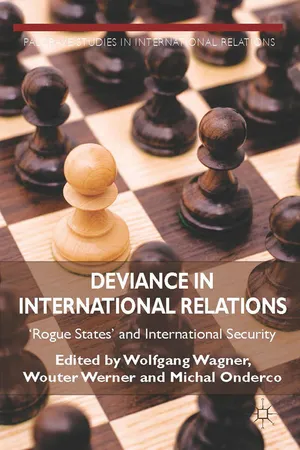
Deviance in International Relations
'Rogue States' and International Security
- English
- ePUB (mobile friendly)
- Available on iOS & Android
eBook - ePub
Deviance in International Relations
'Rogue States' and International Security
About this book
Rogue states' have been high on the policy agenda for many years but their theoretical significance for international relations has remained poorly understood. In contrast to the bulk of writings on 'rogue states' that address them merely as a policy challenge, this book studies what we can learn from deviance about international politics.
Information
Topic
JuraSubtopic
Rechtsvergleich1
Rogues, Pariahs, Outlaws: Theorizing Deviance in International Relations
Deviance and the study of international relations
Whereas the analysis of deviance is an established element in the study of domestic societies, it seems conspicuously absent from International Relations (IR), that is, the study of the international society of states. Sociologists have defined deviance as behavior that violates social norms and thus attracts disapproval and sanctions if detected.1 It is thus distinct from behavior that is merely unusual in a statistical sense (Johnson 1995: 78). The specific content and form of the social norms, their violation and the sanctions to follow are context dependent and cannot be determined in advance. Likewise, sociologists have disagreed over the causes and consequences of deviance as well as the appropriate way to study it (see among others Downes and Rock 2011 [1982], chapters 1 and 2). At the same time, few would dispute Émile Durkheim’s notion that deviance is a main driving force of societal development and its study is a key to understanding a society’s norms and values.2 This begs the question why so little attention has been given to deviance in IR, understood as ‘a flouting of key norms of conduct espoused by the global community, or at least by those who have asserted a credible right to speak for it’ (Nincic 2005: 2). We argue that both theoretical and metatheoretical reasons have prevented IR scholars from studying deviance in much depth.
In terms of theory, the negligence of deviance can be understood as a legacy of structural theorizing. Neorealism which dominated the field during the Cold War and remained the main point of reference for competing theories ever since has emphasized that the anarchic structure of the international system does not allow for any meaningful functional differentiation. According to its most eminent proponent, Kenneth Waltz, the structure of the international system has pressured states to become ‘like units’ (Waltz 1979: 95–7). The international system is a self-help system in which some states ‘do relatively well, others will emulate them or fall by the wayside’ (Waltz 1979: 188, emphasis added).
Of course, neorealism has attracted a great deal of criticism; however, to a considerable extent, critics have suggested amendments and revisions to, rather than a transgression of, structural theory. Neoliberal institutionalists argued that anarchy leaves more room for cooperation among egoistic utility-maximizers than neorealists assumed would be the case without challenging neorealism’s core assumptions (Keohane and Martin 2003). Constructivists argued that state action is not solely driven by cost-benefit calculations in the first place but by norms, values and identities as well. In doing so, however, they modified but did not jettison the idea that the international system exerts strong uniforming powers.3 Martha Finnemore, for example, argued that international organizations teach norms to member states which, as a result, became alike in many respects (1996). While emphasizing possibilities for entrepreneurial action, the voluminous literature on international norms shares the basic notion that international norms, once established, are internalized by states and, as a consequence, make them alike (cf. Finnemore and Sikkink 1998). A similar tendency can be witnessed in so-called compliance studies of international law, which basically seek to explain international law’s normalizing, and thus homogenizing power. Illustrative is Koh’s groundbreaking article, which seeks to answer the question ‘why repeated compliance gradually becomes habitual obedience’ (Koh 1997: 2603).
The most prominent challenge to structural theorizing as such has come from the so-called liberal school of thought. Based on a ‘“bottom-up” view of politics’ (Moravcsik 1997: 517), liberals see state action as a result of domestic interests and institutions. As a consequence, states’ foreign policies are as diverse as the societies they represent. At first glance, this embracement of pluralism seems a good starting point for the study of deviance in IR. However, the concept of deviance requires strong international norms as a reference point which is exactly what liberalism lacks. Taken together, the four major schools of thought in IR all share a tendency to turn a blind eye on deviance in IR – either because they privilege structural theorizing over the investigation of agency, or because they lack a concept of international structure without which deviance becomes indiscernible.
In a similar fashion, international law as such is generally portrayed as a normalizing force in IR. Handbooks in international law routinely refer to failed attempts of revolutionary regimes to denounce the validity of international law, discussing how such regimes eventually returned to the legal community of states and its standards of behavior. And although the very existence of international law is of course based on the possibility of norm-violating behavior, such violations are treated as disruptions of normalcy that call for ‘reparation’. The law of state responsibility, for example, aims at identifying deviations from existing norms and restoring the normal condition of norm conforming behavior. As Brownlie put it: ‘The question of responsibility is, in practical terms, a matter of insistence on performance or restoration of normal standards of international conduct’ (Brownlie 1983: 22). Nowhere does the law of state responsibility go so far as to claim that states that violate international norms become criminal, let alone lose their standing as equal sovereigns under international law. Yet, in international (legal) practice some regimes have been effectively labeled as unredeemable violators of international law and some states have lost considerable parts of their sovereign rights. One only needs to think of Iraq in the 1990s to realize how much international legal instruments can facilitate the labeling and management of states as renegades. The vocabulary of international law, however, hardly makes it possible to make sense of these practices in legal terms.
In IR, the dominance of a positivist metatheory further contributed to the negligence of deviance. According to its proponents, IR should aim at the detection of patterns and regularities, if necessary at a ‘medium range’ to address what Lepgold calls ‘issue-oriented puzzles’ (1998). Especially in quantitative analyses, this discouraged the study of deviance. Instead, deviant cases were understood to be non-representative and, as a consequence, treated as ‘noise’, that is information without relevance for the study of regularities and patterns (Belsey et al. 2004, Fox 1991). Likewise, in small-n, comparative analyses, case selection techniques have been designed to identify and exclude ‘outliers’ from the analysis because their inclusion was seen to unduly bias the results. In international law, positivism has resulted in a strong emphasis on doctrinal analysis, which tied the legal scholar to a particular and restricted vocabulary. As international law does not know categories such as ‘outlaw’, ‘renegade’ or ‘rogue states’, this has hampered the study of formal inequality in the international order. Not surprisingly, the few studies that have been conducted on this topic (for example, Bederman 2002, Simpson 2004) have taken into account insights from adjacent disciplines such as political science and philosophy.
In contrast to the standard wisdom that the study of deviance obstructs insights into IR, this volume starts from the opposite assumption that it provides fruitful avenues of research yielding new perspectives on IR. In addition, this volume departs from the assumption that studying international law’s involvement in the creation of ‘outlaw states’ offers useful insights into the practical workings of international law and institutions.
The contributions to this volume therefore focus on those states that have been effectively labeled as persistent and/or grave violators of core norms of the international community. To designate the special status of these states (and to draw a line between them and the rest of the international community), various labels have been used, including ‘rogues’, ‘pariahs’, ‘renegades’, ‘states of concerns’ or ‘dissidents’. The choice of label is everything but innocent as different labels come with different assumptions about the sources of deviance and appropriate policy responses. Most notoriously, the introduction of the term ‘rogue state’ by the Clinton administration has been understood as a sign of resolve to confront these states, if necessary with military means (Litwak 2000). In contrast, the subsequent replacement of ‘rogue state’ with ‘state of concern’ by the same administration has signaled a de-escalatory policy (Feinstein and Slaughter 2004). By the same token, the re-introduction of the term by the Bush administration has come with a new resolve to confront them. Our decision to talk about ‘rogue states’ throughout this introduction therefore is a compromise. On the one hand, we want to benefit from the defining power of the US government that succeeded in establishing ‘rogue state’ as an almost universally recognized and understood label. On the other hand, we feel obliged to add inverted commas to emphasize that we do not consider these states to have any objective quality of rogueness.
Quite the opposite, any attempt to define ‘rogue states’ by any set of objective criteria is doomed to fail. Although the acquisition of Weapons of Mass Destruction (WMD), aggression and support for terrorism are frequently suggested as defining elements of rogueness (Homolar 2011, O’Reilly 2007), a closer look reveals that double standards are used when states are singled out for their alleged rogueness (pleasurably pointed out by Chomsky 2000). The key to understanding the politics of labeling states as rogues lies in understanding where the defining power of doing so lies (Nincic 2005). Clearly, since the end of the Cold War, democracies have acquired such a powerful position in the international system that rogueness has sometimes become identified with not being a democracy in the first place. However, the discourse on persistent violators of basic community norms is not limited to what (self-proclaimed) democracies say about their non-democratic counterparts. It also covers practices of international organizations such as the United Nations Security Council or the International Criminal Court delegitimizing regimes that violate human rights and/or threatening international security.
Contribution to existing scholarship
The study of ‘rogue states’ has been the homeground of policy analysis, often based in think tanks, rather than universities (for notable examples, see Cha 2002, Cha and Kang 2003, Cordesman and Toukan 2010, Dobbins et al. 2011, Haass and O’Sullivan 2000, Henriksen 1999, O’Sullivan 2000, Perthes 2008).4 In the post-Cold War era, ‘rogue states’ have emerged to epitomize a main threat to international peace and security. Interestingly, this threat perception is compatible with a wide range of understandings of international peace and security: from a traditional, state-centric view, states become ‘rogues’ if they attempt to acquire and proliferate Weapons of Mass Destruction and threaten their neighbors with the use of force. Proponents of a ‘human security’ perspective would instead emphasize the actual harm done to their own citizens in addition to the potential use of force against other states. Yet others would highlight the support of terrorism as a defining feature of ‘rogue states’. More often than not, these aspects conflate and add one to another.
In most policy analysis, ‘rogue states’ are treated as a pre-given category under which states are subsumed according to objective criteria – even though the precise nature of these criteria may be contested.5 The driving question then boils down to ‘what we should do about rogue states’. This is not the question we seek to answer in this book. Instead, this volume problematizes the very practice in which states or regimes are labeled as rogues and subjected to specific disciplinary regimes. Its main question is what the labeling, disciplining and activities of ‘rogue states’ tell us about the deep structure and underlying values of the international society as a whole. With its focus on the constitutive processes our study builds on two streams of literature that so far have dealt with processes of labeling states as ‘rogues’: social constructivism and critical IR scholarship.
Social constructivism emphasizes that the category of ‘rogue states’ is not pre-given but socially constructed. Most studies in this tradition have examined the emergence of the ‘rogue state’ concept in the United States after the end of the Cold War (see among others Homolar 2011, Hoyt 2000, Stritzel and Schmittchen 2011). They typically emphasize the concept’s roots in ‘America’s unique political culture’ in which ‘international affairs is cast as a struggle between forces of good and evil’ (Litwak 2000: 63). With a slightly different emphasis, Alexander Wendt points out that ‘rogues states’ are ‘constituted by social relations to other states in the form of the representational practices of the international community (and of the Great Powers in particular)’ (Wendt 1998: 113).
Within critical IR studies, ‘rogue states’ have been studied predominantly as products of the ‘power to define’; the authority of (hegemonic) states to dictate what counts as basic community norms and the ability to determine who should be regarded as perennial or unredeemable violator of those norms. In terms often indebted to Carl Schmitt’s reading of the post-World War I regime, the creation of ‘rogue states’ is portrayed as embedded in a liberal, universalistic order defined and upheld by US power. Within an international order based on radically uncertain terms such as ‘humanity’, ‘humaneness’ and ‘mankind’, those who challenge the authority of the hegemon are easily labeled as ‘enemies of mankind’, who lack respect for basic considerations of humanity. In this context several authors have pointed at structural resemblances between the way in which Germany was treated after the First World War and the way in which the Bush government has sought to respond to the 9/11 attacks, including the labeling of states as ‘rogues’ and the adoption of extraordinary measures of dubious legality.
This volume builds on three basic insights developed in social constructivism and critical theory: (1) ‘rogue states’ are the product of constitutive linguistic acts (2) ‘rogue states’ are defined in terms of hegemonic conceptions of legitimate statehood in a particular era (3) the power to define and manage ‘rogue states’ is distributed unevenly across states – hegemonic powers have a privileged position in this respect.
However, our study aims to go beyond the insights already developed in constructivist and critical scholarship. ...
Table of contents
- Cover
- Title
- Copyright
- Contents
- Preface and Acknowledgments
- Notes on Contributors
- 1 Rogues, Pariahs, Outlaws: Theorizing Deviance in International Relations
- 2 ‘Roguery’ and Citizenship
- 3 Guises of Sovereignty: ‘Rogue States’ and Democratic States in the International Legal Order
- 4 Liberal Rogues: The Pitfalls of Great Power Collaboration and the Stigmatization of Revolutionary Naples in Post-Napoleonic Europe
- 5 A ‘Rogue’ Gone Norm Entrepreneurial? Iran within the Nuclear Nonproliferation Regime
- 6 Dissident Foreign Policy and the (Re-)production of International Orders
- 7 Role Theory and ‘Rogue States’
- 8 Rehabilitation or Exclusion? A Criminological Perspective on Policies towards ‘Rogue States’
- 9 From a ‘Rogue’ to a Parolee: Analyzing Libya’s ‘De-roguing’
- 10 International Law, Renegade Regimes and the Criminalization of Enmity
- Index
Trusted by 375,005 students
Access to over 1.5 million titles for a fair monthly price.
Study more efficiently using our study tools.
Frequently asked questions
Yes, you can cancel anytime from the Subscription tab in your account settings on the Perlego website. Your subscription will stay active until the end of your current billing period. Learn how to cancel your subscription
No, books cannot be downloaded as external files, such as PDFs, for use outside of Perlego. However, you can download books within the Perlego app for offline reading on mobile or tablet. Learn how to download books offline
Perlego offers two plans: Essential and Complete
- Essential is ideal for learners and professionals who enjoy exploring a wide range of subjects. Access the Essential Library with 800,000+ trusted titles and best-sellers across business, personal growth, and the humanities. Includes unlimited reading time and Standard Read Aloud voice.
- Complete: Perfect for advanced learners and researchers needing full, unrestricted access. Unlock 1.5M+ books across hundreds of subjects, including academic and specialized titles. The Complete Plan also includes advanced features like Premium Read Aloud and Research Assistant.
We are an online textbook subscription service, where you can get access to an entire online library for less than the price of a single book per month. With over 1.5 million books across 990+ topics, we’ve got you covered! Learn about our mission
Look out for the read-aloud symbol on your next book to see if you can listen to it. The read-aloud tool reads text aloud for you, highlighting the text as it is being read. You can pause it, speed it up and slow it down. Learn more about Read Aloud
Yes! You can use the Perlego app on both iOS and Android devices to read anytime, anywhere — even offline. Perfect for commutes or when you’re on the go.
Please note we cannot support devices running on iOS 13 and Android 7 or earlier. Learn more about using the app
Please note we cannot support devices running on iOS 13 and Android 7 or earlier. Learn more about using the app
Yes, you can access Deviance in International Relations by W. Wagner, W. Werner, M. Onderco, W. Wagner,W. Werner,M. Onderco in PDF and/or ePUB format, as well as other popular books in Jura & Rechtsvergleich. We have over 1.5 million books available in our catalogue for you to explore.