eBook - ePub
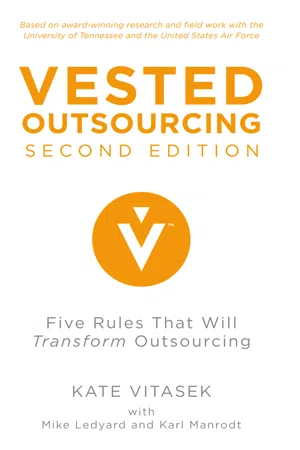
Vested Outsourcing, Second Edition
Five Rules That Will Transform Outsourcing
- English
- ePUB (mobile friendly)
- Available on iOS & Android
eBook - ePub
About this book
In her classic book Vested Outsourcing , Kate Vitasek identified the top 10 flaws in most outsourced business models and shows organizations how to rethink their outsourcing relationships in a way that will lower costs, improve service, and increase innovation. This revised edition includes updated case studies and a new chapter based on Dell.
Information
Publisher
Palgrave MacmillanYear
2013Print ISBN
9781349452071
9781137297198
Edition
2eBook ISBN
9781137321183
PART I
DIAGNOSING THE NEED
CHAPTER 1
THE WHOLE NINE YARDS
THE LESSON OF GIVING YOUR ALL
In 1994, I* was given the challenge to develop a worldwide outsourcing strategy for Microsoft’s marketing programs. At the time, Microsoft was a $4 billion company working to realize Bill Gates’ vision of putting a computer on every person’s desk. In order for Microsoft to achieve this objective, it needed to reach as many people as possible through as many venues as possible, so marketing was a big deal at Microsoft. The company was hiring the best and brightest marketing talent in the business and the challenge for them was to come up with new ways to reach customers worldwide. This resulted in creative new “Marketing Programs” as a key way to reach potential customers. More than a dozen such marketing programs had emerged, each needing a different set of operational requirements. Some of these included:
•Disk and document fulfillment
•Courseware program
•Microsoft Certified Professionals
•“Select” corporate licensing program
These were merely a sample of some of Microsoft’s new programs at this time. The programs were great for sales, but operationally speaking, they were a nightmare because each marketing program had different customers, in different parts of the world, with different operational requirements and materials to send to program customers. To help solve these problems, Microsoft turned to dozens of service providers worldwide.
Like many companies, Microsoft used various service providers to perform a wide range of services. Yet Microsoft did not have a formal outsourcing process. To solve this problem, it brought in a team of experts and consultants to review the process: I was one of those experts. Microsoft later hired me to help implement the outsourcing operations for three of its largest marketing programs. My primary goal was to get the absolute best service levels from our service providers at the absolute best price. Of course, I gave my all to achieve this goal.
Fast forward to 1997. I decided to leave Microsoft and join Stream International—at the time one of Microsoft’s largest outsource partners. Stream International was a $1 billion-plus service provider in customer care, technical support, and manufacturing and distribution in the high-tech sector. It managed some of Microsoft’s most complex outsourcing problems, including much of its corporate licensing fulfillment worldwide.
At Stream International, I led a team that would implement the large sales deals sold by the company’s sales reps. It was a common joke among the operational folks there that the opportunistic sales reps would sell “vaporware.” In the outsourcing profession, vaporware is a term used to describe services that were not fully in place at the service provider. It was my team’s job to figure out how to deliver what the sales reps had sold without customers realizing they had bought vaporware.
The sales reps and the legal team would negotiate the deal, and the goal was always the same: Sell as much as you can with the highest profit margin possible. This would maximize revenue and preserve profit margins. In almost all cases, Stream International charged its clients a price for each “activity” performed, which was customary for the industry. For example, there was a cost per minute to answer calls and provide technical support to the clients’ customers. There was a cost per “touch” to manufacture the customer’s product. There was a price per pallet to store the customer’s product. In short, the more activities we performed, the more money Stream International got paid. And since the sales reps were on a commission plan, the more revenue they booked, the more they got paid. If the customer pressed for lower prices in one area, it was the sales rep’s job to shift the pricing around to keep Stream International’s profit margin “whole.” Thus the sales reps gave their all to maximize revenue and profitability for the firm because when the company won, they personally won.
Once the work was implemented, it was managed by what Stream International called a business manager, who had profit and loss (P&L) responsibility for that account. The goal was simple: Meet customer service levels and meet P&L targets. Business managers had to live with the clients for daily interactions, so for the most part, they would give their customers their all to make the customers happy; as a result, the company was a customer service-oriented firm.
Customers would repeatedly ask business managers for proactive ideas to make the business better. After all, the customers had outsourced to the experts! One of two interesting dynamics would occur.
The first dynamic had to do with the type of ideas that were generated. First, if the business manager found ways to bring efficiency to the client, management often frowned because it would reduce revenue. When a smaller number of activities are performed, revenue is lower, or when the cost to perform services decreases, revenue decreases. Being efficient was just bad business. Over time, a culture developed where business managers would focus their improvement ideas on areas that would generate more revenue for Stream International. These revenue-generating ideas were termed value-added activities. For example, the business manager would work to deliver same-day service (for orders received by the client, to meet last minute changes to an order, etc.). Or he or she would offer to develop a solution for physical destruction and disposal of the client’s inventory when the client eliminated certain stock-keeping units. Although these ideas solved a customer’s problem, they almost always came with a charge associated with the activity. A good business manager at Stream International was very clever at identifying ways to perform an activity that would solve a client’s problem. Once again, business managers gave it their all. Stream International solved the problem, and in return, it was rewarded with billable activity. More activity meant more revenue.
The second dynamic between Stream International and its clients also evolved over time. When a business manager developed an idea that would have a positive impact for clients, clients often discounted the idea or chose not to approve the improvement initiative. The reason was twofold:
First, clients often said, “That is not the way we did the work before. We would like you to keep doing it the same way as we have outlined in our standard operating procedures.” In essence, the clients had outsourced to the experts, but they were not open-minded to change the way the work was done.
The second reason clients gave for not wanting to approve improvement initiatives was because they would have to get another group involved that controlled that part of the process. For example, one business manager pointed out that the client’s bill of materials, which outlined the manufacturing guidelines, often was wrong—as much as 80 percent of the time. The situation was so problematic that it became customary for the business management team to create a new bill of materials based on its expertise in order to produce the client’s product correctly. This work was not in scope. The client’s vendor account manager had tried, to no avail, to get the client’s marketing people to improve their internal process and correct the issues with their bills of materials. The vendor account manager finally solved the problem by allowing Stream International to charge a value-added service to redo the bill of materials rather than work with the marketing people within the client to create a proper bill of materials. This meant the bill of materials was produced twice, once incorrectly by the client and then again by Stream International.
THE WHACK-A-MOLE APPROACH TO OUTSOURCING
If everyone gave their all, what was the problem?
Over and over through many new projects, I witnessed the same dynamics. The client would want the best service at the lowest cost per activity. The service provider would want the highest margin and lots of activities in order to maximize revenue and profits. If Stream International was pushed to reduce its margin, smart people would work to sell more activities. Once the work was implemented, the focus was on maintaining the P&L for the service provider. It was capitalism and free market economics at its best. Clients would win if they were able to reduce costs. Stream International would win if it could maximize revenue and profits. The problem, as I saw it, was that while each party gave their all individually, the overall solution was far from optimized.
I observed that solutions to particular problems often seem to create activities and expenses rather than eliminate them. On the surface, in the case just mentioned, the problem of having bad bills of materials was solved. But in reality, the problem was merely masked. A permanent fix to the accuracy of how bills of material were created was what really was needed. Instead of fixing the real problem, Stream International was paid to fix the symptoms. The reason for these seemingly paradoxical solutions was that often it is much easier to fix symptoms than causes. People on each side of the outsourcing equation put a Band-Aid on the symptoms rather than fixing the root cause of the problems. Decisions were made in a vacuum to optimize the individual firm’s goals rather than looking at the total picture.
I came to call my observation the “mole theory” because the effects were similar to the Whack-a-Mole game children play. When a child whacks the mole in the game, the mole is never really eliminated but is chased somewhere else. My view was that companies were reacting to their problems as a child reacts in the Whack-a-Mole game: giving it their all each time a mole popped up but never permanently eliminating the mole. Unfortunately, in most cases people could not see the entire process. The result was that the problem—the mole—simply popped up somewhere else, almost always out of their line of sight and span of control.
The problem was simple: everyone was working to achieve what was in their own best interest rather than working together for a much broader definition of success.
THE COMPLETE COLLABORATIVE RELATIONSHIP
By nature, the company and the service provider have the same goal: to make a profit. However, they approach this goal from opposite viewpoints. Cost to the company that is outsourcing is revenue to the service provider.
My premise: Create a business model where both the company that outsources and the service provider are able to maximize their profits, together. Doing this means creating a culture where the parties work together to make the end-to-end process efficient regardless of what party is performing activities. This means creating an approach where service providers are rewarded for reducing their revenue.
To be successful, companies have to change the lens through which they look at problems. I turned to my supply chain background and saw a model for a new approach in classic Lean principles. Pioneered by Toyota, Lean is a process improvement method that stresses eliminating all activities that do not add value to a process. Unfortunately, most organizations have applied this thinking rather narrowly, such as at manufacturing plants or warehouses.
My plan was to convey Lean concepts across the entire supply chain and to make improvements in the end-to-end solution regardless of who was performing an activity. In short, my plan would pay the outsource provider to meet service levels while making the overall operations of what is outsourced as efficient as possible. The more efficient the process, the more profit the service provider (or providers, if more than one were involved) would make.
Under my vision, companies and people would not be rewarded for giving their all to solve only the immediate problem and improve their individual position. I would come to call my thinking the Three Musketeers’ approach, which fostered an environment of “all for one, one for all.” When everyone worked together toward an optimized solution, everyone would benefit. All for one, one for all. I had the opportunity to test some of my theories, on companies large and small, when I founded Supply Chain Visions, Ltd., a consulting firm, in 2002. Supply Chain Visions is recognized by ARC Advisory Group as one of the Top 10 (coolest) boutique consulting firms specializing in supply chain management.
Fast forward to 2003. Dr. Alex Miller, the dean for the Center of Executive Education at the University of Tennessee (UT), was spearheading a five-year, $25 million research contract for the United States Air Force to study many aspects of its supply chain. UT has long been known as a leader in supply chain management and logistics.1 A key area that the Air Force wanted UT to explore was how to improve procurement for the logistics and maintenance support for its weapon systems. To put the problem in perspective, it was not uncommon for Air Force logistics and maintenance contracts to exceed $1 billion.
Dr. Miller was particularly intrigued with my experience in outsourcing and performance management and asked me to lead the research effort. Our research began by examining how the Air Force procured its logistics and maintenance support; later the project...
Table of contents
- Cover
- Title Page
- Copyright
- Dedication
- Contents
- List of Figures
- Introduction
- Part I Diagnosing The Need
- Part II Setting The Rules
- Part III Vesting The Partnership
- Part IV
Trusted by 375,005 students
Access to over 1.5 million titles for a fair monthly price.
Study more efficiently using our study tools.
Frequently asked questions
Yes, you can cancel anytime from the Subscription tab in your account settings on the Perlego website. Your subscription will stay active until the end of your current billing period. Learn how to cancel your subscription
No, books cannot be downloaded as external files, such as PDFs, for use outside of Perlego. However, you can download books within the Perlego app for offline reading on mobile or tablet. Learn how to download books offline
We are an online textbook subscription service, where you can get access to an entire online library for less than the price of a single book per month. With over 1.5 million books across 990+ topics, we’ve got you covered! Learn about our mission
Look out for the read-aloud symbol on your next book to see if you can listen to it. The read-aloud tool reads text aloud for you, highlighting the text as it is being read. You can pause it, speed it up and slow it down. Learn more about Read Aloud
Yes! You can use the Perlego app on both iOS and Android devices to read anytime, anywhere — even offline. Perfect for commutes or when you’re on the go.
Please note we cannot support devices running on iOS 13 and Android 7 or earlier. Learn more about using the app
Please note we cannot support devices running on iOS 13 and Android 7 or earlier. Learn more about using the app
Yes, you can access Vested Outsourcing, Second Edition by K. Vitasek,M. Ledyard in PDF and/or ePUB format, as well as other popular books in Business & Business General. We have over 1.5 million books available in our catalogue for you to explore.