- English
- ePUB (mobile friendly)
- Available on iOS & Android
eBook - ePub
About this book
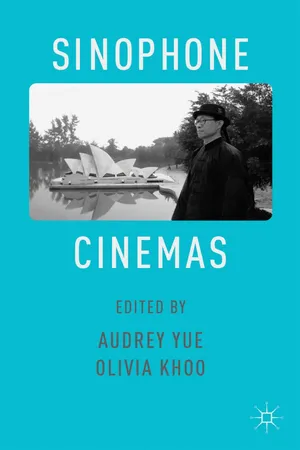
Sinophone Cinemas considers a range of multilingual, multidialect and multi-accented cinemas produced in Chinese-language locations outside mainland China. It showcases new screen cultures from Britain, Hong Kong, Taiwan, Singapore and Australia.
Information
Subtopic
Film & VideoTheorizing Sinophone Cinemas
1
Framing Sinophone Cinemas
Audrey Yue and Olivia Khoo
The concept of the ‘Sinophone’ has received critical traction in recent years as a robust theoretical tool to consider a range of Chinese language cultural productions that have emerged on the margins of China and the global Chinese diasporas. The concept was coined by Shu-mei Shih, in Visuality and Identity: Sinophone Articulations Across the Pacific (2007) to respond to the expiration of the Chinese diaspora as second and third generations become more localized. Shih considers the unifying concept of the Chinese diaspora problematic because it is linked to China through the population category of the ‘huaqiao’/‘overseas Chinese’. This category affirms a Han-centric origin and excludes other ethnicities, languages and cultures; it also supports the Western racialized construction of the diaspora as foreign. ‘Chineseness’, she states, ‘is not an ethnicity but many ethnicities’ (Shih, 2007, p. 24). The Sinophone removes the emphasis on ethnicity and nationality, and instead highlights communities of Sinitic language cultures spoken and used outside China and on the peripheries of China and Chineseness: it is ‘a place-based, everyday practice and experience, and thus it is a historical formation that constantly undergoes transformation reflecting local needs and conditions’ (Shih, 2007, p. 30).
While the notion of the Sinophone has been taken up enthusiastically in cultural criticism, most recently in the form of a Sinophone Studies Critical Reader (Shih, Tsai and Bernards, 2013) and a forthcoming book on Queer Sinophone Cultures (Chiang and Heinrich, 2014), its connections to the cinema have not yet been explored in a sustained manner. This is surprising, given the focus on visuality in Shih’s 2007 book, which opens with a discussion of Ang Lee’s Crouching Tiger, Hidden Dragon (2000), and argues that ‘[t]he visual media through which the Sinophone is more clearly articulated are the cinema and television …’ (Shih, 2007, p. 32). Explorations of the Sinophone concept, including the Critical Reader, have instead tended to concentrate on Sinophone articulations in literature (Tsu and Wang, 2010; Shih, Tsai and Bernards, 2013).
In developing the Sinophone concept, Shih borrows the Deleuzian notion of minor literature to convey the transnationalism of the Sinophone as a site that ‘introduces difference, contradiction, and contingency into those [fixed Chinese] identities’ (2007, p. 35). Key to the Sinophone’s multi-accented and intertextual articulation is anti-China-centrism (Shih, 2007, p. 39). For marginal Sinitic communities living in dominant host cultures, the Sinophone also reveals the process of minoritization in the formations of identity, subjecthood and citizenry. The Sinophone is thus also ‘a method that unsettles binaries and offers in their place the far richer potential of multidirectional critiques’ (Shih, 2010a, p. 482). For Shih, the Sinophone is a network for connecting new visualities and communities that have emerged as a result of global capitalism; it is also a theoretical platform to critique home and host cultures, reflecting multi-accented, multilingual histories of transnational migration where ‘routes’ can also become ‘roots’, inscribing a place-based rather than necessarily ancestral understanding of belonging (Shih, 2010a, pp. 189–90).
The practice of film-making, often across linguistic and cultural boundaries, is increasingly separated from national boundaries, and in the case of ‘Chinese cinemas’ requires conceptual tools that can adequately address the reality of trans-lingual, or trans-local, film-making. In Asia, the rise of Sinophone media cultures from Singapore, Taiwan and Hong Kong attests to a global visual economy of Chineseness made up of a shared East Asian popular cultural imagination (Chua, 2012). In Canada, Europe and the United States, Sinophone media cultures have led to new communities of production and consumption that challenge the hegemony of home and host cultures (see e.g. Dong, 2010; Feng, 2002; Ono and Pham, 2009; Shimizu, 2007). In China, Chinese- and non-Chinese language cinemas have also arisen in recent years to challenge the post-socialist state-sanctioned ‘dapian’/‘big picture’ cinemas of the Fifth and Sixth Generation film-makers. Yet the Sinophone does not necessarily mean the same thing across each of these sites.
The concept of the Sinophone, etymologically defined as a Chinese speaker of a certain language, is usually used to refer to either Chinese-speaking regions (e.g. China or Taiwan), areas where Chinese is spoken as a minority language (e.g. Chinese diasporas in the United States, the United Kingdom, and Australia), and places outside Greater China with Chinese-language communities (e.g. Singapore, Indonesia or Malaysia). This linguistic genealogy covers a large range of regions spanning not only Chinese speaking settlements, countries that use Chinese as an administrative and/or native language, but also countries with Chinese-origin communities that do not speak Chinese, such as Malaysia, Tibet, Vietnam, Korea, India and Mongolia, and even diasporas in South America, South Africa and the Pacific. While Shih includes all of the above (2007, 2011), Geremie Barmé uses the concept to refer to ‘the different forces that have shaped the evolution of Sinophone texts and images, as well as Sinophone ways of sense-making’ (2005, np). In the editorial introduction to the Sinophone book series, Cambria Sinophone World Series, editor Victor Mair outlines the concept thus: ‘The Sinophone world refers to Sinitic-language cultures and communities born of colonial and post-colonial histories on the margins of geopolitical nation-states all across the world’ (2011, np). This book includes all of the above, including the etymological genealogy of Sino-Tibetan linguistic families, the transformation of language and communities as they encounter the flows of new media and capital, and the histories of their colonial and post-colonial imbrications with China and other home and host ethnicities and nationalisms.
This volume demonstrates how Sinophone cinemas might extend or displace other models of Chinese cinema, centred on the nation-state and in particular a Mainland Chinese centre. It intervenes in a shift in the methodological framework of Chinese-language film studies that is explored in more detail in Chapter 2, by Sheldon Lu, and also attends to more recent efforts to ‘De-Westernize’ film studies (Ba and Higbee, 2012). As Shih writes, ‘[i]f the critical operation of Sinophone studies involves a trenchant critique of China-centrism, it equally involves a critique of Eurocentrism and other centrisms, such as Malay-centrism in Malaysia. It is, in short, always a multidirectional critique’ (Shih, 2011, p. 711).
While diasporic Chinese cinema studies has created new filmic sites and visual practices that engage the complex relations between the constructs of ‘China’, ‘Chinese’ and ‘Chineseness’, broadening these concepts to new areas and new objects of enquiry, Chineseness remains largely a question of ethnicity, bound to nationality.
The chapters in this volume examine the critical efficacy of a methodological shift from diasporic cinemas to Sinophone cinemas in order to re-engage new sites of localization, multilingualism and difference that have emerged in Chinese film studies but that are not easily contained by the notion of diaspora. They cover a range of historical periods, geographical locations and critical and methodological perspectives. They engage the political economy of Sinophone film production, distribution, consumption and regulation; cinematic practices of Chinese and non-Chinese language resistance, complicity and transformation; Sinophone communities as sites of cultural production; and new visual economies and cultures. They present case studies of multilingual, multi-dialectal and multi-accented cinemas in their historical, social and cultural contexts, representing screen cultures from Britain, Hong Kong, Taiwan, Singapore, Australia, Mainland China and the Chinese diasporas; and they canvass a range of formats including commercial co-productions, national cinemas, documentaries, digital videos and independent films, to consider what the intersection of Sinophone theory and the cinema can offer.
Part I: Theorising Sinophone Cinemas, develops the application of the Sinophone concept to cinema. Beyond a descriptive meaning of the Sinophone (to describe Chinese language cinema), these chapters consider how the Sinophone operates as a theoretically rich rubric within the cinema.
The second chapter, by Sheldon Lu, provides an important survey of the four major critical paradigms to have emerged in contemporary Chinese-language cinema studies to date. Scholars of current Chinese film studies are likely to be familiar with the first three paradigms: ‘Chinese national cinema’, ‘transnational Chinese cinema’ and ‘Chinese-language cinema’. Lu maps the beginnings, features, effectiveness and weaknesses of each paradigm. In this article, Lu adds a fourth paradigm: Sinophone cinema. He extends the scope of Sinophone cinemas to include rather than exclude China by pointing to the different linguistic and geographical applications of other ‘-phonic’ cultures. While anglophone includes English-speaking Britain, francophone does not include French-speaking France. Lu suggests that Shih, by leaning towards the latter, has inadvertently proposed ‘a theory of Chinese diaspora that does not privilege ancestral home’. Lu proposes widening Shih’s concept, which seeks to ‘exclude China from its geographic and linguistic range’. Lu’s Sinophone encompasses China, Taiwan, Hong Kong, Macau and the Chinese diaspora, and is ‘sensitive to issues of diaspora, identity-formation, colonialism, and postcoloniality’. For Lu, the cinemas and cultures of China are also bound to the marginal in the same way as Shih’s minor Sinophone cultures. Lu presents his concept of the Sinophone by examining the transnational circulation of two 1930s Shanghai films in the contemporary United States, and shows how they must indigenise in various ways (through a new soundtrack or interlingual translation) in order to speak to the local. Lu’s Sinophone is a site for questioning Chinese cinematic modernity, because it can critically confront ‘the translocal, transregional, and transnational circulation of images, speeches, and dialects inside and outside China, in Chinese cultural centres whether under colonial rule or under the sovereignty of another nation’.
Yiman Wang’s chapter elaborates the Sinophone’s emphasis on minor transnationalism by proposing the concept of ‘alter-centring’ as a fundamental approach to Sinophone cinema. Key to this is the critical deployment of ‘worlding’ to tackle what she considers the three main issues of decentralization and minoritization: first the relationship between the centre and margin is not simply that of hegemony vs. resistance, but ‘best characterized by immanence, co-implication, even mutual constitution’; second, there is a need to attend to the ‘sliding positions’ of minoritarian voices including ‘resistance, intervention, subversion, acquiescence and replication of the centre’; and, third, there is a need to account for the multidirectional histories of the shifts in languages and identities. She demonstrates this approach with three groups of films. The first group looks at mid-twentieth-century Hong Kong comedies that highlight the conflicts between China and the Cantonese community in post-war Hong Kong. Examining the phonic and spoken forms of Mandarin and Cantonese, she shows the limitations in the linguistic, scriptural and phonetic standardization of Mandarin, and considers the affective and semiotic co-implications of the Sinophone. The second group looks at recent co-productions that use Mandarin-speaking actors adopting Cantonese and vice-versa. She shows how the Cantonese spoken by Mainland Chinese actresses, such as Tang Wei in films such as Lust, Caution (dir. Ang Lee, 2007) and Crossing Hennessy (dir. Ivy Ho, 2010), provides an alternative-centring of Cantonese, while the southern-regional accent of Mandarin, spoken by Tony Leung Chiu-wai in Lust, Caution, not only heterogenizes Mandarin but also repurposes its accent as a specificity of Hong Kong diasporic experience. In the third group she examines the acoustic archive of Singapore Ga Ga (2005), a documentary by Singapore director Tan Pin Pin, and shows how it uses urban sounds, multiple languages and dialects to form the cacophony of the immigrant city. These films illustrate the ‘alter-centring’ approach as ‘the other site that traverses the centre’ and inscribes its vocal affective flow.
Yifen Beus examines the role film festivals play in shaping the canon of Sinophone cinemas. Using Ang Lee, Jia Zhangke and Wei Te-sheng as the case studies, he problematizes China-centrism by looking at how film festivals both challenge and reinforce state film censorship and contest the politics of identity and nationalism. He maps Lee’s diasporic career, in particular the marketing and reception of films like Brokeback Mountain (2005) and Lust, Caution (2007), and shows how Taiwan media play a central role in constructing his status as a national hero, while China deplores his artistic license through censorship censure. For Taiwan, Lee’s international eminence and ‘pronounced patriotism’ help sustain its standing in the Sinophone canon, and reinforce its agenda as ‘a counter force against China’s dominant posture’. This is also evident in the status as China’s underground auteur of Jia Zhangke, whose films are mostly made with foreign funding and circulate outside of China. Jia’s industrial practices inform his ‘minor philosophy’ and destabilize China as a ‘singular discursive site’. Beus also examines the contradictory reception of Wei Te-sheng’s highly promoted and state-funded Warriors of the Rainbow: Seediq Bale (2011). While it is a box office success in Taiwan and widely acclaimed at international festivals, it failed in China because the story about a minority Taiwanese aboriginal group is seen as a threat to Chinese authorities, who fear the film will incite similar unrest among its own minorities. Significant, here, is how the film inserts the indigenous minor into a national that also decentres China. Together, these case studies show how festival participation influences government censorship decisions, affects official and unofficial distribution, and impacts the canon formation of Sinophone cinemas.
The next two chapters take the ‘phonic’ component of ‘Sinophone’ seriously, and challenge the linguistic centring of the Sinophone concept to explore further polyphonic theoretical possibilities. As Song Hwee Lim writes in his chapter, ‘The Voice of the Sinophone’, ‘[a]s a relatively new field located at the crossroads of film studies, area studies and comparative literature, Chinese cinemas studies has yet to turn its proper attention to sound’. Lim notes that the concept of voice is most often used figuratively in Sinophone studies to express the politicisation of minoritised people and ‘peripheral subjects’ (Shih, 2010a, p. 466). In his chapter Lim examines uses of the voice that are both literal...
Table of contents
- Cover
- Title
- Copyright
- Contents
- List of Figures
- Foreword: The Sinophone Redistribution of the Audible
- Acknowledgements
- Notes on Contributors
- Notes on Chinese Names and Film Titles
- Part I Theorizing Sinophone Cinemas
- Part II Contemporary Sinophone Cinemas
- Bibliography
- Filmography
- Index
Trusted by 375,005 students
Access to over 1.5 million titles for a fair monthly price.
Study more efficiently using our study tools.
Frequently asked questions
Yes, you can cancel anytime from the Subscription tab in your account settings on the Perlego website. Your subscription will stay active until the end of your current billing period. Learn how to cancel your subscription
No, books cannot be downloaded as external files, such as PDFs, for use outside of Perlego. However, you can download books within the Perlego app for offline reading on mobile or tablet. Learn how to download books offline
Perlego offers two plans: Essential and Complete
- Essential is ideal for learners and professionals who enjoy exploring a wide range of subjects. Access the Essential Library with 800,000+ trusted titles and best-sellers across business, personal growth, and the humanities. Includes unlimited reading time and Standard Read Aloud voice.
- Complete: Perfect for advanced learners and researchers needing full, unrestricted access. Unlock 1.5M+ books across hundreds of subjects, including academic and specialized titles. The Complete Plan also includes advanced features like Premium Read Aloud and Research Assistant.
We are an online textbook subscription service, where you can get access to an entire online library for less than the price of a single book per month. With over 1.5 million books across 990+ topics, we’ve got you covered! Learn about our mission
Look out for the read-aloud symbol on your next book to see if you can listen to it. The read-aloud tool reads text aloud for you, highlighting the text as it is being read. You can pause it, speed it up and slow it down. Learn more about Read Aloud
Yes! You can use the Perlego app on both iOS and Android devices to read anytime, anywhere — even offline. Perfect for commutes or when you’re on the go.
Please note we cannot support devices running on iOS 13 and Android 7 or earlier. Learn more about using the app
Please note we cannot support devices running on iOS 13 and Android 7 or earlier. Learn more about using the app
Yes, you can access Sinophone Cinemas by A. Yue, O. Khoo, A. Yue,O. Khoo in PDF and/or ePUB format, as well as other popular books in Media & Performing Arts & Film & Video. We have over 1.5 million books available in our catalogue for you to explore.