- English
- ePUB (mobile friendly)
- Available on iOS & Android
eBook - ePub
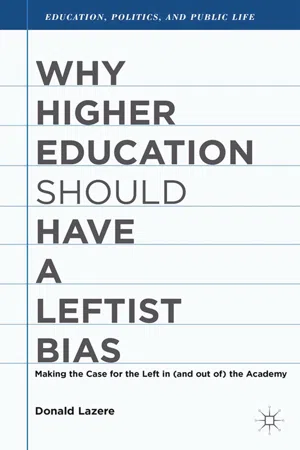
Why Higher Education Should Have a Leftist Bias
About this book
Presenting a thoughtful justification for the left in American education, Donald Lazere argues that to teach students rhetoric and critical thinking, key components of a humanist education, educators must discuss and teach students to grapple with the conservative bias in academia, the media, and politics that is considered to be the status quo.
Information
Topic
EducationSubtopic
Education Theory & PracticePART I
COUNTERING THE BIAS OF BUSINESS AS USUAL
1
CONSERVATISM AS THE UNMARKED NORM
For many years I have been making the case that the ceaseless conservative attack against bias and political correctness among leftists in both education and media disingenuously stands the truth on its head: The far greater bias pervading American society is conservative, but it is not widely perceived as a bias—just as the normative, natural order of things. It is only leftists’ attempts to provide minimal counterbalance to the bias of business as usual in media and education, through critical pedagogy in the latter—that is publicly “marked” as biased. These public perceptions of where bias in education or media lies are largely controlled by conservative propagandists through semantic framing and rhetorical agenda-setting, which serve to limit attention to issues of political bias only to overt, ad hoc, and sensational instances of political correctness—the Ward Churchill Syndrome—while the constant biases of business as usual are not considered worthy of notice or subject to criticism. Likewise, most of the recent criticisms of liberal or left bias in higher education have fixated on the humanities and social sciences, whose influence is blown out of proportion to that of every other aspect of both secondary and higher education that serves the interests of corporate society’s business as usual. In a 1989 column in the Chronicle of Higher Education titled “Conservatives Have a Distorted View of What Constitutes Bias in Academe,” I asked, “If conservatives are sincerely committed to academic balance, shouldn’t they advocate more of a voice for alternative views such as those of Marx and Nader in business administration courses, of the United Farm Workers in agricultural management courses, of proponents of socialized medicine in medical schools, of nuclear-freeze advocates in weapons laboratories, and of atheists in schools of theology?” I further asked about conservatives who attack academic leftists for debasing academic standards, “When have they ever protested the debasement of academic standards by special admissions policies for athletes and the children of rich donors; by education and research for purely commercial ends, or by semi-professional intercollegiate sports and dionysian Greek social life?” I have never received an answer to my numerous variations on these questions, beyond claims that they are facetious (see National Association of Scholars’ president Herbert London’s response to my article along similar lines in MLA’s Profession 89). I certainly did not intend them as such, and to dismiss them that way amounts to a tautological reiteration (whether through opacity or evasion) of blindness to the bias of business as usual.
Even to catalogue the full array of forces for conservatism in America, as I sketchily do in this and subsequent chapters, will provoke accusations that it is me who is stacking the deck in downplaying liberal or left counterforces. Any such full catalogue is also bound to be dismissed by conservatives as “boring,” “tiresome,” “old news”—another instance of the imperviousness of a status quo that prevails through force of custom without need of the painstaking, and admittedly fatiguing, articulation that challenges to it require. I emphasize, then, that I do not deny the existence of counterforces on the left; I just assert that their relative power can only be accurately assessed in proportion to a full accounting of conservative forces. So I urge conservative readers, and any others who may find my catalogue of conservative forces one-sided, in each instance and at the end of it, to offer substantive counterarguments. On all these points, my intention is not to pronounce the last word, but only the first one toward dialogue at a more sophisticated ideological level than that of present American public discourse.
In historical perspective, I suggest in several following passages that the left turn in college education in the sixties occurred as a filling of the vacuum left by the unprecedented depoliticizing of American culture and scholarship after World War II; the left turn might be said to amount, not to politicization, but to de-depoliticization. Thus I contend that the “leftist bias” in critical pedagogy, and its allied movement cultural studies, can be defended on the grounds that academic studies are one of the few remaining areas of American society since World War II that are, or have the potential to be, a counterforce to society-wide domination by conservative corporate, political, and military influences. Conservatives ridicule sixties radicals for turning to academia as the only avenue hospitable to them anymore; the implication is that conservatives will only be content when no forums remain open to the left.
My case here can be made in terms of the Marxian-Gramscian theory of ideological hegemony or Marcusean one-dimensional language, but no theory is really needed to observe the countless daily manifestations of the conservatism that saturates American culture and education. My position here is also a reaffirmation of the tradition of Marxist humanism, a variety of leftism that is, I believe, more faithful to the essential Marx—the contemporary of Mathew Arnold, Ralph Waldo Emerson, John Ruskin, and other nineteenth-century philosophers of a coherent, organic worldview—than the structuralist and poststructuralist Marxism or the postmodernist pluralism that have attempted to discredit humanism and organicism on the left and have failed to stand against the tide of social incoherence and atomization.
A leftist vision can further apply a classical sense of measure and critical discrimination to the rhetorical excesses and debasement of taste in contemporary society. Thus my principal charge against conservative polemicists is that they fail to exercise Aristotelian decorum, in the sense of discerning accurate proportion or what is appropriate to any given situation, especially in application to relative culpability on the American left and right. Consider the claims of those American conservatives who branded Barack Obama a socialist or communist (or even a fascist), or who claimed he was born in Kenya and was a stealth jihadist or Third World revolutionary—even that his “fist bump” with Mrs. Obama on worldwide TV in his election celebration was a secret terrorist signal. While this grotesque distortion of reality was not explicitly endorsed by most responsible conservatives, neither did most of them denounce it as vociferously as they do, say, cases of political correctness among academic and media liberals.1 Indeed, I suggest that, rather than trying to judge the sins of the Republican right and the PC left in accurate proportion, conservative polemicists have tended to fixate exclusively on the sins of the left as a red herring to distract public attention away from far greater ones on the right.
In this perspective, humanistic education has a mandate to be the “adversary culture” neoconservatives abhor, to combat demagogic irrationality, ideological incoherence, and atomized thought and discourse in America with a comprehensive, coherent—but not doctrinaire—vision. In this respect, those of us committed to the political left and critical pedagogy ought not to accept the label, tendentiously pinned on us by conservatives (abetted, to be sure, by the excesses of progressive postmodernism), as the adversaries of the Arnoldian holistic, disinterested vision of the humanities, but should lay claim to being its legitimate successors. I do not think it is doublethink to regard left commitment as compatible with disinterested scholarship, because in this sense, being on the left does not mean pushing a dogmatic political line, but rather maintaining a critical viewpoint outside the ideological mainstream and striving for an integrative epistemology in opposition to the atomizing and interest-controlled dominant culture.
CONTROLLING THE SEMANTIC AGENDA
Conservatives have been able to control the public agenda on the issue of bias in American politics, education, and media through constant repetition of claims of liberal or leftist bias that grossly exaggerate the extent of leftism in mainstream American discourse. Most of that discourse is confined to a narrow spectrum whose leftward limit is the Democratic-Party version of governance by relatively liberal multimillionaire corporate, financial, and military executives, most recently incarnated in the Obama administration—albeit with a multicultural spin. In recent elections, Democratic candidates have even refused to label their positions as liberal, while Republican candidates compete to declare themselves the most conservative. Conservative polemicists play up the power of liberal, and even socialist, forces in America, but I ask them: Why, then, has not just socialism but liberalism become the ideology that dare not speak its name?
The more that American politics has shifted toward the right since the sixties, the more outlandish have conservative scare tactics against the left become, like Ted Cruz’s 2010 red-baiting of Obama and the Harvard Law School discussed in my preface. In 2012, congressman Allen West declared at a conservative conference, “I believe there’s about 78 to 81 members of the Democrat Party who are members of the Communist Party. It’s called the Congressional Progressive Caucus” (Huffington Post, 11 Apr. 2012). Few Republican colleagues took issue with West or Cruz, though West lost reelection in 2012. When a Norwegian right-winger went on a killing rampage at a Labor Party youth camp in 2011, Glenn Beck compared the camp to the Hitler Youth. Of course, in Beck’s political vocabulary, Nazis are defined as socialists, a definition that is half true but that suppresses all the conservative elements of fascism that set it in opposition to Norwegian-style social democracy or to democratic socialism. (Labeling fascism as leftist is one of the semantic ploys conservatives use to distract attention from the realities of right-wing dictatorships and extremism.2) Those like Cruz, West, and Beck may be an embarrassment for more responsible American conservatives, but few of the latter have had the integrity to dissociate themselves from their kind or to correct their irresponsible claims—except when a Beck or Patrick Buchanan is perceived by neoconservative champions of Israel to cross the line into anti-semitism.
Another key example of semantic agenda-setting that favors conservatives is the ambiguity in American public usage of the very terms liberalism and conservatism. These terms of course have multiple meanings, so the issue here is the frequent equivocation by conservatives between different meanings. Conservative spokespersons claim to champion definitions of conservatism that have positive ideological substance—accompanied by high-minded evocations of Adam Smith, Edmund Burke, Friedrich Hayek, and Leo Strauss—but they tend to evade the gross contradictions between those definitions and other, far more salient manifestations of “actual, existing conservatism.” This is an instance of the fallacy warned against in #6 of my “Ground Rules for Polemicists”: “Do not weigh an ideal, theoretical model of your side’s beliefs against the most corrupt actual practices on the other side.” So conservative intellectuals play up conservatism as social stability, self-restraint, long-term concerns, and Judeo-Christian or classical moral values. They downplay the get-rich-quick-and-ignore-the-long-term variety, the mentality of those who devised the subprime-mortgage bubble and who chanted “Drill, Baby, Drill” before they were silenced by the British Petroleum oil spill that despoiled the solidly Republican Gulf Coast (at which point, of course, Republicans were first in line begging for help from the despised federal government).
Probably the most significantly unacknowledged fact about actual, existing conservatism is that the restricted cognitive codes dominating American socialization and communication in most social classes, with the largest exceptions at the top and bottom, also induce conservative attitudes—not in the sense of a principled conservative ideology, but the sense of mass conformity, philistine anti-intellectualism, and the reasoning characteristics of people fixed in an early developmental stage, basically that of children. My basis for saying this is not intellectual snobbery, but my own socialization in Iowa and later immersion in rural and small-town, “red state” communities. This point is developed in chapter 2.
CORPORATIONS? CORPORATIONS? NOBODY HERE BUT US CHICKENS
A further manifestation of actual, existing conservatism, largely—and quite deliberately—kept off the agenda of American public consciousness, is the power of corporations. A key fact downplayed by conservative theorists of the invisible hand of the free market is that a quite visible hand is considered necessary to manipulate the selling of the conservative agenda, through billions of dollars spent every year by corporations and corporate-wealthy individuals on political lobbying and campaign contributions, public relations (PR) agents and party consultants (AKA operatives and spin-doctors), advertising, law firms, foundations, think tanks, and above all news and entertainment media controlled directly or indirectly by ownership and advertising.
For more than a century, corporate public relations agents and lobbyists have propagated an image of large corporations that renders them invisible as economic special interests and wielders of partisan or—bipartisan—political influence. This PR image depicts corporations as champions of a myriad of mom-and-pop businesses, so that any legislation aimed at curbing big business and the corporate wealthy is deflected by selfless claims that it will harm small business. This image further equates corporations with individual citizens, deserving the same constitutional rights as individuals—an assertion whose ultimate vindication came in the 2009 Supreme Court Citizens United case. (For historical perspective on corporate legal and PR strategies here, see Hartmann; Aune; Fones-Wolf; Stauber and Rampton.) The clearest sign of the triumph of this unrelenting campaign is that when college students and writers of letters to the editor complain about excessive power or corruption in America, its source is almost always identified as “the government,” almost never “the corporations.” Few of my students over the years have had any awareness of corporate lobbies and PR as influences on public opinion. Thus national debate over President Obama’s proposed health care reform became framed (largely through health care industry PR) in terms of the dangers of a government monopoly depriving individuals of free choice—a false dilemma that excluded attention to the financial restrictions on individual free choice under the present system of corporate oligopoly in health care, insurance, and pharmaceuticals, or to the immense profits and executive incomes of those corporations. This same pattern is visible in nearly every other conservative campaign, for example, privatizing Social Security, Medicare, and public education, where conservative arguments always play up “individual choice,” not the potential multibillion-dollar profits for the corporate privatizers behind these campaigns. Likewise with debates over gun control, nearly always framed in terms of individual rights, rarely in terms of the profits of gun manufacturers and sellers, nationally and internationally, or their lobbying power at the federal and state level.
Perhaps the least-scrutinized key fact of American political and civic life is that our major institutions of mass communication are themselves corporations driven by the profit motive; it is almost tautological to say that they are the least-likely source to count on for finding intensive criticism of corporate society in general or of their own biases stemming from ownership and commercial sponsorship by conglomerate megacorporations that are involved in a multitude of cross-promotions and conflicts of interest. The blindness of most news media to the impending financial collapse in 2008, caused by runaway speculation and executive income on Wall Street, must have been partly attributable to their top executives and journalists themselves having profited from the boom to jump into the top percentiles of wealth. Or consider the debasement of American politics by the absurd increase in the length of political campaigns, as presidential candidates begin virtually on one election day to run for the next one four years later, while the primary season drags out for a year before the general election. The prime beneficiary here is parties and individuals who can raise the most money to outlast rivals, and who have constantly increased the stakes in campaign financing, mainly from corporate-wealthy patrons. However, the news media are equally complicit, through the billions of profits they now generate from both campaign advertising and the bump in general advertising for coverage of these protracted campaigns. Further beneficiaries of the boom in campaign advertising are the star TV reporters, commentators (whether conservative or liberal), and debate moderators making millions and glorying in their self-importance; or the Barbi and Ken dolls (now at least including some multicultural ones) who have replaced journalists in “infotainment” newscasts, being fed sound bites through their earbuds or teleprompters, while they flash big smiles and joke uproariously between accounts of bloody world conflicts and natural tragedies. So is it surprising that there is virtually no self-scrutiny aired on national or local TV of the corporate concentration of wealth biasing the ideological perspective of mass media? Corporations? What corporations?
Or consider the saturation point in the media’s commercialization and financial corruption of college and professional sports reached in recent decades, when every game has become an orgy of corporate promotions—for example, in the branding of stadiums like Petco Park or GEO Stadium at Florida Atlantic University, sponsored by a private prison corporation, and of golf tournaments like, I kid you not, the Waste Management Open. The funneling of wealth to the corporate elite throughout society is reflected in the increasingly oligarchic major media’s compounding of advertising revenue thro...
Table of contents
- Cover
- Title
- Introduction The Dilemma of Culture-Wars Polemics: Distinguishing Valuable Originals from Gross Parodies
- Part I Countering the Bias of Business as Usual
- Part II Countering the Conservative Counter-Establishment
- Part III Responsible Leftist Teaching
- Conclusion An Appeal to Conservative Readers
- Notes
- Works Cited
- Index
Trusted by 375,005 students
Access to over 1.5 million titles for a fair monthly price.
Study more efficiently using our study tools.
Frequently asked questions
Yes, you can cancel anytime from the Subscription tab in your account settings on the Perlego website. Your subscription will stay active until the end of your current billing period. Learn how to cancel your subscription
No, books cannot be downloaded as external files, such as PDFs, for use outside of Perlego. However, you can download books within the Perlego app for offline reading on mobile or tablet. Learn how to download books offline
Perlego offers two plans: Essential and Complete
- Essential is ideal for learners and professionals who enjoy exploring a wide range of subjects. Access the Essential Library with 800,000+ trusted titles and best-sellers across business, personal growth, and the humanities. Includes unlimited reading time and Standard Read Aloud voice.
- Complete: Perfect for advanced learners and researchers needing full, unrestricted access. Unlock 1.5M+ books across hundreds of subjects, including academic and specialized titles. The Complete Plan also includes advanced features like Premium Read Aloud and Research Assistant.
We are an online textbook subscription service, where you can get access to an entire online library for less than the price of a single book per month. With over 1.5 million books across 990+ topics, we’ve got you covered! Learn about our mission
Look out for the read-aloud symbol on your next book to see if you can listen to it. The read-aloud tool reads text aloud for you, highlighting the text as it is being read. You can pause it, speed it up and slow it down. Learn more about Read Aloud
Yes! You can use the Perlego app on both iOS and Android devices to read anytime, anywhere — even offline. Perfect for commutes or when you’re on the go.
Please note we cannot support devices running on iOS 13 and Android 7 or earlier. Learn more about using the app
Please note we cannot support devices running on iOS 13 and Android 7 or earlier. Learn more about using the app
Yes, you can access Why Higher Education Should Have a Leftist Bias by D. Lazere in PDF and/or ePUB format, as well as other popular books in Education & Education Theory & Practice. We have over 1.5 million books available in our catalogue for you to explore.