- English
- ePUB (mobile friendly)
- Available on iOS & Android
eBook - ePub
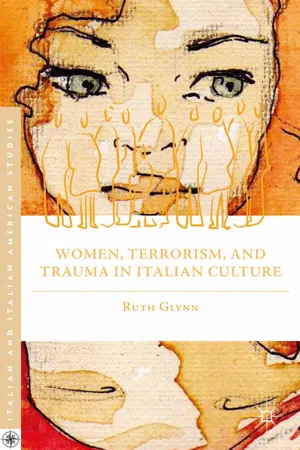
Women, Terrorism, and Trauma in Italian Culture
About this book
Addressing cultural representations of women's participation in the political violence and terrorism of the Italian anni di piombo ('years of lead', c. 1969-83), this book conceptualizes Italy's experience of political violence during those years as a form of cultural and collective trauma.
Information
1
Approaching Women, Terror, and Trauma in Cultural Perspective
In Women and ETA: The Gender Politics of Radical Basque Nationalism, Carrie Hamilton succinctly outlines the problems that have beset the study of women and terrorism:
To date the analysis of women armed activists has been largely the domain of journalists and criminologists, many with little or no engagement with feminism or gender theory. As one group of critics of this literature noted in the mid-1980s, “the majority of the explanations of female involvement in political violence tends to be highly individualistic, emphasising personality factors, social problems, boredom and so on.” [ . . . ] Moreover, in such interpretations the female activist is either lacking in agency (a victim of a boyfriend) or overly independent (a “dangerous element”). Such representations say more about gender ideology and public fantasies about armed women than about the actual lived experience of female activists.1
Hamilton’s observations provide an excellent springboard for discussion of critical approaches to women and terrorism, each meriting further consideration. As Hamilton identifies, women’s participation in political violence has generated intense anxiety among scholars in the field of terrorism studies and resulted in highly individualistic, sometimes idiosyncratic, attempts to explain the phenomenon. There is an overwhelming tendency in the field of terrorism studies to characterize women’s participation in political violence as socially, culturally, and politically exceptional. It should be noted that this construction of exceptionality is not exclusive to women involved in political violence; rather, it pervades discourses relating to women and violence more generally in a wide range of cross-cultural contexts. While it is exceptionally rare for the actions of men to be considered in terms of “male violence” or for male violence to attract significant attention or analysis, “female violence” generates exaggerated attempts to understand, diagnose, or pathologize the involvement of women in what is construed as an unnatural sphere of activity. Women who participate in violence are characterized as deviating from clearly understood and established gender norms that portray women as nurturing, emotionally sensitive, and domesticated; their actions are seen to counter idealized gender stereotypes, established gender discourses, and associated inherited perceptions of women as maternal, emotional, and peace-loving. Consequently, as Laura Sjoberg and Caron Gentry observe, “women’s violence is often discussed in terms of women’s gender; women are not supposed to be violent.”2
All too often, research carried out within the academic field of terrorism studies replicates the general public’s inability to reconcile the figure of “woman”—a category encompassing biological essence and social construction—with that of “terrorist”—a category denoting political and military action. The earliest work in the field tends to attribute to women’s participation in terrorist organizations an obscure deficiency in the biological or psychological makeup of female terrorists. Such work rarely acknowledges women’s intellectual capacity to make deliberate and independent choices and disregards the sociopolitical contexts in which decisions to join armed organizations might be made. Mia Bloom discerns that, even when women’s agency is recognized as possible in such studies, the bulk of the analysis tends to focus on women’s participation as a personal, rather than a political, choice.3 For this reason, many of the resulting explanations resonate with Freudian overtones of the “what does woman want?” variety.4 I begin my exploration of critical approaches to women’s participation in terrorism by discussing some of the most notable and problematic cases, in a bid to unpack the ideological positions that underpin those approaches and to expose the clichés and polarizations presented therein.
As Hamilton reminds us, it was already noted in the 1980s that “the majority of the explanations of female involvement in political violence tends to be highly individualistic, emphasising personality factors, social problems, boredom and so on” (111). Among the most common individualistic or personal explanations offered for women’s participation in terrorism are those of a sexualized or psychological nature. In relation to the sexualization of women’s involvement in terrorism, Luisella de Cataldo Neuburger and Tiziana Valentini observe that the phenomenon reflects tendencies in criminology more generally in the 1970s and even early 1980s, when male criminality tended to be explained by social deprivation but women’s continued to be seen as deviant and sexual in nature.5 An extreme but highly illustrative example of such a sexualized construction of female terrorist activity—designed to explain women terrorists’ deviation from the norm of female behavior—is that of H. H. A. Cooper, whose now infamous essay, “Woman as Terrorist,” is the sole contribution on the subject of terrorism in Freda Adler and Rita James Simon’s influential collection, The Criminology of Deviant Women.6 Cooper’s critique is riddled with a myriad of assumptions about women, gender, and violence, which might best be described as hysterical and which typify the exaggerated reactions that women’s participation in political violence seems to generate. For instance, Cooper asserts that “through the actions of a few extremely vicious examples, the world has come to the shocking, and almost certainly correct, realization that, after all, the female of the species may well be deadlier than the male” (151). He also asserts that “woman as terrorist must be dealt with after the fashion of the Gorgon if those responding would survive” (152). The Kiplingesque claim that women may be more violent than men recurs in several early writings on terrorism; for instance, it is one that Daniel Georges-Abeyie lists among the most common explanations for female involvement in terrorist activities, and it is the claim that Eileen MacDonald sets out to examine in her interviews with women terrorists.7 To be fair to Cooper, he does allow that “it may be that the present lack of understanding of woman as terrorist springs from viewing this problem through masculine eyes” and that “our attitudes towards this new brand of female terrorist are, in the main, quite notably sexist” (151). Nonetheless, it is difficult to excuse Cooper, a legal specialist with no particular training in psychology, psychiatry, or sexuality, for confidently ascribing to all women involved in terrorism an overriding and pathological sexual motive that renders them incapable of autonomous thought or action:
The female terrorist seems unable to escape male influence in this sphere, either in a personal sense or through involvement with men’s movements or objectives. It has been suggested elsewhere that there is a strong connection between terrorism and sex worthy of the closest investigation. [ . . . ] The emotional involvement of women terrorists is unusually intense and invariably very personal. It has an obsessive, pathological quality. It is useless to inquire why women became terrorists. It is only productive to ask why this woman or that sought fulfilment through these means. The lines of inquiry invariably lead back to men in general or to some man in particular. [ . . . ] Indeed, it has been advanced that a primary cause of female terrorism is erotomania. [ . . . ] Clearly, the sexual relationships of women terrorists have considerable influence on what they do and why they do it. The key to female terrorism undoubtedly lies hidden in their complex sexual nature. (154)
In his general alignment between terrorism and sex, Cooper initially allows that male terrorism, too, may have underlying sexual causes, but his clarification that erotomania is a primary cause of female terrorism and his suggestion that women’s participation in political violence has a pathological quality all serve to differentiate clearly between male and female terrorism. His suggestion that it is useless to ask why women became terrorists and his claim that women seek sexual or emotional fulfillment, rather than a political objective, through terrorist activity sets up an implicit and extremely precarious alignment between rational—and therefore acceptable—male terrorism and irrational—and therefore intolerable—female terrorism. The end point of Cooper’s argument is a very clear conscription on the activities of women in his conclusion that terrorism is, for a woman, “a perversion of herself as a woman” (155).
Robin Morgan deftly challenges Cooper’s assumptions in The Demon Lover: On the Sexuality of Terrorism, the first sustained feminist critique of women’s involvement in terrorism. Morgan redirects Cooper’s sexualized thinking back toward male terrorism: “So busy are they at defining women solely in terms of sexuality that it never occurs to these ‘experts’ to examine their own: the key to male terrorism undoubtedly lies hidden somewhere in man’s complex sexual nature.”8 However, Morgan does not explicitly reject Cooper’s construction of sexual motivation as the source of terrorist activity. Rather, she replicates his categorization of women terrorists as dependent, apolitical beings motivated solely by libido when she casts the male terrorist as an homme fatal (112), “pimping for the cause” (203) and ensnaring innocent women with his charm: “Equally pernicious and far more common is the use of sex and ‘love’ to enmesh women—and, in turn, the use of women’s sexuality to further the cause. This form of coercion—recruitment by romance—is what the Demon Lover’s message is all about” (201).9 Thus Morgan follows Cooper in portraying the female terrorist as being in thrall to sexual urges and overly dependent on a male counterpart; portrayed as being led into the realms of the political violence by the charisma of her partner, rather than by her own political agency or subjectivity, her political engagement is downplayed, if not entirely negated.
At the opposite end of the sexualization spectrum is a construction of women’s participation in terrorism that Sjoberg and Gentry classify as a narrative of sexual or erotic dysfunction. They remark that “the characterization of violent women as less than women because of their deviant sexuality has a prominent place in history of dealing with women’s violence” (49). In this narrative, women’s destiny is bound up with their ability to please men. They observe that many stories of violent women discuss their violence in terms of their inability to fulfill that biological destiny, characterizing them as somehow sexually less than real women. This construction explains violent women as lesbians or otherwise sexually deviant, as unable to have or rear children, or as sexually failing their men in some way or another (Sjoberg and Gentry, 47–48). Paula Ruth Gilbert holds a similar view of women’s participation in terrorism but blurs the line between constructions of female terrorists as lesbians and as masculinized: “Perhaps one of the most deeply held myths about violent women involves lesbianism. [ . . . ] If women exhibit violent tendencies, they are not women but rather masculinized.”10 The latter construction of women terrorists as masculinized is one endorsed by Georges-Abeyie, who simply argues that women terrorists commonly exhibit male qualities and “seek success in some non-feminine realm, by displaying aggression, unadorned faces and bodies, toughness, or other masculine qualities” (82). In this construction, then, rather than a perversion of herself as a woman, terrorism is evidence of the terrorist’s lack of femininity and an indication that she is not quite, not fully, a woman.
Even more persistent than the sexualizing tendency of the critical studies outlined previously is the psychological or affective approach that is frequently brought to bear on the study of women terrorists. It is not my intention here to negate the validity of all psychological approaches to terrorism; the theoretical premise of this book is situated uncompromisingly within the psychological framework of trauma, and the argument draws on a number of excellent studies carried out by qualified psychologists who track the progress of individuals and groups through terrorist organizations, paying close attention to the relationship between psychological motivators and social and political factors.11 Nor is it my intention to suggest that male terrorists are not exposed to psychological studies; they are, for the very reason that psychological analysis can “be viewed as a kind of political secret weapon to subvert the subversives by denying their actions the status of rational, purposeful behavior.”12 However, for the very reason that psychological analysis serves to deny terrorist actions the status of rational, purposeful behavior, it is instructive to note that, while sociological and political accounts tend to dominate in gender-neutral studies of terrorism, psychological explanation is especially prevalent in studies of women’s involvement in terrorism. The implications of that situation are outlined by Paige Whaley Eager: “While psychological theories [ . . . ] do not specifically address the relationship between women and terrorism, there has been a tendency by many psychological researchers to label female terrorists psychologically dysfunctional. These researchers often contrast violent female political actors with the acceptable and normal conception of women as nurturing, caring individuals. [ . . . ] These psychological theorists contrast this conception of female psychology with the commonly held assumption that men are calculating, rational and emotionally stable. Whereas men are held to a standard of greater or lesser rational abilities, women are judged by the level of their supposed emotionality.”13
Prime among those critics who constrain women terrorists within a psychological frame that emphasizes emotional factors is journalist Eileen MacDonald, whose book Shoot the Women First explores the lives and motivations of female terrorists, using information garnered from interviews with women involved in terrorist acts.14 The key question posed by MacDonald is one prompted by the words of a German counterterrorism specialist who suggested to her that women terrorists are more likely than their male counterparts to open fire immediately and were more ruthless than the men because they had more to prove. On the basis of that discussion, MacDonald sets out to explore whether women involved in terrorist organizations are indeed more violent than their male counterparts. She thus adopts an approach typical of early psychological terrorism theorists. Although not a psychologist or psychiatrist by profession, she begins her “examinations of political violence under the assumption that individuals primarily engage in violent political activity as a result of distinct psychological mechanisms” (Whaley Eager, 10). Finding that an obviously political answer is usually supplied when she speaks to women about their motivation for joining a politically militant organization, MacDonald proposes to isolate women’s experience by asking them about their emotional involvement: “I swiftly discovered that if you ask a person who is, or was, a member of a movement that endorses violence why they killed or terrorized, you get the obvious answer: ‘To get the Brits out.’ ‘To establish our homeland.’ ‘To bring about the revolution.’ I had therefore to attempt to separate the women from their wars by asking about their emotions, their feelings about violence” (11). MacDonald’s conclusions, perhaps unsurprisingly, point to what she sees as a greater emotional involvement on the part of women terrorists, despite the fact that she did not interview a single male terrorist along the same lines.15 This particular instance is not unusual; rather, it is frequently the case (as will be discussed in relation to the writings of Italian women terrorists in Chapter 4) that male and female terrorists are approached, interviewed, and studied from quite different and inherently gendered perspectives, resulting in equally different and gendered findings.
Feminist Approaches: Problems, Models, Limitations
The problematic examples provided here lend weight to Hamilton’s diagnosis of the problem affecting studies of women and terrorism that fail to engage with feminism or gender theory and that generate highly questionable conclusions and polarized understandings about why women participate in political violence. However, I wish to take issue with the apparent implication in Hamilton’s work that an engagement with feminist or gender theory might at least mitigate the extremes of individualized and polarized constructions of women terrorists. As should already be clear from my earlier reference to Robin Morgan’s work, it is not quite true to say that feminist approaches have been entirely absent from the field; nor it is true to say that they have been entirely unproblematic. Feminism is a broad church, which, although underwritten by common key principles, displays great diversity in the manner in which those principles are interpreted, theorized, and practiced. Placing rigid boundaries around notions of distinct categories of feminism is a difficult task, because many of the distinct categorizations (liberal, radical, cultural/difference, pacifist, socialist, critical, postmodern, etc.) bleed into one another. Moreover, the critical positions taken by individual feminist scholars rarely fall neatly within one particular categorization. Yet, as Miranda Alison observes, when discussing key positions relating to women and violence, distinctly different feminist perspectives emerge quite readily, as I will now outline.16
Morgan’s The Demon Lover is a seminal feminist study of the phenomenon of women’s relationship with terrorism. It is a work of vast scope and extremely insightful criticism that exposes, challenges, and rejects many of the assumptions underlying generalized claims made about women and violence. It also provides a coherent and convincing critique of war, militaries, and militarization as strongly masculinized and repressive institutions and processes. At the same time, however, The Demon Lover presents one of the most problematic critiques of women terrorists in existence. As a radical feminist, Morgan subscribes to the view that women are oppressed precisely because they are women; consequently, any woman who partakes in terrorism does so as a victim or stooge of a male oppressor. She writes that “even when [women] collaborate—and we do, either in traditional roles of support or as tougher-than-thou token militants—we do so out of a disbelief, a suspended knowledge, a longing for acceptance, a tortured love we bear for the men we have birthed and sustained. But whether we collaborate or beg, support or oppose, always it is a case of cherchez l’homme” (24). Morgan writes of the allure of the “terrorist mystique” (56) and theorizes the “sexual component” a...
Table of contents
- Title Page
- Copyright Page
- Contents
- Acknowledgments
- Introduction
- Chapter 1: Approaching Women, Terror, and Trauma in Cultural Perspective
- Chapter 2: Press Representations of Italian Women Terrorists
- Chapter 3: Feminizing Terror: Pentitismo and the Cinema of Containment
- Chapter 4: Writing the Terrorist Self
- Chapter 5: Refeminizing the Female Terrorist
- Chapter 6: Romancing the Female Terrorist
- Chapter 7: Between Myth and Maternity: The Women of the New Red Brigades
- Afterword
- Notes
- Bibliography
Trusted by 375,005 students
Access to over 1.5 million titles for a fair monthly price.
Study more efficiently using our study tools.
Frequently asked questions
Yes, you can cancel anytime from the Subscription tab in your account settings on the Perlego website. Your subscription will stay active until the end of your current billing period. Learn how to cancel your subscription
No, books cannot be downloaded as external files, such as PDFs, for use outside of Perlego. However, you can download books within the Perlego app for offline reading on mobile or tablet. Learn how to download books offline
Perlego offers two plans: Essential and Complete
- Essential is ideal for learners and professionals who enjoy exploring a wide range of subjects. Access the Essential Library with 800,000+ trusted titles and best-sellers across business, personal growth, and the humanities. Includes unlimited reading time and Standard Read Aloud voice.
- Complete: Perfect for advanced learners and researchers needing full, unrestricted access. Unlock 1.5M+ books across hundreds of subjects, including academic and specialized titles. The Complete Plan also includes advanced features like Premium Read Aloud and Research Assistant.
We are an online textbook subscription service, where you can get access to an entire online library for less than the price of a single book per month. With over 1.5 million books across 990+ topics, we’ve got you covered! Learn about our mission
Look out for the read-aloud symbol on your next book to see if you can listen to it. The read-aloud tool reads text aloud for you, highlighting the text as it is being read. You can pause it, speed it up and slow it down. Learn more about Read Aloud
Yes! You can use the Perlego app on both iOS and Android devices to read anytime, anywhere — even offline. Perfect for commutes or when you’re on the go.
Please note we cannot support devices running on iOS 13 and Android 7 or earlier. Learn more about using the app
Please note we cannot support devices running on iOS 13 and Android 7 or earlier. Learn more about using the app
Yes, you can access Women, Terrorism, and Trauma in Italian Culture by R. Glynn in PDF and/or ePUB format, as well as other popular books in Social Sciences & Social History. We have over 1.5 million books available in our catalogue for you to explore.