- English
- ePUB (mobile friendly)
- Available on iOS & Android
eBook - ePub
About this book
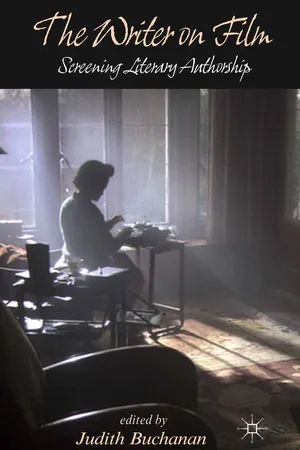
Examining films about writers and acts of writing, The Writer on Film brilliantly refreshes some of the well-worn 'adaptation' debates by inviting film and literature to engage with each other trenchantly and anew – through acts of explicit configuration not adaptation.
Information
Subtopic
Film & VideoPart I
Cinema’s Versions and Uses of Literary Lives
1
The writer in film: authorship and imagination
Laura Marcus
The relationship between the visual and the verbal, image and word, has been the ground of longstanding aesthetic debate. The representation of literary authorship in film bears on this in close and complex ways. This chapter considers a number of films and texts in which the transition between book and film, word and image, is foregrounded both thematically and through formal strategies. The focus of the chapter will be on recent film and literature, though there will also be some discussion of the ways in which authorship is represented in earlier cinema. One significant contrast to which this discussion will point is early film’s use of the dissolve, or similar modes of signalling transition, to represent the move from the authorial mind/hand to his or her created world, actualized in film. In recent cinema, by contrast, there has been a tendency to break down the distinction between ‘real’ and ‘imagined’ worlds, so that ‘the author’ becomes part of, and subject to, the dimensions of the fictional world.
In early cinema we find the representation of the figure of the author in the act of creation or composition, and the production of his characters as emanations of the self. George Méliès’ 1907 film (now lost), Shakespeare writing Julius Caesar, was described by ‘The Star’ film catalogue as:
show[ing] the bard of Avon seated in his study, trying to devise the scene in which Caesar is murdered by the conspirators ... [A]t his wit’s end, he sits down in an armchair, crosses his legs, and leaning on his hand prepares for a good long think. Suddenly, his thoughts take life, and right before him appears an old Roman forum. Shakespeare is still seated in his armchair and now watches all that occurs.1
Shakespeare thus becomes a spectator, as the assassination unfolds in front of him. The film returns to Shakespeare in his study:
Alone he goes through the whole scene and winds up by raising a knife and plunging it furiously into the loaf of bread which was on the table. Realizing the humour of the situation he now joins in a hearty laugh with his servant, but is unable to eat from enthusiasm. When the servant leaves the room he steps back and folds his arms, and the scene dissolves into a bust of Shakespeare around which all the nations wave flags and garlands’.2
In the 1924 film Dickens’ London (dirs. Frank Miller and Harry B. Parkinson), the representation of ‘thoughts taking life’ is inaugurated through images of the writing hand. We see Dickens writing at his desk, representing the composition of characters who then ‘come to life’ on the page/screen.3 There is thus a construction of an identity between the page and screen, word and image. The image of a character emerging from the novelist’s birthplace, a further trope in this film, also becomes emblematic of authorship, understood as a form of generation or birthing. We should also note, however, the continuities between the strategies of this film and those of early films, most notably of British filmmaker Thomas Bentley, which presented ‘life-like’ recreations of Dickens’ and of Dickens’ characters against the ‘real background’ of their geographical settings.4 The performances were theatrical presentations of ‘character’, which in turn drew for their detail on the illustrations to the novels: the cinema added the dimension unavailable to the stage, in the photographic representation of place. Literature was both the origin of incident and re-entered the filmic space as inter-title. The translation that took place from page to screen thus passed through, or brought in its train, many different forms of representation – graphic, verbal, visual and aural. Dickens’ London, in its movement from the act of authorial creation to the author’s created world, anticipated the devices employed in numerous later Dickens’ adaptations, which marked authorial origin and the book as origin of its cinematic interpretation, at the same time as the author’s words (in the era of sound) ‘meld’, in Guerric DeBona’s words, ‘with those of the first person narrator, and finally with the dramatized action [of the film].’5
On the one hand, such sequences might be seen to secure authorial origin and the primacy of the book/literature. On the other, they suggest the singular power of film to bring words to life and to vision, even implying that cinematic/visual imaging may be closer to the dreams and imaginings of authors than writing/language could ever be. Among the most significant examples here are David Lean’s adaptation of Great Expectations (1946) and George Cukor and David O. Selznick’s David Copperfield (1935). At the start of Lean’s film, we see a hand opening a book, and (bypassing the title page) the voice-over begins to read the lines of the first page: ‘My father’s family name being Pirrip, and my Christian name Philip, my infant tongue could make of both names nothing longer or more explicit than Pip. So, I called myself Pip, and came to be called Pip.’ As the camera moves in, the words become legible, so that the spectator can read the words as the voice-over speaks them. The pages of the book begin to be ruffled as by the wind, and we move from the book and voice-over to the image of a boy (Tony Wager) running on a path through marshes, with the sound of the wind that the image of the turning pages had first released. Once the boy has run past a gibbet and into a graveyard, some new text, this time diegetically integrated into the fabric of the scene, appears in shot in the names of Philip Pirrip and ‘also Georgiana, wife of the above’ engraved upon a tombstone.
The opening of Cukor and Selznick’s David Copperfield similarly works to connect page and screen, word and image. Here the credits appear as a form of title page, which resembles an illustrated book. The film’s first shot is of an open volume: written on the page is the epigraph from the revised preface of the 1869 edition of David Copperfield – ‘Like many fond parents I have in my heart of hearts a favourite child. And his name is DAVID COPPERFIELD’ – with the signature of Charles Dickens underneath. As DeBona has argued: ‘This particular film presents us with a “Charles Dickens” who seems to endorse the visual project with his very signature ... [I]t invites the audience to think of “Charles Dickens” as the ultimate creator of the cinematic space.’6 A hand then turns the page to the opening lines of the novel (without voice-over). In the sequence that follows, the figure of a woman (David’s aunt, Betsey Trotwood (Edna May Oliver)), battling her way through the wind to knock on the window of a cottage, emerges as if it were an animated illustration: these first images of the novel’s characters thus appear to connect writing, illustration and film. As in Lean’s Great Expectations, the hero’s father’s tombstone becomes a central image, its inscriptions (naming father and mother, or father alone) a form of writing which transcribes a life as origin and end. In the case of Cukor’s David Copperfield, the gravestone is also the inscribed surface (like a page) over which shots of the changing seasons mark the passing of time, coming between the image of the newborn David and his appearance as a boy by his father’s grave.
In mapping and dramatizing the transitions between novel and film, as both films do, the use of voice-over at the opening of Great Expectations is a way of importing, in only minimally transmediated form, the novel’s first-person narrative into the film medium. By contrast, Lean’s Oliver Twist (1948) opens voicelessly with a lengthy Expressionist-influenced sequence. We see a young pregnant woman, outlined against the sky, held back by a fierce storm as she struggles towards the workhouse, the wind bending both the tree to which she clings and her body. There appears less concern than in Great Expectations with the process of moving from book to film, and fuller engagement with the question of film language itself. The opening sequence represents both the hostile environment and the body in pain, while both body and tree become hieroglyphics of the kind that silent cinema had so fully developed. The Oliver Twist sequence seems indeed to echo films such as D.W. Griffith’s Way Down East (1920) and Orphans of the Storm (1921), as well as F.W. Murnau’s Faust (1926), in which Gretchen (Camilla Horn) is cast into a blizzard with her new-born child.
Despite their differences (including the dominance of voice at the start of Lean’s Great Expectations and of the silent image in his Oliver Twist), the opening sections of all three of the Dickens’ adaptations discussed are connected by their use of wind or storm as energies that drive the transition from one medium into another (book to film, word to image), rather as the tornado in Victor Fleming’s The Wizard of Oz (1939) transports Dorothy, and the spectator, both from one world to another, and, in the process, from sepia-tone to Technicolor.
In these films, as in film adaptations more broadly, issues of visual/verbal relationships as well as those of film history and film technology, including the silent/sound transition, become central. Fiction, as well as film, of the past few decades has seen a widespread engagement with relationships and transitions between the written or printed word and the cinematic image. The intense focus on the materiality of film, which marks much recent film theory, has produced a renewed engagement with the represented word on the screen. This acts as a recapitulation of cinema’s original encounter with written language, which turned upon the use of intertitles, as well as on the ‘film hieroglyphics’ that defined, for many of the film’s early commentators, the pictorial language of silent cinema. For the early film theorist Vachel Lindsay, the hieroglyphic language of film was perceived as a ‘picture writing’, a ‘new universal alphabet’ and ‘a moving picture Esperanto’.7 It was at one, for Lindsay, with the intensely ‘pictorial psychology’ of modern American life and with the graphic dimensions of urban modernity, figured in media such as advertisements, billboards and newspapers.
Much recent fiction has taken up anew the charged and complex relationship between the visual and the verbal, with film often entering the novelistic framework as a distinct but parallel mode of representation and narration. In Paul Auster’s 2002 novel, The Book of Illusions, to take one prominent example, the central protagonist and first person narrator, David Zimmer, desolated by the death of his wife and sons in a plane crash, becomes fascinated, in his grief, by the films of a silent screen actor, Hector Mann, and finds that he is sustained by his research and writing on them. The silent film comedians had, Zimmer asserts:
understood the language they were speaking. They had invented a syntax of the eye, a grammar of pure kinesis ... We watched them across a great chasm of forgetfulness, and the very things that separated them from us were in fact what made them so arresting; their muteness, their absence of color, their fitful, speeded-up rhythms.8
Most interesting here is the alliance or allegiance that is being forged between the contemporary novel and the silent film. There is a suggestion that cinema, having given up on these early manifestations of its medium, having allowed this silent art to die, has in some sense released it for re-animation by the writer, even though it is, Auster insists, a wholly visual language. Describing the processes of putting his film-book together, Zimmer tells a ...
Table of contents
- Cover
- Title
- Copyright
- Dedication
- Contents
- List of Figures
- Notes on Contributors
- Acknowledgements
- Introduction
- Part I Cinema’s Versions and Uses of Literary Lives
- Part II Cinema’s Authorial Proxies and Fictional Authors
- Select Filmography
- Bibliography
- Index
Trusted by 375,005 students
Access to over 1.5 million titles for a fair monthly price.
Study more efficiently using our study tools.
Frequently asked questions
Yes, you can cancel anytime from the Subscription tab in your account settings on the Perlego website. Your subscription will stay active until the end of your current billing period. Learn how to cancel your subscription
No, books cannot be downloaded as external files, such as PDFs, for use outside of Perlego. However, you can download books within the Perlego app for offline reading on mobile or tablet. Learn how to download books offline
Perlego offers two plans: Essential and Complete
- Essential is ideal for learners and professionals who enjoy exploring a wide range of subjects. Access the Essential Library with 800,000+ trusted titles and best-sellers across business, personal growth, and the humanities. Includes unlimited reading time and Standard Read Aloud voice.
- Complete: Perfect for advanced learners and researchers needing full, unrestricted access. Unlock 1.5M+ books across hundreds of subjects, including academic and specialized titles. The Complete Plan also includes advanced features like Premium Read Aloud and Research Assistant.
We are an online textbook subscription service, where you can get access to an entire online library for less than the price of a single book per month. With over 1.5 million books across 990+ topics, we’ve got you covered! Learn about our mission
Look out for the read-aloud symbol on your next book to see if you can listen to it. The read-aloud tool reads text aloud for you, highlighting the text as it is being read. You can pause it, speed it up and slow it down. Learn more about Read Aloud
Yes! You can use the Perlego app on both iOS and Android devices to read anytime, anywhere — even offline. Perfect for commutes or when you’re on the go.
Please note we cannot support devices running on iOS 13 and Android 7 or earlier. Learn more about using the app
Please note we cannot support devices running on iOS 13 and Android 7 or earlier. Learn more about using the app
Yes, you can access The Writer on Film by J. Buchanan in PDF and/or ePUB format, as well as other popular books in Media & Performing Arts & Film & Video. We have over 1.5 million books available in our catalogue for you to explore.