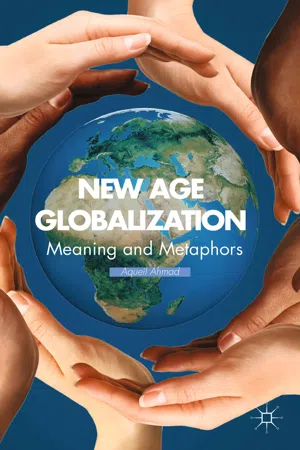
- English
- ePUB (mobile friendly)
- Available on iOS & Android
eBook - ePub
About this book
Using the frameworks of systems theory, modernization, and the world system, New Age Globalization presents a composite multilevel, multidirectional picture of globalization informed by eight different but interdependent subsystems.
Information
1
Conceptual Framework for Exploring New Age Globalization
A Systems Theory Approach
A systems approach to understanding society at large and social organizations in particular was first proposed by biologist Ludwig von Bertalanffy in the 1960s.1 Bertalanffy suggested that complex social and organizational structures resemble natural and organic systems in some important ways—the so-called organismic analogy. Informed by this innovative idea, social scientists and economists like Talcott Parsons and Kenneth Boulding began to develop elaborate theories of social systems, with particular reference to the Western capitalist societies like the United States in the post–World War II and postcolonial climates of the 1950s and 1960s.2 The systems approach to explain interdependent subsystem dynamics of complex organizations and total societies became the rhetoric of the age and a popular technocratic tool in the hands of international development agencies in Europe and America in the emerging development decades: “We can change the world through systemic planning and interventions.” It did not quite work out that way. Political leaders, economic managers, and development planners across the world by now seem to at least partially if not fully understand the problem of unintended consequences of “planned” system interventions from inside or outside in a highly interdependent and interconnected world.
One of the central assumptions of systems theory is that the system as a whole is bigger than the sum of its parts. In a perfect system if one part is affected, the rest is expected to react or respond through built-in feedback mechanisms, in some expected or unexpected positive or negative ways. Societies and social organizations, unlike mechanical/cybernetic networks, are not perfect systems, let alone a global society or global organizations. The theory and practice of strategic (long-term) planning for change in complex organizations have found it useful to rely on basic parameters of systems theory, analysis, and application. But worldwide experiences with unintended consequences of “planned change” at both societal and organizational levels demonstrate that social systems rarely, if ever, respond to interventions with the same degree of regularity as the mechanical and organic systems do. These experiences do not, however, negate the basic assumptions of interdependence, feedback, and integration among the parts of complex large or small social and economic systems, however inaccurate such assumptions may prove to be in the short and long runs. There is enough empirical evidence to support at least partial systemic interdependencies even at the global scale, as the current domino effects in world economies, financial institutions, and the raging political conflicts clearly demonstrate, as does everything else discussed in this book.
Social cause-and-effect relationships, imperfect, inconspicuous, and unpredictable as they may be, are indeed systemic in character. Without them nothing could explain the continuity or change in human, social, or organizational behaviors.3 Everyday observations as well as social research indicate, for example, that crime rates vary according to levels of education, employment, and income in the communities. And that these in turn are extremely sensitive to public policies, infrastructural developments, technologies, business investments, and a host of other political, economic, and judicial factors that may not always be obvious at a particular time or place; all of them among themselves being interdependent on each other in some known and unknown ways.4 Such systemic structural and functional interdependencies are becoming increasingly obvious on a worldwide basis as well. Political turmoil in one country may have global repercussions, as is evident from the violent struggles currently raging in Somalia, Sudan, Congo, Afghanistan, and the Middle East. Economic meltdowns in Asia, Europe, and America affect the rest of the world, as was amply demonstrated in 1987 and 2008, and is once again demonstrated through the troubles in the Euro Zone. Crude oil supply disruptions in the Middle East reflect on industrial and business activity in heavily oil-dependent world economies. It is because of such obvious global interdependencies and interconnections that this analysis of the meaning and metaphors of globalization in our new age greatly benefits from the insights of systems theory regardless of which ideological perspective is used to examine them.
As previously suggested, globalization research can be easily divided into pro- and antiglobalization camps with a middle position in relief that aims at explaining the phenomenon rather than labeling it. Intellectual and ideological postures aside, the reality of globalization itself does not present a consistently positive or negative picture in terms of its effects on peoples and their communities. This contradictory reality of globalization can be explained through the frameworks of modernization and the world systems theory (WST). It should, however, be noted that neither the WST nor the modernization theory are free-floating paradigms. Like any branch of knowledge, they too have drawn from other intellectual traditions twisting and turning some of their threads to form independent heuristic devices however insufficient they might be to explain complex worlds of human experience. The intellectual antecedents of these two opposing paradigms, along with their basic premises and propositions, are briefly described in the following pages. Between the two of them they provide the explanatory framework for analyzing the assumed systemic nature and structure of global society and the accompanying processes of globalization. They will be invoked and referred to when applicable along with other relevant heuristic devices.
Modernization Theory and Its Antecedents
Modernization theory, along with systems logic, became a popular Western construction to look at three sets of structural entities: the non-Western developing countries, the corporate entities, and large operational systems to identify and understand their problems and prospects for stability, change, and development in an increasingly complex world. The basic assumption was that the social and economic backwardness of the postcolonial societies, as well as the operational inefficiencies observed in the corporate and industrial sectors, resided in their lack of technoeconomic modernization, inappropriate and ineffective systems, and inadequate systematic short- and long-term planning. The problems of the developing world, which is an important concern in the study of globalization, could be corrected by applying the modernization model, along with the systems logic for operational efficiency developed in the industrialized West, or so the reasoning went.5 These approaches could as well help resolve the dilemmas of lagging production, sluggish growth, and human resource malfunctions faced by industrializing societies anywhere in the world.6
The eclectic formulations of modernization theory have been informed by a variety of mostly Western intellectual sources.7 Modernization theory assumes that all societies are essentially modernizing systems, going through similar transformative or developmental stages identified by Walt W. Rostow and others in their models of international development, informed by the historical experience in Western Europe and North America and its relevance to postcolonial, non-Western societies.8 Rostow’s five-stage developmental model, simplistic as it may be when applied to the structural, political, and cultural realities of the developing societies, is nonetheless interesting in its specificity and realism about what exactly happens or has to happen for traditions to modernize, take off, and develop.
The most interesting stages in Rostow’s model are the preconditions for takeoff and the actual takeoff itself. These stages would determine the degree and speed of further developments leading to the advanced stages of societal maturity, mass production and consumption, and the material pursuits of happiness—the end products of modernization. This sequential transformation involves modernization of traditional modes of governance from feudalism to liberal democracy; of financial institutions and transactions from barter to money economy; of agricultural and industrial production from labor intensity to capital and technology intensity; and of community orientation to individual initiative and enterprise. These structural changes constitute the preconditions for the actual takeoff to modernity. They may take shorter or longer times to occur depending on the will of the people and their leadership to move in that direction. The will to modernize is assumed to occur through a consensual process because it is in the best interests of society as a whole and would ultimately benefit all its members in varying degrees, if not entirely equally. Once the takeoff has occurred, the process of modernization gets faster and faster until it achieves full speed, like a fully airborne aircraft. The analogy to the flight of an airplane is indeed nifty and catchy.
The systemic and consensual assumptions of modernization theory are grounded in powerful Western intellectual traditions, such as the social contract theories of Thomas Hobbes, Jean-Jacques Rousseau, and John Locke.9 Following Hobbes and Rousseau, Locke suggested that a consensual social contract binds free, equal, and relatively independent social system members into a community “for their comfortable, safe and peaceable living,” implying that a consensual community is in the best interest of the people who form it. Obviously, systems are expected to hold together because of a built-in consensual interdependence among their parts. The global society as a large system would be no exception. For modernization theory, the notion of ‘social contract’ seems to provide the glue for system integration.
In a similar vein, later sociological constructions like structural-functionalism assume that systemic interdependence, integration, maintenance, and change are the result of shared values and goals of (social) system members.10 Émile Durkheim’s idea of “organic solidarity” based on the mutual division of labor in modern industrial societies as opposed to the “mechanical solidarity” of traditional social organizations gibes well with the notion of shared values as building blocks of structural-functionalism.11 Such an assumption of mutuality would indeed be hard to sustain in any analysis of global society with its enormous diversity of material and nonmaterial cultures around the world, despite some significant areas of amalgamation discussed in the section on globalization of cultures in Chapter 7. Nonetheless, contemporary market mechanisms and global political and economic organizations like the United Nations (UN) and multinational corporations (MNCs) do indeed display strong elements of Durkheim’s “organic solidarity.”
Another prominent sociological perspective, symbolic interaction, ostensibly emerged as an antidote to the structural rigidities of functionalists’ constructions of society. But on the issues of social change and stability, the interactionist position has an uncanny resemblance to structural-functionalism: Society (or social order) is created, changed, and maintained through the process of microlevel, everyday interactions among system members as rational actors playing their respective roles according to shared norms of reciprocity, expectations, and etiquettes. Social reality changes when members begin to redefine it and react to it differently from time to time. For symbolic interactionists, social change is essentially cultural change that defines what people need and want to change according to freshly created meanings and definitions of what society is or ought to be but is not. Agents of change are often created in the process of change itself to play prominent roles in mobilizing public support and resources to help build complimentary structures and institutions to satisfy the new expectations and definitions of reality. Younger generations are socialized in those newly constructed “modern” institutions with different value systems and behavior patterns than those embodied in older definitions, structures, and institutions.12 Globalization or global society may thus be construed as a newly constructed reality both symbolically and concretely.
In a highly instructive work, Charles Harper specifies three major spheres of modernization—economic, political, and social/cultural.13 Rostow’s model involves these concepts to imply that modernization and world development are two sides of the same coin essentially depicting the same reality. Economic modernization essentially means a diverse, capital-intensive, privatized technology- and market-driven money economy. As will be discussed later in Chapter 3, this definition of economic modernization on the world scale easily translates into economic globalization or the global economy of today.
The idea of political modernization rests on the proposition of mass participation in the political process, decentralization of power, and generally a rational system of authority and decision making (a la Max Weber’s ideal type of bureaucracy) in business and public affairs.14 This would simply mean that political modernization essentially involves democratization of authority on the basis of adult franchise and bureaucratization of public domain on the basis of expertise, not on political largess, favoritism, or nepotism. Kingdoms, dictatorships, and totalitarian regimes of any kind would undoubtedly not qualify as politically modern according to this definition.
Social modernization accompanies, or should accompany, economic and political modernization in order for the modernization process to complete. It refers to the shifting nature of individual, family, and group relationships as the social structure changes from tradition to modernity, from a largely rural mode of life to a predominantly urban social organization—a transformation quite similar to the sequence of changes in Western industrial societies over the past one hundred to two hundred years. This type of social organization means that primary relations are replaced or largely influenced by businesslike, impersonal secondary relationships; that neighborhoods turn into faceless and amorphous apartment complexes; and that local markets give way to shopping malls and parking lots, analogous to what the German sociologist Ferdinand Tonnies called a movement from Gemeinschaft (community) to Gesellschaft (society).15 This type of “social modernization” of Western-industrial societies is now rapidly replacing the social organization of erstwhile traditional societies under the impact of economic globalization with or without political modernization, its negative social and environmental consequences notwithstanding. Contemporary China, India, and other newly industrializing economies (NIEs) offer good examples of this type of modernization accompanied by serious environmental deterioration and disruption of traditional family structures and relationships, but not necessarily accompanied by the political modernization of Harper’s construction.
To this three-pronged definition of modernization suggested by Harper, a fourth dimension of cultural modernization may also be added. From the points of view of values and attitudes that theoretically underlie the secular Western conceptions of social and physical reality, this would entail a scientific rather than a religious and superstitious worldview, a belief in the power of reason and technological interventions rather than that of dogma and faith, with greater value placed on objective rather than subjective experiences. In this modernist worldview, nature would be subjected to serve human needs. Fate would be replaced by human motivation and energy, enterprise and industry. Failure would be attributed to personal follies or structural malfunctions rather than the will of the supernatural.
From this worldview, and not without it, would concrete individual and group actions and investments emanate toward building modern economic, political, and social infrastructures and institutions to replace the old infrastructures and institutions. While the global economy juggernaut, call it economic modernization if you will, sweeps through the world, it is yet to be seen whether and to what extent it is accompanied, or will be accompanied in the near future, by political, social, and cultural modernizations as conceived by Harper and other modernization theorists.
Critics of modernization theory suggest that it is a disguised formula for Westernization or the spread of global capitalism in the non-Western world, with disastrous consequences for native cultures and environments. They see globalization as just another name for Westernization and therefore tend to resist or reject it.16 Regardless of the proponents or opponents of globalization as modernization or Westernization, modernization theory in this discussion is used as a heuristic device to explain some positive impacts of globalization on world societies, such as expansion of education, employment, and economic opportunities, along with the emergence of advanced production and telecommunication systems in the remotest corners of the world to help disseminate scientific knowledge across national and cultural boundaries in almost all fields of human activity. The view from WST would construct a vastly different picture of globalization.
The World System and Dependency Theories
The WST would reject the basic assumption of modernization theory that globalization can be construed as a positive consequence of Westernization of the non-Western world.17 The WST perspective on globalization, on the other hand, would highlight the latter’s downsides—its negative social, economic, and environmental consequences for world societies.
A modified version of the WST is often called the dependency theory by some Western and non-Western scholars, such as Andre Gunder Frank, Samir Amin, B. N. Ghosh, and others.18 Frank’s provocative work challenges the assumption of Western scholars that European ideas and inventions, for right or wrong reasons, have been the precursors of world development for the past five hundred years. In World System: Five Hundred Years or Five Thousand? Frank and Gills trace the roots of globalization to the expansion of Greco-Roman empires into Egypt, Iran, and Mesopotamia through conquest, domination, and dependency, not just the exploitation by West of the Rest for the past five hundred years.19
Being a product of Egyptian culture, Samir Amin also sees the world economy and society from a critical non-Western perspective. Thus the much touted benefactors of world development, for example the World Bank and the International Monetary Fund (IMF), are seen as agents of global capitalism and Western-style modernization. Amin would like to see globalization shaped and reshaped by local forces in pursuit of equality rather than b...
Table of contents
- Title Page
- Copyright Page
- Dedication
- Contents
- Introduction: The Meaning and Metaphors of New Age Globalization
- 1. Conceptual Framework for Exploring New Age Globalization
- 2. Global Population and Demographic Trends
- 3. The Global Economy (or Economic Globalization)
- 4. The Global Ecological/Environmental System
- 5. The Global Political System (or Political Globalization)
- 6. Global Conflicts
- 7. Globalization of Culture (or Cultural Globalization)
- 8. Globalization of Knowledge, Science, and Technology: The Past, Present, and Future
- 9. World Religions
- Notes
- Bibliography
Trusted by 375,005 students
Access to over 1.5 million titles for a fair monthly price.
Study more efficiently using our study tools.
Frequently asked questions
Yes, you can cancel anytime from the Subscription tab in your account settings on the Perlego website. Your subscription will stay active until the end of your current billing period. Learn how to cancel your subscription
No, books cannot be downloaded as external files, such as PDFs, for use outside of Perlego. However, you can download books within the Perlego app for offline reading on mobile or tablet. Learn how to download books offline
Perlego offers two plans: Essential and Complete
- Essential is ideal for learners and professionals who enjoy exploring a wide range of subjects. Access the Essential Library with 800,000+ trusted titles and best-sellers across business, personal growth, and the humanities. Includes unlimited reading time and Standard Read Aloud voice.
- Complete: Perfect for advanced learners and researchers needing full, unrestricted access. Unlock 1.5M+ books across hundreds of subjects, including academic and specialized titles. The Complete Plan also includes advanced features like Premium Read Aloud and Research Assistant.
We are an online textbook subscription service, where you can get access to an entire online library for less than the price of a single book per month. With over 1.5 million books across 990+ topics, we’ve got you covered! Learn about our mission
Look out for the read-aloud symbol on your next book to see if you can listen to it. The read-aloud tool reads text aloud for you, highlighting the text as it is being read. You can pause it, speed it up and slow it down. Learn more about Read Aloud
Yes! You can use the Perlego app on both iOS and Android devices to read anytime, anywhere — even offline. Perfect for commutes or when you’re on the go.
Please note we cannot support devices running on iOS 13 and Android 7 or earlier. Learn more about using the app
Please note we cannot support devices running on iOS 13 and Android 7 or earlier. Learn more about using the app
Yes, you can access New Age Globalization by A. Ahmad in PDF and/or ePUB format, as well as other popular books in Economics & International Business. We have over 1.5 million books available in our catalogue for you to explore.