- English
- ePUB (mobile friendly)
- Available on iOS & Android
eBook - ePub
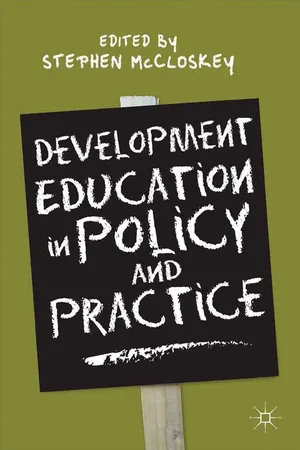
Development Education in Policy and Practice
About this book
Development education is a radical form of learning that addresses the structural causes of poverty and injustice in the global North and South. This volume debates development education practice and the policy environment in which it is delivered. It affirmatively points to the transformative power of education as a means toward social change.
Information
1
Introduction: Transformative Learning in the Age of Neoliberalism
Development education has been occupying an increasingly important and enlarged space within formal and informal education over the past 50 years as a radical pedagogy rooted in the global South with the capacity for self- and communal transformation. It represents the enduring capacity of education to raise the learner beyond his or her physical environment, extend their imagination to new horizons, attain new forms of cultural expression, overcome societal inequalities and embrace humanisation above the ‘otherness’ of materialism. This concept of education as a means of empowerment and justice is largely drawn from the work of the radical educator, philosopher, activist and writer Paulo Freire and was moulded in literacy programmes with poor campesinos in his native Brazil in the 1960s. He succeeded in relating the individual’s process of conscientisation through problem posing education and critical thinking to that of wider society’s struggle for social justice. Thus, just as the learner could become liberated by an awakening of critical consciousness so could society become liberated from the shackles of oppression. This was a truly revolutionary vision of education that resonated throughout Latin America and directly informed the practice of educators in the global North.
This radical approach to learning has operated under various labels but development education is perhaps the most apposite as it explores the intrinsic link between education and development and addresses the fundamental causes of inequality and injustice. It is distinguished from orthodox education policy and practice by suggesting that education is political, ideological and demands an ethical position: ‘washing one’s hands of the conflict between the powerful and the powerless means to side with the powerful, not to be neutral’ (www.freire.org). This radical pedagogy was always likely to struggle for recognition and acceptance within states driven by neoliberal economies that allowed markets to shape the structure and content of education delivery rather than societal wellbeing. Indeed, the ebbs and flows of development education over the past 50 years have to a large extent reflected the political landscape in which it has been delivered. The resilience of the sector has resulted from increasing professionalism and steadfast dedication within its ranks, the flexibility of its delivery in terms of sectors and target groups, and the acceleration of globalisation from the 1980s onward which has renewed the sector’s relevance in the context of persistent poverty.
A key question for development education, and this book, is how the sector has mediated the ideas of Freire in its practice within an increasingly marketised education system. To what extent, as Selby and Kagawa put it in Chapter 9, has there been a ‘compromising of values and trimming of original vision in the light of the economic growth agenda and global marketplace?’ Has the sector struck a ‘Faustian bargain’ ... ‘for knowledge or power or influence, closing one’s eyes to the consequences?’ A theme that permeates the book is how development education can demystify social, economic and cultural relations within the neoliberal system that perpetuates inequality and contribute to the debate on alternative, transformative paradigms that are sustainable, equitable and just. This chapter will begin with an overview of key aspects of development education practice including core components of Freirean pedagogy. It will then consider how policy changes have impacted on development education drawing upon the author’s experiences of the sector in Britain and Ireland before outlining the aims of the book and introducing the contributions that follow.
Development education in practice
In describing an area of practice it is customary to serve up standard definitions to guide the reader as to the main parameters, methods, aims and target groups that will help distil its purpose. This is particularly difficult in the area of development education given its flexibility and breadth as a learning process. For example, does the definition focus on: its active learning and participative methodology; the social and economic justice issues that it seeks to address; the skills, values and attitudes that it imparts; the education sectors in which it operates (adult, community, tertiary, youth, schools etc); the social relations it addresses (class, racial, global South v global North etc); the outcomes it seeks (social and economic justice); or the tools it employs (teaching resources, social media, information technology)? The task is complicated further by the various labels applied to development education by practitioners and policy-makers, including the contributors to this book. Some of the labels used include: global citizenship education; global education; global dimension; sustainable development (suggesting links with environment education); development awareness; and development education and awareness raising (DEAR) often used in a European Union (EU) context. Those who frown upon the use of definitions suggest that they anchor development education in a specific point in history when it is a fluid process operating within a shifting economic, social and political context. They also suggest that definitions sometimes push development education into sectoral silos (formal, non-formal, tertiary) or seek to modify, perhaps dilute, its methodology and goals.
On the positive side, definitions can usefully summarise the distinctive qualities of development education, while suggesting how it complements related sectors like human rights education, global citizenship, environment education and education for sustainable development. So, while being mindful of the limitations of definitions, here are a few that point to its purpose. The first is one of the earliest and most enduring definitions from the United Nations which states that development education seeks:
to enable people to participate in the development of their community, their nation and the world as a whole. Such participation implies a critical awareness of local, national and international situations based on an understanding of social, economic and political processes (Osler, 1994: 51).
The UN definition then goes on to explore some aspects of development education content as being:
concerned with issues of human rights, dignity, self-reliance and social justice in both development and developing countries. It is concerned with the causes of underdevelopment and the promotion of what is involved in development, of how different countries go about undertaking development, and of the reasons for and ways of achieving a new international economic and social order (Ibid.: 51).
This definition is not short of ambition – ‘a new international economic and social order’ – coming from a multilateral institution such as the UN. However, it is rather scant on the methodology and as to how this is to be achieved. The Irish Development Education Association (IDEA) is more forthcoming on the ‘how’ of development education, defining it as:
An educational process aimed at increasing awareness and understanding of the rapidly changing, interdependent and unequal world in which we live. It seeks to engage people in analysis, reflection and action for local and global citizenship and participation. It is about supporting people in understanding, and in acting to transform the social, cultural, political and economic structures which affect their lives and others at personal, community, national and international levels (www.ideaonline.ie).
The IDEA approach to development education as a process of awareness raising, analysis and action is shared by the Development Awareness Raising and Education (DARE) Forum, which comprises representatives from national development education platforms across Europe. In 2004, the DARE Forum agreed a definition which states that:
Development education is an active learning process, founded on values of solidarity, equality, inclusion and co-operation. It enables people to move from basic awareness of international development priorities and sustainable human development, through understanding of the causes and effects of global issues to personal involvement and informed actions (DARE, 2004).
In summary then, the themes that permeate most definitions of development education are as follows:
- the need to encourage action as an outcome of the educational process;
- the local-global axis of education, involving both an understanding of development issues and our interdependence with other societies;
- the development of new skills, values, attitudes, knowledge and understanding that will inform individual action;
- the use of participative, active-learning methodologies;
- education as a visioning exercise toward social transformation;
- social justice, inclusion and equality;
- the need to inform practice with a developing world perspective (McCloskey, 2009: 240–241).
The challenges for the sector in realising the vision outlined in these definitions are, of course, manifold. They include: integrating development issues into national schools curricula; securing sustainable funding lines that do not limit the sector’s independence; monitoring and evaluating the impact of practice on learners; strengthening the sector’s foothold in tertiary education through quality research; operating within shifting and sometimes hostile policy environments; and delivering practice that is informed by the needs of countries in the global South. What is remarkable is the sector’s capacity to sustain its growth and break new ground despite these challenges. For example, a Europe-wide survey of development education in national schools curricula commissioned by DEEEP (Developing Europeans’ Engagement for the Eradication of Global Poverty) in 2010 details ‘the expanding range and currency of what are perceived as “global” issues influencing school curricula and linked to subject teaching in the classroom’ (DEEEP/CONCORD, 2010: 6). While the survey does not address the qualitative aspects of delivery and learning, it points to increased exposure to development issues in schools across Europe.
At a policy level, the European Parliament voted in favour of an official declaration on development education and active global citizenship in July 2012 which reflects the strengthening policy environment for development education in Brussels. As Gerard McCann suggests in Chapter 15: ‘The assertiveness of the declaration left all agencies involved in the sector with no doubt as to the seriousness of the institutional base of the EU in its intentions towards DE’. The sector therefore continues to gather a considerable foothold at policy and practice levels but one persistent challenge that the sector has yet to adequately address is that of the action outcome which I turn to next.
Action toward social change
One of the dimensions of the vision for development education shared by both governments and non-governmental organisations is the concept of education toward action and social change. For example, the Irish government, which has a longstanding record of support for the sector, suggests that development education ‘aims to deepen understanding, and encourage people towards taking action for a more just and sustainable world. It provides a unique opportunity for people in Ireland to reflect on their roles and responsibilities as global citizens’ (Irish Aid, 2013: 35). What has yet to be properly elucidated either by the non-governmental development sector, statutory development bodies or national governments is what kind of process or steps they propose to take to achieve ‘a more just and sustainable world’. If pressed, these bodies are likely to suggest transactional forms of development involving consumerist ‘actions’ such as purchasing fair-trade commodities or, perhaps, engaging in ‘clicktivism’ whereby learners sign petitions or endorse campaigns from their computer terminals.
In research commissioned by Oxfam called Finding Frames (Darnton and Kirk, 2011), it is argued that this more ephemeral engagement with the public, rooted in consumerist values, does not result in the kind of transformative outcomes sought by development education. The report uses the example of the Make Poverty History campaign in 2005 which succeeded as a mass mobilisation but its transformative potential was ‘drowned out by the noise of celebrities, white wristbands and pop concerts’ (Darnton and Kirk, 2011: 6). Make Poverty History’s public mobilisation was therefore not sustained as it was largely informed by a transactional frame ‘in which support for tackling poverty is understood simply as making donations to charities’ (p. 7). The authors of Finding Frames accept that their research does not as yet provide answers, but they do suggest that: ‘Ultimately, we see change as a process of reflective practice, pursued through deliberation and debate’ (p. 9). The term ‘reflective practice’ is one of the central elements of Freirean practice suggesting that more development education is likely to result in the kind of sustainable public engagement with global issues that NGOs and governments seek to achieve. Part of this process involves moving toward action outcomes that are less facile, transient and transactional to become more political, ideological and deep-rooted. The next section briefly considers some key aspects of Freirean practice including ‘reflective action’.
Freirean pedagogy
Paulo Freire’s key work is Pedagogy of the Oppressed (1970) in which he argued that the poor were maintained in a state of ignorance and poverty through economic, social and political domination. By ‘submerging’ the poor in a ‘culture of silence’, a powerful economic and political elite maintained unjust and exploitative social relations that were based, at least in part, on an education system designed to maintain a rigid conformity. Freire sought to end this ‘culture of silence’ through reflective action – a union of theory and practice. This process involves: critical awareness of the social relations and power structures within society like the media and government; contemplative dialogue within the dominated class as a means of analysis; and reflective action informed by dialogue and analysis. For Freire, reflection without an action outcome is mere ‘verbalism’ and action without reflection is pure ‘activism’ (action for action’s sake). He suggests that a ‘revolution is achieved with neither verbalism nor activism, but rather with praxis, that is, with reflection and action directed at the structures to be transformed’ (emphasis in original text, 1970: 107).
In reflecting on how the learner can achieve the critical awareness necessary to intervene in the world, Freire rejected authoritarian teacher-pupil models that assume ‘the teacher knows everything and the students know nothing’ (p. 54). Freire described this model as the ‘banking concept of education’ in which knowledge is deposited by the teacher as ‘narrator’ into students as ‘receptacles’ or ‘containers’ (pp. 52–53). ‘Education thus becomes an act of depositing, in which the students are the depositories and the teacher is the depositor’ (p. 53). The antithesis of this approach is, accordi...
Table of contents
- Cover
- Title
- Copyright
- Contents
- List of Tables and Figures
- Foreword
- Notes on Authors
- Acknowledgements
- List of Abbreviations
- 1 Introduction: Transformative Learning in the Age of Neoliberalism
- Part I Soft versus Critical Development Education
- Part II Development Education Sectors
- Part III Development Education and Sustainable Development
- Part IV New Development Paradigms: Lessons for Development Education
- Part V Development Education’s Shifting Policy Landscape
- Index
Trusted by 375,005 students
Access to over 1.5 million titles for a fair monthly price.
Study more efficiently using our study tools.
Frequently asked questions
Yes, you can cancel anytime from the Subscription tab in your account settings on the Perlego website. Your subscription will stay active until the end of your current billing period. Learn how to cancel your subscription
No, books cannot be downloaded as external files, such as PDFs, for use outside of Perlego. However, you can download books within the Perlego app for offline reading on mobile or tablet. Learn how to download books offline
We are an online textbook subscription service, where you can get access to an entire online library for less than the price of a single book per month. With over 1.5 million books across 990+ topics, we’ve got you covered! Learn about our mission
Look out for the read-aloud symbol on your next book to see if you can listen to it. The read-aloud tool reads text aloud for you, highlighting the text as it is being read. You can pause it, speed it up and slow it down. Learn more about Read Aloud
Yes! You can use the Perlego app on both iOS and Android devices to read anytime, anywhere — even offline. Perfect for commutes or when you’re on the go.
Please note we cannot support devices running on iOS 13 and Android 7 or earlier. Learn more about using the app
Please note we cannot support devices running on iOS 13 and Android 7 or earlier. Learn more about using the app
Yes, you can access Development Education in Policy and Practice by Stephen McCloskey in PDF and/or ePUB format, as well as other popular books in Social Sciences & Education General. We have over 1.5 million books available in our catalogue for you to explore.