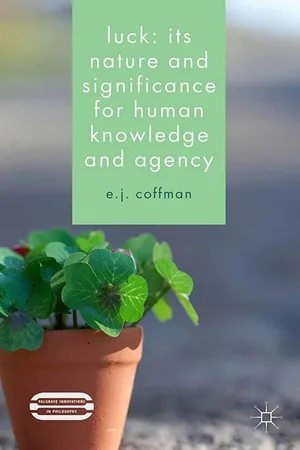
eBook - ePub
Luck: Its Nature and Significance for Human Knowledge and Agency
- English
- ePUB (mobile friendly)
- Available on iOS & Android
eBook - ePub
Luck: Its Nature and Significance for Human Knowledge and Agency
About this book
As thinkers in the market for knowledge and agents aspiring to morally responsible action, we are inevitably subject to luck. This book presents a comprehensive new theory of luck in light of a critical appraisal of the literature's leading accounts, then brings this new theory to bear on issues in the theory of knowledge and philosophy of action.
Information
Topic
PhilosophySubtopic
Epistemology in Philosophy1
Lucky Events: The Current Debate and a New Proposal
A wide range of important debates across such areas as epistemology, philosophy of action, ethics, political philosophy, and philosophy of law center on luck-involving claims (that is, claims that involve the concept of luck itself, or some other luck-related concept) such as the following:
If you know that P, then it’s not lucky that you believe accurately that P.
If it was lucky that you acted as you did, then you did not freely so act.
If you and I behave in the same way but through sheer bad luck my conduct has worse results than yours, then I am no more blameworthy than you are for so behaving.
We should redistribute resources so as to enhance the prospects of those who, through sheer bad luck, are among our worst off.
We can properly punish successful criminal attempts more severely than ones that fail only by luck.
Reflection on such claims can easily impart a strong sense that ‘[t]he concept of luck plays a crucial role in many philosophical discussions’ (Lackey 2008: 255; cf. Pritchard 2007: 278). Under this impression, several theorists working in one or another of the aforementioned areas have recently begun developing and assessing new, and unusually detailed, accounts of luck.1 This nascent research program promises dividends, regardless of whether the concept of luck really is as important as it appears to be in light of claims like those above. If the concept actually does play a ‘crucial role’ in some or other of the indicated debates, then working toward its correct analysis will advance those debates rather directly, by progressively clarifying claims that drive them. But perhaps initial appearances mislead: maybe (at least some of) those discussions don’t really revolve around luck, but instead revolve around some similar, more or less closely related notion(s). In that case, homing in on the correct analysis of luck should help us recognize that our focus on it has been (at least somewhat) misplaced, and such recognition should in turn lead to beneficial clarification of claims like those listed above.
In this chapter and the next one, I aim to reorient current theorizing about luck as an aid to our discerning the concept’s true philosophical importance. Later chapters will bring the analysis of luck developed in the first two chapters to bear on some central debates in epistemology (Chapter 3 and 4) and philosophy of action (Chapter 5 and 6). As will emerge over the course of this book, while I certainly think that luck is a fascinating concept in its own right, I doubt that reflection on it stands much of a chance of illuminating the nature of knowledge and free, morally responsible agency or of revealing surprising limits on the scope of these phenomena among finite, temporal thinkers and agents such as us. Accordingly, this book’s overall line of argument will be at least somewhat pessimistic about luck’s philosophical importance. This relatively deflationary attitude toward luck runs contrary to certain epistemological and action-theoretical views that many would regard as platitudinous. More on all this in Chapters 3 through 6 below.
Here’s an overview of this chapter and the next one.2 After introducing the literature’s leading theories of luck (Section 1.1), I’ll present and defend counterexamples to each of them (Section 1.2). Next, I’ll argue for the thesis that recent luck theorists’ main target of analysis – viz., the concept of an event’s being lucky for a subject – is actually parasitic on the more fundamental notion of an event’s being a stroke of luck for a subject. This thesis will serve as at least a partial diagnosis of the leading theories’ failure (Sections 1.3 and 1.4). I’ll then develop an analysis of strokes of luck that utilizes key insights from the recent luck literature (Sections 2.1 and 2.2). Finally, having set out a comprehensive new theory of luck – the Enriched Strokes Account of lucky events – I’ll return to the initial counterexamples to the literature’s leading theories to show that the Enriched Strokes Account can properly handle all of them (Sections 2.3 and 2.4).3
Before diving in, let me flag an important assumption and describe how I’ll be using some key terms. Following other recent luck theorists, I’ll assume that the luck relation(s) can relate (a) individuals for whom things can go better or worse to (b) events proper as well as obtaining states of affairs (or facts). What I call ‘events proper’ are concrete- object-like entities that have spatiotemporal locations and are denoted by perfect gerundial nominals – for example, ‘Ann’s catching of the ball’, ‘the shark’s biting of Bob’. By contrast, states of affairs are abstract proposition-like entities that obey Boolean principles (they can be conjoined, disjoined, negated, and so on) and are denoted by imperfect gerundial nominals – for example, ‘Ann’s catching the ball’, ‘the shark’s biting Bob’.4 Accordingly – and also in line with other contributors to the recent luck literature – I’ll here use ‘event’ in a relatively broad sense that covers events proper as well as states of affairs. I’ll use ‘happen’ in a correspondingly broad sense to cover both occurrence (for events) and coming to obtain (for states of affairs). And I’ll use ‘do’ in a broad sense to cover both performance (for events) and actualization (or making to obtain – for states of affairs).
1.1 Three leading theories of luck
Say that possible world W1 is close to possible world W2 before time t iff W1 is no more than slightly different from W2 up to (but not including) t.5 With this stipulative definition in hand, we can state the literature’s three leading accounts of luck as follows:
The Modal Account: Event E is at time t (un)lucky for subject S iff (E happens at t and) (i) E is in some respect good (bad) for S, and (ii) E doesn’t happen around t in a wide class of possible worlds that are close to the actual world before t.6
The Control Account: E is at t (un)lucky for S iff (i) E is in some respect good (bad) for S, (ii) S hasn’t successfully exploited E for some purpose, and (iii) E isn’t something that S did intentionally.7
The Mixed Account: E is at t (un)lucky for S iff (i) E is in some respect good (bad) for S, (ii) E doesn’t happen around t in a wide class of possible worlds that are close to the actual world before t, and (iii) E isn’t something that S did intentionally.8
A few remarks about each account’s condition (i), and the Modal and Mixed Accounts’ condition (ii), are now in order. Condition (i) seems to be the best way to understand the significance or value condition on luck (for the best available discussion of the significance condition, see Ballantyne 2012). Since an event can be good for you in one respect but bad for you in another, accounts of luck that incorporate condition (i) correctly allow an event to be both lucky and unlucky for you (cf. Ballantyne 2012: 331). For example, your lottery win may be good luck in that it enables you to retire early, but bad luck in that it makes you a salient target for extortion.
For expressions of the chanciness condition on luck that resemble the Modal and Mixed Accounts’ condition (ii), see Pritchard (2005), Coffman (2007), and Levy (2009, 2011a). It’s important to state condition (ii) with ‘around t’ instead of ‘at t’. If condition (ii) is stated with ‘at’, each account’s right-to-left conditional will be vulnerable to the following kind of counterexample:
Under perfectly normal conditions, you (automatically, non-intentionally) inhale wholesome air at t. Inhaling wholesome air is good for you, and it doesn’t happen at t in a wide class of worlds that are close to the actual world before t. In most such worlds, you’re either exhaling or idle at t.
If condition (ii) is stated with ‘at’, each account’s right-to-left conditional will imply incorrectly that you are at t lucky to be inhaling wholesome air (remember the stipulation that your conditions are perfectly normal). With ‘around’, each account’s right-to-left conditional avoids the implication that you are at t lucky to be inhaling wholesome air (assuming that you inhale wholesome air around t in the vast majority of worlds that are close to the actual world before t).9
Moreover, since different deterministic worlds may nevertheless be close to each other up to a given time, condition (ii) allows the Modal and Mixed Accounts to countenance lucky events in settings where causal determinism obtains (‘causal determinism’ here denotes the thesis that ‘there is at any instant exactly one physically possible future’ [van Inwagen 1983: 3]). Numerous cases illustrate this possibility (cf. Pritchard 2005, Coffman 2007, Levy 2011a). Winning the lottery in a deterministic world is lucky for you, notwithstanding the fact that your lottery win was necessitated by prior events and the laws of nature. For another example, suppose that you live in a deterministic world where your life depends on a certain sphere’s remaining perfectly balanced on the tip of a particular cone throughout some temporal interval.10 We can fill in the details so as to elicit the intuition that you are lucky the sphere remains perfectly balanced on the tip of the cone throughout that interval, notwithstanding the fact that the sphere’s remaining so balanced on the cone’s tip throughout that interval was necessitated by prior events and the laws of nature.
All three of the literature’s leading accounts of luck issue correct verdicts about certain clear cases of luck such as the following:
Good Lottery: You habitually play numbers corresponding to your own birthday in the state lottery. On this occasion, however, you seriously contemplate playing numbers corresponding to your mother’s birthday. In the end, you stick with standard practice and play your own numbers. Lo and behold, you win!
Bad Lottery: You live in a corrupt state where citizens are forced to play in a lottery whose winners lose their life savings to the governor. As before, you vacillate between playing your mother’s birthday numbers and your own birthday numbers. In the end, you stick with your own numbers. Lo and behold, you win!
In each example, your lottery win isn’t something that you did intentionally; you haven’t yet exploited your win for some purpose; and, finally, in a wide class of worlds that are close to the actual world before the time at which you win, you don’t win around then. To verify that the last condition holds, think about various small changes we could make to the actual world before the time at which you won (I assume here that we share the same birthday, and so that you played ‘062976’): ‘6’ (rather than ‘7’) is the penultimate number selected; ‘5’ is the penultimate number selected; ‘4’ is the penultimate number selected; and so on. If things had been slightly different in one or another of these ways before the time at which you won, you would not have won around then. Therefore, in a wide class of possible worlds that are close to the actual world before the time at which you won, you don’t win around then. So, provided that your win in Good Lottery is good for you – and that your win in Bad Lottery is bad for you – each of the literature’s leading accounts of luck entails that your win is (un)lucky for you.
Alas, as we’re about to see, each of the leading accounts is also vulnerable to successful counterexamples.
1.2 Counterexamples to the leading theories of luck
Let’s start with the Modal Account. Over the next few paragraphs, I’ll defeat Levy’s (2011a: 20–2) recent attempted defense of condition (ii)’s necessity for luck from the following counterexample developed by Lackey (2008):
Buried Treasure: Sophie buries her treasure at the one spot where rose bushes can grow on the northwest corner of her island. For personal reasons, Sophie was set on burying her treasure on the island’s northwest corner in a spot that supports rose bushes: that’s her favorite part of the island, and roses are her favorite flowers. All this is unbeknownst to Vincent, another inhabitant of the island who shows up one month later at the exact same spot where Sophie buried her treasure. Like Sophie, Vincent has personal reasons for digging up that spot – but they’re completely different from, and unrelated to, Sophie’s: Vincent is set on planting a rose bush in his mother’s memory on that part of the island. As Vincent goes about his digging, he’s shocked to find buried treasure.
Finding Sophie’s treasure when he does clearly seems lucky for Vincent. But given the stipulated details, Vincent finds Sophie’s treasure around that time in the vast majority of possible worlds that are close to the actual world before he finds it. Buried Treasure thus seems to be a counterexample to condition (ii)’s alleged necessity for luck.
Levy (2011a: 20–2) attempts to defend condition (ii)’s necessity for luck from Buried Treasure. We can understand Levy as trying both to undercut and to rebut the judgment that Vincent is lucky to find Sophie’s treasure. As for the undercutter, Levy suggests that the critic’s judgment that Vincent is lucky to find the treasure stems from the fact that the discovery seems lucky to Vincent. But since E’s seeming lucky to S is perfectly compatible with E’s not actually being lucky for S, the critic’s reason for thinking that the discovery is lucky for Vincent doesn’t justify that judgment.
Levy’s attempt to rebut the judgment that Vincent is lucky to find Sophie’s treasure takes off from the following case (2011a: 21):
Buried Treasure*: Unbeknownst to Vincent, Sophie buried the treasure in the spot at which he found it because Vincent’s eccentric great-uncle wanted him to have the riches (perhaps Sophie was unaware of the plan; perhaps Vincent’s great-uncle is a neuroscientist with the power to implant in Sophie a love of roses, knowing it will lead her to bury her treasure in the one spot where he knows Vincent will dig). In that case, it will seem to Vincent very lucky that there was treasure in the precise spot at which he dug, but luck has nothing to do with it; his f...
Table of contents
- Cover
- Title
- 1 Lucky Events: The Current Debate and a New Proposal
- 2 What Is a Stroke of Luck? Enriching the Strokes Account
- 3 Knowledge and Luck I: Gettiered Belief and the Ease of Mistake Approach
- 4 Knowledge and Luck II: Three More Approaches to Gettiered Belief
- 5 Freedom, Responsibility, and Luck I: The Possibility of Moral Responsibility and Literal Arguments for the Proximal Determination Requirement
- 6 Freedom, Responsibility, and Luck II: Stipulative Arguments for the Proximal Determination Requirement and Three Arguments against It
- Coda
- Notes
- References
- Index
Trusted by 375,005 students
Access to over 1.5 million titles for a fair monthly price.
Study more efficiently using our study tools.
Frequently asked questions
Yes, you can cancel anytime from the Subscription tab in your account settings on the Perlego website. Your subscription will stay active until the end of your current billing period. Learn how to cancel your subscription
No, books cannot be downloaded as external files, such as PDFs, for use outside of Perlego. However, you can download books within the Perlego app for offline reading on mobile or tablet. Learn how to download books offline
Perlego offers two plans: Essential and Complete
- Essential is ideal for learners and professionals who enjoy exploring a wide range of subjects. Access the Essential Library with 800,000+ trusted titles and best-sellers across business, personal growth, and the humanities. Includes unlimited reading time and Standard Read Aloud voice.
- Complete: Perfect for advanced learners and researchers needing full, unrestricted access. Unlock 1.5M+ books across hundreds of subjects, including academic and specialized titles. The Complete Plan also includes advanced features like Premium Read Aloud and Research Assistant.
We are an online textbook subscription service, where you can get access to an entire online library for less than the price of a single book per month. With over 1.5 million books across 990+ topics, we’ve got you covered! Learn about our mission
Look out for the read-aloud symbol on your next book to see if you can listen to it. The read-aloud tool reads text aloud for you, highlighting the text as it is being read. You can pause it, speed it up and slow it down. Learn more about Read Aloud
Yes! You can use the Perlego app on both iOS and Android devices to read anytime, anywhere — even offline. Perfect for commutes or when you’re on the go.
Please note we cannot support devices running on iOS 13 and Android 7 or earlier. Learn more about using the app
Please note we cannot support devices running on iOS 13 and Android 7 or earlier. Learn more about using the app
Yes, you can access Luck: Its Nature and Significance for Human Knowledge and Agency by E.J. Coffman,E. J. Coffman in PDF and/or ePUB format, as well as other popular books in Philosophy & Epistemology in Philosophy. We have over 1.5 million books available in our catalogue for you to explore.