This bookdemonstrates that numerous prominent artists in every period of the modern era were expressing spiritual interests when they created celebrated works of art. This magisterial overview insightfully reveals the centrality of an often denied and misunderstood element in the cultural history of modern art.
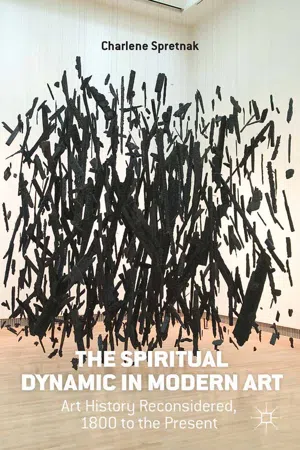
eBook - ePub
The Spiritual Dynamic in Modern Art
Art History Reconsidered, 1800 to the Present
- English
- ePUB (mobile friendly)
- Available on iOS & Android
eBook - ePub
About this book
Information
Subtopic
Art généralCHAPTER 1
THE NINETEENTH CENTURY
EXPRESSING CHRISTIAN THEMES IN A NEWLY SECULAR WORLD
THE INITIATING EVENT OF MODERN ART is generally considered to be the first exhibition of the Impressionists in Paris in 1874. It is more accurate, though, to say that modern art began with modernity itself. By 1800 all the elements of the modern worldview were in place, having emerged gradually over the previous 375 years through the cumulative effects of four foundational movements: Renaissance humanism, the Reformation, the Scientific Revolution, and the Enlightenment. The key element emerging from this progression that was considered unbearable by the pioneers of modern art was the “new mechanical philosophy,” or mechanistic worldview. The perception that all physical reality (including humans) functions mechanistically was established in Newtonian science and Cartesian philosophy, but its influence spread throughout society in the eighteenth century. Eventually, mechanistic, rationalist thought was adopted as the foundational premise of all social institutions and systems of knowledge in Britain and France.
The supreme confidence imbued by the mechanistic worldview—in which the sectors of science, commerce, and governance were conceptualized as wheels whose cogs smoothly engage to create the larger society-as-machine—was shattered in 1789 by the extended violence of the French Revolution and its later stage, the Terror. All across Europe young people had been deeply enthusiastic about the potential of the French Revolution, investing it with their hopes for a new age of liberty and possibility. After 1794, however, they struggled to assimilate the meaning of hope’s descent into the Terror. Yet, even in the face of widespread unease, the larger mechanisms of the emergent modern condition continued to reshape human experience. Shifting economic patterns displaced rural families, who migrated to the industrializing cities, while Adam Smith’s rationalist apologia for the cruelties of the new market economy was the wisdom of the day. By the late eighteenth century, education, culture, and the arts were all brought into alignment with the rigid and regimented preferences of the mechanistic worldview.
In Britain at this point, a young artist and two young poets independently mounted a profound rejection of that worldview, which they regarded as pernicious and utterly false. Between 1788 and 1820, William Blake conducted his aesthetic revolt against both secular humanism and institutional Christianity through his poems and his highly original tinted engravings. In 1798 William Wordsworth and Samuel Taylor Coleridge published Lyrical Ballads, a collection of startlingly new types of poetry that rejected the neoclassical literary forms embraced by sophisticates of the Enlightenment. It is not true, however, though often asserted, that nineteenth-century modern art was simply a formalist reaction against the neoclassical forms of the eighteenth century. Granted, Wordsworth and Coleridge despised the rigid form of Augustan rhymed couplets, just as Blake despised the aesthetic doctrines of Joshua Reynolds, but their respective formal rejections were embedded in a larger rebellion against mechanistic thinking and culture. They saw clearly that the tightly constrained art forms resulted from the tightly constrained mechanistic worldview.
As we will see from the following spiritual profiles of leading modern artists in the nineteenth century, they were pleased to be modern citizens yet were sensitive to what had been lost spiritually. The process of secularization, like the crushing reductionism of rationalist and mechanistic thought, was not neutral toward religion. Moreover, the mechanistic worldview was tone-deaf to organic sensibilities and participatory consciousness, a failure that sparked the intense and artful rebuttals by the Romantic poets. Many visual artists, too, broke from the dominant culture to invent formal modes by which spiritual and aesthetic freedom might be expressed in the new situation. Ironically, then, several types of modern art were begun in an effort to counter particular premises of the overarching modern worldview. These artists made their own modernities.
BLAKE
As a child, William Blake (1757–1827) reported to his parents that he saw a tree full of angels and later saw angels walking in a field. He was enrolled at age ten in a drawing school for four years, followed by a seven-year apprenticeship in the shop of the engraver to the Society of Antiquaries and to the Royal Society. During this period Blake began collecting inexpensive prints of his favorite artists, including Raphael, Michelangelo, and Dürer. At age 22, by then a professional engraver and printer, he was accepted to study painting at the Royal Academy of Arts.
The Academy’s founding president was the prominent painter Sir Joshua Reynolds, who delivered a series of discourses during those years, which were published. He delineated the requirements of the aesthetic that was pleasing to Enlightenment tastes: nature is a serene, orderly backdrop for human purposes and should be depicted as such; the true artist should reduce the variety of nature to the abstract idea; singular forms should give way to ideal forms; “art must get above . . . particularities and details of every kind”; neoclassical propriety and calm must prevail in landscapes, portraits, and historical subject matter. On reading these principles in Reynolds’ third Discourse, Blake erupted in vehement disagreement, as indicated by his marginalia: “A Lie . . . . A Folly . . . . Damn the Fool . . . . Nonsense. Singular & Particular Detail is the Foundation of the Sublime . . . . Every Eye sees differently. As the Eye—such the Object.” Blake felt that every singularity becomes more sublime each time it is perceived, thereby continuing to reveal its profoundly unique quality.1 Blake withdrew from the Royal Academy of Art after a short time and continued to develop his style in watercolors and as an engraver.
Between 1788 and 1820 Blake created many “illuminated” books in which he raged against the mechanistic, neoclassical worldview and against institutional Christianity in order to present his visionary sense of a true Christianity that joins individual freedom with a passionate embrace of the meaning of Christ. In Blake’s rejection of ecclesiastic authority in order to find authentic Christianity, he may be seen to anticipate Kierkegaard by 50 years, but the milieu in which Blake’s thinking developed was London’s energetic subculture of Nonconformist churches and prophetic groups in the late eighteenth century. Some of these groups were direct descendants of the Radical Sects active during the Civil War of the 1640s, who, inspired by the revolutionary quest for greater political freedom, declared their own versions of greater religious freedom than the Church of England allowed. In the 1790s the newly expanded political freedom won in the American and French revolutions again sparked expansive thoughts. In addition, Blake’s mother and her first husband had been members of the Moravian Church in London. Blake himself became interested for a time in the Swedenborgian New Jerusalem Church, but he soon turned against Swedenborg (a man of “mechanistic talents”) and the institutionalizing of his ideas, which he mocked in The Marriage of Heaven and Hell (1790–1793). He was also influenced by the mystical writings of Jakob Böhme; alchemy; Gnosticism; cabala; and Norse, Irish, and Hindu mythology. Foremost, he conveyed the visions that arose in his mind.
Blake saw everywhere the pernicious damage wrought by the mechanistic worldview, which he called “Single Vision & Newton’s Sleep.” For Blake, “He who sees the infinite in all things sees God. He who sees the Ratio only sees himself only.”2 He did not deny Newtonian science, with its fixation on the “vegetable universe,” but situated it as a small part of the far larger transcendent and eternal realm. His phrase “the dark Satanic mills” refers to the imperial centers that impose rationalist, reductionist, objectivist thought (“Satan’s Mathematik Holiness”) as if that were all there is. How could one escape this fallen state with its “mind-forg’d manacles”? Blake assured, “If the doors of perception were cleansed every thing would appear to man as it is, infinite.”
To convey both his critique and his spiritual vision, Blake created an entire mythology, which he presented in his prophetic epics. For example, The Book of Urizen (1794) features a dour, hoary patriarch named Urizen (Your Reason), who personifies Single Vision and rules over the scientistic culture. He is also the demiurge, the God of wrath and jealousy, Old Nobodaddy of the idolatry of science, the giver of moral laws. (Blake considered religious laws to be as stultifying as Newton’s universal laws.) Living under such conditions, “our infinite senses” have so atrophied that we can barely hear “True Harmonies” or make out “the Visions of Eternity.” Inevitably, despair results. Elsewhere Blake proposed that the way beyond the mechanistic “Mundane Shell” is through realizing that the deep powers of the imagination and of the spiritual coalesce, as does art and true religion: the Bible is “the Great Code of Art” and “Jesus & his Apostles & Disciples were all Artists.”3 He saw man and woman (he was a feminist, as expressed in Daughters of Albion) as forms of divine life who can return Jesus to their hearts and recover their imaginative powers of transcendent perception.
The Single Vision of Newton, Locke, and Bacon was responsible, Blake held, for art like that of Joshua Reynolds. Blake’s own art is fluid and often charged with dynamic energy. He insisted on the importance of the “bounding outline” and drew human figures with bulging musculature to indicate spiritual strength. To print his work, Blake invented a new technique called relief etching. In the final step of the process, he or his wife added a tinted wash to the printed page. He called his sumptuous illuminations portable frescoes (see Figure 1).
Blake’s new style of poetry, new forms of art, and idiosyncratic reinvention of Christianity amount to an oeuvre that is sui generis. He was not part of the Romantic movement; their ideal of participatory consciousness as a mode of deep communion with nature was repugnant to Blake. He attacked Wordsworth’s poetry on these grounds, commenting in his notes, “Natural objects always did & now do weaken, deaden & obliterate Imagination in me.”4 Elsewhere he wrote, “Nature teaches nothing about Spiritual Life but only Natural Life.”5 Blake was a mystic whose art inspired many artists, not least for its range of invention. As Arthur Symon noted in Blake (1907), he was “the first utterer, in modern times” of “the message of emancipation from reality through the ‘shaping spirit of imagination.’ ”6
Three years before his death, Blake was introduced to a young painter named Samuel Palmer (1805–1881), who had exhibited works at the Royal Academy since age 14. Blake encouraged him to develop a style based on the power of his imagination, which seems to have propelled Palmer to create, for the next ten years, highly original landscapes in the west of Kent in which he equated beauty with strangeness. These works, his most memorable, include the ink drawings now known as the “Oxford sepias,” whose dark, stylized woodland scenes with cloisonnéd forms are seen by some critics as “the beginning of a line of exaggerated visionary landscape painting” continuing into the works of Van Gogh, Gauguin, Munch, and the Fauves, as well as Hartley and Burchfield.7 His dreamy landscape paintings of that period anticipate by decades both Symbolist paintings and—because of the wispy brushstrokes and modulated, light-infused colors—the techniques of Impressionism.8 Palmer founded a group of young painters called The Ancients, who embraced pre-Renaissance art for its greater spiritual presence and who wore long robes and large, floppy hats, which they felt identified them with medieval artists. They often visited Blake, individually or as a lively group, and called him The Interpreter, after the seer in The Pilgrim’s Progress. Twenty years later the Pre-Raphaelite painters sought out Palmer because of his pioneering art, his spiritual depth, and his living connection with William Blake.
THE GERMAN ROMANTIC PAINTERS
The Romantic movement in both Germany and England rejected the neoclassical sense of nature as a placid, predictable background for the orderly progress made possible by the new science and the rational capabilities of the Enlightenment man. They asserted that nature constitutes a dynamic magnificence, the organic fullness of being, and the cosmic unity of the Creation, or Weltgefühl. Moreover, it is in nature, as Wordsworth asserted, that spiritual dignity originates. In opposition to neoclassical ideals of regimented thinking, the Romantics valued permeative sensibilities and the power of Imagination, by which they meant not merely making things up (which they called “fancy”) but participatory consciousness, daring perception, and vital engagement. They embraced Goethe’s observation that Newton’s theory of light as an “atomistic restriction and isolation” banishes the feel of vision, the experience of light and vision.9 That is, they sought not to deny science but to expand “Newton’s Single Vision” to a multifold vision. The Romantics valued subjectivity, intuition, and expressive art. They saw the artist as a heroic figure, a uniquely experiencing being who illuminates Eigentümlichkeit (particularity). They honored the particular in their perception of the physical world, rejecting the Enlightenment concept of uniformitarianism, the world as composed of simple, uniform components. With regard to time, they again valued the particular, that is, the singular quality of one’s fleeting perceptions of life. Among German Romantics, two additional characteristics manifested themselves: a patriotic urge to celebrate the historical roots of German culture (in resistance to the Napoleonic occupation) and an idealization of death as a more perfect state than life.
German Romanticism began first in philosophy and literature before spreading to the visual arts. Prior to the Romantic movement, Kant published Observations on Our Sentiment of the Beautiful and the Sublime (1764), in which he noted that a snowcovered mountain peak rising above the clouds may have its charm and appeal, but it also inspires awe, and this dual reaction constitutes the natural sublime. In short, beauty charms but the sublime—as found in night, towering oaks, sacred woods—moves us. Subsequently, young painters were influenced by F. W. J. Schelling’s essay “On the Relation of the Fine Arts to Nature” in 1807, in which he advised that the slavish copying of nature results only in “masks” or empty coverings. What is needed is that the artist distance himself from nature just enough to understand its creative power spiritually. He should concentrate not on the products of nature but on conveying its processes. The painting will be a complete universe, hence a symbol of larger truths.10
One of the young painters who absorbed these ideals was Caspar David Friedrich (1774–1840), who was born in the Pomeranian region of the German Baltic coast. He was raised in a family of strict Lutheran persuasion, in which several deaths during his youth left him with a lifelong sadness that developed in his final years into severe depression. He studied art at the University of Greifswald, in his hometown, and then at the Royal Danish Academy of Fine Arts in Copenhagen. He subsequently settled for the rest of his life in Dresden, a hub of Romantic poets, theorists, and artists. He admired the Baroque paintings of Claude Lorrain and Jakob van Ruisdael yet felt strongly that the zeitgeist of his own time called for a very different art.
In making the case that modern art should be seen to begin with Friedrich, rather than with the Impressionists, the art historian Robert Rosenblum observed in 1972 that no traditional, pre-Romantic subject category could have contained Friedrich’s Monk by the Sea (1810); it is not at all what one expected to see in genre painting or marine painting.11 Typical of Friedrich’s works, that painting features a lone figure in the foreground contemplating the distant light with its suggestion of transcendence. Rarely is there any middle ground in his paintings, and there is often no light but twilight, centered on a warm glow of infinity, a spiritual warmth that holds the gaze of the figure but is very far from him. Friedrich painted from meticulous pencil drawings done in nature. He then simplified his oil compositions and often compressed the visual scope with the effect of drawing the viewer into a mythic and primal space. He ruled out the use of traditional religious images because the character of the new age was to be “at the outer boundary of all religions.”12 The moon was to Friedrich the World-Soul (see Figure 2). In addition to paintings of the sea, he created many compositions centered on the ruins of Gothic churches, a reference for Romantics to the more spiritual medieval era—and for German Romantics, a reference to their country’s unified culture before the religious split. In Friedrich’s compositions the foreground figures or structures, including the Crucifix, are dwarfed by the far larger presence of nature in its majesty. He stated that in order to create, “I must know that I am alone in order to see and hear nature fully. I must be in a state of osmosis with my environment.”13
In Dresden, Friedrich was friends with the Romantic painter Philipp Otto Runge (1777–1810), who developed a new pictorial form and a Goethean color theory in order to renew Christian art. After declaring the end of history painting, he created landscapes, portraits, and biblical scenes. He then planned a series of four paintings entitled The Four Times of Day that would express the harmony of the universe through a symbolic and ritual arrangement of humans, nature, and ethereal realms, all illuminated by a transcendent glow. Sadly, he was able to complete only the first of this series, Dawn, before he died of tuberculosis at age 33. In the twentieth century, Runge’s work was cited admiringly by the Blue Rider artists and influenced Max Ernst, as well as the Neue Sachlichkeit (...
Table of contents
- Cover
- Title Page
- Copyright
- Contents
- List of Illustrations
- Introduction: The Great Underground River That Flows Through Modern Art
- 1. The Nineteenth Century: Expressing Christian Themes in a Newly Secular World
- 2. Mid-1880s to 1918: The Quest to Save Civilization from “Materialism” Through a New Art Informed by Esoteric Spirituality
- 3. 1919 – 1939: The Reaction against Prewar Esoteric Spirituality
- 4. 1945 to the Present: Allusive Spirituality
- 5. 1945 to the Present: Spirituality of Immanence
- 6. 1945 to the Present: Rocked in the Bosom of Abraham
- Afterword: When Form Follows Spirit
- Appendix: Making the Case
- Notes
- Acknowledgments
- Index
Trusted by 375,005 students
Access to over 1.5 million titles for a fair monthly price.
Study more efficiently using our study tools.
Frequently asked questions
Yes, you can cancel anytime from the Subscription tab in your account settings on the Perlego website. Your subscription will stay active until the end of your current billing period. Learn how to cancel your subscription
No, books cannot be downloaded as external files, such as PDFs, for use outside of Perlego. However, you can download books within the Perlego app for offline reading on mobile or tablet. Learn how to download books offline
Perlego offers two plans: Essential and Complete
- Essential is ideal for learners and professionals who enjoy exploring a wide range of subjects. Access the Essential Library with 800,000+ trusted titles and best-sellers across business, personal growth, and the humanities. Includes unlimited reading time and Standard Read Aloud voice.
- Complete: Perfect for advanced learners and researchers needing full, unrestricted access. Unlock 1.5M+ books across hundreds of subjects, including academic and specialized titles. The Complete Plan also includes advanced features like Premium Read Aloud and Research Assistant.
We are an online textbook subscription service, where you can get access to an entire online library for less than the price of a single book per month. With over 1.5 million books across 990+ topics, we’ve got you covered! Learn about our mission
Look out for the read-aloud symbol on your next book to see if you can listen to it. The read-aloud tool reads text aloud for you, highlighting the text as it is being read. You can pause it, speed it up and slow it down. Learn more about Read Aloud
Yes! You can use the Perlego app on both iOS and Android devices to read anytime, anywhere — even offline. Perfect for commutes or when you’re on the go.
Please note we cannot support devices running on iOS 13 and Android 7 or earlier. Learn more about using the app
Please note we cannot support devices running on iOS 13 and Android 7 or earlier. Learn more about using the app
Yes, you can access The Spiritual Dynamic in Modern Art by C. Spretnak in PDF and/or ePUB format, as well as other popular books in Théologie et religion & Art général. We have over 1.5 million books available in our catalogue for you to explore.