- English
- ePUB (mobile friendly)
- Available on iOS & Android
eBook - ePub
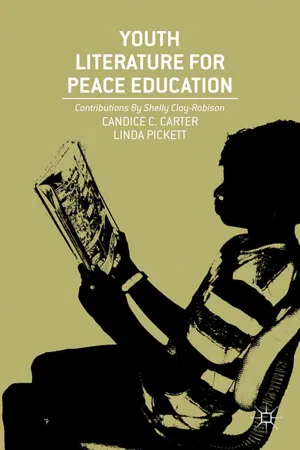
Youth Literature for Peace Education
About this book
Carter and Pickett explore how educators and families can teach peace education through youth literature and literacy development. Showing how to assess, choose, and make use of literature that can be used to teach both literacy and peace education, they walk through individual methods: recognizing and teaching different portrayals of conflict in youth literature, analyzing characterization, and examining the role of illustrations. Educators who want to incorporate peace education within a broader, literacy-focused curriculum, and peace educators looking for age-appropriate materials and methodologies will find Youth Literature for Peace Education a rich and interdisciplinary resource.
Information
Topic
EducationSubtopic
Early Childhood Education1
Teaching for Peace with Youth Literature
Quests for peace through education are worldwide. Teaching for peace remains as old as the words and illustrations that express that goal. Awareness of recent methods for that pursuit is the foundation for advancement of peace through education. Literature and art have been the mortar for construction of knowledge, dispositions, and skills needed in peace development. Visual and verbal communication facilitates the awareness needed for understanding. Literature enables that kind of communication for youth. Included in this chapter are rationales for the use of youth literature in peace education and the cultivation of social literacy. A description of peace education precedes the discussion regarding the use of literature as a method to teach peace.
Construal of Peace
Foremost in education is the articulation of clear learning goals and objectives. The construal of peace makes the learning objectives toward that universal goal possible. A plethora of translations for the concept of peace demonstrates its centrality as a human goal and supports articulation of objectives. People worldwide have included the notion of peace in their spiritual as well as faith-based traditions and have recommended means for accomplishing it.
Beyond faith-based instruction, other pedagogies exist that clearly include lessons on peace. The call for such instruction in secular schools has been responsive to the situations in which people live. First, the division of faith-based instruction from public schooling in the United States, for adherence to the national constitution requiring separation of church and state, resulted in the promotion of peace-oriented instruction in government-funded schools. Moral education, which the French sociologist Emile Durkheim (1973) described, has been an initiative to fill the gap that teachings of the church provided the youth in faith-based schools. Teaching the youth appropriate ways to live in their society has included various forms of character education, involving a clarification of values and a promotion of national goals like patriotism.
The construal of peace is contextually responsive as well as value based. The conception envisions the harmonious enactment of multiple values that are evident in conflict. Patriotism, for example, demonstrates the value of preserving a nation, while pacifism exemplifies the value of violence-free resolutions for international conflicts. These values, when combined, result in people becoming conscientious objectors to their involvement in war and serving their government as noncombatants during international crises. The record of how male and female politicians, as well as citizens of a nation, object to war and call for other means of resolving international conflict demonstrates patriotism without violence. The notion of global patriotism evidences another construal of peace, whereby people think beyond nationalism to an inclusive identity that encompasses global and regional unity. Learning about the unfolding of people’s identities and how those revelations have affected peace developments includes fascinating stories from world regions. Chapter 7 has more discussion of this record. The present discussion is a brief summary of construing peace in education, especially in secular schools.
Harmonious Living
The vision of people living together in ways that accommodate individual and group differences illustrates the harmony of humanity. The enactment of pluralism supports this harmony through acceptance, regardless of ethnic and cultural identity or physical characteristics. Additionally, the advancing concept in the West, which Buddhists in the East and indigenous populations articulated long ago, that harmony includes all life on this planet, has been more recently, described as sustainability. Harmony of all life forms envisions humans adapting to the ongoing changes of the natural environment and the protection of other species, which humans endanger. Interspecies peace is a form of mutualism involving cohabitation of humans with animals and plants (Andrzejewski, Pedersen, & Wicklund, 2009). Further elaboration of harmony includes life beyond earth. Planning for how to preserve the environments in outer space is another peace initiative (Global Network, 2014). In the pursuit of social, political, environmental, and galactic harmony, inevitable conflicts do not need to result in the destruction of life and the natural conditions that support it. Avoidance of unnecessary conflict is another concept of peace.
Conflict Prevention
Conflicts typically result from unmet needs. Those needs exist in the mind and the physical conditions that influence how people think. The pursuit of peace involves recognition of these needs and proactive responses to them, which result when people are unable to create or carry out ways for fulfilling unmet needs. Psychologists have studied the way minds experience needs and responds to them, as well as how people have thought of conflict responses. The Journal of Peace Psychology and other publications offer a window to indirectly observe peace-related behaviors in the face of conflict. Prevention of conflict includes need fulfillment through people sharing ideas about problem prevention and solution. Their proactive responses, which do not involve any type of violence, build peace.
Avoidance and Repair of Harm
Finding a solution to a problem without harming anyone is another concept of peace. Harm can be psychological or physical. Conflict often evidences harm that has occurred. Work for peace entails recognition of harm indicators. Such endeavors involve thorough analysis of how people might respond to conflict. To avoid harm, there is a need for awareness of the conditions in which people live and of their cultural norms; this awareness is important in responding to the psychological and the material circumstances of conflict.
Fulfillment of Needs
Unmet needs resulting in human violence typically are rooted in conditions that do not sustain survival. Peace is not present when concerns regarding the inability to survive exist. Whether the threats to life are physical or mental, the perception of them reveals conflicts that must be resolved. While physical threats to survival necessitate quick elimination, lack of peace in the psychological realm indicates a peace-building opportunity in that community. When one person has a need that is not met, it can result in that person inflicting self-harm as well as harm to others. Such needs can range from a desire for things, especially in a society characterized by materialism, to dissatisfaction with human interactions. Mental peace results from fulfilling the need for recognition, respect, and the power for self-actualization, among other sources of psychological well-being.
Social and Legal Justice
Social and legal justice indicate needs for peace. Social justice describes the societal conditions that determine personal and group well-being. A state in which there is an obstruction to the means for obtaining well-being, and the right to change the conditions that prevent it, demonstrates injustice. Entrenched in these operations are systemic and structural conflicts. When there is a lack of legal representation and protection, as discrimination within a judicial system evidences, there cannot be social peace. All members of a society need the opportunity for well-being and the power to bring it about.
The fulfillment of everyone’s needs occurs through representation. Lacking a voice to express unmet needs impedes peace. Representation of all populations, including those in the environment who cannot speak for themselves in the legal system, such as plants and animals as well as people who do not have fluency in the official language(s) of the government, is essential for peace. Initiatives to represent nature and people in the courts have illustrated this construal of peace. In order to present a conflict and participate in the discussions about how to resolve it, people need power. Lacking that power, the solutions have often failed to sufficiently solve the existing problems and prevent future ones.
Ideas about what constitutes peace are beyond the scope of this publication, which addresses learning. The notion of peace education resulted from the awareness that students who are informed about the many ways in which peace has been created and construed are better prepared for life’s challenges. A vision of harmonious living features youth, as well as adults, who are well-versed in peace for preservation and development of it across many aspects of life. The following about education for peace describes some of the learning opportunities youth have been given to fulfill this vision.
Peace Education
People have used the concept of peace to characterize aspects in the personal, cultural, societal, regional, global, and spiritual realms of their lives. People learned lessons on peace through the informal education of social interactions and physical arrangements comprised in their lives, as well as through formal instruction. Informal education happens through observation and interaction. Many people who engage in peace development had role models or mentors who indirectly taught them through their ideas and corresponding actions. The combination of an ideological foundation, a role model or mentor, and motivation for action in the recognition of unmet needs are common backgrounds of peacemakers (Carter, 2014). A close look at the thoughts and actions of high-profile peacemakers typically reveals a desire for improvement and a better life for those in need along with others in the world. While being aware of those important factors in the pursuit of peace, informal and formal instruction occurs through deliberate cultivation of the knowledge and skills that support success. Through sharing information in literature about peace development, the youth can glean the nature of accomplishments toward peace. With guidance, they can formally identify and demonstrate the knowledge, skills, and dispositions that have been useful in the achievement of peace.
Peace education is culturally defined and contextually distinct. In other words, people within a culture identify peace in the enactment of their values and the lifestyles that embody those principles. A contextual factor that determines the lessons is the nature of the conflicts that have been evident in the society. Evidence of bias is one contextual factor. Stereotyping people as problem causers result in facilitating students’ critical awareness coupled with motivation and skills to counteract bias in their community (Teaching Tolerance, 2014). This is especially acute in areas where direct violence has left visible harms that make it harder to overcome perceptions of “the other” as troublemakers. Other contextual factors have been the nature of the school that sets out to teach youth about violence prevention and conflict resolution. The approaches have been widely varied, depending on the mission of the school, the pedagogy it typically provides, and the commitment of the school members to educating for peace. When the school mission includes language about conflict and peace, there is a clear rationale for instruction by the school staff and teachers in the many situations in which youth will experience conflict and the need for its peaceful resolution. Notwithstanding the importance of a school mission that articulates the goal of peace, educators who are committed to teaching for peace have found means for accomplishing their goal within institutions where there was no clear rationale for such instruction. One reason for this may be the common goal that educators have for teaching youth about conflict management. While peace education has been comprehensive in schools with supporting missions, it has been viable in all the situations in which youth learn about how humans have solved their problems. By their very nature as institutions that manage the daily lives of their students, schools present many conflict lessons.
Teaching Peace
Educating About Conflict
Teaching youth about conflict occurs informally while they experience and observe the ways people avoid and respond to problems (Carter, 2002; Swick & Freeman, 2004). This includes the use of literature that renders problem-solving strategies. Sources of violence, prevention and ending of violence, management of conflict without harm, and peace her/history are components of social education. Whether or not the use of literature is purposefully instructional, readers and listeners find out about the nature of conflict and ways of responding to it. Hence, the presentation of how people face conflict provides opportunities for demonstrating the development of peace. Literary characters are role models for youth, albeit positive or negative. Explicit instruction with literature enables cultivation of analytical skills when examining how people and characters deal with the conflicts they face. To aid the analysis, peace education provides students with categories for conflict and their management. Those categorizations facilitate the identification of strategies that have been useful in avoiding harmful reactions to conflict, including an existing state of violence in the world and effects on relationships and self. To provide relevance, which is crucial in social education, the formal and informal lessons address situations and populations that relate in the context of the students’ lives. Purposefully included are representations of their identities, history, and current, as well as past, situations that members of their culture, community, and nation have faced. Such instruction has variably included revisionist history that presents the involvement and perspectives of dominated peoples, herstory that renders the role of females, as well as males and youth, in the many ways they have been proactive responders to social problems. Recent initiatives to provide conflict instruction are bully education, violence prevention, conflict resolution, along with social and emotional learning (Collaborative for Academic, Social and Emotional Learning, 2014; Johnson & Johnson, 1995; Prothrow-Stith & Spivak, 2005). Most of these approaches to teaching the management of conflict and avoidance of violence demonstrate a vision of human harmony, especially in schools and communities that have a mixture of ethnicities and cultures. The difference of cultural norms in close encounters presents youth with learning opportunities for coexistence.
Coexistence
Youth, and many adults too, need to reach across the cultural borders that they perceive. These borders exist in the alignment of group members and the norms of the group that are different from those of the observer. When the youth have been socialized to think of “the other” as a source of conflict for their identity group, there is a great need for coexistence education. Goals include recognition of and proactive responses to intolerance and injustice, as well as the evidence of ethnocentrism. The development of an ethnorelativistic perception, in which cultural differences are not viewed with a lesser value than one’s own norms, occurs through positive descriptions of and exposure to those differences. Youth move from acceptance to accommodation of those differences, and sometimes adaptation to the different norms of others around them. Strategies that have been provided, some free of cost through nonprofit organizations, include contact and conversations with youth who are on the other side of cultural and political borders (Teaching Tolerance, 2014). For consistency of adult modeling, coexistence education happens through a campus. A World of Difference, for example, is a program that includes diversity lessons and analysis of conflicts resolved through proactive responses by all members of the school (Anti-Defamation League, 2014). Comprehensive peace education promotes more than a culture of peace in schools by broadening the lens to view global sites of intolerance and injustice (Reardon, 1988). For example, it promotes instruction about human rights, especially those identified by the United Nations in the Convention on the Rights of the Child (United Nations, 2009). In addition to promoting coexistence with diverse others and the protection of everyone’s rights, peace education has been increasing the examination of life circumstances for other species.
Sustainable Living
Ecological security and interdependence have become strands of peace education. Sustainability involves preserving and repairing the natural environment, including the earth and other spaces that humans have affected, together with the regions of their solar system. In the study of the natural world, youth learn about the conflicts in nature such as volcanoes, earthquakes, and the predator-prey relationship, which are part of earth’s evolution. In peace education, they are taught about distinctions between human violence to nature and natural evolutionary processes in the physical world. Additionally, they learn the similarities of nature and humanity’s peace work; both are creative processes in response to conflict. In their explanation of environmental peace, Mische and Harris (2008) explain that:
It is an active process in which tremendous creativity is expended in an effort to balance ...
Table of contents
- Cover
- Title
- 1 Teaching for Peace with Youth Literature
- 2 Characterization
- 3 Diversity
- 4 Language Usage
- 5 Illustrations
- 6 Conflict
- 7 Inclusive Peace Her/History
- 8 Developmental Learning
- Featured Literature
- References
- Name Index
- Subject Index
Trusted by 375,005 students
Access to over 1.5 million titles for a fair monthly price.
Study more efficiently using our study tools.
Frequently asked questions
Yes, you can cancel anytime from the Subscription tab in your account settings on the Perlego website. Your subscription will stay active until the end of your current billing period. Learn how to cancel your subscription
No, books cannot be downloaded as external files, such as PDFs, for use outside of Perlego. However, you can download books within the Perlego app for offline reading on mobile or tablet. Learn how to download books offline
Perlego offers two plans: Essential and Complete
- Essential is ideal for learners and professionals who enjoy exploring a wide range of subjects. Access the Essential Library with 800,000+ trusted titles and best-sellers across business, personal growth, and the humanities. Includes unlimited reading time and Standard Read Aloud voice.
- Complete: Perfect for advanced learners and researchers needing full, unrestricted access. Unlock 1.5M+ books across hundreds of subjects, including academic and specialized titles. The Complete Plan also includes advanced features like Premium Read Aloud and Research Assistant.
We are an online textbook subscription service, where you can get access to an entire online library for less than the price of a single book per month. With over 1.5 million books across 990+ topics, we’ve got you covered! Learn about our mission
Look out for the read-aloud symbol on your next book to see if you can listen to it. The read-aloud tool reads text aloud for you, highlighting the text as it is being read. You can pause it, speed it up and slow it down. Learn more about Read Aloud
Yes! You can use the Perlego app on both iOS and Android devices to read anytime, anywhere — even offline. Perfect for commutes or when you’re on the go.
Please note we cannot support devices running on iOS 13 and Android 7 or earlier. Learn more about using the app
Please note we cannot support devices running on iOS 13 and Android 7 or earlier. Learn more about using the app
Yes, you can access Youth Literature for Peace Education by C. Carter,L. Pickett in PDF and/or ePUB format, as well as other popular books in Education & Early Childhood Education. We have over 1.5 million books available in our catalogue for you to explore.