- English
- ePUB (mobile friendly)
- Available on iOS & Android
eBook - ePub
About this book
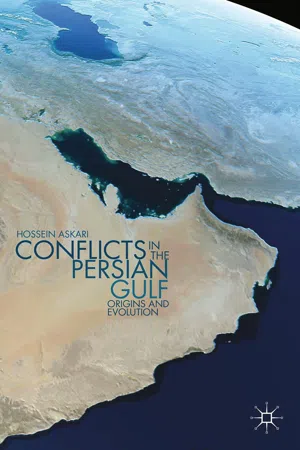
This book analyzes the origins of conflicts and wars in the Persian Gulf, assesses the common factor(s) that have been their essential fuel, determines their fallout for the political, economic, and human development of the region, and provides insight into how they may be better contained.
Information
Chapter 1
Catalogue of Persian Gulf Conflicts
Intrastate and interstate conflicts in the Persian Gulf have been numerous. Some conflicts originated centuries ago and are still intense in 2013. Many of the conflicts are multifaceted and interrelated. Conflicts are both within (interstate) and between countries (intrastate), although their manifestation may be dissimilar or nuanced from country to country. The origins of conflicts are varied and are attributable to a host of factors, including religious, sectarian, ethnic, and tribal feuds; disputes over borders, water rights, and other valuable natural resources such as oil and natural gas; political, social, and economic injustice, deprivation, and discrimination; foreign intervention; and past conflicts that encompass human fatalities, economic loss, and revenge. These disputes, in turn, lead to conflicts that take the form of non-armed and armed struggles and interstate and intrastate wars, with human, social, political, economic, and environmental costs that span generations, are kept alive, and are likely to spawn new conflicts years, decades, or even centuries into the future. The vast majority of conflicts are not new but have a history. They evolve and invariably elude easy reconciliation.
Just consider a partial list of the open conflicts of the past 30 or so years in the Persian Gulf: the Iran-Iraq War; the Iraqi invasion of Kuwait; the First Persian Gulf War; the Second Persian Gulf War; sectarian conflicts in Iraq; sectarian uprisings in Bahrain; sectarian demonstrations in Saudi Arabia; Saudi and Kuwaiti military intervention in Bahrain; territorial disputes between Iran and the UAE; a nuclear proliferation conflict pitting Iran against the other Persian Gulf countries, with strong implications worldwide; ethnic unrest in Iran; surrogate sectarian conflict in Lebanon; conflicts within the region’s Kurdish population and between Kurds and the central government in Iraq, Iran, Syria, and Turkey; and a sectarian conflict with ethnic overtones in Syria.
Add to this drawn-out catalogue of recent conflicts the extensive list of seemingly contained or “dormant” conflicts that include Iran’s historic claim over Bahrain, territorial disputes between Bahrain and Qatar, between Saudi Arabia and the UAE, between Saudi Arabia and Yemen, between Iraq and Kuwait, between Oman, Saudi, Arabia and the UAE, between Qatar and Saudi Arabia, between Oman and the UAE, between Iran and Iraq, and the dimension of conflicts within and between the eight countries of the Persian Gulf (with five of them small and sparsely populated—Bahrain, Kuwait, Oman, Qatar, and the UAE) becomes almost unimaginable. Given the vast size of proven oil (and gas) reserves and the likelihood that much more may yet be discovered under the waters and under the soil of the Persian Gulf, oil (and gas) reserves are the ultimate prize that have been, are, and will be in contention for a number of years to come. And with this prize up for grabs, foreigners—foreign governments, corporations, and individuals—are also implicated!
In the remainder of this chapter, we briefly catalogue the interstate and intrastate conflicts in the region, starting with the countries of the GCC (Bahrain, Kuwait, Oman, Qatar, Saudi Arabia, and the UAE), followed by Iran and Iraq. In our subsequent five chapters (chapters 2 through 6), we analyze in more depth the origins and evolutions of the region’s major conflicts. In chapter 7, we consider the role of foreign powers in generating conflicts, and in chapter 8 we examine the evolution and transformation of most conflicts to one that is centered on the control of, preferential access to, and distribution of resources. In chapter 9, we present a vision of how Islamic teachings could be helpful in developing a path of reconciliation toward reducing and eliminating conflicts, and in chapter 10 we present a summary and our conclusions.
Bahrain
Sectarian and Religious Conflicts
Sunni-Shia Dispute1
The Sunni-Shia dynamics in Bahrain is somewhat unique, because Shia constitute the majority of the Muslim population (approximately 65 percent) yet are subject to legal, political, and economic discrimination. Much like the Al-Sauds, the ruling Al-Khalifa family has done little historically to include and integrate Shia. With political, economic, and military backing from Saudi Arabia, the Al-Khalifas have continued to subjugate Bahrain’s Shia since the 1920s. Conflict between Sunni and Shia increased after the 1979 Iranian Revolution, brought a theocracy to power in Tehran, which in turn mobilized Shia throughout the Persian Gulf to protest their status and demand their rights. Violent protests increased in the late 1990s, when Bahrain “accused Iran of fermenting unrest among Shia and began arresting leading Shia figures.”2
In 2011, with the uprisings of the “Arab Spring,” Bahraini Shia staged large-scale protests against the Al-Khalifas. The Bahraini government requested troops and police from the GCC, which dispatched several thousand troops to put down the uprising on March 14. The following day, King Hamad of Bahrain declared martial law. To the outcry of the international community, the Bahraini regime enacted a brutal crackdown on peaceful and unarmed protestors during the three-month state of emergency, in which over 80 were killed and 2,900 were arrested, with many reportedly tortured.3 As Bahraini Shia continue to be subjugated by their government, continued conflict is inevitable.
Muslim and Christian-Jewish Dispute
Islam is the official religion of Bahrain under its state constitution, and the citizen population is 99.8 percent Muslim (excluding nonnationals). However, the constitution also provides for freedom of religion, with some limits. Non-Muslims are allowed to practice their religion freely in private, and can, with state approval, operate public centers of worship. Historically, there has been little, if any, conflict between Muslim and non-Muslim Bahrainis. Only about 50 Jews are native citizens of Bahrain, and in 2005 Houda Ezra Nonoo became the first female Jewish member of parliament in Bahrain.4 Alice Samaan, the current Bahraini ambassador to the United Kingdom, is Christian.
Ethnic Conflicts
Bahrain-Iran Dispute5
Bahrain was part of the Persian Empire in the seventeenth century and has been subsequently ruled by the Al-Khalifas since the eighteenth century. At times when the Al-Khalifas faced difficulties from the British, they approached Iran for assistance, and as a result Iran reserved a seat in parliament in the early 1900s for a representative from Bahrain. Given this past, “Iran has historically laid claim to the Bahraini Islands for both strategic and nationalistic reasons.”6 In 1970, Iran agreed to a commission to ask Bahrainis what they wanted. The UN Commission concluded that the majority of Bahraini citizens demanded sovereignty, and thus Tehran was forced to relinquish its claim on Bahrain.
In the wake of the 1979 Iranian Revolution, the Al-Khalifas began to view Iran and the rhetoric of the ayatollahs as a threat, and turned to the Al-Sauds for assistance. In 1981, a group of militants with alleged Iranian ties attempted a failed coup d’état, which the Al-Khalifas unofficially viewed as an attempt by Iran to overthrow their government, despite the fact that Iran denied all links with the militants.7 In response, the Al-Khalifas began to crack down on their Shia population,8 which would lead to a number of violent confrontations in the future.9
Tribal Conflicts
Al-Khalifa and Al-Thani Dispute10
In 1867, the Al-Khalifas of Bahrain fought against the Qatari Al-Thanis and their related tribes. The conflict was the most flagrant violation of the 1835 maritime truce established by the Gulf States, and was the only one to require British intervention. While the British had previously recognized Qatar as a Bahraini dependency,11 the conflict resulted in the recognition of the Al-Thanis as a semi-independent political unit, establishing them as rulers. A treaty was signed in 1868 forcing Bahrain to renounce claims of sovereignty over Qatar. This would begin a long legacy of border disputes between the two countries.12
Territorial and Resource Conflicts
Bahrain-Saudi Arabia Dispute
In the 1940s, tensions arose between Saudi Arabia and Bahrain over boundary lines, oil exploration rights, and ownership of the Al Baina Saghir and Al Baina Kabir islands. In 1941, the Bahrain Petroleum Company (BAPCO) was granted exploration rights in the Fasht Abu Sa’fah oil field, which Saudi Arabia disputed. On February 2, 1958, both countries reached a boundary agreement and settled on a joint development area for equal revenue sharing. In addition, Bahrain received Al Baina Saghir and Saudi Arabia received Al Baina Kabir. Today, Saudi Arabia and Bahrain are close allies, and have not sparred over territorial rights in some time.
Bahrain-Qatar Dispute
The dispute between Bahrain and Qatar over Al Zabarah and the Hawar Islands, located off the western coast of Qatar, has been one of the most complex and long-standing territorial disputes in the history of the modern Persian Gulf. It is also the only territorial dispute between two Arab countries to be resolved by the International Court of Justice (ICJ). The conflict, which lasted from 1936 until its resolution in 2001, was centered on a territorial dispute that included resource deposits and their development rights.13 The discovery of significant oil and gas reserves in 1980 led both countries to be more active in pursuing a resolution, which was aided by the creation of the GCC in 1981. While Bahrain wanted Saudi Arabia to mediate the dispute and keep it in the GCC, Qatar insisted on turning to the ICJ because of Bahrain’s closer relationship with Saudi Arabia. Due to number of roadblocks, the process took over a decade, and the ICJ finally reached a decision in 2001. The court granted the Hawar Islands and Fasht al-Jaradah to Bahrain, and gave control of Zabarah, Janan Islands, and Fasht al Dibal to Qatar. Both countries accepted the ruling, and have benefited from the exploitation of resources that have been discovered in their respective territories.14
Political-Social-Economic Conflicts
Bahrain’s unique circumstances have been shaped by two key factors, namely, the presence of a Shia majority ruled by a Sunni minority, and Bahrain’s dependence on Saudi Arabia for political, military, and economic support. Bahrain lacks the oil wealth of Kuwait, Qatar, and the UAE (Abu Dhabi), and thus has grown to be dependent on handouts from Saudi Arabia. However, this support is contingent on continued suppression of Shia in Bahrain, which the Al-Sauds use as a tool to...
Table of contents
- Cover
- Title
- Chapter 1 Catalogue of Persian Gulf Conflicts
- Chapter 2 Conflicts—Sectarian and Religious Disputes
- Chapter 3 Conflicts—Ethnic and Tribal Disputes
- Chapter 4 Conflicts—Territorial and Resource (Oil, Natural Gas, and Water) Disputes
- Chapter 5 Conflicts—The Impact of Governance, Underdevelopment, Deprivation, and Injustice
- Chapter 6 Conflicts—The Impact of Foreigners
- Chapter 7 Conflicts—The Fallout
- Chapter 8 Conflicts—The Evolution
- Chapter 9 Conflicts—Islam and Reconciliation
- Chapter 10 Conclusion
- Notes
- References
- Index
Trusted by 375,005 students
Access to over 1.5 million titles for a fair monthly price.
Study more efficiently using our study tools.
Frequently asked questions
Yes, you can cancel anytime from the Subscription tab in your account settings on the Perlego website. Your subscription will stay active until the end of your current billing period. Learn how to cancel your subscription
No, books cannot be downloaded as external files, such as PDFs, for use outside of Perlego. However, you can download books within the Perlego app for offline reading on mobile or tablet. Learn how to download books offline
Perlego offers two plans: Essential and Complete
- Essential is ideal for learners and professionals who enjoy exploring a wide range of subjects. Access the Essential Library with 800,000+ trusted titles and best-sellers across business, personal growth, and the humanities. Includes unlimited reading time and Standard Read Aloud voice.
- Complete: Perfect for advanced learners and researchers needing full, unrestricted access. Unlock 1.5M+ books across hundreds of subjects, including academic and specialized titles. The Complete Plan also includes advanced features like Premium Read Aloud and Research Assistant.
We are an online textbook subscription service, where you can get access to an entire online library for less than the price of a single book per month. With over 1.5 million books across 990+ topics, we’ve got you covered! Learn about our mission
Look out for the read-aloud symbol on your next book to see if you can listen to it. The read-aloud tool reads text aloud for you, highlighting the text as it is being read. You can pause it, speed it up and slow it down. Learn more about Read Aloud
Yes! You can use the Perlego app on both iOS and Android devices to read anytime, anywhere — even offline. Perfect for commutes or when you’re on the go.
Please note we cannot support devices running on iOS 13 and Android 7 or earlier. Learn more about using the app
Please note we cannot support devices running on iOS 13 and Android 7 or earlier. Learn more about using the app
Yes, you can access Conflicts in the Persian Gulf by H. Askari in PDF and/or ePUB format, as well as other popular books in Politics & International Relations & International Relations. We have over 1.5 million books available in our catalogue for you to explore.