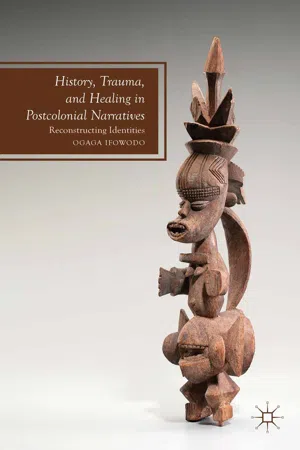
eBook - ePub
History, Trauma, and Healing in Postcolonial Narratives
Reconstructing Identities
- English
- ePUB (mobile friendly)
- Available on iOS & Android
eBook - ePub
About this book
What would it mean to read postcolonial writings under the prism of trauma? Ogaga Ifowodo tackles these questions through a psycho-social examination of the lingering impact of imperialist domination, resulting in a refreshing complement to the cultural-materialist studies that dominate the field.
Information
1
Into “the Zone of Occult Instability”
Frantz Fanon, Postcolonial Trauma, and Identity
If the eighties were the decade of Frantz Fanon’s emergence as a “global theorist” amenable to any theoretical postulations on the postcolonial condition and the universality of oppression, as Henry Louis Gates suggests in his essay, “Critical Fanonism,”1 then it is no coincidence that I should have encountered Fanon for the first time in that fortuitous epoch precisely in 1987, as a sophomore in law at the University of Benin in Nigeria. As part of my initiation into the Cultural Awareness Club—a radical campus group actively involved in the national student movement and the successor to its banned predecessor, the League of Patriotic Students—I was given a list of books that were compulsory reading for every new member. Fanon’s The Wretched of the Earth was among the top five on the list, the others being Karl Marx and Frederick Engels’s The Communist Manifesto, Walter Rodney’s How Europe Underdeveloped Africa, Engels’s The Origin of the Family, Private Property and the State, and Paul Frère’s Pedagogy of the Oppressed. Somehow I never got around to reading the last book. Boasting no previous familiarity with sociopolitical theory other than what I had gleaned from the newspapers, especially the views of the Nigerian and African writers toward which my budding love of poetry and writing had inclined me, this was indeed an epochal moment for me. Moreover, as fate would have it, I entered the university at the same time that the resistance to military dictatorship, which had resulted in the proscription of national and local student union activity, had taken on the spirit of defiance such that, while still insisting on its ban on the National Association of Nigerian Students, the military regime of the day had nevertheless conceded the resumption of local union activity. At my university, agitations had forced the administration, after several subterfuges, to allow an election.
As it happened, however, most of the previous members of the Cultural Awareness Club under its old name had been banned from participating in student union elections. Not deeming it a worthy battle to fight to lift the ban before we could have our union back, it was decided that we would field candidates principally for the position of secretary-general but also for any other position for which we had enough bodies from among the new members. I was persuaded, against my protests of not being ready so soon to take up a position of leadership in the highly political and risky business of student unionism in a neocolonial outpost, to run for the office of secretary-general. Lacking the resources that other individuals and campus interest groups seemed to have in abundance, we began to campaign rather late but managed to put up posters and distribute leaflets just two days before the election. But this is where I “appropriated” the revolutionary Fanon of The Wretched of the Earth and Toward the African Revolution, the one unsoiled by the “petit-bourgeois stink”2 Cedric Robinson believes taints Fanon’s first work, Black Skin, White Masks, a book I would not even read until a full fifteen years later. The only distinguishing feature of a hurriedly produced campaign poster was Fanon’s famous words: “Each generation must out of relative obscurity discover its mission, fulfill it, or betray it.” Two other Fanonian staples made up the handbill: “Every onlooker is either a traitor or a coward,”3 and “The future will have no pity for those men who, possessing the exceptional privilege of being able to speak words of truth to their oppressors, have taken refuge in an attitude of passivity, of mute indifference, and sometimes of cold complicity.”4 I won the election handily, with the revolutionary Fanon enough, it seemed, to rally the student voters to our side.
But in this book, it is the Fanon of Black Skin, White Masks, whom I discovered a full decade and a half later, that I have been more eager to summon. My title, in particular the word trauma, discloses the reason I should find this work more relevant to my present purposes. I propose to read postcolonial history as a history of trauma—as not just the devastating record of imperialist conquest and domination, and so the empirical damage on the materialist plane, but also that of the arguably more catastrophic injury to the psyche of the colonized. The psychological aspect of the wound of colonialism, I argue, speaks more directly to the problem of postcolonial identity, of the struggle to recover individual and collective identities shattered by the massive blows of slavery and colonialism, than is generally acknowledged. But this task, if it is to attain its aim, must link the phenomenal and the epiphenomenal dimensions of the trauma of colonialism. To make that link, I argue, one must be armed with an adequate theory of reference made possible only through a return to the social basis of language. As the first black thinker to point to the inescapably fused nature of the task, Fanon becomes relevant to my goal of asserting the indispensability of identity politics to the struggles of the postcolonial subject. In the Preface, I made reference to his bold but mostly unheeded claim that “only a psychoanalytical interpretation of the black problem can lay bare the anomalies of affect that are responsible for the structure of the complex.”5 Implicit to Fanon’s insistence on a sociodiagnostic methodology in that regard is the claim developed in the analyses of my primary texts that every trauma refers to the socially lived world of the historical event that caused it (which may also be repeating the trauma in new ways). But Fanon tends to be stripped of cultural specificity, often in order to summon him to all kinds of promiscuous projects, not least the anti-identitarian one. The thrust of this chapter in which I argue the necessity of a return to the psychoanalytic Fanon is to answer the question, Why that Fanon? I will begin then with the controversy over the “proper” way of appropriating Fanon in order to clear the ground for my “appropriation” of him not as an untethered global theorist of oppression but as a socially located insurgent, equal parts theorist and activist. Despite claims to the contrary by deconstructionists and materialists alike, I argue it is far from the case that the psychoanalytic approach Fanon favors is incompatible with the aims of a salutary identity politics. This is shown, among other ways, by the emphasis Fanon lays on the racial ideology that subtended the colonial project of subjugation and dispossession. A related aim is to show the precise manner in which I delineate a sociodiagnostic mode of reading Fanon, in the light of his revisionist psychoanalysis, to make him amenable to the Freudian concept of trauma that forms the theoretical fulcrum of my analysis. As a result, this exercise delves rather too deeply into the arena of the discursive battles fought with Fanon as standard bearer, but it seems to me that this is necessary, especially given the dominance of the postmodernist celebration of radical indeterminacy as well as disavowal of identity and linguistic reference by some of the most influential theory “warriors.” In other words, because of the paucity of critical interventions that take up in any meaningful way the gauntlet of Fanon’s call for a psychoanalytical interpretive framework, the way to delineating that mode of inquiry lies mainly in showing how not to do so, even when the appeal is ostensibly to the Fanon of Black Skin, White Masks or “Colonial War and Mental Disorders.”
Would it be right then to conclude that I have abandoned the revolutionary Fanon, that my project is no more than a “class-specific initiative”6 as Robinson might say? And are there really two Fanons—the one revolutionary and the other compromised by class ideology and by political immaturity? Of course, in invoking Fanon for the urgent political needs of a student movement battling an unconscionable military dictatorship, I could not be accused of the sort of discursive appropriations of his theory that Gates and Robinson deplore and from which Tony Martin felt called upon to “rescue” him as early as 1970.7 Ironically, Gates himself would be charged by Robinson with an antirevolutionary appropriation of Fanon in his essay under reference plainly titled, “The Appropriation of Frantz Fanon.” The range of rather unlikely places where Gates finds that Fanon is unhesitatingly drafted into battle is indeed fascinating. From British romanticism and the interdisciplinary practices of the new historicism to rereadings of the Renaissance, it has been possible, Gates informs us, to call Fanon to duty in the service of “a grand, unified theory of oppression.” While the insurrectionary force of Fanon’s theory and its resultant universal appeal may be a source of pride to many who labor in the salt mines of minority and ethnic studies, something of academia’s internal colony, any such pride comes however with the inescapable price of popularity or the chic factor. Fanon, Gates charges, is too often adopted “as both totem and text,” as a global theorist in vacuo denied “his own historical particularity” inescapably marked by his personal crisis of identity. Surprisingly though, it is not the “outside” appropriators that Gates is most troubled by8 but those launched by Fanon’s legitimate postcolonial heirs: “If Said made of Fanon an advocate of post-modern counter-narratives of liberation; if JanMohamed made of Fanon a Manichaean theorist of colonialism as absolute negation; and if Bhabha cloned, from Fanon’s theoria, another Third World post-structuralist, Parry’s Fanon (which I generally find persuasive) turns out to confirm her own rather optimistic vision of literature and social action.”9
Gates declares an “extremely limited” goal of providing a prelude to a reading of Fanon through contemporary colonial discourse theory and, with the benefit of his own readings of several of today’s most influential postcolonial theorists, attempts to show us the pitfalls of an uncritical Fanonism. Or more specifically, Gates shows us the propensity to succumb to “the imperial agenda of global theory” and, consequently, to “elevate” Fanon above his localities of discourse—thereby disregarding the lesson of his disclaimer that he was irreducibly a man of his time and certainly not a visionary of the world to come. Gates regrets that in the context of the fraught colonial binarism of the self/other, which Fanon devoted his short but prodigiously fruitful life to explaining and transcending, “we’ve seldom admitted how disruptive the psychoanalytic model can be, elaborating a productive relation between oppressed and oppressor—productive of each as speaking subjects.” The fault, Gates believes, lies in a tendency of postcolonial critics to conduct their inquiry entirely within “the colonial paradigm”; hence Gates urgently calls for us to move beyond “the colonial paradigm,” convinced that while it has proved valuable in foregrounding issues of power and position, it nonetheless has reached its limit. Thus it “may be time to question its ascendance in literary and cultural studies.”10
Robinson, on the other hand, thinks that Gates is as guilty of misappropriating Fanon as any of his immediate targets and, even worse, guilty of being an “anti-Fanonist.” Robinson considers Gates to be closer to Spivak and Bhabha, card-carrying members of the poststructuralist and deconstructionist school of discourse whose project is necessarily “laced with aporias and disjunctures,”11 than Said, JanMohamed, and Parry who, according to him, represent what Fanon embodied, which is “the sustained attempt to locate and subsequently advertise a fixed and stable site of radical liberationist criticism and creativity.”12 For a moment, it would seem Robinson and Gates believe in the same thing: reinscribing the specificity of time and place from which Fanon did the difficult work of interpreting the troubling colonized-colonizer relationship. But since Gates’s own poststructuralist sympathies lead him toward the aporetic, it would seem that he desires Fanon’s specificity only to repudiate it by emphasizing those inchoate moments in his biography and theory that subvert particularity. So Gates states as follows: “My claim is that what Jacques Derrida calls writing, Spivak, in a brilliant reversal, has renamed colonial discourse. So it is no accident that the two terms share precisely the same functionality. The Derridian mot, that there is nothing outside the text, is reprised as the argument that there is nothing outside (the discourse of) colonialism. And it leads, as well, to the argument that this very discourse must be read as heterogeneous to itself, as laced with the aporias and disjunctures that any deconstructive reading must elicit and engage.”13
If an awareness of what a deconstructive reading does to his larger claim of establishing Fanon’s historical particularity, of “rehistoricizing Fanon,” obliges Gates to call for the abandonment of the colonial paradigm, it is only to make it easier for us to admit just “how disruptive the psychoanalytic model can be,” especially how well it marks “the exceptional instability” of Fanon’s rhetoric—in short, to acknowledge Fanon as “a battlefield in himself” with all the terrifying vagaries and grave uncertainties that this metaphor evokes. It is no surprise, therefore, that Gates then goes on to propose “theoretical reflections [that] must be as provisional, reactive, and local as the texts we reflect upon.” But, surprisingly, Gates concludes that heeding his call will lead to the “recognition that we, too, just as much as Fanon, may be fated to rehearse the agonisms of a culture that may never earn the title of postcolonial.”14 Two things strike the reader here: Gates’s recommendation that we approach Fanon, in essence, as a text and that we abandon the colonial paradigm even when, according to him, we are to all intents and purposes still firmly entrenched within the colonial and may very well never transcend it. What explains this contradiction or—if you like—ambivalence? In disagreeing with Gates’s proposition here, my problem is not with the assertion that all knowledge claims, inside or outside of discourse, are provisional or contingent, but that Gates seems to assume the only discursive formation alive to the complexity or heterogeneity of issues of power and position in the postcolony is the poststructuralist or deconstructionist one; furthermore, that any theorist working within the colonial paradigm is bound to end up with the sort of unsophisticated Manichaeism that leads him or her to seek an immediate exit from “the ‘disciplinary enclave’ of anti-imperialist discourse.”15 For Gates, it seems, the only option available to anyone who wishes to recognize the density of the colonized-colonizer relationship, which constitutes the productive site of Fanon’s oeuvre, is the total rejection of the constricting colonial discourse paradigm in favor of an interpretive method hinged on indeterminacy—on aporia and disjuncture. To achieve Gates’s avowed aim of reclaiming Fanon’s (post)colonial identity without making him an eternally open text, even when adopting the psychoanalytic approach, is by and large the burden of this work as I hope to show in the rest of this introduction and in the subsequent chapters.
What is clear from the foregoing is that the slippery position Gates assumes in this essay appears to be the result of his wish to follow the Derridian prescript such that, as Robinson remarks, Gates’s “search for the real Fanon” takes him “from one interpretive text to the next text, from one clever exposition to its more clever critique.” The performance, Robinson adds, yields “only the fascination of exposition” and results in a Fanon who “can never have the gravity due to the real” and whose only “reward is to become another of those intriguing texts.” Continuing his critique, Robinson accuses Gates of wishing to “preserve and consume Fanon all in the same moment.”16 But Robinson appears too polemical in his response to Gates and seems too keen to relegate the psychological mode of interrogating the postcolonial quandary to a subservient position in a way that creates a false dichotomy and disregards the significance Fanon attached to it. Robinson does not subordinate the psychological for the same reason that Gates elevates it—because it constitutes a disruptive model and so poses an effective antidote to a binary identity politics that ignores the “productive relation between oppressed and oppressor . . . as speaking subjects.”17 Yet it is not clear that “the mature Fanon turned away from psychoanalysis and its preoccupation with sexuality as the explanatory paradigm for the ‘Black problem,’” nor is it clear that the psychoanalytic approach is averse to the project of inscribing “the fixed and stable site of radical liberationist criticism and creativity,” whatever this means. For we may ask, are there ever any such fixed and unchanging points of intellectual engagement, and can we insist on them without waxing nostalgic about the good old days of essentialist discourse? Far from turning away from psychoanalysis, Fanon’s entire work began and ended on that note: starting with Black Skin, White Masks and ending tellingly with “Colonial War and Mental Disorders,” the closing chapter of The Wretched of the Earth in which he examines various manifestations, during the “period of successful colonization,” of the “regular and important mental pathology which is the direct product of oppression.”18 Any reader not turned off by the purported “petit-bourgeois stink” of the psychoanalytic will find its traces scattered all over the work in between. Indeed, Fanon’s remark that perhaps his closing chapter of The Wretched would be found “ill-timed and singularly out of place” but that “we can do nothing about that”19 ought to caution against the inclination to make the ps...
Table of contents
- Title Page
- Copyright Page
- Dedication
- Contents
- Preface
- Acknowledgments
- 1. Into “the Zone of Occult Instability”: Frantz Fanon, Postcolonial Trauma, and Identity
- 2. Identity or Death! The Trauma of Life and Continuity in Wole Soyinka’s Death and the King’s Horseman
- 3. Experience as the Best Teacher: Trauma, Reference, and Realism in Toni Morrison’s Beloved
- 4. “Till the Wound and the Word Fit”: Healing the Postcolonial Body Politic in Derek Walcott’s Omeros
- 5. Conclusion: Reading Postcolonial History as a History of Trauma: The Corruption Complex
- Notes
- Bibliography
Trusted by 375,005 students
Access to over 1.5 million titles for a fair monthly price.
Study more efficiently using our study tools.
Frequently asked questions
Yes, you can cancel anytime from the Subscription tab in your account settings on the Perlego website. Your subscription will stay active until the end of your current billing period. Learn how to cancel your subscription
No, books cannot be downloaded as external files, such as PDFs, for use outside of Perlego. However, you can download books within the Perlego app for offline reading on mobile or tablet. Learn how to download books offline
Perlego offers two plans: Essential and Complete
- Essential is ideal for learners and professionals who enjoy exploring a wide range of subjects. Access the Essential Library with 800,000+ trusted titles and best-sellers across business, personal growth, and the humanities. Includes unlimited reading time and Standard Read Aloud voice.
- Complete: Perfect for advanced learners and researchers needing full, unrestricted access. Unlock 1.5M+ books across hundreds of subjects, including academic and specialized titles. The Complete Plan also includes advanced features like Premium Read Aloud and Research Assistant.
We are an online textbook subscription service, where you can get access to an entire online library for less than the price of a single book per month. With over 1.5 million books across 990+ topics, we’ve got you covered! Learn about our mission
Look out for the read-aloud symbol on your next book to see if you can listen to it. The read-aloud tool reads text aloud for you, highlighting the text as it is being read. You can pause it, speed it up and slow it down. Learn more about Read Aloud
Yes! You can use the Perlego app on both iOS and Android devices to read anytime, anywhere — even offline. Perfect for commutes or when you’re on the go.
Please note we cannot support devices running on iOS 13 and Android 7 or earlier. Learn more about using the app
Please note we cannot support devices running on iOS 13 and Android 7 or earlier. Learn more about using the app
Yes, you can access History, Trauma, and Healing in Postcolonial Narratives by O. Ifowodo in PDF and/or ePUB format, as well as other popular books in Social Sciences & World History. We have over 1.5 million books available in our catalogue for you to explore.