- English
- ePUB (mobile friendly)
- Available on iOS & Android
eBook - ePub
About this book
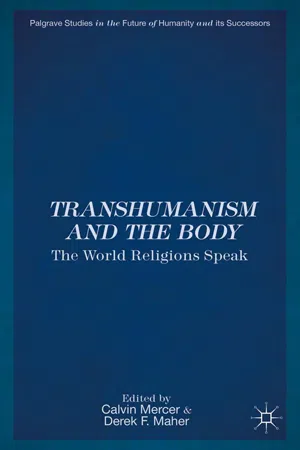
This collection of original articles, a sequel of sorts to the 2009 Religion and the Implications of Radical Life Extension (Palgrave Macmillan), is the first sustained reflection, by scholars with expertise in the faith traditions, on how the transhumanist agenda might impact the body.
Information
Topic
Ciencias socialesSubtopic
Ética y filosofía moralC h a p t e r 1
Buddhism: The Transformed Body in Buddhism
Derek F. Maher
BUDDHISM AROSE IN A HISTORICAL PERIOD THAT ALSO SAW THE EMERGENCE of both a world-denying asceticism and a well-developed system of yoga. Indic religions during the Upaniṣadic period (tenth to fourth century BCE) were grappling with an array of questions concerned with how the body should be regarded: Is there some form of continuing existence after the body dies? Does liberation lie along a path of renunciation that eschews the physical and mortifies the bodily form? Is the deepest identity, the self (ātman), physical (the Jain view) or does it exist only beyond the body (a dominant Hindu view)? Does the religious path require celibacy or a full embrace of the family life?
The Buddha (fifth century BCE) himself and his successors who systematized his views developed a rival religious model that participated in the discourses about physicality in the broader Indian communities, but which elaborated a distinctive Buddhist perspective on the body. These early views are evident in the narratives and metaphors found in the Buddhist scriptures, including the suttas of the Pali Canon and the Jataka Tales purporting to describe the Buddha’s previous incarnations. In time, as distinct philosophical schools endeavored to develop systematic presentations of Buddhist soteriology and epistemology, more complex and refined conceptions of the body were developed. In subsequent centuries, new depictions of the body came to prominence as Buddhism contended with alchemical and tantric models and as Buddhism moved along trade routes to encounter indigenous ideologies across Asia. This entire heritage shapes how contemporary Buddhists think about and react to the futuristic developments unfolding in modern biomedicine, including those extraordinary advancements championed within the movement known as transhumanism.
How Early Buddhists Understood the Body
Prior to his enlightenment, the Buddha experimented with practices of self-mortification and austerities, including starvation practices, as he participated in a vigorous and multifaceted ascetic movement. In the end, he advocated a middle path between those rigorous self-abnegations and the self-indulgence that had characterized his pampered youth as a prince. The life he lived during his 45 years of ministry after becoming a Buddha offered a paradigm for his followers in which a reserved, modest, and calm disposition were to be combined with a sustained and rigorous contemplative life, with the corporeal appetites to be tamed through the cultivation of a celibate monasticism. This way of being, in turn, was considered to be the means of enabling practitioners to overcome afflictive attachment and to manifest a moral life, both regarded as necessary to the achievement of higher insights. The basic disposition toward the body that is evident in Buddha’s life is that it was a mere vehicle in service of the real work of a largely interior spiritual life. Although he had earlier engaged in physical practices, his final enlightenment is not attributed to them. Still, early Buddhism recognizes the importance of the body, both as a potential obstacle to wisdom in that the pursuit of bodily pleasures could distract the mind from Buddhist values and as a possible tool to advance religious aims through the performance of meritorious activities.
Upon the Buddha’s death, his body was cremated, and reverential funeral ceremonies were conducted. His physical remains were parceled out among eight patrons and supporters, who constructed stūpas or monuments housing the remains in the disparate places where the Buddha had developed support.1 The presence of the Buddha’s bodily remains in these places mapped them onto the Buddhist topography, transforming them into lands where Buddhism could safely flourish. As the teachings of the Buddha continued to spread in the following centuries, the form of Buddhist religion transformed from one characterized by disorganized groups of wandering mendicants to institutional monasticism requiring patronage and infrastructure on a grand scale. Narratives about the Mauryan king Aśoka (third century BCE) depict him as embracing Buddhism and working tirelessly to extend its influence throughout his kingdom, which occupied the vast majority of the Indian subcontinent. A key expression of his extension of Buddhist religious authority throughout the kingdom is found in the claims that he opened those earliest stūpas, recovered the Buddha’s bodily remains, and distributed them in 84,000 stūpas throughout the entire range of his lands and beyond.2
In essence, the presence of the Buddha’s body during his lifetime had made those places sacred. By depositing the bodily remains further afield after his death, King Aśoka rendered those new places as sacred Buddhist lands as well. Hence, even as a central message of the Buddha consists in denying the pleasures of the body and rejecting the pervasive attachment to it, early Buddhists constructed a significant part of their missionary activities around a reverence for the body of the Buddha, and pilgrimage to stūpas became a key practice among the laity.3
The suttas that record the Buddha’s words and the scriptures called the Vinaya that describe and justify the monastic code of conduct constitute two of the three central elements of the Buddhist canon.4 Both the suttas and the Vinaya articulate in detail early Buddhist attitudes toward the body, which, John Powers aptly notes, are diverse and ambivalent. The body is corrupt, disgusting, filthy, and yet provokes attachment due to its ability to provide pleasure.5
The second century scholar-adept Nāgārjuna reinforced the body’s negative side as a way to urge fidelity to the celibate life, saying, “Just as a fool lusts for an ornamented pot of filth, so foolish, deluded people lust for women.”6 His disciple and commentator, Āryadeva, wrote:
Since a woman and an outhouse
Are both containers of filth,
Someone who knows the truth
Would not eagerly desire her.7
Some have seen misogyny in these depictions of women’s bodies,8 but it may be that the authors’ characterizations of the body were intended to be understood as applying equally to all bodies; under this theory, the authors focused on female bodies simply because they were speaking to a mainly male audience, a male monastic audience at that.
However that may be, there is a pronounced trend in Buddhist literature to emphasize the fetid and corrupt nature of the body as a way to help readers disengage from idealizing the body and its pleasures. People endeavor to train their minds by meditating on the body in this light. Likewise, practices such as the sky burial performed in Tibet, in which an individual volunteers to cut up the community’s corpses and feed the pieces to birds, provide the person with an opportunity to meditate on the impermanence of all phenomena. (Such an attitude toward a dead body is in sharp contrast to the treatment of corpses and the understanding of the body in the afterlife that is found in other religions, particularly the Abrahamic monotheistic religions.) Speaking more broadly, such activities are regarded, within Buddhism, as therapeutic methods of training the mind to reinforce attitudes that are regarded as salutary and to dislodge habitual patterns of thought that are seen as harmful to spiritual practice. These practices are meant to negate the default position of being enchanted by and obsessed with physicality.
With the full development of institutional monastic Buddhism, authorities worked diligently to structure the lives of celibate monks so as to prevent them from straying from their renunciation of the worldly life of a householder. Both the rules embedded in the monastic code and the narrative exhortations found in inspirational literature sought to encourage monks to maintain a life of restraint. Monks and nuns were enjoined to walk calmly, to avoid being overly expressive, to resist swinging their arms about, to carry a dignified and sober bearing, and to remain mindful of their behavior at all times. Monastic rules place all manner of restrictions on touching one another, playfulness, tickling, and other forms of contacts that might stimulate sexual arousal or be regarded by others as leading in that direction. Monastics were prohibited from any kind of sexual conduct, and the Vinaya is replete with detailed and explicit rules forbidding all manner of penetration, stimulation, emission, fantasy, and sexual contact with people, animals, and objects. Lay people, too, are encouraged to cultivate a life in which the appetites and the passions do not rule excessively. However, for monastics, these rules are of the utmost importance as they help to create an environment that is conducive to cultivating Buddhist values and virtues.9
Transformations of the Body and Mind
Despite the negative perspectives on the body, Buddhist literature also repeatedly argues that it is through training the mind and disciplining the body that higher states of awareness can be achieved. The yoga tradition that eventually came to be associated so thoroughly with Hinduism is explicitly concerned with creating a harmonious union between the body and the mind. Indeed, the word “yoga” derives from the verbal root yuj, an Indo-European derivation, which means to join or unite, as in, to yoke two oxen together. Although beginning with the Buddha himself, Buddhists did not embrace the most physical manifestations of yoga and place it at the center of their practice, as was the case with Hinduism, yoga, physical practices, and a concern for a healthy physical form continued to arise in Buddhism in various forms.
Breathing meditation and mindfulness practices, both prominent Buddhist preoccupations, induce the practitioner to train the mind through maintaining deep attention to aspects of the body. Some forms of movement practices, akin to yoga, are cultivated in forms of Buddhism found in Tibet, China, and Southeast Asia, both as companions to contemplation and as methods of healing. Martial arts are often connected to Buddhism, from Shaolin Monastery in China to the samurai of Japan. But it is within Buddhist tantra that the body is most evidently understood to provide a route to spiritual enrichment.
The broad outlines of Buddhist tantra and a complex tantric physiology partly borrowed from yogic ideologies, provides the narrative framing for understanding processes of spiritual transformation that lead from the afflicted states of being, bound by ignorance, all the way to the exalted state of a fully perfected Buddha. The yogic body of a human, interwoven within the coarse physical body, is thought to have 72,000 nonphysical channels (nāḍī) embedded within it in a network of relationships. Within those channels, subtle energies called winds (prāna) course in purposeful controllable fashions. Consciousness rides on those winds as attention is directed throughout the yogic body. At specific locations within the yogic body, channels gather together creating points of intense power, called wheels (cakra). Embedded to the left and right along the central channel (avadhūtī) through the body, red and white drops (bindu)—originating from the parental sexual fluids in the procreative act—are distributed according to a complex tantric embryology. Tantric yoga involves the cultivation of control over the movement of these energies and the manipulation of the drops.
The processes of tantric practice, however, are not solely physical or even simply focused ...
Table of contents
- Cover
- Series Introduction
- Introduction—The Transhumanist FAQ: A General Introduction
- 1. Buddhism: The Transformed Body in Buddhism
- 2. Daoism—Enhancing Cosmic Energy: The Daoist Body in the Twenty-first Century
- 3. Hinduism: Many Paths, Many Births
- 4. Islam—God’s Deputy: Islam and Transhumanism
- 5. Jainism: The Good Life and the Transcendence of Death
- 6. Judaism—The Body Belongs to God: Judaism and Transhumanism
- 7. Mormonism—Suffering, Agency, and Redemption: Mormonism and Transhumanism
- 8. Protestant Christianity—Sorting Out Soma in the Debate About Transhumanism: One Protestant’s Perspective
- 9. Roman Catholic Christianity—Embodiment and Relationality: Roman Catholic Concerns about Transhumanist Proposals
- 10. Afterword—Concluding Reflections: Yearning for Enhancement
- Works Cited
- About the Contributors
- Index
Trusted by 375,005 students
Access to over 1.5 million titles for a fair monthly price.
Study more efficiently using our study tools.
Frequently asked questions
Yes, you can cancel anytime from the Subscription tab in your account settings on the Perlego website. Your subscription will stay active until the end of your current billing period. Learn how to cancel your subscription
No, books cannot be downloaded as external files, such as PDFs, for use outside of Perlego. However, you can download books within the Perlego app for offline reading on mobile or tablet. Learn how to download books offline
Perlego offers two plans: Essential and Complete
- Essential is ideal for learners and professionals who enjoy exploring a wide range of subjects. Access the Essential Library with 800,000+ trusted titles and best-sellers across business, personal growth, and the humanities. Includes unlimited reading time and Standard Read Aloud voice.
- Complete: Perfect for advanced learners and researchers needing full, unrestricted access. Unlock 1.5M+ books across hundreds of subjects, including academic and specialized titles. The Complete Plan also includes advanced features like Premium Read Aloud and Research Assistant.
We are an online textbook subscription service, where you can get access to an entire online library for less than the price of a single book per month. With over 1.5 million books across 990+ topics, we’ve got you covered! Learn about our mission
Look out for the read-aloud symbol on your next book to see if you can listen to it. The read-aloud tool reads text aloud for you, highlighting the text as it is being read. You can pause it, speed it up and slow it down. Learn more about Read Aloud
Yes! You can use the Perlego app on both iOS and Android devices to read anytime, anywhere — even offline. Perfect for commutes or when you’re on the go.
Please note we cannot support devices running on iOS 13 and Android 7 or earlier. Learn more about using the app
Please note we cannot support devices running on iOS 13 and Android 7 or earlier. Learn more about using the app
Yes, you can access Transhumanism and the Body by C. Mercer, D. Maher, C. Mercer,D. Maher in PDF and/or ePUB format, as well as other popular books in Ciencias sociales & Ética y filosofía moral. We have over 1.5 million books available in our catalogue for you to explore.