- English
- ePUB (mobile friendly)
- Available on iOS & Android
eBook - ePub
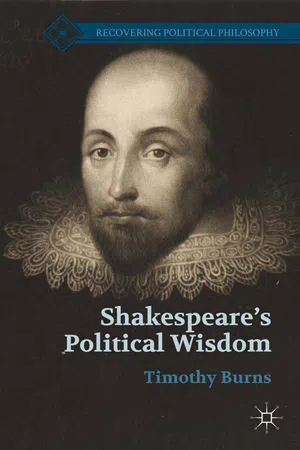
Shakespeare’s Political Wisdom
About this book
Shakespeare's Political Wisdom offers interpretations of five Shakespearean plays with a view to the enduring guidance those plays can provide to human, political life. The plays have been chosen for their relentless attention to the questions that were once and may sometime become, or be recognized as being, the heart and soul of politics.
Information
CHAPTER 1
JULIUS CAESAR: THE PROBLEM OF CLASSICAL REPUBLICANISM
Julius Caesar is Shakespeare’s masterpiece. In it he brings all of his gifts to bear on the problem that Aristotle presents as confronting political life at its peak—the problem of the outstandingly virtuous individual, and the dilemma that his rule poses to the life of virtue.1 In artfully presenting the drama of this problem as it confronted and was faced by noble Romans, Shakespeare affords his readers the means to reflect seriously on an issue that contemporary politics—the politics of indirect governance of allegedly sovereign individuals—veils from us. Our particular historical circumstances make the play’s probing drama more vital than ever to our understanding of the human condition.
* * *
We are confronted with the elements of the problem in the opening scene, in the actions and words of Flavius and Murellus, tribunes who prove in their relation to the commoners to represent two sides of the republican principle. Shakespeare’s use of them is daring inasmuch as they will never be seen again, their disappearance only remarked upon darkly in a subsequent scene. They are upset with the commoners for being idle and well-dressed on what is not a holy day but a laboring day. But when Murellus questions one of the commoners about his activities, he is unable even to understand him, despite the commoner’s effort to speak as Murellus would speak. The distinction between classes, and especially between the common people and all others, is prominent, and so then is the question of what Rome’s leaders have done and should do with and for the people, the many, in the republic. Caesar, we will learn, has been executing a plan for the commoners.
The cobbler, leader of the parade of commoners, has however his own plan. Through a series of puns we learn that he is a “mender of soles,” who leads the crowd into activities that cause their soles/souls to be in need of mending. Were the setting a Christian nation and the man a priest, we would have here a biting forerunner of Nietzsche’s presentation of the Christian priest as one who makes the souls of his flock sick in order to tend them. But this is pre-Christian Rome, and a priest is not yet the chief leader of the commoners. Another person is, and he seems by some to be now considered a god; the holiday (in fact, the Lupercal) is being celebrated to honor him. In the cobbler’s comic banter we get a whiff, in other words, of the Christian leadership to come, or a brief look at the shore to which Shakespeare bids adieu as he heads back to pagan Rome, where we find leaders of quite a different stamp—not proclaiming human guilt and a need to confess sins, nor counseling humility and meekness but instead pride and strength, bent themselves on achieving honor as a confirmation of their worth.
As we are immediately made to see, however, the mature and robust political life that characterizes leadership in the Roman republic is problematical. Murellus delivers (at 1.1.32–55) a harangue of the commoners in which he upbraids them for infidelity to, or loss of enduring gratitude for, Pompey. He bids them be gone, to run to pray that the gods might intermit a plague to punish their ingratitude. His warning of divine punishment seems as heartfelt as it is harsh. Flavius, on the other hand, is poetic rather than pious in his brief address to the commoners. And his poetic appeals are of a worldly but noble sort: he invites his “good countrymen” to weep into the Tiber their lowest stream of tears, so that it will end up “kissing the exalted shores [of Rome].” When he then asks Murellus for a disrobing of the images (1.1.65), Murellus shows that he fears any such impious act. Flavius insists, however, that the disrobing is a political matter, and that the vulgar must be driven from the streets. The reason he then gives for his objection to Caesar’s popularity differs strikingly from Murellus’s reason. Its basis is a noble pride: he does not wish to live in “servile fearfulness,” as he would were republican rule of equals to be lost. He says nothing of Pompey—whose rule would, of course, be as objectionable as Caesar’s in soaring too high.
We see from the start, then, a principled division in the political class, even among members of the tribunate. The two tribunes embody each a different principle of republican rule. On one hand the pious Murellus objects not to the imperial rule of Pompey but to Caesar’s ascent, precisely because it came at the cost of Pompey and his sons, to whose preeminence he shows no aversion and for whose just deeds on behalf of Romans he demands enduring gratitude from the people—a demand supported, in his mind, by divine justice. He demands that Romans accord the virtuous their just deserts, and since Pompey was most virtuous, honoring his successful opponent is unjust.2 Flavius, on the other hand, wishes to take action against Caesar on opposite grounds. When he looks up it is not to another human being nor to gods, but to Rome, the exalted city, whose members are equal. He would pluck the feathers from Caesar’s wings lest Caesar soar above the view of man and keep “us,” all others, in servile fearfulness. Flavius would rather die than submit to the rule of another man, be it of Pompey, Caesar, or any other. However beneficent their rule, he implies, it would render him and every other Roman a kept man, and destroy the legal equality on which depends the freedom that characterizes republican political life.
While Murellus stands, then, for just desert and hence for the rule of the most deserving, Flavius stands for freedom grounded in a rough equality of virtuous men—though a freedom, as is here manifest, that depends on those men not exploiting the desires of the commoners in order to gain authority over other virtuous men. These two principles of justice, honoring the most virtuous and equality in virtue, which guide republican Rome, sit together uneasily. Their tension drives the action of the play, disclosing a problem within justice that rises to the surface when political life produces an outstandingly virtuous human being.3
* * *
Having thus introduced the central problem to which the play is addressed, Shakespeare gives us, in scene two, our first of only three scenes in which Julius Caesar appears. The paucity of Caesar’s lines compels us to examine them closely if we are to understand the title character. But we must first pause and puzzle over the fact of this paucity. Most of the play involves not Caesar’s actions and words but a failed conspiracy and its aftermath, a conspiracy to eliminate him and thereby restore the republic that his rule threatens. Caesar is killed, but others take his place and defeat the conspirators. He lives on, as it were, in Antony and (eventually) in Octavius, or “Augustus Caesar.” And of course he lives on much longer, in the titles of subsequent Roman emperors (made permanent in Rome by Vespasian) and rulers elsewhere who aspired to his greatness: Czar, Kaiser, Qaisar-e-Ru-m, and so on. “We have no king but Caesar,” shouts the crowd of an outlying province to Pontius Pilate, 74 years after Julius Caesar’s death. Subsequent political life and perhaps all political life seems haunted by, or in some way to point to, Caesar as its peak and culmination; it points to the virtuous ruler who, being without peer, deserves to rule alone, and to an ambition to emulate his rule. Yet if he rules alone, he destroys political life properly speaking; he casts a shadow over the virtuous activities of others, who are unable to rule or to have their chance, their place in the sun, their opportunity to manifest virtue and thereby fulfill themselves through service to their city or country. Can it really be just, then, that such a one rule? We thus see a possible reason for the play’s title: Caesar is as much a central, problematic phenomenon of political life as he is a historical character or actual person, and as such deserves our attention.
The first word out of the mouth of the man Caesar is a call to his wife: “Calpurnia!” But the call is not an indication of any primary concern for his private life. On the contrary, it is a summons; Caesar’s verbs are all in the imperative. Wanting an heir, he summons his wife to enact a superstitious fertility ritual connected with the chariot race he is observing. As we will learn later, his apparent superstitious proclivity is a recent development, corresponding to his rise in public esteem. In his subsequent lines (1.2.13f.) Caesar gives more orders and refers to himself (when speaking to soothsayers) twice in the third person. His self-presentation is that of a man who is himself bigger than human, or who is aware and wishes that his public deeds hold at least highly unusual significance for their observers. And those around him appear in their remarkable deference to accept this, though the broader context (of the play and of the Roman plays collectively) makes this deference somewhat suspicious. We see and hear Antony, who appears utterly subservient, hearing and obeying, slavishly—yet this man will himself rule half the world, to be pulled away from that rule only by the beautiful Cleopatra. We see likewise Casca, who appears as another acolyte of Caesar but who is in fact ready to join a conspiracy against him, and who is known by at least one shrewd observer to adopt a simple or even a rustic simpleton’s demeanor in order to maintain an inner freedom.
And we immediately learn, from a private conversation that takes place while the public actions of Caesar continue in the background (1.2.25–50), that a deep discontent among Rome’s foremost citizens has set afoot the tentative beginnings of a conspiracy against Caesar. Cassius for some time has wanted to approach Brutus, but has been held back by Brutus’s behavior. He has found Brutus stubborn and strange to his “friend that loves him.” He suspects, we gather, that Brutus suspects him. (Caesar for his part, as we’ll see, does suspect Cassius.) But Cassius seems to have been mistaken about Brutus, who has been out of sorts indeed but for a different if related reason:
Vexed I am
Of late with passions of some difference,
Conceptions only proper to myself,
Which give some soil, perhaps, to my behaviors;
But let not therefore my good friends be griev’d
(Among which number, Cassius, be you one),
Nor construe any further my neglect,
Than that poor Brutus, with himself at war,
Forgets the shows of love to other men. (1.2.39–47)
Brutus is torn by some contradiction, which he doesn’t state but which Shakespeare gradually unfolds for us in Act I.
Reassured, Cassius begins his attempt to win Brutus over. Why he must do so becomes clear from the adjectives he uses to describe his friend: “Gentle Brutus . . . noble Brutus.” Cassius offers to be a mirror for Brutus’s soul, to supply him with self-knowledge, to show him his hidden worthiness. He fulfills the offer by first telling Brutus how highly others think of him and of how they, groaning under this age’s yoke, have wished that noble Brutus had the eyes to see the reflection of himself in them or in their longing for a savior. Brutus is the savior of suffering Romans. Can he not see this? Sensing what Cassius has in mind, Brutus warns him: it is not in me, and it is dangerous. Cassius must therefore establish his trustworthiness: he is not fickle or false when he declares his love or friendship, but is true. Brutus makes no reply.
For at this point the first shouts of the crowd are heard, and Cassius uses them in his efforts. “I do fear,” Brutus remarks, “the people choose Caesar for their king.” Cassius replies: “Ay, do you fear it? / Then must I think you would not have it so” (1.2.80–82). Here, then, is the first disclosure of the contradiction that has been troubling Brutus. He loves Caesar, which bespeaks Caesar’s worthiness of devotion, yet he would not have him king. This trouble reflects another in himself:
But wherefore do you hold me here so long?
What is it that you would impart to me?
If it be aught toward the general good,
Set honor in one eye and death i’ th’ other
And I will look on both indifferently;
For let the gods so speed me as I love
The name of honor more than I fear death. (1.2.83–89)
If Cassius’s plan with respect to Caesar is for the general good, the common good, Brutus will be indifferent to death or honor. Or rather, as he restates it, to death; he loves the name of honor more than he fears death. The tension between the first and second statements is not insignificant. It reflects a great difficulty for a noble man: he must be prepared, as virtue demands, to sacrifice even his life for the common good, yet would such a one be willing to sacrifice his honor, his virtue, for the common good? Can the honor that confirms the nobility of sacrificing oneself for the common good—can that common good—demand that he give up his virtue, that he become vicious? How could that be an honorable thing? And if it is, can a noble person do it? Or is his honor and virtue not emphatically his virtue, which he will not give up? But then is not the noble person really self-concerned, after all? Is there a genuine common good? Or does the city instead simply afford men the opportunity to obtain honor by manifesting their virtue? Surely in standing ready to serve what he holds to be the common good, Brutus is moved by the most just motive there is. His devotion to it, as he senses, makes him trustworthy, worthy of rule and of the people’s affection. But if his fundamental concern is with his own virtue and the honor that confirms it, then the deep devotion he believes himself to have, and to make him worthy of honor, is something he does not actually possess. (Cf. Aristotle, N. Ethics 1123b16ff.) His position would be similar to that of a lover who professes devotion to his beloved’s happiness but who would in truth be disappointed to learn that his beloved is quite happy when on holiday with others, since the lover wishes to be himself the source of that happiness. With such a dilemma besetting the moral life, it is little wonder that the noble Brutus is troubled.
Cassius attempts to win over the troubled Brutus by persuading him that Caesar is not worthy of ruling as he does. The attempt brings to light another aspect of the dilemma that besets both citizens. Cassius argues first against awe or reverence of Caesar, who is merely human. Freedom, self-rule, having a share in rule, requires a recognition of a fundamental equality. Caesar eats, and so on, like all humans, does he not? Both Brutus and Cassius can endure cold “as well as he,” no? If Caesar is a god, on the other hand, that makes Cassius a slave, a “wretched creature,” created as it were by Caesar; he’d be no more than what Caesar wants. Honor must be roughly equal, in other words, if there is to be freedom.
Yet Cassius’s examples immediately and as it were inevitably move from showing Caesar’s equality in virtue to revealing his deficiency in virtue. The claim against Caesar’s outstanding superiority leads to examples of Caesar’s comparative deficiency: I, Cassius, went into the Tiber and bid Caesar follow, and ended up saving him when he cried for help, carrying him on my shoulder like Aeneas. Cassius beautifully employs a Virgilian metaphor to make himself, over and against Caesar, appear to be the true emulator of the epic founder of Rome (1.2.112).4 Caesar is by contrast a feeble man, less worthy than Cassius. He is even a coward, crying like a girl when sick. And this wimp, Cassius protests, is being called a god? An immortal? Cassius expresses astonishment in the end not that a man should “bear the palm alone,” but that such a man should do so. He thinks, in other words, that a human being of superior virtue would indeed deserve to do so—that perhaps he himself deserves it—but Caesar is certainly not such a one. The movement of his argument indicates that as a title to rule, virtue points inevitably not to equality in rule among the virtuous but to the rule of the most virtuous simply, the virtuous without e...
Table of contents
- Cover
- Title Page
- Introduction
- 1. Julius Caesar: The Problem of Classical Republicanism
- 2. Macbeth: Ambition Driven into Darkness
- 3. The Merchant of Venice: Roman Virtue in a Christian Commercial Republic
- 4. King Lear: The Question of Divine Justice
- 5. The Tempest: A Philosopher-Poet Educating Citizens
- Notes
- Index
Trusted by 375,005 students
Access to over 1.5 million titles for a fair monthly price.
Study more efficiently using our study tools.
Frequently asked questions
Yes, you can cancel anytime from the Subscription tab in your account settings on the Perlego website. Your subscription will stay active until the end of your current billing period. Learn how to cancel your subscription
No, books cannot be downloaded as external files, such as PDFs, for use outside of Perlego. However, you can download books within the Perlego app for offline reading on mobile or tablet. Learn how to download books offline
Perlego offers two plans: Essential and Complete
- Essential is ideal for learners and professionals who enjoy exploring a wide range of subjects. Access the Essential Library with 800,000+ trusted titles and best-sellers across business, personal growth, and the humanities. Includes unlimited reading time and Standard Read Aloud voice.
- Complete: Perfect for advanced learners and researchers needing full, unrestricted access. Unlock 1.5M+ books across hundreds of subjects, including academic and specialized titles. The Complete Plan also includes advanced features like Premium Read Aloud and Research Assistant.
We are an online textbook subscription service, where you can get access to an entire online library for less than the price of a single book per month. With over 1.5 million books across 990+ topics, we’ve got you covered! Learn about our mission
Look out for the read-aloud symbol on your next book to see if you can listen to it. The read-aloud tool reads text aloud for you, highlighting the text as it is being read. You can pause it, speed it up and slow it down. Learn more about Read Aloud
Yes! You can use the Perlego app on both iOS and Android devices to read anytime, anywhere — even offline. Perfect for commutes or when you’re on the go.
Please note we cannot support devices running on iOS 13 and Android 7 or earlier. Learn more about using the app
Please note we cannot support devices running on iOS 13 and Android 7 or earlier. Learn more about using the app
Yes, you can access Shakespeare’s Political Wisdom by T. Burns in PDF and/or ePUB format, as well as other popular books in Politics & International Relations & European Literary Criticism. We have over 1.5 million books available in our catalogue for you to explore.