- English
- ePUB (mobile friendly)
- Available on iOS & Android
eBook - ePub
About this book
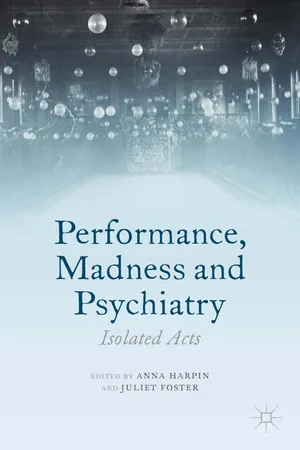
This exciting collection of essays explores the complex area of madness and performance. The book spans from the 18th century to the present and unearths the overlooked history of theatre and performance in, and about, psychiatric asylums and hospitals. The book will appeal to historians, social scientists, theatre scholars, and artists alike.
Information
Subtopic
Art GeneralSection IV
Theatrical Maladies
7
Ophelia Confined: Madness and Infantilisation in Some Versions of Hamlet
Bridget Escolme
I’m actually finding observing how toddlers behave in public helps more.1
Thought and affliction, passion, hell itself, she turns to favour and to prettiness.2
A friend once amused me with a tale about a drawing her daughter had made in kindergarten, in the weeks approaching one Christmas. The drawing depicted a tiny, prone human figure enclosed in some kind of cradle, surrounded by taller figures, towering above it. It was the kindergarten teacher’s habit to ask the children what their pictures represented, so that she could write explanatory titles on them. The little girl told the teacher that, in this drawing, ‘the baby Jesus is crying in the manger and they are all trying to calm him down’. The infant deity of Christianity and Renaissance art was reduced, or expanded, to a twentieth-century child’s experience of adult panic at a crying child and, perhaps, this little girl’s own experience of watching her peers being ‘calmed down’. The child’s drawing mapped itself comically back onto the Nativity, in its awareness of the extraordinary power of a seemingly helpless being. I recalled this anecdote when I first saw an image from the programme of Peter Brook’s 1955 production of Hamlet, in which Mary Ure, as Ophelia, flanked by Horatio (Michael David) and Gertrude (Diana Wynyard) and with Claudius (Alec Clunes) towering above, gazes up and away to her left as Gertrude holds her right wrist and looks at her, in her mad state, with an expression that could be read as pity or anxiety. The hold on the wrist seems to be a restraining one, as if Gertrude wants to calm Ophelia down and to prevent her hands from flailing too wildly. Ophelia’s fingers are spiky and open. Her frozen gesture does not read as natural: perhaps she is imitating a gesture she has seen elsewhere. The seeming tightness of Gertrude’s grip is the punctum in this photograph, to use Barthes’s well-known term; it breaks the studium of a compassionate court, all concern for a pitiful, mad child.3
Ophelia’s madness in this image is not distraught and angry – her expression is quizzical and childlike; she signifies madness by appearing, like Hamlet in Gertrude’s closet, to be focusing on something that is not there. She is not dressed in the elaborate, ruffed and buttoned-up Elizabethan costumes of the other characters but in a simpler black dress, her collarbone exposed, her hair down, like the Ophelia of Quarto One.4 She seems to be mad, then, because not conventionally dressed, not properly socialised – but also because she seems somehow to be imitating adult behaviour, as a child might in play, rather than fully and unselfconsciously embodying it. In appearing thus, paradoxically both more natural and more theatrical than the other figures in the image, she puts the conventions of their dress and their behaviour – and their attempts to calm her down – into challenging quotation marks. They look stilted and over-elaborate in comparison to Ophelia, as the adults in the little girl’s drawing looked comically large. As the central figure imitates their vocabulary of social gestures, their sanity is in danger of being exposed as mere social convention. The tense grip of Gertrude’s hand on Ophelia’s wrist suggests that the Queen senses the girl’s disruptive potential. Ophelia is both childlike and powerful: the child in the face of whose unpredictable disruptions the adults trying to calm her down are rendered helpless.
In this chapter, I am going to consider the performance of Ophelia in the light of ways in which the fools and the madmen and women of the early modern drama are depicted as childlike, and explore ways in which Ophelia is infantilised in nineteenth-century versions of the figure. I am then going to consider some recent productions of Hamlet. In three of them, I read Ophelia as trapped in and confined by her state of madness, in ways that tend to erase her as a disruptive force. The focus here is on Ophelia, but she might be used to explore the ways in which different historical periods have mapped their fears and wishes around children onto their fears and wishes around the ‘mad’. Something appears to be powerfully at stake in representing this young woman as childlike, calmable and containable.
Mary Ure’s costume in the Brook production encourages the contemporary viewer to read her as a particularly twentieth-century phenomenon. Her simple black dress, jagged fringe and loose hair are positively beatnik in comparison to the rigid Elizabethan dress code of those trying to calm her down. She recalls Nan, R.D. Laing’s coma patient, who was quiet and acquiescent before her brain damage, but who became quite a different person after her partial recovery. Laing argued that Nan’s carers constructed a new personality for her in response to her involuntary convulsions as she recovered, rewarding her for gestures that they read as witty and friendly until she indeed became a witty, friendly flirt. The image of Mary Ure’s Ophelia surrounded by a court that is at once both caring and oppressive appears to prefigure Laing’s emerging notions of mental illness as a reaction to society’s dysfunctional constructions of the self.5 But of course, the idea of madness being tightly bonded to social convention or its transgression is not unique to the mid-twentieth century. Is this an archetype produced by the 1950s, or can this mad Ophelia, disruptive and childlike, be read as coded in the historical play text? Elaine Showalter, author of the seminal essay ‘Representing Ophelia: Women, Madness and the Responsibilities of Feminist Criticism’ might argue that this question is beside the point. Her call to the feminist critic in 1986 was for an examination not of some originary Shakespearean Ophelia but of the representation of Ophelia in patriarchy, through history: ‘in English and French painting, photography, and literature, as well as in theatrical production’. Particularly, Showalter wanted to demonstrate ‘the representational bonds between female insanity and female sexuality’ and ‘the two-way transaction between psychiatric theory and cultural representation’.6 The two-way transaction between medical model and stage representation is one in which I too am interested. Questions of how ideas about insanity produce Ophelia and how Ophelia produces ideas about insanity are significant because of their very historical and cultural contingency. They do not turn upon doubtfully recuperable truths about an original stage Ophelia. However, I still want to privilege a notional ‘first’ Ophelia, one who can be partially reconstructed from text and early playhouse conditions, and to let her putative early performance and reception colour the study of madness, the childlike and the feminine that follows. Firstly, because in order to illuminate the ways in which history produces Ophelia, it is useful to return to a sense of the early material with which later iterations of the figure are working. Secondly, because speculation about the ‘early modern’ Ophelia offers a challenge to those across history who have sought to protect or redeem her from a range of sexual stereotypes. In doing so, I am going to argue that they have occasionally missed the challenge to those stereotypes she might actually offer a later period and its theatre.
The childish fool and madwoman
Over naturall fooles, children, or mad-men there is no Law, no more than over brute beasts; nor are they capable of the title of just, or unjust; because they had never power to make any covenant, or to understand the consequences thereof…7
The modern reader of Hobbes’s statement here might take it to mean either that children and madmen were rendered powerless by early modern society – they were considered of no more value in the law than beasts – or that the early modern period understood children and the mad as different from sane adults and thus in need of different kinds of care and protection. Beings for whom ‘there is no Law’ might be frighteningly lawless, or in need of protection that the law cannot give them, or in need of exception from the rigours of the law, as they do not ‘understand the consequences’ of their actions. They are both potentially dangerous and in want of compassionate care. In her mad state, in Hamlet 4.5, Ophelia is nearly prevented from coming on stage altogether. But she is finally allowed into the King and Queen’s presence, on Horatio’s warning that ‘’Twere good she were spoken with, for she may strew / Dangerous conjectures in ill-breeding minds’ (4.5.14–15). The impression is of the madwoman wandering about the Danish court, her movements and discourse dangerously unconfined. Both her entrances in 4.5 are pre-empted by the exhortation to ‘Let her come in’ (4.5.16, 152), begging the question of where she has been. Once she has entered, Gertrude and Claudius endeavour to calm this unnerving character down, using the soothing terms one might use to a child: ‘Nay, but Ophelia –’; ‘How do you pretty lady?’; ‘Pretty Ophelia!’ (4.5.34, 41, 56). Both her exits have a distracted illogic to them – she goes as abruptly as she comes: in the middle of the scene, she suddenly says goodbye to the ‘Sweet ladies’ of her imagination, prompting Claudius’s instruction to ‘Follow her close, give her good watch’ (74). Then an equally abrupt ‘God buy you’ marks her last exit (197). The exchanges between court and madwoman suggest that Ophelia is both childlike and powerful, in need of both care and containment.
The idea that those with mental disorders were regarded as more childlike than those not ...
Table of contents
- Cover
- Title
- Copyright
- Dedication
- Contents
- List of Illustrations
- Acknowledgements
- Notes on Contributors
- Introduction: Locating Madness and Performance
- Section I Historical Perspectives
- Section II Applying Performance
- Section III Contemporary Practices
- Section IV Theatrical Maladies
- Afterword: Relocating Madness
- Select Bibliography
- Index
Trusted by 375,005 students
Access to over 1.5 million titles for a fair monthly price.
Study more efficiently using our study tools.
Frequently asked questions
Yes, you can cancel anytime from the Subscription tab in your account settings on the Perlego website. Your subscription will stay active until the end of your current billing period. Learn how to cancel your subscription
No, books cannot be downloaded as external files, such as PDFs, for use outside of Perlego. However, you can download books within the Perlego app for offline reading on mobile or tablet. Learn how to download books offline
Perlego offers two plans: Essential and Complete
- Essential is ideal for learners and professionals who enjoy exploring a wide range of subjects. Access the Essential Library with 800,000+ trusted titles and best-sellers across business, personal growth, and the humanities. Includes unlimited reading time and Standard Read Aloud voice.
- Complete: Perfect for advanced learners and researchers needing full, unrestricted access. Unlock 1.5M+ books across hundreds of subjects, including academic and specialized titles. The Complete Plan also includes advanced features like Premium Read Aloud and Research Assistant.
We are an online textbook subscription service, where you can get access to an entire online library for less than the price of a single book per month. With over 1.5 million books across 990+ topics, we’ve got you covered! Learn about our mission
Look out for the read-aloud symbol on your next book to see if you can listen to it. The read-aloud tool reads text aloud for you, highlighting the text as it is being read. You can pause it, speed it up and slow it down. Learn more about Read Aloud
Yes! You can use the Perlego app on both iOS and Android devices to read anytime, anywhere — even offline. Perfect for commutes or when you’re on the go.
Please note we cannot support devices running on iOS 13 and Android 7 or earlier. Learn more about using the app
Please note we cannot support devices running on iOS 13 and Android 7 or earlier. Learn more about using the app
Yes, you can access Performance, Madness and Psychiatry by A. Harpin, J. Foster, A. Harpin,J. Foster in PDF and/or ePUB format, as well as other popular books in Media & Performing Arts & Art General. We have over 1.5 million books available in our catalogue for you to explore.