- English
- ePUB (mobile friendly)
- Available on iOS & Android
eBook - ePub
About this book
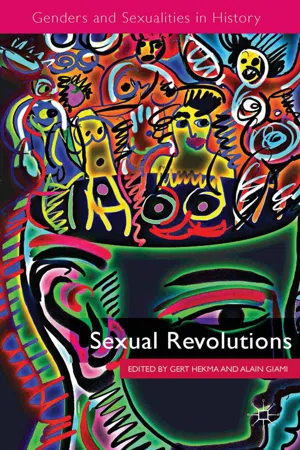
Sexual Revolutions explores the sexual revolution of the late twentieth century in several European countries and the USA by engaging with themes from sexual freedom and abortion to pornography and sexual variation. This work discusses the involvement of youth, feminism, left, liberalism, arts, science and religion in the process of sexual change.
Information
1
Sexual Revolutions: An Introduction
Preamble
The 1960s saw a series of events in Western countries that created new perspectives and practices regarding sexuality and brought a flood of eroticised texts and images into the public realm. This was the sexual revolution. Beginning early in the decade, Sweden saw debates on abortion, the Netherlands witnessed Provos that advocated general amoral promiscuity in 1965, England was host to a summer of love in 1967,1 Paris provided the setting for the May 1968 uprising and demonstrations which produced a pivotal image of the 1960s,2 and in 1969 New York’s Stonewall Inn became the symbol for gay liberation. The decade saw the ascendancy of the pill, pop music and festivals like Woodstock, feminism, homosexual emancipation and gay liberation, student revolts, sex shops and shows, girls without bras and with miniskirts, sexualised media and the TV that broadcast it all. Marriage and the nuclear family came under attack and people developed alternative relational models such as communal living and group sex. Nudity infiltrated theatre and ballet stages, cinemas showed Italian and German films containing sexual content, and the streets became the site for ‘streakers’. Pornography was liberalised in Denmark and later on in other European countries. Hippies were busy changing the cityscapes by sleeping in parks and public squares and shopping for food, clothing and drugs in countercultural circuits of squatted buildings such as in Copenhagen’s Christiana. The political landscape was transformed through organised social movements and demonstrations including Black Power and protests against Vietnam, colonial wars, and nuclear technology. Sexuality became politicised and society eroticised. Western countries made gigantic steps forward in the 1960s with an aperture, upsurge and liberation of sexualities.
The sexual revolution was about movements that politicised private and everyday life, subjectivity, the arts and culture as well as other terrains such as prisons, conceptions of justice, army and conscription, asylums, medicine, education, religion. In the 1960s, social movements were created alongside the sexual revolution that sparked a cultural revolution in the sense that many domains of existence were transformed. Some people applauded the sexual openness, the freedom of speech or the emancipation of female and gay sexuality; others decried the loss of traditional values, continuing sexism, growing consumerism, extreme individualism or unabated Puritanism. The authors of this book discuss the events and evaluations of the sexual revolution that go in their various trajectories.
Although many of these events and debates occurred throughout Western society, some remained more local. The sexual revolution was a patchwork of ideas, events, controversies and (broken) dreams, which makes it difficult to give a singular definition or to identify its main characteristics.3 Here we use the term to indicate important changes in sexual behaviours and beliefs that led to greater freedom and extended agency for individuals. As will be seen in this book, these terms guarantee complications. What promises more self-determination for one group may mean less for another. The new demand for sexual equality is beneficial for women and gay/lesbian couples, less so for heterosexual pairs who face gender inequality, and unfavourable for child or animal lovers whose relations are seen as inherently unequal. And one could question how much agency people who believe in innate drives and orientations actually allow themselves.
When it comes to time periods, many authors of this book see the revolution as a long-term development that started with the modernisation of sexuality at the end of the 19th century,4 or with the sexual reconstruction in post-war Western societies after 1945. There are also good arguments for seeing it as a short, radical phase in the late 1960s when a real sexual explosion took place, or for combining both periodisations. Regarding utopia and revolution, the former is more a question of imagining how things could be, and the latter how erotic ambitions are put into practice. This book is about both sexual realities and erotic dreams as the two are difficult to separate. Most authors agree that in the late 1960s something really changed both in sexual lives and values and we will give many examples in this collection.
There have been many books that touch upon issues of the sexual revolution, but remarkably few which have it as a main topic. Some concentrate on a single country or city, others on very relevant sub-topics such as abortion or the gay movement, but very few take a more encompassing perspective.5 In this introduction, we first discuss the history of utopian and radical thought on sexuality, secondly the changes that the sexual revolution created, and thirdly the political and theoretical critiques it received.
Sexual revolutions and utopias from the 18th to the 20th century
The early radicals: Sade and Fourier
There is a long series of authors who wrote about utopias, but they rarely addressed sexual issues or, like Thomas More and Francis Bacon, were harsh on sexual variation.6 It was only during the 18th-century Enlightenment that some authors broke the repressive hold that church and state had on sexual pleasure and developed more radical ideas, especially in France, the Dutch Republic and England. Starting in the 17th century, the work of Descartes and Spinoza and of the first pornographers suggested a break with a religious past.7 In England, authors such as Thomas Hobbes, Bernard Mandeville and Jeremy Bentham wrote in defence of sexual freedoms. According to Faramerz Dabhoiwala, together with poets, novelists and early feminists, they initiated a first sexual revolution mostly for well-to-do men and less for the poor, women or pederasts.8 In 1789, a radical change was taking place in France where the politically subversive work of pornographers, libertines and other authors such as Julien Offray de La Mettrie, Nicolas Edme Restif de la Bretonne and the philosophes laid the groundwork for the French Revolution.
The most important sex radical was Donatien A.F. de Sade (1750–1814), whose work was published after 1789. He denounced both the sexual morals of the Ancient Régime and Catholic church and of the enlightened philosophes, claiming that they did not go far enough. He strongly disliked the sexuality that most people practised, coital sex, and endorsed its opposite, sodomy (non-reproductive, particularly anal sex). At the time, sodomy was demonised by state and church alike while enlightened thinkers rather sought to prevent it.9 For Sade, sodomy was the most pleasurable of all practices and exemplary for all sexual variations – anal sex, shit, whipping and cruelty being prominent in his work. His rejection of church, state and family was materialised in an erotic interest in blasphemy, sodomy and incest. All sexual variations belonged to human nature so there was no reason to persecute them; he in fact suggested teaching these practices to adolescents. Sade’s work inspired many philosophers and artists in the twentieth century, including groups like the Surrealists, Situationists and Dutch Provos, and it has been read by many since the 1960s as pornography.10
In legal terms, the great revolution of the 18th century came as a result of the judicial philosophy of the Enlightenment: the change of criminal law. Instead of forbidding all ‘unnatural’ sexual acts under broad categories such as sodomy, the French Penal Codes of 1791 and 1810 strongly limited the number of ‘crimes against morals’ to rape, public indecency, the habitual debauchery of minors under 21 years (generally meaning bringing them into prostitution) and adultery by the female spouse.11 The enduring sexual legacy of the Enlightenment includes new ideas about nature, gender, privacy, identity and writing (novels, pornography). Sexuality became a natural drive (mostly in men while women should be chaste wives and mothers); citizens acquired freedom in private space, and sexuality developed into the deepest secret and truth of individual identity. While pornography mainly served subversive aims before the French Revolution, afterwards it was divided between high and low culture: at one end literature, and at the other end illicit erotica. The 18th century marked a first sexual revolution for straight men of fortune.12
After Sade, the next sex radical who inspired the youth of 1968 was Charles Fourier (1772–1837), whose Le nouveau monde amoureux was only published in 1967. For him, sex was an essential passion and he suggested a ‘rallying love’ that would not be monogamous and instead would build bridges between more people, thereby promoting social cohesion. Monogamy (egoism for two) and the nuclear family were selfish institutions that contravened social needs and sexual passions. He defended all erotic variations – in particular lesbianism – and gender equality. He suggested communal arrangements in ‘phalanstères’ where hundreds of people should live and work together and persons with special tastes fulfil their desires. Erotic passions should be experienced on a daily basis, possibly in bacchanals. Ugly and older people should also be entitled to sexual opportunities: social equality for the marginalised.13 Fourier has been cast aside by Marxists as a utopian socialist, but they should have taken sexual politics much more seriously. Engels in The Origin of the Family, Private Property and the State (1884) supported bourgeois sexual morality with the exception of gender inequality: women should be equal to men in socialism and men should become monogamous as women already were. Divorce would be allowed as an escape mechanism from unhappy marriages. These themes would be followed by most socialist sex radicals, some of whom might add, like Fourier, communal housing solutions.14
Beginning in the late 19th century, many authors started to write about and many people began to live ‘free loves’. This frequently meant that couples were not married, strived for equality and opposed traditional marriage and gender inequality. These open relationships often failed due to ingrained gender norms and external social pressure, but remained steadfast elements of anarchist-socialist utopias, as seen in the work of the French writer Ernest Armand (1872–1962) who not only wrote in favour of free love and open relations, but also created an organisation for travellers who could visit other members of his club and engage in sexual relations with them. He defended ideas of ‘sexual comradeship’, homosexual and inter-generational sex.15
Sexual reformism: science serving sexual justice
With the rise of sexology in the late 19th century, medical authors started to discuss sexuality and to voice liberal and reformist ideas on sexuality. Their assumedly objective, scientific approach made them propose humane ideas on sexuality; for example, Richard von Krafft-Ebing, Albert Moll, Havelock Ellis, Sigmund Freud and others. Society should accept sexual abnormalities, more as ways of being rather than of doing, and in case prevention and therapy did not work. Their approach stood in contrast to anarchist and socialist approaches that demanded social change in terms of a critique of capitalism rather than asking pity for ‘stepchildren of nature’ such as perverts and prostitutes. However, results might not be so different as most socialists saw sex work and perversion as decadent, capitalist ills.
The short-lived World League for Sexual Reform (1928–1935) is a typical example of the reformist approach. Led by leading sexologists Havelock Ellis, Auguste Forel and Magnus Hirschfeld, the League endorsed gender equality, legality of divorce, supported freedom of sexual relations between mutually consenting adults, and was in favour of preventing venereal diseases and prostitution. It proposed rational attitudes towards sexually abnormal persons (probably homosexuals) in spite of the leadership of the famous homosexual rights activist Hirschfeld.16
The nearly completely forgotten Frenchman René Guyon (1876–1963) took the opposite position and defended prostitution. This lawyer published six of the 11 volumes he had planned and wrote on topics like Sex Life and Sex Ethics and Sexual Freedom.17 Writing from a pragmatic rationalist perspective, sexuality consisted of mechanical acts that we should enjoy; abstinence or platonic (chaste) love was abnormal. Guyon strongly objected to Christian tenets that made sexuality problematic. He endorsed most sexual variations, including masturbation and homosexuality, with the only exception being the violent variants of sadism and masochism. As women have greater physiological capacities for sex, and are inferior, he views them as courtesans and slaves to man. For him, marriage and prostitution are similar: men pay women for sex. In his view, a desire for variation drives sexuality and therefore he does not believe in eternal love or monogamy. He combines a low regard for women with a strong defence of sexual pleasure. Guyon lived in Thailand for most of his life and contributed to the country’s law-making processes. He criticised both the League of Nations and the United Nations because their declarations on human rights left out sexual freedom, or only negated this, for example, with treatises on ‘white slavery’.18
The major author on issues of sexuality in the immediate post-war period was Alfred Kinsey (1894–1956). With his collaborators, he did the great sociological surveys of the white US population in which he strived for objectivity, but there remains a strong politi...
Table of contents
- Cover
- Title
- Copyright
- Contents
- List of Figures
- Preface
- Notes on Contributors
- 1 Sexual Revolutions: An Introduction
- 2 Sexual Liberalism in Sweden
- 3 The Long Sexual Revolution: The Police and the New Gay Man
- 4 A Radical Break with a Puritanical Past: The Dutch Case
- 5 Catholics and Sexual Change in Flanders
- 6 The Long History of the ‘Sexual Revolution’ in West Germany
- 7 Sexual Revolution(s) in Britain
- 8 The Revival of Sexuality Studies in France in the Late 1950s
- 9 Therapies of Sexual Liberation: Society, Sex and Self
- 10 ‘Something Much Bigger than Lust or the Struggle for Homosexuality’: The Ambivalent Sexual Emancipation of Daniel Guérin
- 11 The Gay Liberation Movement in France
- 12 Pornography, Perversity and the Sexual Revolution
- 13 ‘Sex Freedom Girls Speak Out’. Women in Sexual Revolution
- 14 The Sexual Revolution in the USSR: Dynamics Beneath the Ice
- 15 Abortion, Christianity, Disability: Western Europe, 1960s–1970s
- 16 Pedophilia, Homosexuality and Gay and Lesbian Activism
- Select Bibliography on Sexual Revolutions
- Index
Trusted by 375,005 students
Access to over 1.5 million titles for a fair monthly price.
Study more efficiently using our study tools.
Frequently asked questions
Yes, you can cancel anytime from the Subscription tab in your account settings on the Perlego website. Your subscription will stay active until the end of your current billing period. Learn how to cancel your subscription
No, books cannot be downloaded as external files, such as PDFs, for use outside of Perlego. However, you can download books within the Perlego app for offline reading on mobile or tablet. Learn how to download books offline
Perlego offers two plans: Essential and Complete
- Essential is ideal for learners and professionals who enjoy exploring a wide range of subjects. Access the Essential Library with 800,000+ trusted titles and best-sellers across business, personal growth, and the humanities. Includes unlimited reading time and Standard Read Aloud voice.
- Complete: Perfect for advanced learners and researchers needing full, unrestricted access. Unlock 1.5M+ books across hundreds of subjects, including academic and specialized titles. The Complete Plan also includes advanced features like Premium Read Aloud and Research Assistant.
We are an online textbook subscription service, where you can get access to an entire online library for less than the price of a single book per month. With over 1.5 million books across 990+ topics, we’ve got you covered! Learn about our mission
Look out for the read-aloud symbol on your next book to see if you can listen to it. The read-aloud tool reads text aloud for you, highlighting the text as it is being read. You can pause it, speed it up and slow it down. Learn more about Read Aloud
Yes! You can use the Perlego app on both iOS and Android devices to read anytime, anywhere — even offline. Perfect for commutes or when you’re on the go.
Please note we cannot support devices running on iOS 13 and Android 7 or earlier. Learn more about using the app
Please note we cannot support devices running on iOS 13 and Android 7 or earlier. Learn more about using the app
Yes, you can access Sexual Revolutions by G. Hekma, A. Giami, G. Hekma,A. Giami in PDF and/or ePUB format, as well as other popular books in History & Eastern European History. We have over 1.5 million books available in our catalogue for you to explore.