eBook - ePub
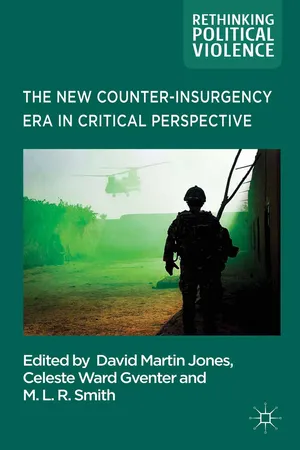
The New Counter-insurgency Era in Critical Perspective
- English
- ePUB (mobile friendly)
- Available on iOS & Android
eBook - ePub
The New Counter-insurgency Era in Critical Perspective
About this book
The notion of counter-insurgency has become a dominant paradigm in American and British thinking about the wars in Iraq and Afghanistan. This volume brings together international academics and practitioners to evaluate the broader theoretical and historical factors that underpin COIN, providing a critical reappraisal of counter-insurgency thinking.
Information
Part I
Counter-insurgency: History and Theory
1
Minting New COIN: Critiquing Counter-insurgency Theory
Introduction
Over the last half-decade, counter-insurgency (COIN) rose to prominence as the dominant paradigm in American and British thinking about the wars in Iraq and Afghanistan, and indeed for the presumed wars of the future. ‘COIN’ achieved such currency in the strategic community that it became more than a military doctrine, which is its nominal status. Instead, it became a universal panacea. It offered a strategy, a theory of warfare, a movement in defence and military circles, and a ‘how to’ guide for implementing an interventionist American and allied foreign policy, informed by a seemingly humanitarian orientation.1
In recent years, however, scholars have raised serious questions about the applicability of counter-insurgency thinking to Iraq and Afghanistan. Despite initial claims that implementation of a robust counter-insurgency was chiefly responsible for the decline in violence in Iraq in 2007–2008, there is growing acceptance that this explanation is, at best, incomplete.2 Observers have also noted that a variety of conditions in Afghanistan – including the absence of a competent and legitimate host government and the existence of insurgent sanctuaries in a neighbouring country – make counter-insurgency, as conventionally understood, difficult, if not impossible, to implement there.3 Partially as a result of these developments, COIN, like any intellectual trend, seems to have lost its lustre. For all the vast energy and money expended on fighting a series of counter-insurgency campaigns, the question is whether for all its initial promise COIN offers only meagre returns on such an enormous intellectual and monetary investment: mere pennies on the dollar?
But the theory and practise of COIN should end not with a whimper, but with a proper accounting of the past decade’s debates. This accounting should go beyond whether what we call COIN might be or, indeed, was effectively implemented in recent conflicts. It is also important to explore more deeply the origins and underpinnings of COIN and the reasons for its exceptional prominence in recent discourse. Given the significance of COIN, its undeniable impact on American and British security policy, and the inevitability of debate over future interventions, the theory itself merits closer scrutiny.
The debate will no doubt continue for some time, as the discourse of counter-insurgency and the terms of involvement in wars of choice appear with troubling regularity in Western military thought. This chapter is an attempt to begin a larger discussion by addressing a fundamental question: what is COIN? The examination begins by exploring whether counter-insurgency is a strategy, as has been asserted by many analysts and pundits. The analysis then proposes to examine the theoretical basis of counter-insurgency thinking and situate it in the context of military and strategic thought, pointing out some of the incoherence in COIN thought and practise. The study concludes with a discussion of the role that COIN has played in recent strategic discourse. Ultimately, this analysis suggests that the phenomenon of COIN, as it has been represented in contemporary debate in the Anglo-sphere, comprises a number of not entirely logically related features, but which when put together in a single package for public consumption enables a consoling narrative to be put forward that offers degrees of, not necessarily accurate, reassurance to be conveyed to both military and popular constituencies about the purpose of Western involvement in deeply problematic external entanglements.
Is COIN a strategy?
Since 2005 and in particular after the ‘Surge’ in Iraq in 2007, COIN became the defining orthodoxy governing the Western state military response to so-called low-intensity conflicts, small wars, and global asymmetric threats. Commentators widely discussed the concept of a ‘counter-insurgency strategy’. This phrase has been used extensively in the media and in larger discussions of US and allied approaches in Iraq and Afghanistan. A US Army War College workshop in 2007 was entitled ‘COIN of the Realm: US Counterinsurgency Strategy’.4 In 2009, The Guardian newspaper noted that ‘the US military commander in Afghanistan, General Stanley McChrystal, has quietly launched a new counter-insurgency strategy aimed at bolstering popular support for the government in Kabul’.5 The Obama administration famously debated, in late 2009, whether to ‘Surge’ in Afghanistan, and its two choices were presented as a ‘counterterrorism strategy’ or a ‘counter-insurgency strategy’.6 But what is ‘COIN’ and is it, in fact, a strategy?
In the broadest terms, inferring from the recent literature, it is reasonable to view COIN as an attempt to confound a challenge to established authority. This is a plausible though somewhat vague formulation. It contains the notion that an insurgency (from the Latin insurgo; insurgere to swell or rise up) is a challenge to the legally constituted government. It is not clear, however, from such a broad definition whether an insurgency has to be an armed challenge to authority. Can it be an unarmed challenge or even constitute any form of organised or disorganised dissent (occupying Wall Street or Greek workers demonstrating violently about budget cuts for instance)? The breadth of the definition worryingly connotes any potential opposition, peaceful or violent, as insurgent.
The terms insurgency and counter-insurgency are therefore generously wide in scope. Indeed, so all-embracing is the term, potentially, that any government, irrespective of its ideological and political composition, could be said to engage in permanent COIN to ensure the continuation of established authority. From such an all-inclusive perspective even non-authoritarian, democratic governments that wish to minimise discontent that might threaten their authority and legitimacy conduct counter-insurgency.
The US Army/Marine Corps Counterinsurgency Field Manual and its British counterpart are the most recent official articulations of COIN theory and helpfully offer more specific definitions. According to the Field Manual, an insurgency is a ‘movement aimed at the overthrow of a constituted government through the use of subversion and armed conflict’.7 Consequently, counter-insurgency is the ‘military, paramilitary, political, economic, psychological, and civic actions taken by a government to defeat an insurgency’.8 This at least offers some greater specificity. However, if we insert instead the less euphemistic word ‘combatant’ in place of the term ‘insurgency’ and ‘war’ in place of the term ‘counter-insurgency’, we would derive the following statement:
War involves military, paramilitary, political, economic, psychological, and civic actions taken by a government to defeat a combatant.
In this way we arrive at a definition that ironically applies to all war. Yet the doctrine outlined in the Field Manual also asserts a uniform military response. The document tells us that ‘most insurgencies follow a similar course of development. The tactics used to successfully defeat them are likewise similar in most cases’.9 In other words, the Field Manual, while ostensibly providing technical guidance, seems to maintain that counter-insurgency is a universal strategy. This leads, then, to the further question: does counter-insurgency, as the set of principles set out in publications like the Counterinsurgency Field Manual, and the British COIN manual, Countering Insurgency, represent a coherent strategy?
Broadly defined, strategy connotes the attempt to attain goals with available means.10 In a military context this entails the procedure by which armed force is translated into intended political effects.11 It is a process of thought that, while guided by certain understandings of military planning, is certainly not, or should not, especially in a functioning democracy of appropriate checks and balances, be determined by them. This is because strategy requires clear answers to the following existential questions: What are we fighting for? How can we use the means at our disposal to help attain desired outcomes? How will we know when we have achieved these outcomes? How can we attain these outcomes at proportionate costs and without causing further problems later?12
Somewhat problematically, neither US or British contemporary COIN manuals nor the commentary by COIN specialists address these strategic questions. The COIN handbooks in particular do not explain why coalition forces are fighting in Afghanistan or remained, until recently, in Iraq. They do not elucidate the political object of fighting or how to achieve strategic goals, however they might be defined. They do not identify what success entails or offer any method for assessing proportionality. These questions are not raised or answered precisely, it would seem, because they involve or require a political judgement.
Any such judgement would rely on assessments of how armed forces can be used in circumstances that will never be repeated. But contemporary COIN analysis is silent about the political intent informing the recourse to armed force. Counter-insurgency as an understanding therefore cannot be a strategy. This point will be elucidated further in the discussion below.
Understanding COIN
COIN as doctrine
If COIN is not a strategy, what is it? COIN, nominally, is military doctrine. According to the US military, doctrine constitutes the ‘fundamental principles by which the military forces or elements thereof guide their actions in support of national objectives … It is authoritative but requires judgment in application’.13 Doctrine seeks to develop a set of agreed-upon methods by which the military will conduct its operations and a common language for doing so. Military doctrine encompasses all facets of operational activity – maritime doctrine, air power doctrine, land warfare, and others.
But what, it may be asked, does doctrine mean? Significantly, the term itself derives from the tenets and structure of religious thought laid out in a set of practises, or doctrines, that the official priesthood inculcates as the correct or orthodox path of belief. At its core, then, doctrine is a system of faith, and faith ought by its nature to be unyielding. Hence we describe someone who is rigid and inflexible in their orthodoxy as dogmatic, or more accurately, doctrinaire.
Yet ‘war’, Carl von Clausewitz, observed, is ‘more than a true chameleon that slightly adapts its characteristics to any given case’.14 Clausewitz contended that all wars are exceptional in their origins, shape, and practise. They are sculpted by their time and place. What governs instances of war, and the way the observer perceives them, is always different, reflecting the contingent circumstances of each case. At the same time, Clausewitz also maintained that in its ultimate purpose war is the same, the pursuit of political ends through violent means.15 Yet its character is always distinctive, formed by a unique mix in each discrete conflict of the variables of time and place and the trinity of passion, chance, and reason.16 Here lies a paradox that confronts all strategic formulation: if all war is unique, how is it possible to plan for it? How can military planners and policymakers make stable assumptions about the likely course of future wars they might confront?
To reiterate, all war is unique, yet all doctrine is – in theory – fixed. This paradox, it seems, can never be fully resolved. The course of any war cannot be predicted beyond the Clausewitzian formula of a known set of independent variables (passion, chance, and reason), which regulate all war. Yet how those variables will interact in each unique circumstance of time and place is always unknown beforehand.
COIN, according to its exponents, is a doctrine derived from the observation of historical cases. The core instrumental assumption of contemporary counter-insurgency doctrine is that, Clausewitz notwithstanding, there are distinct ‘types’ of war that are rep...
Table of contents
- Cover
- Title
- Copyright
- Contents
- List of Figures and Tables
- Acknowledgements
- Notes on Contributors
- Introduction
- Part 01: Counter-insurgency: History and Theory
- Part 02: Counter-insurgency in Iraq and Afghanistan?
- Part 03: Questions about COIN after Iraq and Afghanistan
- Index
Trusted by 375,005 students
Access to over 1.5 million titles for a fair monthly price.
Study more efficiently using our study tools.
Frequently asked questions
Yes, you can cancel anytime from the Subscription tab in your account settings on the Perlego website. Your subscription will stay active until the end of your current billing period. Learn how to cancel your subscription
No, books cannot be downloaded as external files, such as PDFs, for use outside of Perlego. However, you can download books within the Perlego app for offline reading on mobile or tablet. Learn how to download books offline
Perlego offers two plans: Essential and Complete
- Essential is ideal for learners and professionals who enjoy exploring a wide range of subjects. Access the Essential Library with 800,000+ trusted titles and best-sellers across business, personal growth, and the humanities. Includes unlimited reading time and Standard Read Aloud voice.
- Complete: Perfect for advanced learners and researchers needing full, unrestricted access. Unlock 1.5M+ books across hundreds of subjects, including academic and specialized titles. The Complete Plan also includes advanced features like Premium Read Aloud and Research Assistant.
We are an online textbook subscription service, where you can get access to an entire online library for less than the price of a single book per month. With over 1.5 million books across 990+ topics, we’ve got you covered! Learn about our mission
Look out for the read-aloud symbol on your next book to see if you can listen to it. The read-aloud tool reads text aloud for you, highlighting the text as it is being read. You can pause it, speed it up and slow it down. Learn more about Read Aloud
Yes! You can use the Perlego app on both iOS and Android devices to read anytime, anywhere — even offline. Perfect for commutes or when you’re on the go.
Please note we cannot support devices running on iOS 13 and Android 7 or earlier. Learn more about using the app
Please note we cannot support devices running on iOS 13 and Android 7 or earlier. Learn more about using the app
Yes, you can access The New Counter-insurgency Era in Critical Perspective by Celeste Ward Gventer,M.L.R Smith,M. L. R Smith, D. Jones in PDF and/or ePUB format, as well as other popular books in Politics & International Relations & Diplomacy & Treaties. We have over 1.5 million books available in our catalogue for you to explore.