eBook - ePub
Staged Transgression in Shakespeare's England
- English
- ePUB (mobile friendly)
- Available on iOS & Android
eBook - ePub
Staged Transgression in Shakespeare's England
About this book
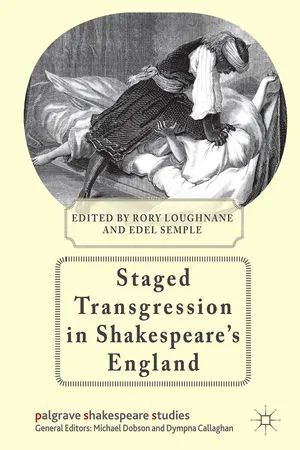
Staged Transgression in Shakespeare's England is a groundbreaking collection of seventeen essays, drawing together leading and emerging scholars to discuss and challenge critical assumptions about the transgressive nature of the early modern English stage. These essays shed new light on issues of gender, race, sexuality, law and politics. Staged Transgression was followed by a companion collection, Staged Normality in Shakespeare's England (2019), also available from Palgrave: https://link.springer.com/book/10.1007/978-3-030-00892-5
Information
Topic
LittératureSubtopic
Critique littéraire européenne1
‘On the most Eminent seate thereof is Gouernement Illustrated’: Staging Power in the Lord Mayor’s Show
Tracey Hill
The most spectacular London stage in the early modern period was not the Globe or the Blackfriars, nor even the Banqueting House at Whitehall, but the annual Lord Mayor’s Show. The Show was the City’s celebration of the inauguration of the most important commoner in the country and it was noted across Europe for its splendour. As one of the multiple dramatic modes that thrived in sixteenth- and seventeenth-century London the Lord Mayor’s Show was high-profile street theatre. The mayoral Show also serves to challenge the still-prevalent notion that civic authorities were uniformly hostile to all forms of theatricality in this period.1 Rather, the Lord Mayor’s Show reveals the City’s government at times to be an enabler rather than an oppressor of theatre. Moreover, the Shows amply demonstrate what this volume calls the ‘innate theatricality’of the governing practices of the early modern metropolis.2 It is this juxtaposition of theatricality and modes of power that this chapter will explore.
The Show was essentially a medium by which the power and prestige of civic authority were foregrounded. However, although that may have been the intention, this does not necessarily guarantee that the intended response was always elicited. Kate Levin poses the question with which all pageant producers in this period had to engage: ‘who were these performances for?’.3 The pageantry of Lord Mayor’s Day in this period was co-designed by professional playwrights and it was performed to a large, heterogeneous audience. On the one hand, there was the immediate, explicitly invoked audience of the new Lord Mayor and his retinue; on the other, more problematically for any monologic reading of the Shows, there was the mass audience of Londoners and visitors, domestic and overseas, who flocked in their thousands to see the spectacle. As Lawrence Manley has argued, and as I will demonstrate further, the Shows were ‘fraught with messages for a variety of constituencies’.4
Spectatorship did not necessarily entail passivity. Eyewitness accounts of the Shows are more plentiful than one might imagine, and they demonstrate a sometimes lively engagement with the spectacle. Civic pageantry was the most extravagant form of public theatre in early modern London, with no entry payment required and with the space of the whole city at its disposal. In particular, the format of the mayoral Show, as Manley has argued, was more dynamic than the ‘static tableaux and arches of the royal entry’, since it incorporated peripatetic devices, sideshows, and of course the central figures of the Lord Mayor and other dignitaries.5 Many contemporary witnesses testify that the Show was the highlight of the City’s ritual year. In geographical terms it was performed in a series of ceremonially significant open theatrical spaces, from Paul’s Yard to Cheapside, some of which (the Standard on Cheapside, for instance) also functioned as spaces of punishment and other forms of display of civic and state power.6 The Show thus presented a high-profile opportunity for writers and their collaborators to engage with the sociopolitical issues of the day in locations charged with meaning.
Crucially, civic government is not simply ‘illustrated’ in a static way in the Shows. As the seventeenth century progressed, they were staged in an environment that enabled, sometimes even invited, the critique of power, be it civic or monarchical. Indeed, The triumphs of honor and prosperity (1626) features ‘The Speech of Gouernment’ to emphasize how government is well and truly staged here. Rather than theatricality in itself neutering ‘transgression’, as the New Historicist subversion and containment model would have had it, the staging of power presents oppositional politics in an active, not a passive way. After all, staging the strategies of power for all to see is a double-edged business. Thus the riot scenes in the late Elizabethan play Sir Thomas More would have lost most of their force had they been reduced solely to a ‘reportt’, as required by the Master of the Revels Edmund Tilney, rather than being openly played out before an audience one might expect to be at least partly sympathetic. Closer to home, as Phil Robinson has argued in respect of the 1613 Show, ‘the clarity of the speech [of the King of the Moors] might seem less like a ringing endorsement for trading values than a means of rendering visible the greed involved in those values’.7 Such ‘clarity’ and ‘rendering visible’ is, of course, only possible in the context of a staged presentation, subject to the vagaries of actorly emphasis and audience interpretation.
The focus of this chapter is primarily on the Shows from the later 1610s and the 1620s written by Middleton, Dekker and Webster.8 There is a certain consistency about the strongly Protestant religio-political impulses that underscore the Shows produced in this period.9 Middleton’s commentary on contemporary events and figures could certainly be more trenchant than those of some of his fellow pageant writers – his satirical impulse, it seems, could not be contained regardless of the cultural context.10 In addition, his involvement in the Shows came during the troubled later years of James I’s reign when the fault lines that were to split the country apart were already making their presence felt. Even his formal, salaried role as City Chronologer from 1620 onwards seems not to have inhibited Middleton’s willingness to speak his mind.11 All the same, I am not arguing, as some have, that Middleton’s mayoral Shows were uniquely outspoken. For instance, Ian Munro claims that The triumphs of truth (1613) offers ‘a radical reimagining of the form and content of civic pageantry’ when compared to other Shows which ‘present a perfect, and perfectly legible, London’.12 Shows co-produced by other pageant writers – and one should also take care not to prioritize the writers over their collaborators – frequently reveal fissures, contradictions, and uncertainties that disprove this idea of ‘perfection’.
Pageant writers of the early seventeenth century did not speak truth to power in unambiguous ways, but, as I will demonstrate, neither were the Shows uncomplicated panegyric as many have assumed. James Knowles, for example, has argued that the Shows, in their ‘very form’, ‘embody reconciliation and inculcate order’.13 My reading is rather different. In these productions power is being treated in ambivalent ways that threaten to undercut the erstwhile celebrations. As Nina Levine has argued, the view that ‘the annual Lord Mayor’s show becomes little more than a civic version of the king’s game, said to “mystify the rule by the oligarchy”, widening the gap between the city elite and the throngs of journeymen, artisans, and apprentices who watched from the sidelines’ is ripe for reappraisal.14 I will therefore emphasize the contingency in Manley’s conclusion that the Shows ‘attempt to reinforce authority … by inculcating ideals of obedience and cooperation’.15
For the majority of the citizens of the early modern City of London, Lord Mayor’s Day served as the recurrent and predictable marker of a moment of transition in the civic year that combined novelty, in the person of the new Lord Mayor, and continuity, in terms of the office itself. The Shows consequently had an eye to posterity as well as to their present moment. To bridge the chronological divide, a central figure in many of the productions was that ubiquitous early modern emblem, Fame, who often appears in order to mark the new incumbent in her historical record. Previous Lord Mayors are ‘staged’ in ‘Fames Illustrious Sanctuary’ in The triumphs of loue and antiquity (1619: B4v). Before his term of office has even begun the newly appointed Lord Mayor is already included in a tableau of worthies, to sit alongside not only past mayors but also royal and aristocratic members of the Skinners’ Company: ‘7. Kings, 5. Queenes, onely one Prince alone,/ 8. Dukes, [and] 2. Earles’ (C1r). His presence in such illustrious company brings demands, however: pressure is brought to bear on William Cockayne to emulate his notable predecessors as he is told to ‘Be carefull then … to bring forth Deedes,/ To match that Honor, that from hence proceedes’ (C1v). To emphasize the point, the text supplies full details of these esteemed past members of the Skinners, highlighting their worthy deeds such as founding colleges and defeating the French at Agincourt, leaving Cockayne with a substantial challenge to meet.
As the above example indicates, unlike Shakespeare’s Duke in Measure for Measure, the City’s ruler could not escape ‘loud applause and aves vehement’ in the mayoral Show, when he was indeed staged to the eyes of the people. The Shows employed many speeches addressed to the new Lord Mayor, who is thereby presented to the audience as the recipient of advice, admonition and, although not without ambivalence, praise. However, although past Lord Mayors often occur, figures of contemporary power are rarely given the chance to speak. Furthermore, the format of the Show did not allow for any response from the Lord Mayor himself, and his consequent passivity only enhances the sense that he was an object being staged for public scrutiny. The ‘love’ directed towards Cockayne in The triumphs of loue and antiquity is not unconditional but contingent: the citizens are said to ‘expect some faire Requittal from the Man/ They’ue all so largely Honord’. This ‘Requittal’ must take the form of ‘Iustice’, ‘Care’, ‘Zeale’ (one of Middleton’s favoured qualities) and ‘Workes that are cleere & faire’ (C4v). Similarly, the 1626 Show concludes with a declaration that ‘if’– not ‘when’– ‘Power [is] worthily, and rightly spen[t] ,/ It must with Mercy both begin and end’ (B3v).
A note of contingency is also struck when the ...
Table of contents
- Cover
- Title
- Introduction: Stages of Transgression
- 1 ‘On the most Eminent seate thereof is Gouernement Illustrated’: Staging Power in the Lord Mayor’s Show
- 2 The Transgressive Stage Player
- 3 ‘Ha, Ha, Ha’: Shakespeare and the Edge of Laughter
- 4 ‘Have we done aught amiss?’: Transgression, Indirection and Audience Reception in Titus Andronicus
- 5 The King’s Three Bodies: Resistance Theory and Richard III
- 6 Marriage, Politics and Law in The Tragedy of Mariam and The Duchess of Malfi
- 7 Incapacitated Will
- 8 Transgression Embodied: Medicine, Religion and Shakespeare’s Dramatized Persons
- 9 The Taming of the Jew: Spit and the Civilizing Process in The Merchant of Venice
- 10 ‘Edgar I Nothing Am’: Blackface in King Lear
- 11 Marrying the Dead: A Midsummer Night’s Dream, Hamlet, Antony and Cleopatra, Cymbeline and The Tempest
- 12 Speaking Out of Turn: Gender, Language and Transgression in Early Modern England
- 13 Rethinking Transgression with Shakespeare’s Bawds
- 14 ‘Nothing but pickled cucumbers’: the Longing Wives of Middletonian City Comedy
- 15 Lady Macbeth and Othello, Convention and Transgression in Early Modern Tragedy
- 16 ‘How to vse your Brothers Brotherly’: Civility, Incivility and Civil War in 3 Henry VI
- Afterword: Thinking Staged Transgression Literally
- Works Cited
- Index
Trusted by 375,005 students
Access to over 1.5 million titles for a fair monthly price.
Study more efficiently using our study tools.
Frequently asked questions
Yes, you can cancel anytime from the Subscription tab in your account settings on the Perlego website. Your subscription will stay active until the end of your current billing period. Learn how to cancel your subscription
No, books cannot be downloaded as external files, such as PDFs, for use outside of Perlego. However, you can download books within the Perlego app for offline reading on mobile or tablet. Learn how to download books offline
Perlego offers two plans: Essential and Complete
- Essential is ideal for learners and professionals who enjoy exploring a wide range of subjects. Access the Essential Library with 800,000+ trusted titles and best-sellers across business, personal growth, and the humanities. Includes unlimited reading time and Standard Read Aloud voice.
- Complete: Perfect for advanced learners and researchers needing full, unrestricted access. Unlock 1.5M+ books across hundreds of subjects, including academic and specialized titles. The Complete Plan also includes advanced features like Premium Read Aloud and Research Assistant.
We are an online textbook subscription service, where you can get access to an entire online library for less than the price of a single book per month. With over 1.5 million books across 990+ topics, we’ve got you covered! Learn about our mission
Look out for the read-aloud symbol on your next book to see if you can listen to it. The read-aloud tool reads text aloud for you, highlighting the text as it is being read. You can pause it, speed it up and slow it down. Learn more about Read Aloud
Yes! You can use the Perlego app on both iOS and Android devices to read anytime, anywhere — even offline. Perfect for commutes or when you’re on the go.
Please note we cannot support devices running on iOS 13 and Android 7 or earlier. Learn more about using the app
Please note we cannot support devices running on iOS 13 and Android 7 or earlier. Learn more about using the app
Yes, you can access Staged Transgression in Shakespeare's England by R. Loughnane, E. Semple, R. Loughnane,E. Semple in PDF and/or ePUB format, as well as other popular books in Littérature & Critique littéraire européenne. We have over 1.5 million books available in our catalogue for you to explore.