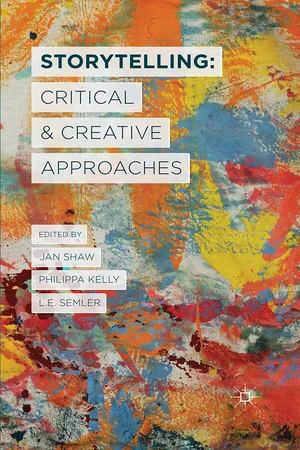
This collectionuses the concept of 'story' to connect literary materials and methods of analysis to wider issues of social and political importance. Drawing on a range of texts, themes include post-colonial literatures, history in literature, old stories in contemporary contexts, and the relationship between creativity and criticism.
- English
- ePUB (mobile friendly)
- Available on iOS & Android
eBook - ePub
About this book
Information
Part I
Indigenous Stories
1
The State of the Nation’s Narratives
Witi Ihimaera
For the past few months I have been haunted by an image. It’s an engraving reproduced in In Ruins: A Journey through History, Art and Literature, by Christopher Woodward. Here’s what Woodward has to say about it:
Blackened shells of buildings rise at the marshy edge of a slow and reedy river, one façade advertising ‘COMMERCIAL WHARF’. This is London – or, rather, its future as imagined by the artist Gustave Dore in 1873. The wizard-like figure in Dore’s engraving is a traveller from New Zealand, for to many Victorians this young colony seemed to represent the dominant civilisation of the future. He sits on a broken arch of London Bridge to sketch the ruins of St Paul’s, exactly as Victorian Englishmen sketched those of ancient Rome. The cathedral-like ruin next to the commercial warehouse is Cannon Street Station, brand-new in 1873 but here imagined with the cast-iron piers of the bridge rusting away in the tidal ooze. (Woodward, 1–2)
What haunts me is not only the engraving itself but Woodward’s notion that ‘to many Victorians this young colony seemed to represent the dominant civilisation of the future’.
What happened?
***
Whakarongo aku au, ki te tangi a te manu nei a te ma tui, tui, tuituia! Tuia i runga, tuia i raro, tuia i roto tuia i waho, tuia i te here tangata ka rongo te Ao, ka rongo te Po! Tuia i te kawae tangata ka heke mai ki Hawaiki nui, Hawaiki roa, Hawaiki pamamao, ki te hono i wairua, ki te Whai Ao, ki te Ao Marama! Tihei mauriora!
My name is Witi Ihimaera; I am a Māori New Zealander. The title of this chapter is the somewhat high-sounding ‘The State of the Nation’s Narratives’. I focus primarily on these shaky islands and Australia across the ditch.
Nau mai, haramai, kua tae mai, welcome.
First of all, I want to acknowledge what distinguished New Zealand novelist and poet, C. K. Stead, says about the aesthetic imperative of literature in his book, Answering to the Language: Essays on Modern Writers, and I quote:
. . . the writer’s first and last responsibility is to the language, word by word, phrase by phrase, sentence by sentence – to the sense, to the sound, to the sound-and-sense in orchestration. (Stead, 12)
In New Zealand our best writers have held to that responsibility: Katherine Mansfield, Janet Frame, Patricia Grace and among our new generation of writers, Eleanor Catton; poets Allen Curnow, Ruth Dallas and the other Ruth Gilbert, Bill Manhire and Robert Sullivan; filmmakers like Vincent Ward, Merata Mita and Niki Caro. I’m sure my Australian colleagues can come up with their list of wordsmiths and imagists like Miles Franklin, Patrick White, Peter Carey, Shirley Hazzard, Murray Bail, and for entirely different linguistic reasons, Les Murray; among filmmakers Fred Schepisi, Bruce Beresford and Baz Luhrmann; and David Williamson must be one of the top playwrights in the world today. This chapter, however, is concerned with literature’s other, political, imperative, the writer’s responsibility to what Tom Beckett, in his interview with Charles Bernstein, reproduced in Content’s Dream; Essays 1975–1984, called:
[the] matrix of social and historical relations that are more significant to the individual text than any personal qualities of life or voice of an author. (Bernstein, 408)
In other words, the writer’s role in showing that matrix, to itself: its successes, its failures, its nightmares, and all of its peoples’ dreams. In particular, I shall be asking the question: ‘Why haven’t we, and I am including Australia in the question, become that dominant nation referenced by Christopher Woodward . . . as far as our narratives are concerned?’
***
My perspective on this question is concerned with whether or not you consider that our ancestors, those migrants who populated Australia and New Zealand, came with a particular vision in mind and whether or not we have a custodial responsibility to that vision.
As a member of the first migrant settlers, the Māori, I can state our case: overcrowding in Raiatea, the island in French Polynesia from which Māori originated, and intra-tribal or intra-societal conflict, led our ancestors to migrate to a fabled land far to the South. We arrived in Aotearoa by various means – and those of you who know my novel The Whale Rider will recall that it is about one of my ancestors, Paikea, a prince escaping from a place where royal futures were contestable. He had a brother, Ruatapu, who planned to kill him and other sons from the royal houses of Raiatea by taking them out in a seagoing canoe and scuttling it. As the canoe was sinking, a huge whale came up from under to save Paikea. We cut to Rarotonga in the Cook Islands. There, the local people have a story about a man called Paikea who arrived from Raiatea and married a local woman. One day she saw him leave to go fishing. He disappeared into a storm, and in fact her bones were discovered only a few years ago at the place where she watched him sail away. They say she pined away for love. Paikea continued on his journey and he landed at Whangara on the East Coast of the North Island, at dawn, just as the star Poututerangi appeared over Hikurangi mountain. It’s a great metaphor isn’t it: the voyager, heading to the horizon and arriving as a new day is dawning.
The story of Paikea is not generic; it is highly inflected. I want to emphasize this because when it comes to Māori the whole tradition of storytelling, in the original meaning of the word, has really been the way in which we have preserved our historical DNA and insured its detail and meaning. We created tribal structures and then bound our relationships tightly together by constant oral recitation, chanting and singing of whakapapa, genealogy, korero, history, pakiwaitara, stories and song, waiata, to maintain unity politically, economically and culturally. We did this by walking backwards into the future. Another way of saying this is that we put our past in front of us. Not as a passive act of memory but an active one, with one main purpose or kaupapa to serve: To carry the huge and various inventories of the culture forward to the mokopuna.
For us, therefore, putting the past constantly upfront and making it visible through oral korero future-proofs the destiny for our mokopuna: the grandchildren. Of course one could say that this is wired into our genetic memory as survivors, not only of long ocean journeys, but also of the long and often bitter encounter with the second great migrant to New Zealand, the European settlers. Regardless of the losses, and mindful of the many gains, we still chart our course by the investments the ancestors made before us. It is perhaps exemplified at the end of film Whale Rider (2002) where the heroine Pai sits with her grandfather Koro in a large ocean-going waka which, until that moment uncompleted, has now been finished and launched onto the sea. A group of young Māori and Pakeha are paddling the canoe towards the horizon. Pai, the leader of the future, says: ‘I know we will go on, with all our strength, for all our peoples.’
Whale Rider had a huge impact on my career. People overseas began to call me the Prince of Whales. When Keisha Castle-Hughes, the actress who played Pai, became the youngest woman to be ever nominated in the Best Actress category of the Academy Awards, she became Moby Chick.
***
Let me return from Pai to the Gustave Dore engraving. Of course, Dore was not imagining a Māori New Zealander looking over that futuristic London. He was imagining instead, a Pakeha pilgrim, possibly returning to the country he had left some years earlier, perhaps from Wellington, which at that time was known throughout the Commonwealth as Empire City.
To quickly go through the Pakeha origin stories, Australia and New Zealand were claimed by the same man, Captain James Cook who made landfall in Poverty Bay on 7 October 1769, quite close to Whangara in fact. Cook had been in Tahiti observing the transit of Venus, and had secret instructions to search for the great Southern Continent – Terra Australis Incognita, a terra nullius – which some eighteenth-century scientists claimed was necessary to balance the great land masses of the northern hemisphere. Instead Cook discovered Australia and New Zealand – these countries were the main anchors to keep the northern hemisphere stabilized. Subsequently, began this country’s second settlement when Europeans – mainly from England, Scotland, Ireland and Wales – migrated here to make a home for themselves in the southern hemisphere on this side of the world. My presumption is that when those second ancestors arrived they certainly had it in mind, like the Māori settlers, to create something better than the culture they had left. I like to think that that generation which, for instance, abolished slavery, wanted not just to transplant what they brought with them but also to graft whatever they found and make something new out of it. Perhaps, that something ‘new’ which would make that notion of Christopher Woodward’s a reality.
As far as the nation’s narratives are concerned, the European migrants had an excellent story to tell. They set about the great colonial enterprise of naming, claiming, mapping out and overwriting and overprinting their identity onto the countries they had found and, in the process, created those entities we now call New Zealand, Australia, the Cook Islands, the Solomon Islands and so on.
Of course, the countries were neither terra nor nullius, and so all our histories and narratives contain huge conflicts. In New Zealand they involved civil wars over land during 1860 to 1888 as Māori battled Pakeha over the transplantation and the forceful substitution of Westminster structures, leading to the political, economic and cultural displacement of the culture that had preceded it. Some 150 years later, Māori and Pakeha are still locked into battles, now fought mainly in law courts, attempting to obtain redress for illegal occupations of Aotearoa. We have so much unresolved history here.
This narrative of conflict was not the primary objective of the early Pakeha narrators or their narratives – including in the definition architects, artists, composers, historians, editors – all those involved in culture formation. New Zealand began to achieve nationhood and a sense of Pakeha rather than European identity, and wonderful writers and artists arose to support it: Frank Sargeson; a personal favourite Dan Davin writing about the Irish Catholics of Southland; Robin Hyde; poet A. R. D. Fairburn; editor James Brasch; composer Douglas Lilburn. In Australia, I can think of Xavier Herbert, Tom Keneally – I can still remember going to the Australian High Commission to celebrate when The Chant of Jimmy Blacksmith (Keneally) was shortlisted for the Man Booker Prize – Elizabeth Jolley, Judith Wright and composer John Henry Antill. They were assisted by the kind of iconic events around which identity is formulated: Gallipoli, the Anzacs, the War in the Pacific. For New Zealanders, Hillary conquering Mount Everest, the sailing of small protest vessels into the Nuclear Zone of Moruroa – Raiatea, the original launching place of the Māori is not far from Moruroa – the rise of the All Blacks, the sinking of the Rainbow Warrior, the winning of the Americas Cup. Other writers and narrators followed: in New Zealand, James K. Baxter, Ian Cross, Maurice Shadbolt, Fiona Kidman, Owen Marshall, Ian Wedde. In film, John O’Shea. In art, the great Colin McCahon. In Australia, Robert Dessaix, Christos Tsidakas and, in music, Richard Meale.
Collectively, the New Zealand narrators established the New Zealand Canon, what I call the Primary Text, but it wasn’t until post-coloniality opened the doors to the possibilities of the ‘Other’ joining the conversation, that Māori began to make written what had once been an oral voice.
We started way behind the pack with Hone Tuwhare’s first book of poetry, No Ordinary Sun. Five years later came the first Māori novelist. I’m not sure who the first indigenous Australian novelist was now that Colin Johnson’s claim to that is contestable. Albert Wendt was the first Samoan novelist. But what is so affirming is that the Māori or alternative text has become added to the canon, the poutama, the stairway of excellence of our narratives: among them Keri Hulme’s the bone people and Alan Duff’s Once Were Warriors. Of the top four New Zealand films, three are Māori: Boy (2010) is the highest money-making New Zealand film ever. And if I can just squeeze in here that as far as the Pacific is concerned, Pasifika narrators and narratorial energy is revitalizing New Zealand in other ways, reminding us not only of our local but also Pacific inventories.
But was it enough? Has it been enough? How successful have New Zealand and Australia been in securing for our Southern Antipodean matrix to the world the kind of dominance Christopher Woodward speaks of? Have all our collective inventories ever achieved the kind of critical mass, energy and compulsion large enough to even remotely challenge British hegemony? As far as our narratives are concerned, could they ever have been installed successfully enough to even qualify us for any assumption that we would represent ‘the dominant civilisation of the future’? If not, why not?
No . . . and no.
One of the reasons is that we have not been able to achieve our own tino rangatiratanga, our own sovereignty. Part of this has to do with our failure to disconnect fully from the British umbilical. Another reason is that we have lost sight of that custodial responsibility to our inventories I referred to earlier: Patrick Evans aptly titled his last book of essays on post-colonial literary culture in New Zealand, ‘The Long Forgetting’. Therefore, I do not believe that the huge and various inventories of Pakeha culture in Aotearoa have been carried forward, with all the required inflection, intensity, passion and pride, to all your mokopuna. But I would say that, wouldn’t I, being Māori and committed to writing for the tribe. I have a long line of ancestors stretching all the way back to the beginning of the world to whom I am accountable and with whom I have an implicit contract. And now, of course, there are even greater challenges that diminish our chances of achieving lift off, escape velocity, free fall, to answering to all our ancestors.
***
The well-known New Zealand commentator, Colin James, pictorialized the dilemma for New Zealanders about how and why we must keep up with the rest of the world, in an article published in The Dominion Post (10 J...
Table of contents
- Cover
- Title
- Introduction Story Streams: Stories and their Tellers
- Part I Indigenous Stories
- Part II Fictional History and Historical Fiction
- Part III The Sea of Stories
- Part IV Critical Creativity
- Index
Trusted by 375,005 students
Access to over 1.5 million titles for a fair monthly price.
Study more efficiently using our study tools.
Frequently asked questions
Yes, you can cancel anytime from the Subscription tab in your account settings on the Perlego website. Your subscription will stay active until the end of your current billing period. Learn how to cancel your subscription
No, books cannot be downloaded as external files, such as PDFs, for use outside of Perlego. However, you can download books within the Perlego app for offline reading on mobile or tablet. Learn how to download books offline
Perlego offers two plans: Essential and Complete
- Essential is ideal for learners and professionals who enjoy exploring a wide range of subjects. Access the Essential Library with 800,000+ trusted titles and best-sellers across business, personal growth, and the humanities. Includes unlimited reading time and Standard Read Aloud voice.
- Complete: Perfect for advanced learners and researchers needing full, unrestricted access. Unlock 1.5M+ books across hundreds of subjects, including academic and specialized titles. The Complete Plan also includes advanced features like Premium Read Aloud and Research Assistant.
We are an online textbook subscription service, where you can get access to an entire online library for less than the price of a single book per month. With over 1.5 million books across 990+ topics, we’ve got you covered! Learn about our mission
Look out for the read-aloud symbol on your next book to see if you can listen to it. The read-aloud tool reads text aloud for you, highlighting the text as it is being read. You can pause it, speed it up and slow it down. Learn more about Read Aloud
Yes! You can use the Perlego app on both iOS and Android devices to read anytime, anywhere — even offline. Perfect for commutes or when you’re on the go.
Please note we cannot support devices running on iOS 13 and Android 7 or earlier. Learn more about using the app
Please note we cannot support devices running on iOS 13 and Android 7 or earlier. Learn more about using the app
Yes, you can access Storytelling: Critical and Creative Approaches by J. Shaw, P. Kelly, L. Semler, J. Shaw,P. Kelly,L. Semler in PDF and/or ePUB format, as well as other popular books in Literature & Creative Writing. We have over 1.5 million books available in our catalogue for you to explore.