Virginia Woolf, Jeanette Winterson, and Ali Smith share an ecological philosophy of the world as one highly interconnected entity comprised of multiple and equal, human and non-human participants. This study argues that these writers' texts have an ecological significance in fostering respect for and understanding of difference, human and nonhuman.
eBook - ePub
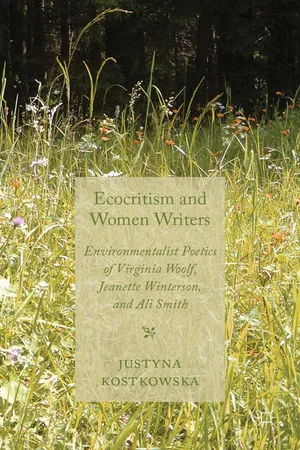
Ecocriticism and Women Writers
Environmentalist Poetics of Virginia Woolf, Jeanette Winterson, and Ali Smith
- English
- ePUB (mobile friendly)
- Available on iOS & Android
eBook - ePub
Ecocriticism and Women Writers
Environmentalist Poetics of Virginia Woolf, Jeanette Winterson, and Ali Smith
About this book
Information
1
The Narrative Ecology of “Kew Gardens”: Virginia Woolf’s Ecofeminist Imagination and the Narrative Discovery of Jacob’s Room
My discussion of the ecological implications of fictional forms starts in 1917, with what is regarded as the beginnings of Virginia Woolf’s modernist innovation. This chapter identifies Woolf’s experiment with narrative perspective and organic form in Jacob’s Room as a consequence of her writings of the period 1917–22, centrally her short story “Kew Gardens.” Basing on Woolf’s diary entries and letters, I frame her experiment in ecological terms, and propose a connection between the decentered, situated feminist narrative method of Jacob’s Room and what I call her ecological imagination, which is evident in her earlier writings. I first examine Woolf’s diaries and the unusual narrative perspective of “Kew Gardens,” and then outline what I see as their influence on Jacob’s Room. Underlying all these considerations is the ecocritical premise that a text is never separate from its environment:
Genres and texts are themselves arguably “ecosystems,” not only in the narrow sense of the text as a discursive “environment,” but also in the broader sense that “texts help reproduce sociohistorical environments” in stylized form (Barwashi 2001: 73). Indeed, an individual text must be thought of as environmentally embedded from its germination to its reception. (Buell 2005: 44)
Asheham: Developing a Microscopic Vision
On August 3, 1917, Virginia Woolf resumed her diary entries after a two-year silence following a return of her illness in 1915. While she continued her social communication through letter writing, the diary—her more private, introspective medium—remained significantly quiet. It only resumed when she arrived at Asheham, the country house she rented from 1911 to 1919. Asheham provided an environment very different from the Hogarth House in Richmond, where the Woolfs were busy printing and socializing. It was a country retreat where visitors rarely just dropped by, and where Woolf was often alone when Leonard was absent on business. The resumed diary entries show a person who is less gregarious, quieter, and more observant of the outside environment. The entries of that summer comprise little more than ornithological and botanical records of life at Asheham, including lists of specific species of butterflies (1977–84, I: 40–43). A typical entry reads:
Sat in the hollow; & found the carterpillar, now becoming a Chrysalis, wh. I saw the other day. A horrid sight: head turning from side to side, tail paralysed; brown colour, purple spots just visible; like a snake in movement. No mushrooms. Walked over the down with L.S. B. [Lytton Strachey] & Mr [Bunny] Garnett for dinner. (1977–84, I: 43)
A reader familiar with the intellectually charged, simultaneously social and introspective voice of Woolf’s earlier diaries finds entries like this one stunning in their contrast. The discussion of ideas that must have been exchanged during the social interactions is conspicuously missing. In its place, events of nonhuman life are reported in great detail and given unprecedented attention. The definite article and the verb “found,” for example, suggest that Woolf went back to the same place, purposefully looking for the caterpillar she had seen before. The narrative, similar in structure to many of that period, shifts between the nonhuman and the human subjects, a method that will later be replicated in both “Kew Gardens” and Jacob’s Room. Whether we view Woolf’s focus on nature as an attempt to quiet her mind or as motivated by sheer interest and pleasure, its results may have surpassed the original intention. Her immersion in nature seems to have influenced her perspective; the secluded, self-contained world of Asheham has retrained her vision to become microscopic, to pay attention to what she may not have noticed before.
During this time, Woolf visits Kew Gardens frequently, and never fails to record the new plants or bird life observed. She describes with excitement the appearance of crocuses and new plantings in the flowerbeds in the spring. When she goes to Kew Gardens in May 1918, she notes:
To the general loveliness & freshness was added a sense of being out when we should have been at home; this always turns things into a kind of spectacle. It seems to be going on without you. We sat under a tree, & became a centre for sparrows & robins, & pestered by the attentions of a gigantic aeroplane. (1977–84, I: 148)
She observes, half with surprise, half with incredulity, the richness and energy of the outside world, flourishing without human presence. There is a sense that she wants to change her pattern and be outside instead of inside more often. What is also interesting in this brief description is how she configures the human and natural elements: the humans serving as a center for animal life, being “used” by it, as opposed to themselves using nature to their advantage as they have traditionally done. Interestingly, she describes the approach of the birds as welcome, and the appearance of the man-made airplane as annoying through words such as “pestered,” “gigantic.” Subtle observations like this indicate, in my opinion, a shift of vision vital to the creative breakthrough that was brewing in Woolf’s mind. The anthropocentric worldview was being dislodged; it was making room for something else.
As early as August 1917, according to Hermione Lee’s dating, and in late November of that year according to mine, but definitely before July 1, 1918, Woolf writes “Kew Gardens” and “An Unwritten Novel,” two short stories unlike anything she had written before.1 Later, as she starts conceptualizing Jacob’s Room in January 1920, she notes in her diary that the short stories of 1917–19, published separately and then together in 1921, have opened new, “immense possibilities in the form” (1977–84, II: 14). Contemporary critics unanimously agree that the Monday or Tuesday short stories were germinal to Woolf’s new fictional method, taking it into the unchartered territory of modernist and even postmodern experiment.2 Writing about “Kew Gardens,” Edward Bishop notes: “Woolf is gently forcing the reader out of his [her] established perceptual habits, raising questions about the nature of discourse and the conventions used to render it” (1982: 273). Alice Staveley points out Woolf’s story’s “defiance of former (literary, cultural, political) exclusions … that deny cultural authority to women” (2004: 47). To this list of exclusions “defied” by Woolf’s experiment in “Kew Gardens,” I will add “ecological,” expanding the scope of Woolf’s feminist vision to include a reform of the androcentric and anthropocentric view of the world.3
My approach, which focuses on Woolf’s constructing connections rather than oppositions, diverges from Julia Briggs’ analysis of “Kew Gardens” as a “highly formal design constructed from the alternation of binary opposites” (2005: 101) and is closer to John Oakland and Edward Bishop in its stress on unities. While pursuing a more formalist argument, Oakland shares my ecological terminology, praising the cohesion of “Kew Gardens” as “the gradual fusion of the human and the nonhuman into an organic whole” (1987: 267). Bishop analyzes the unifying effect of the “Kew” experiment as incorporating the world of the reader:
Woolf displays what would become the defining characteristic of her later prose: a flexible narrative style which allows her to move without obvious transition from an external point of view to one within the mind of a character, and back again, thus fusing the physical setting with the perceiving consciousness. Further, it is a mode which invites the reader’s participation in the process, so that the reality Woolf conveys is apprehended through the experience of reading. .… the reader becomes conscious of moving among words, just as the characters do. (1982: 272, my italics)
Importantly, Bishop shows here that Woolf’s narrative method is inherently ecological, as it deconstructs the boundary between the outside world and the characters’ mind. Woolf’s famous “indirect” stream of consciousness performs an important function of unifying the character and the environment in a way that contemporary ecocriticism is increasingly appreciating.4 That seamless inclusion extends to the reader her/himself. Ultimately, the unity of the text, and of the text and the reader, models the inherent unity of the “real” world.
The ecocritical ecofeminist approach enables us to draw a connection between Woolf’s attention to the natural world in this period and her revision of the traditional nineteenth-century narrative. Woolf can be seen as thinking about writing the way modern ecocomposition does, studying relationships between writing and writing environments.5 Throughout the period 1917–21, her diary records the impact that the immersion in nature at Asheham has had on her creative being. In January 1918, she writes that she responds differently to the environments of Asheham and London:
But what I like most about Asheham is that I read books there; so divine it is, coming in from a walk to have tea by the fire & then read & read. … one’s faculties are so oddly clarified that the page detaches itself in its true meaning & lies as if illuminated, before one’s eyes; seen whole & truly not in jerks & spasms so as often in London. (1977–84, I: 94–5)
Woolf notices that the natural environment of the outside walk enhances her creative and analytical thinking. She describes her experience of reading in Asheham in the absolute, almost extreme terms of “true meaning,” “page seen whole and truly,” and contrasts it to the distracting effect of London. In May 1918, she notes that “to take up the pen directly upon coming back from Asheham shows I hope that this book is now a natural growth of mine—a rather dishevelled, rambling plant, running a yard of green stalk for every flower. The metaphor comes from Asheham” (1977–84, I: 150). Again she makes a connection between the environment of the country and her creative process, forming an organic metaphor for her diary writing: “a natural growth of mine.” She continues in the same entry:
Last night at Charleston I lay with my window open listening to a nightingale, which beginning in the distance came very near the garden. Fishes splashed in the pond. May in England is all they say—so teeming, amorous, & creative. (1977–84, I: 151)
Here she binds together nature’s creativity with her own, in the description of the month of May as “teeming” and “creative.” She contextualizes her writing process in nature. In September 1918, she recalls one of her recent walks:
I remember lying on the side of a hollow, waiting for L. to come & mushroom, & seeing a red hare loping up the side & thinking suddenly “This is Earth life.” I seemed to see how earthly it all was, & I myself an evolved kind of hare; as if a moon visitor saw me. A good life it is, at such moments; but I can’t recapture the queer impression I had of its being earth life seen from the moon. (1977–84, I: 190–1)
Woolf shows a capacity to abandon traditional, habitual perspectives, starting with the androcentric one: she is able to identify herself as another, albeit evolved, animal, and to imagine herself and the earth from an extraterrestrial being’s perspective. She is aware of the world as a multisystem, of all life forms’ simultaneous diversity and interconnectedness. This view is a continuation of her famous childhood observation of a flower being one with the earth that she records in Moments of Being: ‘“That is the whole,’ I said. I was looking at a plant with a spread of leaves; and it seemed suddenly plain that the flower itself was a part of the earth” (1978b: 71). She describes this concept of connectedness as a life-long “philosophy” and “a constant idea of mine” (1978b: 72):
It is only by putting it into words that I make it whole … it gives me … a great delight to put the severed parts together. … It is the rapture I get when in writing I seem to be discovering what belongs to what. … We—I mean all human beings—are connected with this; that the whole world is a work of art; that we are parts of the work of art. (1978b: 72)
Again, the natural unity becomes an inspiration for creating artistic unities; again, one is an extension of the other. All in all, it may not have been a coincidence that Woolf felt the creative pressure to develop alternatives to the single, centralized narrative authority (male and all-knowing) after spending months observing nature: watching life at the microscopic level of other beings, entertaining other perspectives and other centers of consciousness.
This chapter puts forward the hypothesis that the experiment of Jacob’s Room had an ecological/environmental genesis. I suggest that Virginia Woolf’s 1917 immersion in nature at Asheham focused her eye on minute natural events and resulted in the creation of the nature-centered point of view in “Kew Gardens.” I see her unusual decision to place the narrative perspective at the ground level of the flowerbed (making the snail’s world equal in subjectivity to the human) as the first formulation of her idea of multiple centers of consciousness, each offering a point of view on the “central” character of Jacob. Woolf’s imaginative, ecocentric view of the world that prompted her to give narrative subjectivity to a nonhuman was the origin of the decentered, dispersed, and subjective narrative perspective of her next novel.
The Narrative Ecology of “Kew Gardens”
The striking innovation of “Kew Gardens” lies in Woolf’s disposing of the primacy of the perspective of the human eye. Instead, she places the narrative center of the story at the eye level of a snail, and at the ground level of the flowerbed. This is where the observation point remains, the life of the snail being interrupted whenever “there came past the bed the feet of human beings” (1997: 41). When the people can no longer be seen from the vantage point of the flowerbed, they dissolve “in the green-blue atmosphere” (1997: 45). Instead of humans looking down on small natural others, we have a validation of a “reversed,” ecocentric perspective, which is maintained throughout the story as an equally “natural” and functional way of seeing the world.
The flowerbed is not merely an accidental, convenient location, but a significant parallel microcosm with its own inhabitants (the flowers, the butterflies, and the snail) with their respective problems and dilemmas, such as how to conquer obstacles in one’s path:
The snail had now considered every possible method of reaching his goal without going round the dead leaf or climbing over it. Let alone the effort needed for climbing a leaf, he was doubtful whether the thin texture which vibrated with such alarming crackle when touched even by the tip of his horns would bear his weight. … He had just inserted his head in the opening … and was getting used to the cool brown light when two other people came past outside on the turf. (1997: 43)
The narrator shows a remarkable empathic ability to convey the snail’s perspective, with microscopic observational power including anticipation of the leaf’s durability as well as the specific environmental sounds and sights that the snail experiences. The anthropomorphic tint of these observations makes them no less remarkable, since anthropomorphic language is the only medium readily available to the narrator in which to describe the snail. Moreover, anthropomorphism helps to achieve the portrayal of the minute snail’s sensibility as equally complex and significant as a human’s.
The parallels and equivalence between the world of the humans and the world of the flowerbed are maintained consistently throughout the story. The comparison of the people’s “irregular” movement to that of the white and blue butterflies is made in reference to the approaching men and women, and repeated as a frame at the end after the last couple departs. Elements of nature (the dragonfly, the red water lilies, the forests of Uruguay, the dirt of the flowerbed) are always present within the human stories, connecting what would traditionally be seen as two separate worlds. Woolf’s technique creates one integrated universe in which the very dichotomy disappears. Her metaphors criss-cross the traditional realms, injecting human attributes into the natural description (“heart-shaped,” “mouth,” “throats,” “tongue-shaped,” “flesh of the leaf”) and vice versa (“words with short wings for the heavy body of meaning”). The interchangeability of the terms and qualities underscores the unity and equality of the human and the nonhuman. The world is presented as a cosmos in which snails and people go about their equally important lives. Interestingly, the story’s main critical praise focused on its unified atmosphere, its portrait of “the essence of the human and the natural world of the garden,” and on “immers[ing] the reader in the atmosphere of the garden” (Bishop 1982: 269). Stated in ecological terms, this is a portrait of the world as one well-functioning ecosystem, in which humans do not dominate but coexist with the other universal participants. What Woolf is effectively doing here is presenting an ecological vision that contemporary ecophilosophers such as Anthony We...
Table of contents
- Cover
- Title
- Copyright
- Contents
- Acknowledgments
- Introduction
- 1 The Narrative Ecology of “Kew Gardens”: Virginia Woolf’s Ecofeminist Imagination and the Narrative Discovery of Jacob’s Room
- 2 “All Taken Together”: Ecological Form in Mrs. Dalloway
- 3 Singing the World in The Waves: The Ecopoetics of Woolf’s Play-Poem
- 4 Living with the Other: Jeanette Winterson’s Written on the Body
- 5 Multiplicity and Coexistence in The Powerbook
- 6 The Fiction of Abundance and Awareness: Jeanette Winterson’s Lighthousekeeping
- 7 Hotel World: A Symbiotic Narrative Space
- 8 Getting Close: The Ecopoetics of Intimacy in Ali Smith’s Like
- 9 Stories That Change the World: Ali Smith’s Ecological “Realityfiction”
- Conclusion: Re-visioning the World from the Inside Out
- Notes
- Bibliography
- Index
Trusted by 375,005 students
Access to over 1.5 million titles for a fair monthly price.
Study more efficiently using our study tools.
Frequently asked questions
Yes, you can cancel anytime from the Subscription tab in your account settings on the Perlego website. Your subscription will stay active until the end of your current billing period. Learn how to cancel your subscription
No, books cannot be downloaded as external files, such as PDFs, for use outside of Perlego. However, you can download books within the Perlego app for offline reading on mobile or tablet. Learn how to download books offline
Perlego offers two plans: Essential and Complete
- Essential is ideal for learners and professionals who enjoy exploring a wide range of subjects. Access the Essential Library with 800,000+ trusted titles and best-sellers across business, personal growth, and the humanities. Includes unlimited reading time and Standard Read Aloud voice.
- Complete: Perfect for advanced learners and researchers needing full, unrestricted access. Unlock 1.5M+ books across hundreds of subjects, including academic and specialized titles. The Complete Plan also includes advanced features like Premium Read Aloud and Research Assistant.
We are an online textbook subscription service, where you can get access to an entire online library for less than the price of a single book per month. With over 1.5 million books across 990+ topics, we’ve got you covered! Learn about our mission
Look out for the read-aloud symbol on your next book to see if you can listen to it. The read-aloud tool reads text aloud for you, highlighting the text as it is being read. You can pause it, speed it up and slow it down. Learn more about Read Aloud
Yes! You can use the Perlego app on both iOS and Android devices to read anytime, anywhere — even offline. Perfect for commutes or when you’re on the go.
Please note we cannot support devices running on iOS 13 and Android 7 or earlier. Learn more about using the app
Please note we cannot support devices running on iOS 13 and Android 7 or earlier. Learn more about using the app
Yes, you can access Ecocriticism and Women Writers by J. Kostkowska in PDF and/or ePUB format, as well as other popular books in Politics & International Relations & Literature General. We have over 1.5 million books available in our catalogue for you to explore.