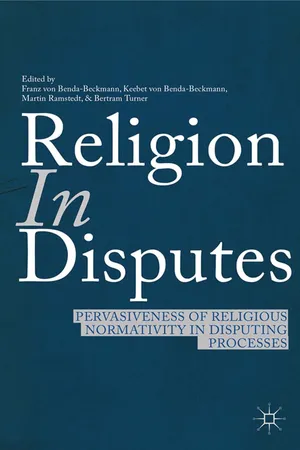
How are time-honored tenets of faith, different ritual sensibilities, and newly emerging eschatological imaginaries articulated with other normative registers and moral susceptibilities in disputes? This book examines such questions through cases in Europe, the United States, Israel, Africa, and South and Southeast Asia.
eBook - ePub
Religion in Disputes
Pervasiveness of Religious Normativity in Disputing Processes
- English
- ePUB (mobile friendly)
- Available on iOS & Android
eBook - ePub
Religion in Disputes
Pervasiveness of Religious Normativity in Disputing Processes
About this book
Information
Topic
Ciencias socialesSubtopic
Política1
INTERMINABLE DISPUTES IN NORTHWEST MADAGASCAR
Michael Lambek
The literature in the anthropology of religion has queried not only how to define religion but also whether religion can be defined at all and whether, as an object, it is a product of the modern state.1 Insofar as there is some truth to the latter (Asad, 1993; 2003), religion is, in part, constituted by means of law, but simultaneously as something that is constituted to stand at arm’s length from the law. Hence, it is no straightforward matter to describe the relationship between religion and law—as though the law could readily interfere in religious disputes or religion in legal ones (cf. Kirsch and Turner, 2009). When I began to write, I had in mind to contrast this relationship between religion and law in the modern state (“secularism”) with the relationship pertaining in a society in which law and religion were not disembedded from a social whole, in this case a sacred monarchy. The problem in the monarchy was not the separation between religion and law, however convoluted, but the lack of distinction between them. If we begin not with the modern state and, hence, not with the way law circumscribes religion, but with the sacred monarchy and, hence, with the constitution of and contestation over the sacred, then the picture looks rather different. In both models, religion and law are inextricably entangled; one starts with features intrinsic to law, whereas the other starts with features that (it claims) are intrinsic to religion. In so doing, it is a point of similarity rather than a difference that is marked across the secular/nonsecular division.2
The central theme of this chapter is the impossibility or near impossibility of reaching a satisfactory resolution in certain kinds of disputes.3 These are not resolvable in the kind of polity, call it, uneasily, a sacred monarchy, that I describe here, nor, I venture, in the kind of social fields, call them, uneasily, religions, that are the subject of so much current excitement and discourse. I briefly review two conflicts—in effect, two distinct kinds of conflict—in the sacred monarchy: first, a long-standing factional split and second concerning appropriate governance of the main shrine. I use each to make a slightly different point and illustrate how they remain interminable—unless one considers either succession—definitively replacing one contender or one form of authority by another—or secession—a permanent splitting of the contending parties—to be forms of closure. Neither (suppression of) “voice” nor “exit” of this kind (transformations in time and space, respectively) are forms of “resolution” in the sense of fairness, compromise, or mediation.4
The sacred monarchy is that of the Sakalava polity of Boina in northwest Madagascar.5 I write “sacred monarchy” rather than “sacred kingship” because reigning monarchs are often women. From the origin of the polity around 1700, neither religion nor law were institutions disembedded from the political and social whole. Yet today of course, the monarchy is encapsulated within the secular state of Madagascar and, hence, is subject to similar kinds of legal circumscription as religion in Europe. Sakalava are state citizens and subject to state law and institutions. Many are Christian or Muslim, while others declare that they are neither and yet (as Asad would appreciate) do not explicitly identify their attachment to ancestral practice as a “religion.” In fact, many Christians and Muslims also participate in “ancestral practice.”
The most vivid manifestation of attachment is spirit possession, which occurs not through conversion but through practical experience, whether it is a matter of particular spirits choosing to manifest themselves in the body of a particular person, who thereby becomes a medium, or through solicitation, deference, or other forms of social interaction people have with spirits manifest in the bodies of their kin or neighbors. The spirits, tromba, are distinct social actors and are (for the most part) deceased members of the royal clan; the earlier their generation, the more sacred they are. Spirits collect funds to support their respective ancestors as well as the living monarch and the ongoing reconstruction of sacred enclosures, requesting contributions from their mediums and clients. In recent decades, mediumship has become increasingly widespread, both in sheer numbers and in the kinds of people who become possessed, including many non-Sakalava throughout Madagascar and in Mayotte, the Comoros, Réunion, and metropolitan France. The financial contributions of the latter are substantial.
With the conquest of Boina by the Merina in the early nineteenth century and then the French conquest of the entire island, the power and autonomy of Sakalava were drastically curtailed. The following vignette illustrates a contemporary manifestation of subjection to the state. At the end of the large annual ceremony, the Great Service (fanompoabe), held in 2007, the officiating but still provisional monarch was consulting with several ancestral diviners who had manifested themselves in spirit mediums who had come from the countryside for the ceremony. The living show great respect and deference to spirits, but this time the consultation was suddenly interrupted when the king’s cell phone rang and he took the call. It was from a senior government official with whom it was even more important that he remain on good and deferential terms than with the spirits. Nevertheless, despite this power to interrupt, there remains some confusion on the part of successive governments as to how to handle the ancestral polity and in what respects to treat it as primarily a political, religious, or cultural institution. While there has been little consistency, many state officials would prefer not to bear responsibility for resolving the polity’s internal affairs, notably the disputes among factions of the royal clan concerning proprietorship of the ancestral relics and shrine that form the axis of contemporary practices, where interference could have profound public repercussions.
WHO HAS RIGHTS TO THE SACRED?
The relics of the founding ancestors of Boina are housed at the Doany Ndramisara (the shrine of Ndramisara) on the outskirts of the city of Mahajanga. They are visited by devotees throughout the year and especially at the annual ceremony during which the reliquaries are bathed (Lambek, 2002). The Great Service attracts thousands of people, and a good deal of money and other gifts pour in to the ancestors and the shrine that houses them. The relics provide for the well-being of their descendants, subjects of the monarchy, and other devotees. The relics are equally a responsibility; their continuing sanctity and power are understood to be dependent upon the respect and proper treatment they receive. They are the most sacred objects in northwest Madagascar, and their sanctity is preserved through the means by which they are housed, cared for, and protected from a variety of pollution. They are sacred precisely in the Durkheimian sense of being “set apart.”
As sacred objects, the relics are the sort of things that anthropologists refer to as inalienable possessions. However, this begs the question, inalienable from whom? While all devotees, especially spirit mediums and active custodians of the shrine, assume certain rights of access to the relics, members of the royal clan—that is, descendants of the persons manifest in the relics—claim a special relationship. Indeed, because members of this clan do not fully die but continue in a half-life of ancestorhood, in which they are capable of manifesting themselves in the bodies of spirit mediums, all the descendants of the senior ancestors, both living and semideceased (hence ancestors themselves), could be said to share in the rights and obligations toward them. In particular, it is a living descendant, the reigning monarch of the region, who oversees the shrine and who is the immediate recipient of the gifts brought to the Great Service. Because descent among Sakalava moves through both women and men, producing numerous collateral lines, royal succession is not straightforward; there are multiple claimants to the throne and to responsibility for the relics. Hence, the inalienability of the relics from the royal clan and from the people (vahoaka) goes hand in hand with a great deal of conflict, especially between two factions of the clan who never resolved ancient claims of succession, both of whom claim rights to and responsibility over the relics and accuse the other of alienating the relics from them. Indeed, since the French colonial period and explicitly continuously since at least 1956, the two factions have been involved in a struggle with one another. For a time, they established a division of ritual labor, each side having complementary rights and responsibilities at the shrine, enacted and displayed during the annual ceremony. However, this was followed by accusations of arson, theft, counter-theft, mishandling, and misappropriation and included the construction and eventual destruction of a second, competing shrine.
Not being able to resolve the conflict themselves and seeking any means to win, the two factions each turned to the state for assistance. During the colonial period, they hired French lawyers, and they have been engaged in legal actions, appeals, and counter-appeals ever since. However, the modern state has been no more successful than the ancestral polity at resolving the conflict. Marie-Pierre Ballarin (2000) has shown in fascinating detail all the reasons why recourse to the courts has failed. These include cultural misunderstandings (e.g., whether the relics are to be treated in the law as objects or persons); confusion or even outright contradiction between judicial and executive or administrative pronouncements and actions; use of multiple levels of the court system (regional, national, appellate, etc.); political interference in the judicial process; questions about whether the appropriate jurisdiction is one of customary law and, if so, what are the correct customary precepts; and most of all, the fact that whenever a judgment has gone against one or the other of the two factions, they have been able simply to ignore it.6 Resolutions by the courts have been ineffective and also not fully authoritative because their independence and disinterestedness are always questioned. The conflict has, thus, been interminable; there have been de facto winners and losers, but the dispute intensifies again when the means become available to the aggrieved party.7
In sum, the fact that relics are inalienable, in principle, makes their disposition all the more contentious insofar as there are competing parties who consider the relics inalienable from them in particular. In the face of this, my argument is neither how religion helps solve nonreligious disputes, nor how the law helps solve religious disputes, but how both “religion” (here the ancestral polity) and the law (here the judicial system of the Malagasy state) appear to be inadequate to the task of resolving the dispute at issue. I suspect this is true of disputes over the sacred in general. This is because sacred objects (or words, texts, etc.) are both inalienable and foundational; it is precisely the sacred objects themselves that confer legitimacy to do things like adjudicate and resolve conflicts. Because both Sakalava factions claim rights over the vehicles of sanctification that are themselves essential to effective and authoritative resolution, this case illustrates something more general. If, as argued by so many Durkheimian anthropologists, the performance of certain kinds of rituals can resolve conflict or affirm group unity, what happens when the conflict occurs over the right to perform, officiate, or participate in the rituals in the first place?
Theoretically, a concept of the sacred as described here precedes any kind of institutional distinction between religion, politics, and the law; it is, rather, the very ground on which such distinctions might be legitimated (Derrida, 1989−1990). Hence, neither religion nor the law is adequate to resolve conflicts with respect to sanctity (although religion may be able to restore sanctity when it has been displaced or eroded by conflict). In this view, both “religion” and “law” draw from the property of sanctity. As elucidated by Roy Rappaport (1999) and summarized here, ritual produces a kind of performative truth and certainty, and this truth, encoded in what he calls “ultimate sacred postulates” (but that for Sakalava are the relics themselves), is used to legitimate or sanctify more mundane forms of utterance, including statements and adjudications. Sanctity provides the contract underlying the contract, so to speak; that is, it provides the grounds from which more substantive or particular truth claims and laws are able to draw their authority. In the United States, this is exemplified by the act of swearing in witnesses with a hand placed on the Bible and in the phrase “In God we trust” on US currency. God is the ultimate and inalienable guarantor of the validity of American finance and law. Thus, despite the ostensible separation of church and state, at a more basic level, there is a connection (cf. Bellah, 1991 [1967]).
In Rappaport’s model (1999, pp. 441−445), a distinctive feature of the most sacred postulates is that, while deeply meaningful, they are relatively informationless, that is, they are socially unspecific. Sanctity best serves the law by remaining neutral or disinterested with respect to the outcome of specific cases or political platforms. When religion fails to maintain this neutrality by overspecifying and substantiating the sacred, it suffers from idolatry.
If religion, in the sense of sanctification, helps ensure the authority of the law by rendering possible the enactment of valid forms of adjudication and dispute resolution, Rappaport’s argument leaves open the question of what happens when the sacred postulates themselves are in question. Indeed, in Rappaport’s formulation, the absence of information (substantive content) in the reiterated postulates renders them unquestionable and, hence, unlikely to be contested. What can arise are conflicts over the felicity conditions of their invocation (Austin, 1965): who has the right to utter the postulates, in which circumstances, with what manner and means, and so forth. Indeed, the conflicts I describe are precisely over the felicity conditions surrou...
Table of contents
- Cover
- Title
- 1 Interminable Disputes in Northwest Madagascar
- 2 Dispelling Dispute in Native American Church Healing
- 3 Religion, Crisis Pregnancies, and the Battle over Abortion: Redefining Conflict and Consensus in the American Pro-Life Movement
- 4 Religious Subtleties in Disputing: Spatiotemporal Inscriptions of Faith in the Nomosphere in Rural Morocco
- 5 “God Moves Big Time in Sophiatown”: Community Policing and “the Fight against Evil” in a Poor Johannesburg Neighborhood
- 6 Toward Reconciliation: Religiously Oriented Disputing Processes in Mozambique
- 7 Religion and Disputes in Bali’s New Village Jurisdictions
- 8 Sanctity and Shariah: Two Islamic Modes of Resolving Disputes in Today’s England
- 9 Forum Shopping between Civil and Shariʿa Courts: Maintenance Suits in Contemporary Jerusalem
- 10 Legal Pluralism in the Supreme Court: Law, Religion, and Culture Pertaining to Women’s Rights in Nepal
- 11 Natural Law, Religion, and the Jurisprudence of the US Supreme Court
- 12 Divine Law and Ecclesiastical Hierarchy
- 13 Religion, Modernity, and Injury in Thailand
- 14 Law and Religion in Historic Tibet
- Notes on Contributors
- Index
Trusted by 375,005 students
Access to over 1.5 million titles for a fair monthly price.
Study more efficiently using our study tools.
Frequently asked questions
Yes, you can cancel anytime from the Subscription tab in your account settings on the Perlego website. Your subscription will stay active until the end of your current billing period. Learn how to cancel your subscription
No, books cannot be downloaded as external files, such as PDFs, for use outside of Perlego. However, you can download books within the Perlego app for offline reading on mobile or tablet. Learn how to download books offline
Perlego offers two plans: Essential and Complete
- Essential is ideal for learners and professionals who enjoy exploring a wide range of subjects. Access the Essential Library with 800,000+ trusted titles and best-sellers across business, personal growth, and the humanities. Includes unlimited reading time and Standard Read Aloud voice.
- Complete: Perfect for advanced learners and researchers needing full, unrestricted access. Unlock 1.5M+ books across hundreds of subjects, including academic and specialized titles. The Complete Plan also includes advanced features like Premium Read Aloud and Research Assistant.
We are an online textbook subscription service, where you can get access to an entire online library for less than the price of a single book per month. With over 1.5 million books across 990+ topics, we’ve got you covered! Learn about our mission
Look out for the read-aloud symbol on your next book to see if you can listen to it. The read-aloud tool reads text aloud for you, highlighting the text as it is being read. You can pause it, speed it up and slow it down. Learn more about Read Aloud
Yes! You can use the Perlego app on both iOS and Android devices to read anytime, anywhere — even offline. Perfect for commutes or when you’re on the go.
Please note we cannot support devices running on iOS 13 and Android 7 or earlier. Learn more about using the app
Please note we cannot support devices running on iOS 13 and Android 7 or earlier. Learn more about using the app
Yes, you can access Religion in Disputes by F. von Benda-Beckmann, Kenneth A. Loparo, M. Ramstedt, B. Turner, F. von Benda-Beckmann,Kenneth A. Loparo,M. Ramstedt,B. Turner,Keebet von Benda-Beckmann in PDF and/or ePUB format, as well as other popular books in Ciencias sociales & Política. We have over 1.5 million books available in our catalogue for you to explore.