- English
- ePUB (mobile friendly)
- Available on iOS & Android
eBook - ePub
About this book
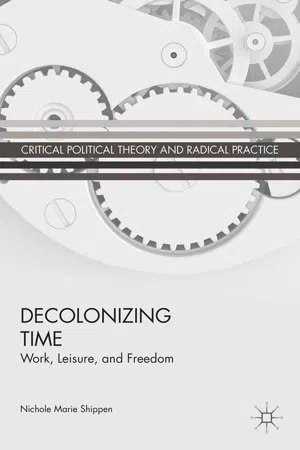
Decolonizing Time: Work, Leisure, and Freedom demonstrates the importance of time as a central category for political theory, providing not only a history of the fight for time through political, feminist, and critical theory, but also assessing this tradition in the context of the United States.
Information
CHAPTER 1
Reclaiming Leisure
The origin of the modern fight for time is based on an earlier, broader, and more radical conception of time grounded in the Aristotelian-Marxist tradition. This tradition includes a classical republican understanding of freedom based on non-domination that remains useful for developing a politics of time because it places structural forms of domination and the possibilities for “structural freedom as non-domination” at the forefront of its analysis.1 Politics is, after all, not only about raising awareness or developing critical thinking about the structural relationships of power, which remains crucial, but also about collectively organizing for political-economic transformation to improve the condition of people’s lives in concrete ways. The fight for time lends itself to both through the institutional reduction of the length of the workday, while simultaneously bringing ethical and philosophical considerations of time to bear on the political relevance of the fight for time for questions of social justice.
Aristotle is the central figure in this tradition since he anticipates two of the defining elements of the modern fight for time, namely the recognition that leisure is a central aspect of the good life, and the structural, or political-economic conditions that make leisure possible by preventing human existence from being overdetermined by necessity.2 Necessity is defined by varying social and historical standards, but as a starting point we shall assume it is the minimum amount of time that must be spent on the basic biological, household, and financial needs.3 There are, of course, political reasons as to why particular individuals spend more or less time on necessity that are related to the intersectionality of various structural forms of oppression further mediated by the colonization of time by capital. Applying a general theory of distributive justice with regard to the overall distribution of social time, I argue that no individual’s life should be overdetermined by necessity. Importantly, necessity is not the problem as much as the unequal distribution of necessity. Time not determined by necessity, I henceforth refer to as “discretionary time,” instead of “free time,” which is rendered meaningless as license, rather than as something that is much more substantially related to freedom.4 In contrast to free time, discretionary time helps highlight the relevance of individuals having control over their time for developing and exercising autonomy, or more specifically “temporal autonomy.”5
While the desire to have more control over our time already exists, as made apparent in the recent attention paid to the publicconversations around the “work-life balance,” the way toward politically achieving that goal is not immediately obvious since struggles around the issue of time are more often than not framed as an individual plight requiring individual solutions in the form of time management and the utilization of time-saving technology. Framing work-life balance in this way mystifies the colonization of time by capital whereas capital creates the experience of time as loss that it then profits from in a variety of ways. The tradition of liberalism only serves to reinforce this idea with its notion of individuals abstracted from the concrete realities of their political-economic circumstances, which insinuates people have much more control over their time than they actually do. For these reasons, leisure is seldom recognized as political, let alone a salient political issue around which people might organize and make demands around. Perhaps the closest we come to discussing leisure involves a consideration of the overall lack of vacation days in comparison to other advanced economies, but the combined public issues necessitating guaranteed paid time off from work to address human needs are never put together under a more general fight for time. The rare exception is Take Back Your Time, which does attempt to make leisure a political demand by raising awareness, creating a Take Back Your Time Day, and supporting public policies that increase discretionary time.6 It is only since 2003 that the US Department of Labor’s Bureau of Labor Statistics even started to measure time use.
Reclaiming Aristotle’s understanding of leisure is an important part of renewing the fight for time as a social critique and a political demand because leisure represents the ideal form of temporal autonomy, or the ability to control one’s time in a meaningful and self-directed way. Therefore, leisure is the “regulative ideal” that should guide the fight for increasing discretionary time and potentially temporal autonomy since time alone does not in itself guarantee the development or exercise of autonomy. Using leisure as a regulative ideal simply means using an ideal (leisure) for practical/political purposes. Generally speaking, a regulative ideal functions in at least two ways: first, by allowing for a critique of that which exists by comparison to the ideal, and, second, by continually striving toward the ideal by making improvements in the status quo.7 The ideal may never be reached, but it nevertheless continues to serve a practical/political purpose.
Leisure as a regulative ideal provides a social critique of the contemporary understanding of leisure, and a foundation for an alternative and more meaningful understanding of what I refer to as “time consciousness” with which to politically contest the severely limited understanding of time we experience on a daily basis under capitalism. Reclaiming leisure is an important part of developing a collective critical awareness about time as already a political issue, and seeks to resist, confront, challenge, and ultimately transform the colonization of time by capital. At the conceptual level, leisure as a regulative ideal allows for critical distinctions to be made between the classical understanding of leisure and the common sense and the often conflated notions of leisure and free time that are largely defined in relationship to production (work) and consumption (consumerism). In addition, leisure as a regulative ideal allows for critical judgment of contemporary leisure activities, which works against the somewhat formidable idea that leisure represents the ultimate freedom of individual choice when in reality “choice” is overly determined by the system and logic capitalism. Thus we can begin to make judgments between better and worse leisure activities as is done with the quality of food in food politics today.8 If our overall goal is health, for example, some foods are better than others, and we might begin to think about leisure in a similar fashion, with our goal being more civically oriented toward well-being, quality of life, or happiness.9 This goal rests upon Aristotle’s (and later Hegel’s and Marx’s) assertion that humans are political, or relational, animals.
Expanding discretionary time and enlarging temporal autonomy might begin by focusing on enlarging, extending, or creating public policies (and honoring more holidays) that would increase discretionary time for all to the extent that people could actually make a choice to work less. Some examples might include making Election Day a national holiday, decreasing the workweek to 30 hours a week without a significant decrease in pay in order to share the available work, providing a basic income and a living wage, expanding paid parental and sick leave, and increasing paid vacation time.10 In more general terms, using leisure as a regulative ideal helps to argue for leisure and leisure activities that are better for developing personal autonomy and facilitating greater conditions of freedom, equality, and democracy for all.
Taking my cue from Aristotle’s advice that each citizen should know how to rule and be ruled, I argue that leisure activities that actively ask something of participants in terms of developing critical reflection, thought, or action are necessary for making choice more meaningful and expanding the realm of choices beyond some of the more passive activities that are offered in direct service to the profit motive. The purpose of the Greeks’ emphasis on active citizen participation, which was only made possible by the existence of leisure, was to “enable people to develop their distinctive human capacities and virtues—to deliberate about the common good, to acquire practical judgment, to share in self-government, to care for the fate of the community as a whole.”11 As Michael J. Sandel explains, “Moral virtue therefore requires judgment, a kind of knowledge Aristotle calls ‘practical wisdom’ . . . The life of the citizen enables us to exercise capacities for deliberation and practical wisdom that would otherwise lie dormant. This is not the kind of thing we can do at home . . . We become good at deliberating only by entering the arena, weighing the alternatives, arguing our case, ruling and being ruled—in short, by being citizens.”12 While Sandel notes that the primary distinction between ancient and modern political thinkers is their respective emphasis on virtue or freedom, I argue virtue and freedom are only at cross-purposes when freedom is defined by the liberal tradition solely in terms of negative freedom, or the freedom from arbitrary interference by individuals, groups, and institutions (namely the state).13 John Dewey later extends liberalism’s argument to include freedom from the arbitrary interference of corporations since he argues they have become more of a danger to individual freedom than the state.14
In terms of negative freedom, the fight for time takes the form of reducing the workday in order to increase discretionary time, or the area of noninterference, while positive freedom is more interested in the content or value that discretionary time takes on. If the goal of increasing discretionary time is guided by the development and exercise of temporal autonomy that is civically and democratically oriented, it is not without good reason. Active civic engagement not only creates healthier individuals and stronger communities, but is also a possible source of happiness and freedom.15 People are relational beings who develop their unique capabilities through their interactions with others, but when people’s lives are overdetermined by necessity, they are prevented from developing their unique potential as human beings. If Hegel is correct, what people want most of all from other people is reciprocity, or the mutual recognition of their humanity. Under capitalism it remains unclear whether reciprocity is possible, but the fight for time gives one possible way to reduce the inequality that prevents us from recognizing each other’s humanity by giving us more discretionary time with which to build community and sustain relationships.
Work, Leisure, and Free Time
The conditions of capitalism have reduced the classical understanding of leisure as a good in itself to an instrumental, disciplined, and commodified understanding of leisure and free time defined primarily in relation to production (work) and consumption (consumerism). Conceptually, creating a distinction between the classical ideal of leisure, and the common sense, or uncritical understanding of leisure and free time, is central to enabling people to begin to expand their imaginations about what they might want to do with and be in their leisure beyond this more limited understanding. Sebastian de Grazia argues that we do not have leisure at all, but free time, which is qualitatively different than the classical ideal of leisure: “We can note to start that free time accentuates time; it sets aside a unit of time free from the job. In Aristotle’s short definition time has no role. Leisure is a condition or a state—the state of being free from the necessity to labor.”16 In the Greek context, leisure was made possible by the political-economic conditions that prevented male citizens from being enslaved to necessity so that they could have time to participate in politics and experience leisure. By comparison, free time is a truncated version of leisure that is greatly constrained by the necessity to work under the terms and conditions set by capitalism. Owing to the problem of overwork, for example, free time is often desired for rest and relaxation in order to recuperate one’s strengths in order to be able to return to work: “‘Time off’ for the workers is simply to rest them up to re-enter the workforce. No other activity can be of open-ended duration, all is confined by work-time.”17 Even in those moments designated “free,” we remain aware of the unavoidable return to work: “Free time for the worker is always for limited periods of time, within or away from work; there is no way to forget the limits of measured time, no possibility of unlimited entry into any activity but work. Most of non-work time is spent in recuperative and diversionary activity whose purpose is to prepare for the return to work.”18 Thus the form and content of free time are a direct reflection of a workdriven society since free time is greatly restricted by work time.
Kathi Weeks provides a succinct description of what she refers to as “the problem with work” in the context of the United States: “Those problems include the low wages in most sectors of the economy; the unemployment, underemployment, and precarious employment suffered by many workers; and the overwork that often characterizes even the most privileged forms of employment—after all, even the best job is a problem when it monopolizes so much of life.”19 It is important to note that time spent away from work does not in itself create leisure. As Weeks argues, “The amount of time alone that the average citizen is expected to devote to work—particularly when we include the time spent training, searching, and preparing for work, not to mention recovering from it—would suggest that the experience warrants more consideratio...
Table of contents
- Cover
- Title
- Introduction Decolonizing Time
- Chapter 1 Reclaiming Leisure
- Chapter 2 Criticizing After Dinner: Marx and the Fight for Time for Human Development
- Chapter 3 The Reification of Time-Consciousness and the Fight for Time Reconsidered
- Chapter 4 Critical Thoughts on Leisure
- Chapter 5 The Culture Industry: The Extension of Work, Disciplined Leisure, and the Deterioration of Culture
- Chapter 6 Developing a Politics of Time: André Gorz and the Domestic Labor Debates
- Conclusion
- Notes
- Bibliography
- Index
Trusted by 375,005 students
Access to over 1.5 million titles for a fair monthly price.
Study more efficiently using our study tools.
Frequently asked questions
Yes, you can cancel anytime from the Subscription tab in your account settings on the Perlego website. Your subscription will stay active until the end of your current billing period. Learn how to cancel your subscription
No, books cannot be downloaded as external files, such as PDFs, for use outside of Perlego. However, you can download books within the Perlego app for offline reading on mobile or tablet. Learn how to download books offline
Perlego offers two plans: Essential and Complete
- Essential is ideal for learners and professionals who enjoy exploring a wide range of subjects. Access the Essential Library with 800,000+ trusted titles and best-sellers across business, personal growth, and the humanities. Includes unlimited reading time and Standard Read Aloud voice.
- Complete: Perfect for advanced learners and researchers needing full, unrestricted access. Unlock 1.5M+ books across hundreds of subjects, including academic and specialized titles. The Complete Plan also includes advanced features like Premium Read Aloud and Research Assistant.
We are an online textbook subscription service, where you can get access to an entire online library for less than the price of a single book per month. With over 1.5 million books across 990+ topics, we’ve got you covered! Learn about our mission
Look out for the read-aloud symbol on your next book to see if you can listen to it. The read-aloud tool reads text aloud for you, highlighting the text as it is being read. You can pause it, speed it up and slow it down. Learn more about Read Aloud
Yes! You can use the Perlego app on both iOS and Android devices to read anytime, anywhere — even offline. Perfect for commutes or when you’re on the go.
Please note we cannot support devices running on iOS 13 and Android 7 or earlier. Learn more about using the app
Please note we cannot support devices running on iOS 13 and Android 7 or earlier. Learn more about using the app
Yes, you can access Decolonizing Time by N. Shippen in PDF and/or ePUB format, as well as other popular books in Politics & International Relations & Civil Rights in Law. We have over 1.5 million books available in our catalogue for you to explore.