eBook - ePub
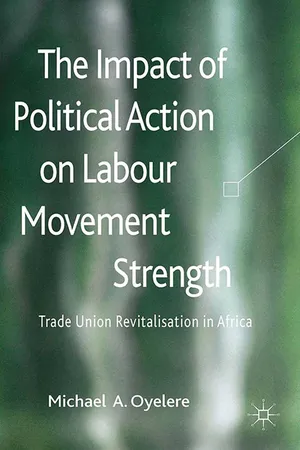
The Impact of Political Action on Labour Movement Strength
Trade Union Revitalisation in Africa
- English
- ePUB (mobile friendly)
- Available on iOS & Android
eBook - ePub
The Impact of Political Action on Labour Movement Strength
Trade Union Revitalisation in Africa
About this book
In light of the decline of trade union membership and the role TU are expected to play in industrial relations, this book explores the consequences of government action and the economic policies on TU membership, investigating the forms of political action undertaken by TU and reviewing the conditions under which these actions succeed or fail.
Information
Part I
Overview
1
Introduction
Worker organisations in both developed and emerging economies have been seen to embark on proactive action in order to counter the exigencies of the “capitalist”. With support from the ILO, many workers under military and one party despotic rule are able to mitigate the exigencies of the organisers of work. However, it is interesting that this is not a factor synonymous to emerging economies. Workers in many developed economies are faced with similar situations albeit, sometimes in a more subtle manner.In the text, I have attempted to take a wider view of trade union organisations especially from the perspective of their roles and functions within the industrial relations context by examining a number of different aspects of current situations and trying to discern future possibilities.
This book is concerned with trade union political and economic activity in Nigeria over the period 1983–2012. It examines the effects of state political and economic action on trade union activities and their own activities in both spheres as the two subjects are closely intertwined. The book examines the conditions in which the political and economic actions of unions could be considered successful and how these activities are balanced against each other and against other functions. The book discusses the issue in the context of the decline in the fortunes and membership of the trade union movement in Nigeria.
This research provides an insight into the broad global concern about the changing fortunes of trade unions and, more specifically, an insight into the fortunes of trade unionism from the perspective of a developing nation. This is done through a review of the existing pattern of labour political and economic activities.
Trade unions have experienced considerable global decline since the late 1970s (Addison 1999; Verma, Kochan and Wood 2002). Although union influence remains significant in most nations, most unions have witnessed a fall in membership, on which this influence ultimately depends (Verma, Kochan and Wood 2002). In the recent past attempts at turning the fortunes of unions around in the face of “globalisation” and national predicaments have been the concern of union leaderships (Visser 2002). In addressing the general problem, though, while there are global dimensions to decline, the way that these global influences shape events occur at national level (Godard 2003). In the case of Nigeria, such events are economic circumstances, the use of legal instrumentality such as decrees and edicts, and lack of democratic environment due to constant military intervention in Nigeria’s political system.
In order to achieve a considerable and substantial improvement in the prosperity of the labour movement, more effective political action within a more accommodating regime may be required. This need has been recognised by Charlwood (2004), who concludes that in the face of overwhelming industrial difficulties occasioned by harsh and inhospitable environments, unions have unsurprisingly turned their attention to political activities in the hope of altering the environment in which they operate. James (2004) shows that the presence of unions does strengthen individual protection from discriminatory treatment and Levesque and Murray (2005) examine union involvement in workplace change and highlight the sources of local union power to cope with the changes.
The book is designed to explore the consequences of military and civilian rule and the attendant economic and political policies on union membership and clout. Furthermore, the book will investigate the forms and methods of political action undertaken by trade unions and to understand the conditions under which unions’ political actions succeed or fail. Finally the book will further seek to explore how trade unions balance this function in relation to their main function of collective bargaining.
The book objectives are mainly concerned with the analysis of how successful trade unions remain in the use of political and economic action in pursuit of their goals, both generally, given the global trend of trade union membership decline, and specifically under a military and one party rule. This is closely linked with the extent to which form of government, governmental policies and programmes are responsible for union density decline.
Structure of the book
Chapter 1 presents an introduction to the world of work and the position of the ILO. In Chapter 2, I review industrial relations development from the perspective of developed economies. The final chapter in this section examines contemporary theories and union actions.
These chapters are germane to providing a theoretical base for the study. A review of some existing theories was undertaken, beginning in Chapter 2. This chapter provides insight into the relevance of unions’ political actions and how this action has affected unions’ development and influence. Classical and contemporary theories were reviewed. Most of the classical theories provided historical antecedents that help understanding of the current state of affairs within the labour movement worldwide. The contemporary theories revealed the state of the labour movement especially the course of union action.
The classic works by Webb and Webb (1894, 1897) and Cunningham (1882) form the bedrock for the study of unions’ activities in the United Kingdom, while Commons (1905) and Foner (1964,1965, 1975) inform understanding of what transpired in the USA. Both sets of studies also have much wider relevance. These classics are all useful in aiding understanding of what is happening in the trade union world today.
The Webbs’ work details the historical development of modern trade unions and also provides evidence as to the type of political action embarked upon by unions. The two accounts referred to in this study (Webb and Webb 1894, 1897) provide examples of unions embarking on political actions, with the reasons for such action clearly specified. Similarly, Commons provides insights into why unions in developing economies have often lacked political power. Together these works provide insight into why it was first difficult to establish a national labour centre during the early stage of development of the Nigeria labour movement. However, more contemporary studies of “social movement unionism” were also considered relevant here and Chapter 2 continued with a review of contemporary theories.
Some of the contemporary theories reviewed explain the pattern of development of the labour movement in Nigeria. Some of the studies reviewed highlight the importance of internal democracy to the success of unions’ action. During the imposition of administrators on unions, the study revealed that union members may become disillusioned in unions’ activities if they become detached from the experiences of working people. Some of the literature further revealed that the Nigerian labour movement is likely to take on the role of social movement unionism.
The issue of democratic struggle is detailed later in Chapter 4. This chapter presents a concise examination of Nigeria’s political economy since independence. Initially the composition of successive governments and what led to the collapse of these governments is examined. The review highlights the implications of a prolonged military rule on the labour movement and concludes by examining the unions’ actions which are aimed at stemming these problems.
This chapter also considers more recent developments following the return to civilian rule and draws on literature examining the effects of the imposition of neo-liberal policies of Structural Adjustment Programmes on developing countries. Furthermore, the chapter provided theoretical answers to the second research question by revealing the reasons why the labour movement embarked on political activities. The chapter also examines how Obasanjo governments have employed legal instruments to obstruct labour movement actions.
In particular, Chapter 4 sheds light on the issues of the origin and nature of Nigeria’s labour movement and how this has differed from those in western democracies. While it can be argued that modern trade unionism was a product of industrialisation in the western world, the same cannot be said of trade unionism in Nigeria and by extension most African states. The labour movement preceded industrialisation in Nigeria and attained the position of relevance because of its involvement in political struggle, especially during the struggle for independence (Fajana 2007).
The main essence of the chapter was therefore to undertake a critique of the literature, and to provide an insight into the socio-politico and economic developments in Nigeria in order to understand why the labour movement exhibits certain characteristics at particular times.
Against the background of increased interest in the relationship between government and labour movements and especially after the return to democratic rule, attention was drawn to actions taken by the labour movement. In Chapters 6, 7 and 8 the findings from this study are discussed. Each chapter discusses a particular aspect of the research question.
Firstly, Chapter 6 considers the issue of how political changes affect the influence and strength of the labour movement. The discussion was categorised into four elements, each of which detailed some specific period in time and the form of regime in power. Examples of unions severely affected by the political decision during this period were discussed. For instance during the first period (1966–1979), the study examines the impact of political events on the NLC and NUPENG generally but also discusses the specific case of government political policies under Gowon and Murtala/Obasanjo 1966–1975 and 1975–1979 periods of military rule respectively.
Secondly, the chapter considers the period 1979–1983. The period was referred to as the second republic. The Shehu Shagari-led civilian administration was famous for corruption. The study examines how political activities of this regime impacted on the labour movement. Examples were drawn from two case studies of the NLC and NUTGTWN. The section concludes with an examination of corrupt practices and its implication on the labour movement.
Thirdly, the study examines the period 1983–1999, a long period of military rule characterised by coups and counter coups and a succession of military governments. This period marked the end of corporatism and the beginning of a more authoritarian kind of industrial relations. The experiences of the four case studies during this period were different; hence a detailed discussion of the political impact of all the case studies was presented.
Fourthly, the period 1999–2007 is examined. The period marked yet another civil rule, headed by a former military dictator. The regime first attempted a return to corporatism. However the failure of the regime to properly co-opt labour organisations led to a strategic attempt at strengthening individualism at the expense of collectivism among union members. Examples from the four case studies were utilised.
In each of the categories, the effect of changes in political policies on union membership is discussed and it is concluded that government political policies have relatively low consequences on union membership when compared to economic ones. In the concluding section, the relationship between the government and the unions is discussed. The response from members of the NCSU revealed that although workers expected an improved relationship after the support given to democratic struggle by unions, they were astonished at the hostile actions of the civilian government toward the unions.
Chapter 7 presents unions’ responses to the effect of economic pressure on the trade unions. The chapter centres on factors that are the result of economic policies and situations. The presentation in the chapter is similar to those in Chapter 6. It discusses responses of each of the industrial unions studied separately. These responses were categorised based on the earlier structured dimension (1966–1979; 1979–1983; 1983–1999; 1999–2007). However the emphasis was on the economic factors instead of the regime or type of government.
The chapter begins by examining the impact of economic factors during the second republic, 1979–1983 and then the period 1983–2007 was examined. This period spans both military and civil administrations. This period was chosen to highlight the effect of the policy of SAPs on the trade unions. The policy began under the military during the 1980s and continued under the civilian government that took over in 1999. The chapter concludes by examining collective bargaining issues under the civil administration of Obasanjo between 1999 and 2007. This chapter revealed that although government policies affect union membership and influence, economic decisions seem to have greater implications for union membership.
In Chapter 8, the study detailed unions’ responses to socio-politico and economic changes. The chapter is divided into four sections. Each of the sections presented actions taken by the union either in response to socio-politico and economic demands of the environment or as response to workers’ demands on the union leaders.
In the first section of the chapter, the study examined how NUPENG responded to an overwhelming societal need (the annulment of the 1993 general election) during the political stalemate of the 1990s and, later, how the officials responded to workers’ plight during the casualisation of work in the oil industry. The second segment was about NUTGTWN and the response of NUTGTWN leaders to the growing problem of casualisation of workers in the industry and the continued closure of textile mills in the country. In the third section, the study showed how the NCSU leadership assisted workers in the public sector to cope with the casualisation and retrenchment exercises in businesses solely owned by government. In the final section of this chapter, the study surveyed how the central labour organisation responded to external demands especially from other civil organisations and the general populace, and yet maintained its traditional responsibility to the working class.
Chapter 9 examined the current state of labour movement in Nigeria. The chapter discusses various issues affecting the labour movement as a whole. It addresses issues relating to type of government and how this has impacted on the development of trade union. Moreover, it highlights the change in methods employed by both military and civilian government in subjecting the labour movement to their control. Two main methods were revealed – co-option and coercion.
The chapter also discusses the impact of government economic policies on trade union membership, in particular the introduction of SAPs, especially the policies of commercialisation and privatisation, market deregulation and the casualisation of workers.
The concluding section examines the interrelationship between political and economic issues and how the two combined with societal influence have shaped and continued to determine the direction and type of action employed by trade unions and the ideology of trade union leaders. For example, it was noted that, as a result of these pressures, the trade unions now exhibit some characteristics of social movement organisations. However, even though unions participate in social movement activities, they are not fully fledged social movement organisations. Thin distinctions exist between the two forms of organisations. Although evidence exists that the labour movement exhibits some characteristics of a social movement, it is not entirely safe to consider the labour movement in Nigeria as a social movement organisation.
2
Industrial Relations Development: Perspectives from Advanced Economies
Introduction
This chapter reviews the changing approaches taken by trade unions. In order to understand why trade unions embark on certain methods of action as a means for achieving their objectives, some classic and contemporary theories in the field will be examined. This examination aims to provide insight into the relevance of unions’ political actions and how such action has affected unions’ development and power. The study will further provide a review of literature dealing with methods employed by labour movements in the United Kingdom and United States. This is not intended to be a highly detailed review. Rather, it highlights major political actions and the antecedents and consequences of such actions on the labour movement. The works of Webb and Webb (1894, 1897), Cunningham (1882), Foner (1964, 1965, 1975) and Commons (1905, 1918) are amongst the classictheorists that will be visited.
In their classic The History of Trade Unionism, Webb and Webb (1894) traced the origin and growth of trade union movements as a whole, industrially and politically. In a similar fashion Unwin (1925), in a well-reasoned account of the various forms of industrial organisation from the period of mediaeval craft guilds to the beginnings of the modern trade unions provided detailed accounts of labour activities with proofs and illustrations from continental conditions. Commons (1918), on the other hand, detailed the history of labour movement in the United States; he was more concerned with the impact of the federal system on the ability of labour organisations to effectively organise and protect their members’ interest. The principal distinctions among American unions, he maintained, were in their internal organisation. This he identified as “industrial” and “trade” unions.
Trade union and political action: the Webbs
In this section, the significance of political action in relation to other forms of action is analysed. Webb and Webb (1894) is a classic work on trade unionism in the United Kingdom. This work provi...
Table of contents
- Cover
- Title
- Part I Overview
- Part II The Nigerian Context and Case Study Organisations
- Part III Politics and Trade Unions
- Part IV The State and Predicament of the Labour Movement
- References
- Index
Trusted by 375,005 students
Access to over 1.5 million titles for a fair monthly price.
Study more efficiently using our study tools.
Frequently asked questions
Yes, you can cancel anytime from the Subscription tab in your account settings on the Perlego website. Your subscription will stay active until the end of your current billing period. Learn how to cancel your subscription
No, books cannot be downloaded as external files, such as PDFs, for use outside of Perlego. However, you can download books within the Perlego app for offline reading on mobile or tablet. Learn how to download books offline
Perlego offers two plans: Essential and Complete
- Essential is ideal for learners and professionals who enjoy exploring a wide range of subjects. Access the Essential Library with 800,000+ trusted titles and best-sellers across business, personal growth, and the humanities. Includes unlimited reading time and Standard Read Aloud voice.
- Complete: Perfect for advanced learners and researchers needing full, unrestricted access. Unlock 1.5M+ books across hundreds of subjects, including academic and specialized titles. The Complete Plan also includes advanced features like Premium Read Aloud and Research Assistant.
We are an online textbook subscription service, where you can get access to an entire online library for less than the price of a single book per month. With over 1.5 million books across 990+ topics, we’ve got you covered! Learn about our mission
Look out for the read-aloud symbol on your next book to see if you can listen to it. The read-aloud tool reads text aloud for you, highlighting the text as it is being read. You can pause it, speed it up and slow it down. Learn more about Read Aloud
Yes! You can use the Perlego app on both iOS and Android devices to read anytime, anywhere — even offline. Perfect for commutes or when you’re on the go.
Please note we cannot support devices running on iOS 13 and Android 7 or earlier. Learn more about using the app
Please note we cannot support devices running on iOS 13 and Android 7 or earlier. Learn more about using the app
Yes, you can access The Impact of Political Action on Labour Movement Strength by M. Oyelere in PDF and/or ePUB format, as well as other popular books in Business & Business Strategy. We have over 1.5 million books available in our catalogue for you to explore.