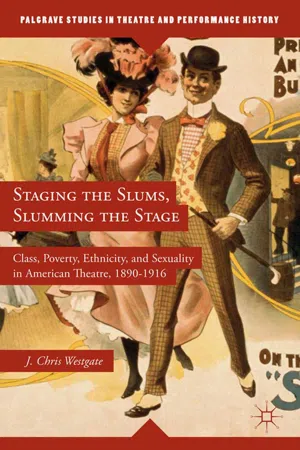
Drawing on traditional archival research, reception theory, cultural histories of slumming, and recent work in critical theory on literary representations of poverty, Westgate argues that the productions of slum plays served as enactments of the emergent definitions of the slum and the corresponding ethical obligations involved therein.
1. “Strange Things” from the Bowery: The Tourism Narrative in Slum Plays
Shortly after A Trip to Chinatown made its New York City debut at the Madison Square Theatre in 1891, Charles H. Hoyt described his ambitions behind the play in refreshingly candid terms: “to amuse the public, and, incidentally, to make money.”1 According to Arthur Hobson Quinn, Hoyt was successful in both ambitions: A Trip to Chinatown had “the longest consecutive run of any play given in the United States” at that time, 650 performances; and after a six-month hiatus during which it was refurbished with new songs and dance numbers, it would reach the 700-performance mark.2 Much of this achievement derived from the “charming nonsense”3 of farce that Hoyt employed to great success: witty banter, mistaken identities, lost letters, singing and spectacle. What distinguished A Trip to Chinatown from other Hoyt plays was a mixture of commercial perspicacity and authorial imagination that linked this play with the fascination for slum tourism. Hoyt did this in two ways, beginning with the title, which indicates the drama’s primary conceit: the younger characters want to attend a masquerade ball that they know the family patriarch, Uncle Ben, will disapprove of, so they gain permission to go on a “night tour of Chinatown” because it was all “the fashion,” thereby putting themselves at liberty for their revelry—although it goes comically awry.4 Additionally, the highpoint of A Trip to Chinatown was Welland Strong’s song “The Bowery,” which tells of his intention to “enjoy of the sights” of the Bowery years earlier and which, likewise, goes comically awry so that he ends up having “one of the devil’s own nights!”5 He is conned out of his money, is scandalized at the immodesty of concert halls, and has a lucky escape with his life when a brawl erupts in a dive. His only souvenirs a “black eye” and “battered nose,” Strong swears off any further escapades in the slums of New York with the chorus: “On the Bow’ry! The Bow’ry! / I’ll never go there any more!”6
Although A Trip to Chinatown was not the first play to represent what Strong defines as the “strange things” of the Bowery, this play debuted at a significant moment in New York City. Only seven years earlier, the New York Times published an article entitled “Slumming in This Town: A Fashionable London Mania Reaches New-York”—the article that correctly predicted the transformation of what had been a private pastime into a full-scale industry.7 Before 1884, slumming expeditions were usually around half a dozen or so wealthy adventurers employing a police escort to take them on tours. After 1884, slumming grew in popularity and opportunity as an infrastructure of slum tourism developed out of the determination of shrewd tour guides and perceptive businessmen. Originally, slumming was the “fashionable dissipation” among the upper classes of New York, who were intent on emulating their betters in London, where slumming had long been a favorite pastime. Additionally, slumming appealed to the emergent middle class by affording members of this class the opportunity to contrast themselves with the lower classes—so that they could differentiate themselves from immigrants and the working class and participate in the amusements from immigrant and working-class life. By the time A Trip to Chinatown debuted, the Rand McNally & Co published A Week in New York, by Ernest Ingersoll, a guidebook that described how to take a “night ramble” of the slums.8 During the same year, “a group of enterprising New Yorkers had established a corporation designed to capitalize on the growing belief that ‘slumming is the most absorbing of diversions.’ ”9 Recognizing slumming as an investment opportunity, these tourism boosters provided “sightseers with a souvenir map of the city ‘on which the slums are indicated by dark shading,’ but also promised them safe nighttime glimpses of ‘the poor man in his home, the laborer in his hovel, the opium joint, fan tan games, and Italian dens where at times thirty people live together in a room twenty feet square.”10 These interests were selling the “strange things” of the slums to the sightseers of New York City as part of a new leisure economy.
Considered in this context, Hoyt’s A Trip to Chinatown serves as a key production in the history of slum plays. The play clearly drew on the emergent leisure economy both in terms of what it represented about slumming and the way that it affiliated itself with this increasingly fashionable amusement. More than that, the play implicitly advanced an argument about the superiority of slumming the stage rather than the streets. To understand the contribution of A Trip to Chinatown, it is necessary to recognize that the commercialization of the strange things of the slums could be charted on a continuum that ranged from firsthand experiences (tours) to fully mediated representations (magazines, newspapers, or novels). On this continuum, theatre occupied a noteworthy position. On the one hand, theatre could represent the destinations and even some of the experiences of slumming with more fidelity than most literary representations since it includes characters and settings that could be verisimilar recreations or genuine features of slum life. One anonymous reviewer of A Trip to Chinatown argued that theatregoing could replace slumming: “Those who have not been to San Francisco can go to the Chestnut theatre this week and see what Charles H. Hoyt . . . gives as his idea of ‘A Trip to Chinatown.’ ”11 Although this proposition is erroneous for A Trip to Chinatown since the tour never occurs, the principle is sound. As a genre, theatre could represent the slums with more embellishment and verisimilitude than magazines, newspapers, or novels. On the other hand, theatre safeguarded the welfare of theatregoers in ways that slumming could not always guarantee. However thrilling the representations of the slums in the plays, those thrills were representations in the bourgeois space of the theatre. Theatre could supply the chance to glimpse strange things from the slums without accumulating bruises to bodies or egos like in “The Bowery.” Thus, A Trip to Chinatown advanced a key premise behind slum plays, namely, that slumming in the theatres of New York was superior to slumming in the streets of New York.
However much “The Bowery” became a sensation during and even after the extended run of A Trip to Chinatown, this was only the beginning of the ascendancy of slum plays toward the commanding place they would occupy in New York theatres. The next phase involved a group of enterprising producers, including William T. Keogh, Thomas H. Davis, and Al Woods, who recognized the box office potential of this intersection of theatregoing and slumming and went one better than A Trip to Chinatown. Rather than including one character who sings about these strange things, they would stage these things for the amusement of slumming audiences. Out of the same ambitions acknowledged by Hoyt, such producers commissioned playwrights to compose plays like On the Bowery (1894), In the Tenderloin (1894), and The Bowery After Dark (1899). As these titles suggest, the plays promised not just the sights of the slums but further an immersive experience in slum life that would rival anything to be had in the streets of New York City. They did just what the reviewer of A Trip to Chinatown described: they represented slum life as spectacles of amusement in the comfort of the theatre. This change from diegesis to mimesis maximized the immediacy, exhilaration, and, at times, the verisimilitude in staging the slums and slumming the stage. Because the producers and the playwrights that they employed were most familiar with the sensational melodramas during the 1890s, they tended to focus on the more unsavory elements of slum life, including vices and crime. In fact, the plays represented elements of slum life much stranger than anything described by Welland Strong. Just the three plays mentioned here featured topics such as saloons, drunkenness, and bar fights; opium dens, drug addiction, and white slavery; gambling, crime, and murder—much worse than bruises or broken noses. What Al Woods declared about The Bowery After Dark describes the ambition behind these early slum plays: they sought to provide audiences with “a thrill a minute, a laugh a second.”12
Because these plays emphasized the adventure and amusement to be had in the slums of New York City during the decade when slum tourism was becoming an industry, I describe the enactments of poverty discourse involved in these plays as the tourism narrative. As discussed in the introduction, enactment describes both representing a particular version of slum life and ratifying the modes of ethical engagement therewith. In the case of the tourism narrative, the representation involved privileging the sights/sites of the slums through the emphasis on plot and setting. Nearly all the slum plays in the 1890s involved some version of the abduction plot, which involved a young woman being kidnapped from the country or from an upscale part of New York City by nefarious types (thieves and white slavers) and being imprisoned in the underworld. Highly episodic, the abduction plot was an excellent way to produce the thrills described by Woods since the story involved rescuers pursuing the kidnappers and liberating the young woman from a sensational peril (pulling her from burning buildings or from bodies of water were commonplace); and the sightseeing that was at the heart of slumming since the plotting took the rescuers and audiences ever deeper into the underworld. Additionally, these productions involved a good deal of effort and expense—if not accuracy—in the ways that they represented slumming locales. Reviews routinely lavished approval on the “scenes” and the “scenographic equipment” used to represent these settings, often using terms such as “real,” “realistic,” and “realism”—a curious trend that suggests how fungible the term “realism” may be in theatre history. If not already evident, this privileging of plotting and setting came at the expense of characterization, which tended to be flat and static in contrast to the complexity and depth in contemporary plays such as James Herne’s Margaret Fleming (1890). With a few noteworthy exceptions, the representation of the working-class and immigrant populations of the slums correlated with the Victorian concept of “types” in which individuals were classified in a rigid and condescending taxonomy demonstrated in Riis’s How the Other Half Lives.13
Naturally, the tourism narrative had serious ramifications in terms of how it prescribed cross-class encounters with the slums, especially during the transition from the Victorian to the modern regime of poverty. After all, plays like On the Bowery and The Queen of Chinatown (1899) were doing more than just representing slum life. They were sanctioning understandings and ethical engagements with that life in the ways that they represented it. The tourism narrative endorsed abjection of the working class and immigrants of New York City, that is, it invited audiences to contrast themselves, morally and materially, with what they found in there. This abjection took multiple forms, the most common of which involved viewing the lower classes as spectacles of amusement not despite but because of the difficulties of slum life. Many plays featured scenes that encouraged laughter at material deprivations, drunkenness, and addiction instead of the philanthropy that Howells felt toward the tramp with the maimed hand. The Irish and Germans were frequently ridiculed through exaggerated dialects, mannerisms, and behaviors such as drinking and drunkenness. Chinese immigrants faced much worse as they were routinely targeted for denigration according to some of the worst ethnic stereotypes behind the nativism movement, including apprehension about Chinese men seducing white women with opium or kidnapping them as part of a white slavery ring. Treating the working class and immigrants as spectacles of derision and denigration in the theatre most likely had consequences in the streets beyond, where slumming was charting geographical and ideological boundaries of New York City. Being encouraged to laugh at the imprudence of the working class or to fear or scorn the difference of the immigrant in the theatre could influence how the wealthy understood these populations in the streets, especially since theatre was often the last stop of the evening before going slumming.14 It would be possible, then, for audiences to see a play about the Bowery and then visit the Bowery with that play’s representations informing their horizon of expectations, to reverse a common concept of reception theory—all in the same evening’s entertainment.
Although the tourism narrative affirmed the privilege of the wealthy in the ways that it represented the other half as spectacles of entertainment, these slum plays did not always fully conform to this narrative. Instead, they evinced contradictions regarding this privilege and the discourses of poverty. Some of these contradictions were deliberately promoted by producers and playwrights with their exaggerations of the hazards of the slums. According to slum plays from the 1890s, the Bowery, the Lower East Side, and the Tenderloin were rife with crime, vice, and violence, so much so that slummers would be thankful to come away with only the minor bruises to their bodies and sensibilities described in “The Bowery.” While there were areas of the slums that were too dangerous for slumming, the exaggerations in these plays contrasted with guidebooks from this decade, which reassured readers of the safety of slumming, such as A Week in New York, which included this remark: “As for danger—pooh!”15 Theatre producers were attempting to capitalize on the fascination with the slums by staging things too strange to be encountered firsthand. Hence, slum plays served as much as a bulwark against the slums as an entrance into them. Less common but still noteworthy was another contradiction evident in slum plays. Although these plays tended to pathologize the working class through discourses of pauperism and individualis...
Table of contents
Cover
Title
Introduction: Darnton’s Lament
Part I Modes of Staging the Slums
Part II Slumming Destinations on Stage
Part III Case Studies in Slum Plays
Notes
Bibliography
Index
Trusted by 375,005 students
Access to over 1.5 million titles for a fair monthly price.
Study more efficiently using our study tools.
Frequently asked questions
Yes, you can cancel anytime from the Subscription tab in your account settings on the Perlego website. Your subscription will stay active until the end of your current billing period. Learn how to cancel your subscription
No, books cannot be downloaded as external files, such as PDFs, for use outside of Perlego. However, you can download books within the Perlego app for offline reading on mobile or tablet. Learn how to download books offline
Perlego offers two plans: Essential and Complete
Essential is ideal for learners and professionals who enjoy exploring a wide range of subjects. Access the Essential Library with 800,000+ trusted titles and best-sellers across business, personal growth, and the humanities. Includes unlimited reading time and Standard Read Aloud voice.
Complete: Perfect for advanced learners and researchers needing full, unrestricted access. Unlock 1.5M+ books across hundreds of subjects, including academic and specialized titles. The Complete Plan also includes advanced features like Premium Read Aloud and Research Assistant.
Both plans are available with monthly, semester, or annual billing cycles.
We are an online textbook subscription service, where you can get access to an entire online library for less than the price of a single book per month. With over 1.5 million books across 990+ topics, we’ve got you covered! Learn about our mission
Look out for the read-aloud symbol on your next book to see if you can listen to it. The read-aloud tool reads text aloud for you, highlighting the text as it is being read. You can pause it, speed it up and slow it down. Learn more about Read Aloud
Yes! You can use the Perlego app on both iOS and Android devices to read anytime, anywhere — even offline. Perfect for commutes or when you’re on the go. Please note we cannot support devices running on iOS 13 and Android 7 or earlier. Learn more about using the app
Yes, you can access Staging the Slums, Slumming the Stage by J. Westgate in PDF and/or ePUB format, as well as other popular books in Social Sciences & Art General. We have over 1.5 million books available in our catalogue for you to explore.