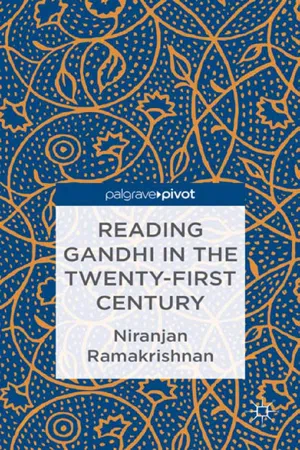
Niranjan Ramakrishnan examines the surprising extent to which Gandhi's writings still provide insight into current global tensions and the assumptions that drive them. This book explores how ideas Gandhi expressed over a century ago can be applied today to issues from terrorism to the environment, globalization to the 'Clash of Civilizations.' In particular it looks at Gandhi's emphasis on the small, the local, and the human – an emphasis that today begins to appear practical, attractive, and even inescapable. Written in an accessible style invoking examples from everyday happenings familiar to all, this concise volume reintroduces Gandhi to today's audiences in relevant terms.
- English
- ePUB (mobile friendly)
- Available on iOS & Android
eBook - ePub
Reading Gandhi in the Twenty-First Century
About this book
Information
1
What’s So Great about Gandhi, Anyway?
Abstract: What sets Gandhi apart? Did he think differently, did he act differently, or was he just a pious man who happened to be in the right place at the right time? Chapter 1 offers a brief examination of his approach to a variety of issues, such as terrorism, freedom, economic policy, industrialism, technology, etc.
Ramakrishnan, Niranjan. Reading Gandhi in the Twenty-First Century. New York: Palgrave Macmillan, 2013.
DOI: 10.1057/9781137325150.
DOI: 10.1057/9781137325150.
“Mahatma Gandhi was OK, but he was no Manmohan Singh,” remarked a friend of mine. I laughed out loud at this deadpan humor, only to realize that my friend, a smart and successful technology baron in Silicon Valley, was serious. He genuinely thought that Gandhi’s contribution was merely to freeing the country from the British, and that Singh, who as Indian finance minister had freed the Indian economy from governmental shackles in the early 1990s, thus ushering India into the global economy, was clearly the larger figure.
This is a notion shared by increasing numbers of the intelligentsia, both in India and abroad. To many, Gandhi is no more than a goody-goody icon who talked about nonviolence and held Luddite views on industry and trade. True, he may have been honest and upright, but then those were different times. Some (mistakenly, in my opinion) associate Gandhi with India’s pursuit of economic protectionism after independence (a policy followed by his associate Jawaharlal Nehru) and hold Gandhi responsible for India’s perceived backwardness. Others consider his approach to Muslims and Pakistan naive and gullible. All in all, they conclude, the coward who shot him in 1948 did India a favor, for Gandhi would have been an albatross around our modern necks. In a world where terrorism lurks at every corner and smartphones sit in every pocket, Gandhi is passé.
Is he?
As I watch world events unfold, Gandhi’s life appears increasingly relevant. With each passing day, his words and methods seem even more uncannily prescient.
Gandhi had numerous interesting and formidable personal characteristics—prodigious courage both physical and political, enormous self-discipline, asceticism and industry (more than a hundred volumes of writings and twenty-hour days), a fine sense of humor, and the ability to laugh at himself—that must have played a major role in the making of the Mahatma. But if I were to condense his political philosophy into one phrase, it would be this: the freedom of the individual.
Complete liberty, for Gandhi, was the first and last goal. India’s freedom from Britain, to him, was only an objective along the path, and a rather insignificant one at that. Far more important was the ability of each individual to seek out his or her own freedom. “Real Swaraj [freedom] will come, not by the acquisition of authority by a few, but by the acquisition of the capacity by all to resist authority when abused,” he wrote.1 I think of this statement every time I recall how mutely the public of the United States accepted the slap delivered full to its face by the Rehnquist Supreme Court after the 2000 presidential elections, followed by the post-9/11 march of official arbitrariness and open violation of liberties.
It is also in the context of liberty that ahimsa, Gandhi’s creed of nonviolence, must be understood. It was not out of some sense of piety that he espoused peaceful means. He held nonviolence to be essential because it afforded the only democratic means of struggle. It was available to everyone—not just to those who owned weapons. Second, a violent victory, even a just one, would prove only that violence had triumphed, not necessarily that justice had done so. A violent solution would mean that the fate of the unarmed many would be mortgaged to the benevolence of the armed few. This was contrary to liberty as Gandhi saw it.
An extremely intelligent man, he had a knack of cutting right through shibboleths to the heart of the matter. In an earlier echo of the American position on Iraq and Afghanistan, the British kept telling India that they would leave India in a heartbeat, if only they could be sure the country would not fall into anarchy. This made some sense to many in view of the vicissitudes and general caprice of feudal rule in pre-British India, until Gandhi gently reminded us that good governance was no substitute for self-governance. When one hears the cant that passes for political discussion on our airwaves, how one longs for a similar voice today.
Gandhi saw that millions had lost their livelihood because the British, in a former era of globalization, had systematically destroyed India’s cottage industries to create a market for the products of the Industrial Revolution. Gandhi was the chief architect of India’s revived cottage industry. Although this was a magnificent achievement in itself, even more telling was the way he brought it about. He did not run complaining to the British government, asking it to reduce exports to India. Instead, he mobilized people to buy Indian-made goods. Huge bonfires of foreign cloth resulted in the handspun Indian fabric khadi replacing foreign mill-cloth to become, in Jawaharlal Nehru’s words, “the livery of India’s freedom.”
This too has to do with freedom. To have demanded something of the government would only have increased its power. Gandhi instead chose to empower each individual to make a statement by shedding foreign cloth and wearing khadi. Today, a third rail of American politics is the word “trade.” It is commonly accepted, and rarely challenged, that trade is a deity to be propitiated at all costs—even if doing so means sacrificing jobs, families, homes, even towns or entire ecologies. Gandhi wrote that he would like to see all of a community’s needs met from within a reasonable radius. Some years ago Vegetarian Times carried a mind-boggling statistic: the average item consumed in America travels 1,200 miles. Is it any surprise we have to invade other countries for oil? As American gadflies such as Ralph Nader and Pat Buchanan rail against NAFTA and the WTO, one wonders why they haven’t thought of organizing a movement to buy American-made products.
Gandhi was an exponent of “demand-side economics.” This was a much longer and more arduous path than supply-side economics, but a more enduring one, and one with fewer deleterious side-effects. He believed that, ultimately, the only guarantee of good society lay in the quality of the citizenry. Benjamin Franklin’s famous reply upon being asked whether the United States had a republic or a monarchy—“A republic, if you can keep it”—approximates Gandhi’s belief. A society with no demand for cigarettes, for instance, would soon stop manufacturing them. Gandhi believed the gift of liberty carried with it the utmost moral responsibility for its use. In a famous interview with the noted birth-control proponent Margaret Sanger, he said flat out that he was against contraception, as it meant escaping the consequences of one’s action. He was no politically correct weathervane, preferring rather the liberty to say what he thought. He gave Sanger an analogy along these lines (not an exact quote): “I overeat, and instead of suffering the consequences of my indulgence, I go to the doctor and get some pills. To mitigate the side-effects of the pills, I then take some whiskey. . . . Where does it end?”2 He would certainly be aghast at the blithe acceptance of abortion today. He always connected individual morality and public policy.
Consider the drug war, for example. We do practically nothing to discourage the taking of drugs. Instead, we pour money into drug interdiction efforts, change foreign governments, denude entire countrysides, and fight endlessly (Panama, Colombia, Peru) because we don’t have the guts to demand the highest of our own citizenry. Gandhi was unafraid of public opprobrium, even assassination. Every politician is willing to tell us what is wrong with someone else; Gandhi was different because he told us what was wrong with us. “Let us turn the searchlight inward,” he once said, to the astonishment of a crowd that had gathered to hear some rousing rhetoric condemning the British, only to find him spouting uncomfortable home truths about how Indians themselves enabled British rule in a hundred small ways.
If we turn the searchlight upon our own contradictions, we might wonder how, while complaining about the disappearance of our forests, we continue to build new housing developments (and prize this as an index of economic health), or how, while complaining of rising medical costs, we cannot stay away from our Big Macs.
Like Jefferson, Gandhi believed in small government, noting with approval the saying “That government is best which governs least.” Once again, this is an offshoot of his ideal of least external control, and maximum individual freedom, coupled with complete moral responsibility—making for an uncharacteristic meeting point between Karl Marx (the state withering away) and Ayn Rand (individual freedom from the collective). As fear-stricken citizens throughout the world surrender their personal rights, in the name of safeguarding their personal security, to their fear-stricken governments, which in turn surrender their sovereignty to faceless agencies such as the WTO in the name of economic security, we might recall Gandhi’s words “Fearlessness is the first requisite of spirituality. Cowards can never be moral.”3
The art of forging popular movements based on inveterate opposition to injustice, while always demanding the highest moral standards both of the individual and of the collective, is Gandhi’s enduring contribution to politics. It is almost certainly due to Gandhi’s movement that India, for all its flaws, has remained a liberal democracy. (No other country freed from the colonial yoke can make a similar claim.) Without a Gandhi, India might well have ended up like Pakistan, a hotbed of intolerance and obscurantism. (It might be pure coincidence that the more India rejects Gandhi, the more that seems to be the direction in which it is headed.) At the risk of oversimplification, we can note that Martin Luther King applied Gandhi’s means and managed to avoid a West Bank in America. The Palestinians did not—and did not.
Some time ago, the Indian socialist Rammanohar Lohia wrote that the twentieth century had produced one innovation, the atom bomb, and one innovator, Mahatma Gandhi. As paranoia and insanity sweep our times, Lohia’s terms come into sharper focus: fear versus freedom. In this consequential contest, Gandhi is not merely relevant; he is central.
Notes
1Young India, January 29,1925. Collected Works of Mahatma Gandhi, Vol. 30, p. 159.
2“You do not take chocolate for the sake of your physical need. You take it for pleasure and then ask the doctor for an antidote. Perhaps you tell the doctor that whiskey befogs your brain and he gives you an antidote.” Interview with Margaret Sanger, 1935. Collected Works of Mahatma Gandhi, Vol. 68, p. 192.
3Collected Works of Mahatma Gandhi, Vol. 24, p. 411.
2
Gandhi in the Time of Terrorism
Abstract: Since 9/11, terrorism has come to occupy center stage in twenty-first-century political discourse. Yet the problem long precedes some planes hitting two tall buildings on a bright autumn morning. Gandhi not only was aware of the problem but even wrote about it, using the very word. What self-deceptions about terrorism are we prey to, and how can Gandhi help us resolve this endless war on ourselves?
Ramakrishnan, Niranjan. Reading Gandhi in the Twenty-First Century. New York: Palgrave Macmillan, 2013.
DOI: 10.1057/9781137325150.
DOI: 10.1057/9781137325150.
“Happy families are all alike,” Tolstoy writes in Anna Karenina. “Every unhappy family is unhappy in its own way.”
The latter statement seems much the norm in the case of terrorism. From Russia to Australia, from Iran to Japan, from Great Britain to Argentina, not to mention the United States of America, every land can relate its own “favorite” incident of firebombing, kidnapping, hijacking, or other innovations in mayhem attempted or successful. Add assassination to the list and you might need a microscope to find an entity on the world map that can claim to have been terror-free.
Little surprise, then, that the word “terrorism” lights up the radar screens in every context; practically everyone can associate themselves with some place that has been hit by terror. For the philosophically inclined, it might be tempting to recall the parable in which the Buddha, beseeched by a woman to revive her dead child, assures her he would do so—if only she could procure a handful of rice from a home where no death has ever occurred.
Should we similarly console ourselves that terror, like death and taxes, is inevitable? Most people, at least in places where terror has not (yet?) become the norm, would say no. Everyone accepts death as natural, but we hold terror to be an aberration, a fear that seems different from other varieties of fear.
What distinguishes terror from good old everyday fear? I haven’t looked up the dictionary meaning of either word before writing this, but most people would agree there is a difference in meaning as both words are commonly used. Everyone has fears. We fear injury, death, illness. We might fear losing a job or forfeiting our home, or for the health of a friend or relative. Then there are specialized fears—phobias about spiders, spaces, heights, etc.—a long list. But we don’t associate the word “terror” with any of these. Even though we use “terrified,” or “terrorized,” as a synonym for “fear,” “terrorism” seems to be in a different league altogether.
So what is terror? Below are some aspects to consider:
1Terror has a face: “Terror” strikes fear, of course. But it does more. It seems terror has elements of the macabre, the unexpected, an active component of malice. Terror has personification. The key aspect of the terrorist act is that it is meant to be remembered, to serve as a warning or a calling card, a self-propagating organism.
2Terror is collective: There is another discernible pattern in the usage of the two words. Although an average kidnapper may strike fear into the heart of a captive a...
Table of contents
- Cover
- Title
- Prologue: A World at Sea
- 1 Whats So Great about Gandhi, Anyway?
- 2 Gandhi in the Time of Terrorism
- 3 Privatization...Privation...Privacy
- 4 Globalization...of What?
- 5 A Fundamental(ist) Irony
- 6 Environmentalism
- 7 The C(l)ash of Civilizations
- 8 East versus West: Win, Lose or Draw?
- 9 Media Matters...and Citizen Mutters
- 10 Technological Titans, Moral Midgets: The Death of Aleksandr Solzhenitsyn
- 11 Corruption and Its Discontents
- 12 Of Suicides and Stock Markets: Leave It to Psainath
- 13 Unbroken Connectivity, Brokered Lives: Industrialism and Its Consequences
- 14 W(h)ither the State?
- Epilogue: Where Do We Go from Here?
- Bibliography
- Index
Trusted by 375,005 students
Access to over 1.5 million titles for a fair monthly price.
Study more efficiently using our study tools.
Frequently asked questions
Yes, you can cancel anytime from the Subscription tab in your account settings on the Perlego website. Your subscription will stay active until the end of your current billing period. Learn how to cancel your subscription
No, books cannot be downloaded as external files, such as PDFs, for use outside of Perlego. However, you can download books within the Perlego app for offline reading on mobile or tablet. Learn how to download books offline
Perlego offers two plans: Essential and Complete
- Essential is ideal for learners and professionals who enjoy exploring a wide range of subjects. Access the Essential Library with 800,000+ trusted titles and best-sellers across business, personal growth, and the humanities. Includes unlimited reading time and Standard Read Aloud voice.
- Complete: Perfect for advanced learners and researchers needing full, unrestricted access. Unlock 1.5M+ books across hundreds of subjects, including academic and specialized titles. The Complete Plan also includes advanced features like Premium Read Aloud and Research Assistant.
We are an online textbook subscription service, where you can get access to an entire online library for less than the price of a single book per month. With over 1.5 million books across 990+ topics, we’ve got you covered! Learn about our mission
Look out for the read-aloud symbol on your next book to see if you can listen to it. The read-aloud tool reads text aloud for you, highlighting the text as it is being read. You can pause it, speed it up and slow it down. Learn more about Read Aloud
Yes! You can use the Perlego app on both iOS and Android devices to read anytime, anywhere — even offline. Perfect for commutes or when you’re on the go.
Please note we cannot support devices running on iOS 13 and Android 7 or earlier. Learn more about using the app
Please note we cannot support devices running on iOS 13 and Android 7 or earlier. Learn more about using the app
Yes, you can access Reading Gandhi in the Twenty-First Century by Niranjan Ramakrishnan in PDF and/or ePUB format, as well as other popular books in Politics & International Relations & Political Philosophy. We have over 1.5 million books available in our catalogue for you to explore.