- English
- ePUB (mobile friendly)
- Available on iOS & Android
eBook - ePub
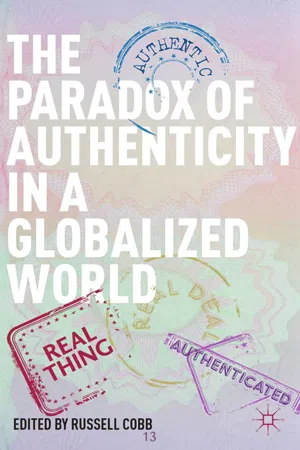
The Paradox of Authenticity in a Globalized World
About this book
Authenticity in our globalized world is a paradox. This collection examines how authenticity relates to cultural products, looking closely at how a particular "ethnic" food, or genre of popular music, or indigenous religious belief attains its aura of originality, when all traditional cultural products are invented in a certain time and place.
Information
Topic
Scienze socialiSubtopic
AntropologiaC H A P T E R 1
Introduction: The Artifice of Authenticity in the Age of Digital Reproduction
Russell Cobb
Like many people who live a great deal of their professional and social lives online, I used to regard the notion of authenticity as hopelessly old-fashioned, self-delusional even. As James Block remarks in this volume, we now live in the “age of the copy,” an era that, on the face of it, seems to promise a democratization of all forms of culture. As entire libraries of music and literature went online in the early twenty-first century, it seemed to me that only Luddites would fetishize authentic artifacts such as paper books, vinyl albums, and photographic prints. After all, the very word “authenticity” is only a few linguistic paces removed from the word “authoritarian,” and both words conjure up the idea of a single authority who imposes a master narrative of meaning. Rejecting authenticity, then, would seem to be a liberation from both the physical shackles of the real object and from the ideological controls of meaning. Jettisoning the ideas behind authenticity would seem to further the disappearance of the “aura” of the original, something Walter Benjamin famously noted in “The Work of Art in the Age of Mechanical Reproduction.”1
Indeed, our current age of digital reproduction seems to invalidate the root of authenticity, the Ancient Greek notion of authentikos, connoting both the idea of an original, authoritative text as well as authority over something or someone. In our era of digital reproduction, the authoritative album has been replaced by the personally curated playlist; a digitized pdf replaces the book in a library. Because these digital copies are cheaper—if not free—and more convenient, few people (other than companies that lose money off digital reproduction) bemoan their infinite replication. In recent years, some prominent literary figures have celebrated this loss of the authoritative original as a liberation from capitalist controls over copyright (an issue taken up by Kaja Marczewska in her essay on the controversial novelists Michel Houllebecq and Helene Hegemann—both accused of plagiarism—later in this volume).
However, something strange has been occurring over the past decade or so. Despite decades of postmodern critique and the digital turn of the humanities more generally, I am surrounded by the rhetoric of authenticity. My breakfast yogurt proclaims itself to be “authentic Greek yogurt.” I drive by an “authentic Indian restaurant” in a western Canadian strip mall on my way to work. We are besieged by claims of authenticity from retailers of all kinds: clothing stores, bookstores, supermarkets; all are selling the idea of authentikos—a pure, authoritative, original product, whether it be a Peruvian sweater, a memoir of drug abuse, or a Malbec wine from Argentina. Even the 2012 US presidential election became a debate about authenticity. Washington Post reporter Dan Balz noted that authenticity—not ideology—was the main obstacle to Mitt Romney’s connection with conservative voters:
Over the course of this presidential campaign, there has been one consistent reservation many Republican voters—and others—have expressed about GOP front-runner Mitt Romney. They question his authenticity. They don’t know if they can trust him. They wonder who he really is.2
In our contemporary age, authenticity is not simply the quality of being authoritative, of “possessing original or inherent authority” as the OED would have it.3 There is another feature to authenticity that connects the term to a deep structure within the development of modernity in the Western world. This is the notion of authenticity as a correspondence between what a person says and what he or she truly feels, a concept traced by the literary critic Lionel Trilling back to the origins of Christianity. For Trilling, it was only relatively recently in Western culture—during the early modern period (especially the seventeenth century in England)—that authenticity displaced sincerity as the most elevated character trait.4 For a speaker to be sincere, he or she merely needed to mean what was said in a given social situation. In early modernity, the authentic person needed to be more than sincere; society required a correspondence between a person’s moral core and his or her speech acts. It is in this context that Polonius offers his most memorable piece of advice to Hamlet: “This above all, to thine own self be true . . . and it doth follow that thou canst be false to no man.”5 One need not be true to social conventions, church doctrine, clan loyalty, and so on, but only to oneself, the Cartesian subject. It is the beginnings of an existentialist rebellion based on the singularity of the self, a position taken up again by Block in his reading of the television series Mad Men and two contemporary films.
The concept of authentikos, (that of a person who possesses both “mastery” and “authority” over something) then, is not sufficient to understand how authenticity works in contemporary society. Even since the advent of the age of the copy, we continue to demand cultural artifacts that—following Benjamin—occupy a unique “presence in time and space” in the physical world.6 This condition permits a cultural moment in which the record collector combs garage sales for vinyl albums even though she has a digital library of music, or in which the literature aficionado goes for a live reading by a poet, even though he could watch the performance on YouTube. Both of them might shop at a farmer’s market for authentic local produce while buying bulk products made in China at Costco.
Globalization, we were told at the end of the Cold War, was supposed to flatten our cultural and political differences, creating a homogenous world where the cold logic of the marketplace dictated what films we watched, what music we listened to, and what literature we read.7 In fact, though, our desire for a real, authentic experience remains undimmed. Gavin James Campbell, for example, shows us that Western travelers to Japan continue to be fascinated by Japanese toilet rituals, going so far as to see the toilet as a window onto the Japanese soul, even when that toilet—the hypermodern “washlet”—challenges many Western stereotypes. Michael Martin and Stephen Fielding show how an increased desire for authenticity has led to a flourishing scene of Cajun restaurants in southern Louisiana and niche Indian restaurants in Great Britain, respectively. Our increasingly globalized word has not led to cultural flatness, but has rather piqued the interest of diners, readers, and listeners about what lies beyond their physical and virtual borders. Rather than destroying authenticity, globalization has created an ever-increasing appetite for it.
What has resulted is a paradox in which the democratization of culture as enabled by digitization and globalization has led to a greater desire for authentic cultural products. It is as if Baudrillard’s famous simulacrum has been flipped on its head. Instead of living in a world in which the image “bears no relation to any reality whatever; it is its own pure simulacrum,” we are instead in a constant search for something pure and completely authentic, even when the authentic thing is little more than a response to market demands.8 Following Baudrillard’s idea of the simulacrum to its logical conclusion leads one to discard any notion of authenticity in culture since there is no reality behind the virtual one created by Disneyland, CNN, YouTube, and so on. Paradoxically, however, the advent of a new millennium rooted in the virtual experience and the digital copy has led to a resurgence in authenticity as an evaluative aesthetic property.
This reconsideration of authenticity during the digital age started in earnest while researching the work of a distant relative (Henry Ives Cobb) who was also one of Chicago’s most important architects and urban planners during the turn of the twentieth century. An Internet search led me to the work of one of his sons, who turned out to be an accomplished artist. As I sought out more information about his career, I discovered he had formally studied art in Paris and mounted several important exhibitions in New York City during the 1920s and 1930s. The search eventually led me to eBay, where an art dealer claimed to have an oil painting dating from the 1920s by this great-great uncle, also named Henry Ives Cobb.
I zoomed in to get a detailed view of the brush strokes, unsure of whether it was a copy or an original. The idea that there was an actual physical presence behind the pixels on the screen made me want to see more. One image showed the back of the frame and I recognized the handwriting: it was similar to that of my great-grandfather’s. The signature also looked distinctly familiar. The dealer vouched for the painting’s authenticity and he showed me a certification that it had been bought at an auction. The discovery of a real painting by a long-dead relative on eBay gave me a distinct sort of pleasure that seems exceedingly rare in the age of digital reproduction. The auction price was about what I spent on food for a month—way above the modest disposable income in my budget. Still, I was determined to buy it. The painting came to my house and I unwrapped the packaging with care. I gently cleaned the 90-year-old glass and the painting came alive. There was a pleasure of knowing that this painting was absolutely singular, and that there were no digital copies apart from the ones that had been on eBay (the dealer later took them down). Holding the painting in my hands reminded me of what Walter Benjamin called the “prerequisite to the concept of authenticity”: a work of art’s “presence in time and space.”9 Perhaps it was the sensation of being in the presence of something that occupied a unique space and time and was crafted by a human hand that made me happy to possess it. It was not the mastery of style: the painting, titled “Afternoon in the Park,” portrays an autumn scene in New York’s Central Park in a sort of naïve impressionistic style, including a few obvious flaws in the way the artist tries to bring out the effect of a late-afternoon sunshine. Indeed, the flaws in technique made it even more appealing, more human, in its singularity. For me, the painting was authentikos in the sense of being an original, even if it was not quite authentikos in the sense of portraying total mastery.
But how are we to evaluate authenticity in a cultural text such as a work of literature or music—something that is, by its very nature, a performance? When it comes to evaluating authenticity in cultural texts, critics as well as consumers often react in a manner similar to Supreme Court Justice Potter Stewart when he was asked to define the parameters of obscenity in a particular film. Stewart famously quipped that while he could not come up with objective criteria for defining what was and what was not obscene, “I know it when I see it.”10 Stewart opted for a pragmatic approach, one that inevitably leads us into a tautology that cannot escape the socially constructed nature of authenticity. (“What makes this obscene?” one might ask. “Community standards,” another would reply. “And who sets the standards?” “A given community.”) One of the contributors to this volume, Michael Lopez, takes up the question of authentic selfhood in the US legal system, exploring how such a term can be used to represent a collective of voices when our cultural bias is toward the individual. Lopez is concerned with how one can create a collective self under Rule 23, the class action lawsuit, which allows for a group of people to be represented by one voice.
It is because we often defer to a pragmatic approach to the question of authenticity that we often debate not the concept per se, but the perception of it in cultural texts. Indeed, an entire subfield of marketing examines the concept of authenticity with regard to its degree of success as an advertising campaign, without any regard as to the truth of the claims. In the field of marketing, scholars hope to understand the characteristics that consumers identify as an “authentic Argentine Malbec,” unaware, perhaps, of the irony that anything that reeks of marketing is, ipso facto, deemed “inauthentic” by consumers in search of something that is not mediated through globalized capitalism.11 The fact that something is dreamed up in a meeting at an advertising corporation runs against what, recalling Benjamin again, we might call the “first principle of the authentic”: that the artifact occupies a singular place and time in the real world, and that it evokes a “sense of place.”
The mere existence of a thing in ...
Table of contents
- Cover
- Title
- 1 Introduction: The Artifice of Authenticity in the Age of Digital Reproduction
- Part I A Matter of Taste: Authenticity and Innovation in Food Culture
- Part II Performing the Real: Mediating Authenticity in Music, Television, and Publishing
- Part III Stereotypes, Clichés, and the Real Thing: Authenticity in Cultural Contact Zones
- Part IV Cut, Paste, Authenticate: Literary Studies and the Question of Authenticity
- Part V Real Politics: The Cultural Politics of Authenticity
- Notes on Contributors
- Index
Trusted by 375,005 students
Access to over 1.5 million titles for a fair monthly price.
Study more efficiently using our study tools.
Frequently asked questions
Yes, you can cancel anytime from the Subscription tab in your account settings on the Perlego website. Your subscription will stay active until the end of your current billing period. Learn how to cancel your subscription
No, books cannot be downloaded as external files, such as PDFs, for use outside of Perlego. However, you can download books within the Perlego app for offline reading on mobile or tablet. Learn how to download books offline
Perlego offers two plans: Essential and Complete
- Essential is ideal for learners and professionals who enjoy exploring a wide range of subjects. Access the Essential Library with 800,000+ trusted titles and best-sellers across business, personal growth, and the humanities. Includes unlimited reading time and Standard Read Aloud voice.
- Complete: Perfect for advanced learners and researchers needing full, unrestricted access. Unlock 1.5M+ books across hundreds of subjects, including academic and specialized titles. The Complete Plan also includes advanced features like Premium Read Aloud and Research Assistant.
We are an online textbook subscription service, where you can get access to an entire online library for less than the price of a single book per month. With over 1.5 million books across 990+ topics, we’ve got you covered! Learn about our mission
Look out for the read-aloud symbol on your next book to see if you can listen to it. The read-aloud tool reads text aloud for you, highlighting the text as it is being read. You can pause it, speed it up and slow it down. Learn more about Read Aloud
Yes! You can use the Perlego app on both iOS and Android devices to read anytime, anywhere — even offline. Perfect for commutes or when you’re on the go.
Please note we cannot support devices running on iOS 13 and Android 7 or earlier. Learn more about using the app
Please note we cannot support devices running on iOS 13 and Android 7 or earlier. Learn more about using the app
Yes, you can access The Paradox of Authenticity in a Globalized World by R. Cobb in PDF and/or ePUB format, as well as other popular books in Scienze sociali & Antropologia. We have over 1.5 million books available in our catalogue for you to explore.