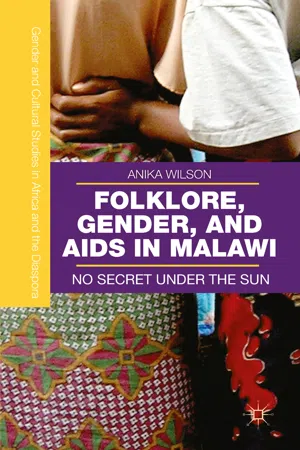
Informal folk narrative genres such as gossip, advice, rumor, and urban legends provide a unique lens through which to discern popular formations of gender conflict and AIDS beliefs. This is the first book on AIDS and gender in Africa to draw primarily on such narratives. By exploring tales of love medicine, gossip about romantic rivalries, rumors of mysterious new diseases, marital advice, and stories of rape, among others, it provides rich, personally grounded insights into the everyday struggles of people living in an era marked by social upheaval.
- English
- ePUB (mobile friendly)
- Available on iOS & Android
eBook - ePub
About this book
Information
CHAPTER 1
INTRODUCTION
In the late 1990s, the American media seemed to have some definite ideas about what was driving the AIDS epidemic in Central and Southern Africa to such startling proportions. Any casual observer of that time could hardly be blamed for thinking that high infection rates were due to some kind of “savage” culture wherein men raped babies as a cure for AIDS, sexuality was unregulated, condoms were shunned, and a continent of “failed” states was now doomed to physical annihilation and self-destruction. All the worst of old fashioned European “Dark Continent” imaginings were reanimated. In 1999, Time Magazine published an article entitled “An Epidemic of Rapes,” which told the story of a woman in South Africa brutally raped and left in doubt of her HIV status. The article also spoke of a teenage girl who had been raped by her father. The author linked these rapes, as well as the many others being reported in South Africa at that time, to the fact that “many believe that raping a virgin will kill HIV” (Hawthorne, 1999). Some sources claimed that this was a common belief across “sub-Saharan Africa” that was fueling the high infection rates in the region while others have denied the existence of the practice altogether (Barnard, 2005; Jewkes et al., 2002).
When I first began conducting research in Malawi in 2003, such media messages, passively consumed, had an impact on the kinds of questions I asked. Indeed, though my first line of inquiry for my graduate research involved asking married women whether they had any concerns about HIV infection with regards to their husbands, I also asked them whether they had ever heard stories about men who raped virgins to be cured of AIDS. I wondered if there was any validity to these reports. Most people I spoke to either said they had not heard of this happening or they had heard of these things as “general stories” on the radio. However, there was one woman, Grace, I interviewed in 2006 in a village in Northern Malawi who spontaneously told us (myself and my research assistant) that she was connected to a story of a man who raped two little girls “for medicine.” It was suspected that the two girls had been infected with HIV because of the assault. Grace tearfully told us that she was being accused of ultimately having given the girls HIV because that man was her boyfriend. It was believed that he had contracted HIV from Grace whose husband was said to have died of AIDS. The gossip about her was painful, especially stories about how her two frequently ailing children were beautiful because “AIDS kids are beautiful” and claims that the children would be dying soon also.
Grace seemed to embody the image of vulnerable, stigmatized, and violated woman as imagined by the media (Western and Malawian), local and international NGOs, and scholars. A stigmatized woman who’s voice is silenced, unheard. There seemed to be something in the media stories I had heard back home. But looking back at the interview transcripts later I realized I had misunderstood Grace’s story in several ways that would only become clear the longer I lived in Malawi. First, when Grace spoke of the man assaulting the young girls for “medicine”, she did not explicitly reference HIV as the disease he hoped to be cured of. This is important because stories more commonly circulated are those about people who must sleep with a virgin (or someone with whom it is taboo to sleep—mother, sister, child, etc.) to activate medicine to increase wealth and good fortune. While this type of story, like those about the virgin cure, is also “sensational” it shifts the perspective from what is found interesting (or loathsome) to Western audiences to the concerns preoccupying Malawians. When hearing Grace’s story, I first assumed that people must be seeking medicine for HIV, yet rumors and gossip in Malawi suggest some people want medicine for gaining money and material advancement or security. While AIDS looms large in the Western imaginings of “African” communities, even in the most epidemic stricken areas (specifically Southern Africa) people are contending with a multiplicity of priorities and concerns among which AIDS is only one.
My perspective shifted then—these stories about virgin cures were the ones “we” like to tell. What are the stories Malawian men and women want to tell, do tell? What narratives, whether mundane or outrageous, capture imaginations in Malawi? Informal folk narratives such as gossip, advice, rumor, and contemporary legends provide a unique lens through which to discern popular formulations of AIDS beliefs and marital conflict. This book presents Malawian narratives of love medicine, gossip about violent romantic rivalry, rumors of a mysterious and new sexually transmitted disease, common marital advice, and stories of rape accomplished through magic to gain insight into an era marked by social upheaval in Southern Africa. Folklore, Gender, and AIDS in Malawi begins with narratives of Malawian wives dealing with the risk of HIV infection introduced by their husbands and then opens up to present a broader set of narratives portraying contemporary marital struggles in a context of high AIDS prevalence, political transition, and economic insecurity. This book analyzes folk narratives to present local definitions of vulnerability and empowerment, risk perception and risk management, and knowledge and desire. Women and men desire more than just to avoid HIV. People also seek to maintain the relationships that imbue their lives with meaning, status, and a sense of belonging.
Women of Southern Africa have been portrayed by many scholars and journalists as victims of men in the AIDS epidemic. Whether as mothers and wives who are infected by roaming husbands or prostitutes forced by cruel economic circumstances to sell sex, a similar refrain of women’s vulnerability has been sung for decades. This construction of women’s vulnerability in Malawi has lead to the creation of many public health interventions targeted toward improving women’s plights. However, often these well-intentioned programs instruct women to change their behavior without otherwise altering the social field in which they operate. Marriage is a particularly important institution in which many women operate thus the first part of the book (chapters 2 and 3) focuses on narratives specifically about marriage and marital conflict in a time of AIDS, while the last two chapters speak to a broader sense of gendered vulnerability to AIDS and women’s position vis-à-vis men in sexual relationships. This book seeks not to deny women’s vulnerability but to show how vulnerability is defined, navigated, and critiqued in informal, folkloric expression.
Informal narratives can produce knowledge that becomes the basis for action. The cautionary tales shared among peers and between elders and younger married couples are part of advice giving and therefore the narratives explicitly set the basis for action. Informal narratives also constitute disciplining discourses that prescribe behavior in subtle ways (Foucault, 1978). In other instances, gossip and rumor provide directed bases for action (Shibutani, 1966). In one village where I conducted interviews, the outrageous rumors about a man who was said to magically sleep with women at night caused the local women to rush for HIV testing. Even those who had experienced no characteristic dream or physical evidence associated with supernatural seduction made their way to a testing facility. There is nothing “idle” or trivial about gossip and other types of narratives that generate knowledge and action.
Ultimately, the narratives presented in this book display the intensely collective nature of problems and the correspondingly collective nature of problem solving, knowledge building, and social critique that occurs beneath the level of official interventions. While public health organizations around the world struggle to modify failing models and messages of individual behavior change, Malawians go about actively crafting responses to the epidemic in ways that are sensitive to the social basis of health and illness they encounter everyday. These narratives express both the strengths and limitations people experience in seeking to mitigate their risk of HIV infection and reimagine intimate relationships.
AIDS in Malawi
Malawi, like other countries in Southern Africa, is in the midst of an entrenched AIDS crisis. Three decades deep into the epidemic, Malawi’s current HIV prevalence rate hovers at an estimated 10 percent among adults ages 15–49 (Department of Nutrition, HIV and AIDS, 2012: 2). The rate among that age group peaked at 16.4 in 1999 and then began declining. At the time of my initial interviews, men’s prevalence rate was 10 percent and women’s 13 percent (National Statistics Office [NSO], 2005: 230). HIV prevalence rates also vary according to whether one lives in a city or in a rural area. Urban women had a much higher HIV prevalence rate than rural woman (18 percent versus 13 percent), but the difference between urban and rural men was even more pronounced (16 percent and 9 percent, respectively), suggesting that whether in the city or on their farms, women have been more vulnerable to HIV infection than men (NSO, 2005: 17). Though an epidemic of these proportions has been decades in the making, the public health infrastructure has had little success in keeping pace with the need. Malawi, a small country located in Southeast Africa with a population of roughly 15 million, not only has one of the highest AIDS burdens, but it is one of the poorest nations in the world, a circumstance that adds to the difficulties in stemming the expansion of the disease.
In the mid-1980s, Malawi’s government instituted strategies for battling the spreading epidemic. Since the drafting of the first strategic plan, HIV/AIDS programs have been primarily geared toward activities of testing, creating “awareness,” preventing mother-to-child-transmission (PMTCT), and promoting behavior change (Department of Nutrition, HIV and AIDS, 2005). With scarce resources and a weak public health infrastructure, the government provided relatively little in the way of treatment. According to Malawi’s own Ministry of Health, of more than 20,000 healthcare posts, 33 percent are vacant, a total of 64 percent of nursing positions had not been filled, and Malawian healthcare facilities retains only one-sixth of the number of recommended doctors (Harries et al., 2006: 1070). It was only in 2005 that the government began dispensing, free of charge, anti-retroviral drugs (ARVs), which lengthen the lives of AIDS sufferers; a decade earlier these drugs had transformed AIDS into a chronic disease in rich nations (Palella et al., 1998).
To a great extent, the government’s current provision of ARVs has been made possible by external donors, most notably the Global Fund to fight AIDS, Tuberculosis, and Malaria (Harries, 2006: 1071). The newly democratic government, with its assets of democracy and “good governance,” was able to attract substantial donor funds to address the problem that Malawi’s own underfunded public health system could not. By the late 1990s, one researcher estimated that at least seventy-three nongovernmental organizations (NGOs), both local and international, were dealing with AIDS in Malawi, the largest contributors being UNAIDS, USAID, UNDP, UNICEF, Action-Aid, and the British governmental aid agency DFID. By 2009, approximately 200,000 Malawians were receiving free ARVs (HIV and AIDS Monitoring and Evaluation Report, 2008–2009).
Despite the government’s coordination of ARV distribution, external donors and NGOs appear to have considerable influence in the distribution and usage of AIDS funds. The extension of influence of international nongovernmental sector and multilateral organizations on policies and practices in resource poor nations like Malawi has been described as transnational governmentality (Englund, 2006). Since the 1970s, NGOs have been viewed as a preferred route through which international donor funds flow, particularly in sub-Saharan African nations whose governments have been branded as corrupt, inefficient, and not accountable to citizens; by contrast, NGOs are perceived as stable, honest, and participatory entities (Morfit, 2011: 2). Morfit suggests that NGOs’ special focus on “AIDS in Africa” draws funds and attention away from equally pressing developmental issues and distorts the missions of various agencies. The proliferation of AIDS-related organizations or affiliations has been described by some Malawians as constituting an “AIDS Industry” wherein employees or volunteers receive benefits of pay, travel, status, and other various amenities as they “sensitize” the “masses” to the dangers of HIV/AIDS (Wilson, 2008). Messages routed through the “AIDS Industry” are sometimes welcomed and sometimes met with ambivalence. These messages are supplemented by thriving informal information dissemination and discussion that I explored in my fieldwork and narrative collection.
Fieldwork
The topics I chose to research emerged from preliminary fieldwork in Malawi during the summers of 2004 and 2005 in conjunction with my participation in the Malawi Diffusion and Ideational Change Project (MDICP). 1 The MDICP is a longitudinal survey project that solicits data on the impact of social networks in the dissemination of health information and behavior change. The project has a qualitative component, a journal project in which Malawians, trained to work as interviewers for MDICP, write down everyday conversations about AIDS they overhear or take part in. During my assignments as a graduate research assistant, one of my responsibilities was thematically coding such reports.2
While coding, I realized that these everyday conversations are a major means by which health information is imparted, debated, and reinterpreted; the stories being told about HIV and AIDS were stories about infidelity, sick neighbors and their symptoms, rich men enticing young girls with money, women fighting over men, scandals of men and women caught in the act of “Illicit” sexual intercourse, concern about the youth and the “nowadays disease,” discussions of biomedical treatment of AIDS versus treatment by traditional healers (sing’anga), men and women fretting over how to choose a sex partner or spouse, and controversies over the efficacy and morality of condom use. People debated the usefulness of testing and speculated about the merit of revealing one’s HIV status. There were complaints about local healthcare workers and wasteful government spending. Through these stories, I was drawn to study rumor, gossip, and conspiracy theory as processes of health belief formation. As people try to make sense of the magnitude and impact of AIDS on the nation and in their communities, they come together to actively seek and constitute knowledge.
The strength of the ethnographic journals is that they give a glimpse into natural conversation and the ways in which themes of narratives flow one into another, displaying cognitive links. My initial forays into villages of Northern Malawi helped me in shaping a course of inquiry that included both guided interviews and an expanded journal project I designed to focus specifically on marital conflict and women’s prevention strategies.
In addition to collecting journals, I conducted interviews with the aid of a research assistant, Catherine Simkonda. Our aim was to engage in conversation with women who had been married within a particular village so that we might hear multiple versions of a story to better grasp the distribution of information and its varying interpretations. After choosing the particular village, we interviewed women based on their marital status and willingness to be interviewed; some respondents were found by just approaching homes and asking to speak to married women there. After those interviews, we asked for referrals to other women within that compound, creating a snowball sample. Sometimes we moved on from one compound to another without a reference when there seemed to be no more married women available or when practical concerns arose; for example, we once moved on to a new compound because it was too difficult for Catherine Simkonda to walk up the hill in the previous village as her pregnancy progressed.3 We interviewed in five compounds of a single village between January 2005 and May 2006.
With the help of a research assistant and interpreter, I conducted my interviews with married women in one particular village, Chikuwala, near Phukwa’s provincial trading center. Chikuwala is situated below a tarmac that connects to Mzuzu (the city of the north) in one direction and to the nexus of Malawi, Tanzania, and Zambia in the other. Though not a hub for governmental administration, Phukwa (a pseudonym for the small trading center; the word means “to desire”) is an educational center having both men’s and women’s technical schools as well as a nationally renowned secondary school. Down the road from the polytechnic schools is the Phukwa market, where many of my informants purchased the groceries they did not produce themselves and sold mangoes and stalks of sugar cane. Phukwa boasted a bar and a resthouse which loomed large in the imagination of wives in Chikuwala, becoming a synecdochic referent for prostitution and men’s mobility and adultery.
We interviewed 60 women and a subset of 15 were chosen to be visited a second and third time. With each visit, we were updated on developments in relevant narratives. This method is similar to the social anthropology “extended-case study method” that developed in the 1950s and 1960s in studies of witchcraft, urbanization, and modernization. Put simply, this method follows the conflicts of particular persons as they develop over time and is particularly suited to the study of conflict and the processes that bring about change. Englund states,“The actual relations of Tom, Dick and Harry’ could themselves generate processes that circumvented or modified general principles—processes that were not, however, utterly devoid of logic” (Englund, 2002a: 28–29).4 The extended case method is useful bec...
Table of contents
- Cover
- Title
- 1. Introduction
- 2. Advice Is Good Medicine: Marriage, Advice, and the Comforts of Home
- 3. Funny, Yet Sorrowful: Narratives of Empowerment and Empathy in Woman Against Woman Struggles
- 4. “Nobody Fears AIDS, Mphutsi is More Fire”: Disease Rumors in the Age of AIDS Treatment
- 5. Mgoneko: Magical Rape, Media Panic, and Gender-Based Violence
- Conclusion
- Notes
- References
- Index
Trusted by 375,005 students
Access to over 1.5 million titles for a fair monthly price.
Study more efficiently using our study tools.
Frequently asked questions
Yes, you can cancel anytime from the Subscription tab in your account settings on the Perlego website. Your subscription will stay active until the end of your current billing period. Learn how to cancel your subscription
No, books cannot be downloaded as external files, such as PDFs, for use outside of Perlego. However, you can download books within the Perlego app for offline reading on mobile or tablet. Learn how to download books offline
Perlego offers two plans: Essential and Complete
- Essential is ideal for learners and professionals who enjoy exploring a wide range of subjects. Access the Essential Library with 800,000+ trusted titles and best-sellers across business, personal growth, and the humanities. Includes unlimited reading time and Standard Read Aloud voice.
- Complete: Perfect for advanced learners and researchers needing full, unrestricted access. Unlock 1.5M+ books across hundreds of subjects, including academic and specialized titles. The Complete Plan also includes advanced features like Premium Read Aloud and Research Assistant.
We are an online textbook subscription service, where you can get access to an entire online library for less than the price of a single book per month. With over 1.5 million books across 990+ topics, we’ve got you covered! Learn about our mission
Look out for the read-aloud symbol on your next book to see if you can listen to it. The read-aloud tool reads text aloud for you, highlighting the text as it is being read. You can pause it, speed it up and slow it down. Learn more about Read Aloud
Yes! You can use the Perlego app on both iOS and Android devices to read anytime, anywhere — even offline. Perfect for commutes or when you’re on the go.
Please note we cannot support devices running on iOS 13 and Android 7 or earlier. Learn more about using the app
Please note we cannot support devices running on iOS 13 and Android 7 or earlier. Learn more about using the app
Yes, you can access Folklore, Gender, and AIDS in Malawi by A. Wilson in PDF and/or ePUB format, as well as other popular books in Social Sciences & Anthropology. We have over 1.5 million books available in our catalogue for you to explore.