- English
- ePUB (mobile friendly)
- Available on iOS & Android
eBook - ePub
About this book
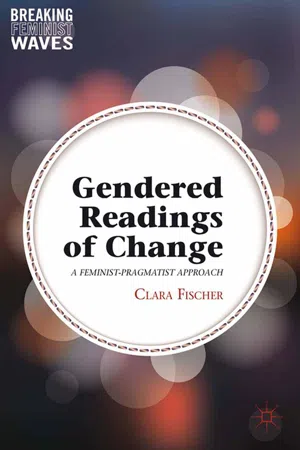
This book develops a unique theory of change by drawing on American philosophy and contemporary feminist thought. Via a select history of ancient Greek and Pragmatist philosophies of change, Fischer argues for a reconstruction of transformation that is inclusive of women's experiences and thought.
Information
P A R T I
Genealogical Reflections on Change
C H A P T E R 1
Women, Change, and the Birth of Philosophy
The mares that carry me kept conveying me as far as ever my spirit reached, once they had taken and set me on the goddess’ way of much discourse, which carries through every stage to meet her face to face a man of understanding. On this I was carried, for on this the sagacious mares were carrying me, straining at the chariot and guided by maidens along the way.
—Parmenides, On Nature
With this verse, Parmenides’s poem “On Nature” invites the audience to follow the philosopher on a mystical journey—a journey that promises to enlighten listeners with certain knowledge, by distinguishing between what is merely perception or opinion, and what is truth. The latter, for Parmenides, consists of immutability and singularity, premised upon a strict delineation of Being and Not-Being. That truth should lie in a denial of change and plurality seems intuitively misled, and yet, Parmenides’ ideas were highly pertinent for subsequent philosophizing. In his startling denial of what most of us take to be obviously true, he rejected change, and, as will become clear, woman. Parmenides is indicative of much philosophical theorizing on women and change, and it is my objective here to outline the problematic treatment of women in their relationship to change, and to trace this to the development of philosophy itself.
Women’s traditional omission from the philosophical canon has placed them in a rather paradoxical position within male philosophers’ expositions of change.1 On the one hand, women are conflated with change, which is seen as threatening and destabilizing, on the other hand, women represent stasis and passivity, as forward-looking activity and spirited change are reserved for men. In order to untangle some of these contradictory treatments of women and change, I draw upon specific sources from ancient Greek mythology and philosophy. Thus, the story of Athens’ origins, Pandora’s myth, Parmenides’ “On Nature,” and some of Aristotle’s thought, serve to highlight the continuity of certain themes, which come significantly to bear upon Western philosophical understandings of women and change.
For instance, one encounters the motifs of man’s fear of death, mortality, and dependence; and his desire to be godlike, immortal and self-sufficient, on a recurrent basis. When such themes are coupled with an analysis of the gradual arrangement of “opposites” in Greek mythology into a hierarchical ordering in the philosophies of Plato and Aristotle, woman assumes not only an inferior position as part of a strict polarity, but eventually becomes part of a system wherein she is “by nature” lower in rank than man. Thus, following the work of G. E. R. Lloyd and Page duBois,2 it is possible to trace Aristotle’s establishment of a “great chain of being”3—wherein every existent assumes a position lower in degree from that which comes before it—to the widespread ancient classification of beings and natural phenomena into “opposites.” The texts I draw on are representative of key points in this evolution from opposites to hierarchical ordering. Parmenides occupies a historical and intellectual halfway mark in the course of this development, hence my selection of his poem, the preceding myths of Pandora and Athens, and the later philosophy of Aristotle for analysis.
In Polarity and Analogy,4 Lloyd gives a thorough account of the use of opposites by the ancient Greeks. He shows that right/left, light/dark, and man/woman, are just some of the contraries the Greeks identified in their myths and early philosophizing. They constitute direct polar opposites, with each oppositional being assigned value, hence the analogical relationship between positive oppositionals and negative oppositionals. Woman was always grouped with the inferior oppositional, such as left and dark, and man with the superior oppositional, such as right and light. Indeed, Aristotle provides us with a Pythagorean Table of Opposites in Metaphysics,5 which details ten contraries, amongst them limited/unlimited, even/odd, one/many, still/moving, and male/female. Notably, the latter of each contrary occupies the same column as evil, while the former is classified alongside the good. Hence, woman is, by analogy, coterminous with all of the subordinate oppositionals, including evil.
While this organization into diametrically opposed positive and negative poles is implicit in much of Greek mythology and poetry, it becomes more explicitly theorized with the onset of philosophy,6 and eventually modulates into a hierarchical systematization, most obviously expressed by Aristotle. Thus, Parmenides’ “On Nature” is littered with opposites, as he argues for Being over Not-Being,7 immutability over mutability, and singularity over plurality. The contraries of man/woman are inextricably bound up with this, as woman, in her analogical relationship with change, is denied.
The grouping of woman with change as inferior oppositional is by no means consistently and coherently applied by thinkers. The axiological correlation of mutability/woman and immutability/woman, which was variously constructed in ancient myth and philosophy by means of a hierarchy or polarity, was often contradictory and contrived to sustain the “chain of being,” or the rigid dichotomy of opposites. Thus, woman is categorized alongside change as inferior oppositional, or alongside immutability as inferior oppositional. While change may be “good” or “bad” depending upon the particular context, woman is always classed as negative and ascribed mutability or stasis accordingly. Since gender, and the value placed upon woman in particular, comes to play a central role in the designation of change or immutability, I refer to this as gendered (im)mutability. In what follows, it will become clear that gendered (im)mutability is part of philosophy since its inception, hence the necessity of a feminist exposition of change.8
1. PARMENIDES
a) “On Nature”
Parmenides is usually interpreted as a monist, and in the absence of a complete copy of his sometimes cryptic poem “On Nature,” he endures as one of the most fascinating figures of early Greek philosophy.9 His thought is based on the belief that something either is, or it is not, or that there is Being, or Not-Being.10 This tenet is expressed in what remains of his thought, his poem entitled “On Nature.”11 The poem is structured in three parts, a prologue (or proem), a mid section detailing the “Way of the Truth,” and a final part treating of the “Way of Belief.” These two ways deal with the assumptions of mortals and the true knowledge of the gods respectively.12 The poem introduces a goddess, who acts as narrator, enlightening the audience with regard to both divine truth and mortal opinion.
“On Nature” opens with a mystical account of a young man, presumably Parmenides, who is swept away by maidens to a realm where the goddess resides. Upon arrival at the entrance to this abode, key-holder Justice is persuaded by the traveler’s companions to open “the gates between the journeys of night and day.”13 Crossing a gulf, the traveler encounters the goddess, who welcomes him by taking his hand and pronounces:
Welcome, O youth, arriving at our dwelling as consort of immortal charioteers and mares which carry you; no ill fate sent you forth to travel on this way, which is far removed indeed from the step of men, but right and justice. You must be informed of everything, both of the unmoved heart of persuasive reality and of the beliefs of mortals, which comprise no genuine conviction; nevertheless you shall learn these also14
Thus the youth is invited to partake first in an unfolding of ontological truth, and secondly in an unfolding of cosmological belief, for even though the former is clearly superior to the latter, mortal assumptions about the nature of the universe need to be judged by the youth, or by the listener, as he assesses “how it was necessary that the things that are believed to be should have their being in general acceptance, ranging through all things from end to end.”15
The goddess then begins her account of the way of truth, “about those ways of enquiry which are alone conceivable.”16 This section contains the crucial tenet that Being and Not-Being, or that a thing is or is not, are not simultaneously possible. Parmenides, through the goddess, argues that Being is the first way of truth, “the one, that a thing is, and that it is not for not being, is the journey of persuasion, for persuasion attends on reality.”17 Not-Being, or that a thing is not, is addressed by the goddess, but is immediately dismissed, as “that a thing is not, and that it must needs not be, this I tell you is a path wholly without report, for you can neither know what is not (for it is impossible) nor tell of it.”18 Language and thought thus act as barriers to the hypostatization of Not-Being.19
Reasserting that Being “is for being, but Nothing is not,”20 Parmenides warns of another way of confused mortals “with no understanding . . . by whom this has been accepted as both being and not being the same and not the same.”21 In contravention of the law of contradiction, these people are destined not to complete their journey, but rather, are forced “backwards again.”22
Because Being and Not-Being are mutually exclusive, all change is denied in Parmenides’ ontology, as transformations of becoming and decay are rejected. Change risks the infection of Being with Not-Being, as change means Being is no longer what it used to be, nor may it be in the future what it is now. Hence, Parmenides asks:
And how could what becomes have being, how come into being, seeing that, if it came to be, it is not, nor is it, if at some time it is going to be?23
Parmenides denies that something can come of nothing, as Being always already is. Similarly, the loss of something in terms of its disappearance into nothingness, or Not-Being, is repudiated, hence birth and death are ultimate impossibilities:
Thus becoming has been extinguished and perishing is unheard of.24
Instead, Being should be thought of as a sphere,25 which is indivisible, “since it is all alike and not any more in degree in some respect.”26
Furthermore, it is “full of Being” and “all united.”27 Being is
changeless in the coils of huge bonds, without beginning or cessation, since becoming and perishing have strayed very far away, thrust back by authentic conviction.28
The goddess’s divine knowledge has ousted birth and death and has left in their stead Being, which is “in a state of perfection from every viewpoint, like the volume of a spherical ball, and equally poised in every direction from its center.”29 Being is not encumbered by the effects of change over time, as “time is not nor will be another thing alongside Being, since this was bound fast by fate to be entire and changeless.”30
Describing Being as a sphere is important to Parmenides’ argument, as it protects Being from encroachment of Not-Being. A sphere is a perfectly symmetrical three-dimensional object, and as such is the most apt representation of Being, which is indivisible,...
Table of contents
- Cover
- Title
- Introduction
- Part I Genealogical Reflections on Change
- Part II Feminist-Pragmatist Reconstruction of Change
- Conclusion
- Notes
- Bibliography
- Index
Trusted by 375,005 students
Access to over 1.5 million titles for a fair monthly price.
Study more efficiently using our study tools.
Frequently asked questions
Yes, you can cancel anytime from the Subscription tab in your account settings on the Perlego website. Your subscription will stay active until the end of your current billing period. Learn how to cancel your subscription
No, books cannot be downloaded as external files, such as PDFs, for use outside of Perlego. However, you can download books within the Perlego app for offline reading on mobile or tablet. Learn how to download books offline
Perlego offers two plans: Essential and Complete
- Essential is ideal for learners and professionals who enjoy exploring a wide range of subjects. Access the Essential Library with 800,000+ trusted titles and best-sellers across business, personal growth, and the humanities. Includes unlimited reading time and Standard Read Aloud voice.
- Complete: Perfect for advanced learners and researchers needing full, unrestricted access. Unlock 1.5M+ books across hundreds of subjects, including academic and specialized titles. The Complete Plan also includes advanced features like Premium Read Aloud and Research Assistant.
We are an online textbook subscription service, where you can get access to an entire online library for less than the price of a single book per month. With over 1.5 million books across 990+ topics, we’ve got you covered! Learn about our mission
Look out for the read-aloud symbol on your next book to see if you can listen to it. The read-aloud tool reads text aloud for you, highlighting the text as it is being read. You can pause it, speed it up and slow it down. Learn more about Read Aloud
Yes! You can use the Perlego app on both iOS and Android devices to read anytime, anywhere — even offline. Perfect for commutes or when you’re on the go.
Please note we cannot support devices running on iOS 13 and Android 7 or earlier. Learn more about using the app
Please note we cannot support devices running on iOS 13 and Android 7 or earlier. Learn more about using the app
Yes, you can access Gendered Readings of Change by C. Fischer in PDF and/or ePUB format, as well as other popular books in Social Sciences & Pragmatism in Philosophy. We have over 1.5 million books available in our catalogue for you to explore.