eBook - ePub
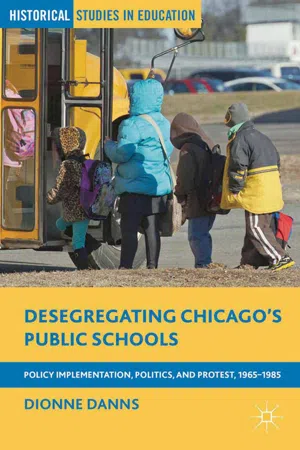
Desegregating Chicago’s Public Schools
Policy Implementation, Politics, and Protest, 1965–1985
- English
- ePUB (mobile friendly)
- Available on iOS & Android
eBook - ePub
Desegregating Chicago’s Public Schools
Policy Implementation, Politics, and Protest, 1965–1985
About this book
Highlighting the processes and missteps involved in creating and carrying out school desegregation policies in Chicago, Dionne Danns discusses the challenges of using the 1964 Civil Rights Act to implement school desegregation and the resultant limitations and effectiveness of government legislative power in bringing about social change.
Information
Topic
PedagogíaC H A P T E R 1
Redmond’s School Desegregation Plan and Reactions
At first appearance James Redmond may not have seemed all that different from the previous Chicago superintendent Benjamin Willis, whom Redmond replaced in 1966. Both were older, white, clean-shaven men with neatly trimmed hair. But Redmond’s entrance into the superintendent’s office marked a symbolic shift in the handling of the city’s schools—at least in regard to the city’s image of desegregation. While Willis had been praised for increasing resources in some of the city’s schools, his record regarding desegregation and the inequalities between black and white schools had come under vehement public attack. As black schools became increasingly overcrowded, Willis merely responded by installing mobile units, which his critics called “Willis Wagons.” Willis had stubbornly maintained that outcries regarding desegregation and inequality were unwarranted—despite federal reports that acknowledged such inequalities.1 Redmond replaced Willis upon Willis’s retirement in 1966 giving civil rights activists high expectations for the city’s desegregation efforts.
In January 1967, and not long after Redmond became superintendent, the Department of Health, Education and Welfare’s (HEW) US Office of Education sent Chicago Public Schools a report that discussed concerns about faculty and student assignments, apprenticeship programs, and vocational education. This was a direct result of the Coordinating Council of Community Organization’s (CCCO) 1965 Title VI (of the 1964 Civil Rights Act) complaint that raised those very concerns. Chicago received a US Office of Education planning grant to conduct a study of segregation, and Redmond used the funding to create a school desegregation plan in conjunction with expert consultants. Titled “Increasing Desegregation of Faculties, Students, and Vocational Education Programs,” and also known as the Redmond Plan, it was a response to federal pressure to desegregate Chicago Public Schools. Issued in August 1967, it provided a series of recommendations; the most controversial dealt with student desegregation.2
The political fallout from the CCCO Title VI complaint meant that any resulting school desegregation plan would be limited and politically risky. While the federal government had to enforce the 1964 Civil Rights Act, federal officials gave the city an out by not pressing for a substantive plan. Still, some sort of plan needed to be implemented, and the superintendent, his staff, and the Board of Education were given ownership of the policy implementation process. However, Chicago residents demanded their voices be heard when the board announced its busing plan (a scaled-down version of the Redmond Plan), and these stakeholders were able to impact the scope of the plan in some notable ways. Consequently, the implementation of federal policy became hotly contested and was not simply a top-down mandate, but rather it resulted in a negotiation between federal and local officials as well as the stakeholders in the city.
After the initial Redmond Plan was issued, Superintendent Redmond and his staff created a limited desegregation busing plan announced in January 1968—which resulted in immense controversy. The busing plan caused great consternation within the white and black communities on Chicago’s Southeast and Northwest Sides, and in the Austin community on the West Side. The attempt to implement the limited busing plan led to contentious white responses that clouded the lines between racism, a desire for neighborhood schools, and neighborhood stabilization. While some arguments were overtly racist, others were cloaked in the presumed cultural deprivation of blacks or the imposition of school policies on individual liberties. Some whites simply opposed the limited busing plan and favored a two-way busing plan. Black responses to Superintendent Redmond’s proposal also complicated Chicago’s desegregation efforts in 1968. Some questioned the underlying assumptions about black inferiority in the desegregation plans. Others pushed for desegregation as an opportunity to relieve overcrowded neighborhood schools. The varied responses to such a modest plan helped to set the stage for further desegregation in the city. Meanwhile, Mayor Daley remained relatively quiet in public about his views on the issue in order to appear neutral on such divisive school issues. However, city aldermen from his Democratic Machine publicly spoke in opposition to the plan, which strongly signified that Daley also opposed it. The development of the plan and conflicting reactions also demonstrated the challenges of policy implementation in a context in which the affected communities were not fully in favor.
HOUSING, RACIAL STABILIZATION, AND SCHOOL REALITIES ON THE WEST SIDE
One major contributor to school segregation in Chicago was residential segregation, since children were assigned to neighborhood schools.3 However, residential segregation in Chicago was not the result of passive “choice” habitation. Residential segregation in the city had been fiercely enforced for decades through intimidation, violence, and discriminatory housing practices. A number of small housing riots broke out as blacks began migrating to Chicago from the South. In the 1910s, homes of blacks and real estate agents who served them were bombed. Deadly riots occurred in 1919, resulting in the deaths of 23 blacks, 15 whites, and one Latino—520 more were injured.4 Smaller riots occurred in the 1940s and 1950s, illustrating the lengths white home owners were willing to go to keep their neighborhoods exclusively white.5
In addition, unscrupulous realtors made tremendous profit by scaring whites into selling their homes in areas surrounding expanding black areas. Once whites hurried to sell their homes at a lower price, realtors then rented to blacks or sold the homes through contract sales. Blacks often could not obtain legitimate loans from traditional mortgage lenders because of redlining policies that devalued property where blacks lived. In a contract sale, a down payment was made and money would be paid on the contract until it was all paid off. If home owners missed one month of payment, they lost all of the money they put into the home and the contract dealer would start a new contract with someone else.6 As a result, blacks tended to pay much more for housing than whites leaving the neighborhoods, and paid, on average, higher rents as well.
The shortage of housing after World War II only exacerbated the existing problem. Black families had to work extremely hard and take on additional work shifts in order to keep homes on contract payments. Some even housed additional tenants to make ends meet. In an effort to keep their homes, maintenance was often neglected because there was no money left. As Beryl Satter indicates, whites saw the crowded homes, unsupervised children, and decaying property as a problem with blacks; others blamed economic exploitation for the home problems blacks experienced.7
Whites who opposed blacks moving into their neighborhoods feared the loss of neighborhood stabilization—meaning that a neighborhood would not turn over racially from white to black. In some communities, whites fought to stay in their homes in an attempt to delay black encroachment and maintain stabilization. On Chicago’s West Side, home owners had fought for years to be included in the city’s revitalization plans.8 Without the power necessary to garner funds, the West Side had begun to deteriorate well before blacks moved into those neighborhoods in the 1960s. Whites sought various avenues to acquire aid to fix the crumbling infrastructure, but the city used urban renewal funds acquired from the federal government to revitalize downtown and the surrounding areas. The neighborhoods around the University of Chicago, which also received financial support, began to flourish as well. Whites on the West Side wanted to maintain their properties and stay in the city. They formed organizations to rally for neighborhood improvements as well as to keep blacks out. Beginning in the mid-1950s, residents even lobbied for the new University of Illinois Chicago campus to be placed in a park on the West Side with the hopes of improving their neighborhoods while stemming the tide of black migration into those areas. Despite community efforts, city officials used urban renewal funds for their priorities. Once the funding ran out, there was no money to improve other city areas like Austin. After a number of years of lobbying for neighborhood improvements, West Side whites eventually moved to other areas of the city or into the developing suburbs.9
As with other midwestern cities, Chicago’s neighborhoods had a long history of concentrated ethnic enclaves and fierce contestation when neighborhood demographics transitioned from one racial group to another. Before the 1930s, Germans, Irish, Swedes, and to a lesser extent, Italians and Russian Jews dominated the Austin community on the West Side of Chicago. Italians became the largest group in 1960, followed by Irish, Germans, and Poles. The area began experiencing rapid transition from white to black. In 1960, there were only 31 blacks in Austin; but by 1970, 41,583 blacks lived in the community, making up 32.5 percent of the community population.10 Beginning in 1961, blacks began to move into the very southeastern and poorer section of a community once settled by Italians. Although whites fought to maintain their neighborhoods, the great need for black housing meant that this area would continue to open up. Generally, blacks occupied certain census tracks as they entered the community and eventually spread to nearby tracks. By 1966, blacks began to enter even higher socioeconomic areas of Austin. Consequently, some census tracks had more middle-class blacks than others. Although middle-class blacks replaced some of the white residents, more of the new residents were below the poverty line. For example, two of the community’s poorest census tracts, which were virtually all white in 1960, had 10.8 and 12.5 percent of residents living below the poverty line. By 1970, these same census tracts were over 80 percent black with 17 and 26.4 percent of residents living below the poverty line.11 The loss of manufacturing jobs exacerbated employment opportunities for blacks. The racial and socioeconomic transitions brought additional strain to the community. City services, already lagging when whites occupied the neighborhoods, continued to deteriorate.12
As blacks entered the Austin area, they brought households with more children than the departing white families, and families more reliant on the public schools. The result was that some of Austin’s public school populations almost doubled. Two schools in particular, May and Spencer, saw great increases in their numbers. May Elementary School had 801 students in 1963, 87.4 percent of whom were white. By 1967, there were 1,554 students, 83.9 percent of whom were black. Spencer Elementary School saw similar changes. In 1963, there were 903 pupils at Spencer, 98.7 percent of whom were white. In 1967, 82.4 percent of the 1,342 students were black. Vast overcrowding would put a strain on any school system—but the shift in the racial and socioeconomic composition imposed additional burdens on the schools as well. White teachers were at times unprepared for (or unwilling to deal with) black students. Some of these teachers quickly left for schools more to their liking. As the racial and class composition of the public school students began to change, some middle-class blacks also withdrew their children from these public schools and enrolled them in the area’s two Catholic schools. This exacerbated white departure from the community because black students occupied spaces in private schools sought by whites hoping to remain in Austin. The school system was unable to immediately provide additional facilities for the community, besides mobile units.13
Austin High School also experienced racial transition, though not as quickly as at the May and Spencer schools. As whites with school-age children stopped moving into Austin in anticipation of black migration, the population of Austin High School began to change. With a smaller number of white school-age children, the high school enrollment began to shrink between 1960 and 1962. Black migrants eventually filled that void. Blacks comprised 25 percent of the Austin High School enrollment in 1966, and 39 percent in 1967. The increase in African Americans led to a number of racial brawls in the school. In 1965, both blacks and whites fought each other and attacked students of the other race unfortunate enough to be found alone. Police presence helped to stem the tide of violence at the school.14 Relative calm reigned for the remainder of the 1965–1966 school year, but the damage had been done in the minds of white parents who contemplated leaving the community.
As the conditions in Austin’s schools deteriorated, both blacks and whites turned their anger on the schools. Whites, particularly those in South Austin, were concerned about the increasing numbers of blacks in their schools and the school boundary changes that helped to ensure the schools would become predominantly black. Blacks were concerned about the treatment of their children and the deteriorating conditions in the schools. The school boundaries were altered in such a way as to protect white communities in North Austin. White children were placed into a predominantly white high school beyond the Austin High School boundary. North Austin’s whites were satisfied with the boundary changes because they thought the changes would be a way to stabilize their neighborhoods and limit incoming blacks. South Austin’s white residents were outraged. They blamed the school’s a...
Table of contents
- Cover
- Title
- Introduction
- 1 Redmond’s School Desegregation Plan and Reactions
- 2 Faculty Desegregation, 1969–1981
- 3 State Involvement with Student Desegregation, 1971–1979
- 4 Federal Involvement with Student Desegregation
- 5 Chicago Desegregates Predominantly White Schools
- Conclusion
- Appendix: Timeline of Chicago Desegregation Efforts
- Notes
- Index
Trusted by 375,005 students
Access to over 1.5 million titles for a fair monthly price.
Study more efficiently using our study tools.
Frequently asked questions
Yes, you can cancel anytime from the Subscription tab in your account settings on the Perlego website. Your subscription will stay active until the end of your current billing period. Learn how to cancel your subscription
No, books cannot be downloaded as external files, such as PDFs, for use outside of Perlego. However, you can download books within the Perlego app for offline reading on mobile or tablet. Learn how to download books offline
Perlego offers two plans: Essential and Complete
- Essential is ideal for learners and professionals who enjoy exploring a wide range of subjects. Access the Essential Library with 800,000+ trusted titles and best-sellers across business, personal growth, and the humanities. Includes unlimited reading time and Standard Read Aloud voice.
- Complete: Perfect for advanced learners and researchers needing full, unrestricted access. Unlock 1.5M+ books across hundreds of subjects, including academic and specialized titles. The Complete Plan also includes advanced features like Premium Read Aloud and Research Assistant.
We are an online textbook subscription service, where you can get access to an entire online library for less than the price of a single book per month. With over 1.5 million books across 990+ topics, we’ve got you covered! Learn about our mission
Look out for the read-aloud symbol on your next book to see if you can listen to it. The read-aloud tool reads text aloud for you, highlighting the text as it is being read. You can pause it, speed it up and slow it down. Learn more about Read Aloud
Yes! You can use the Perlego app on both iOS and Android devices to read anytime, anywhere — even offline. Perfect for commutes or when you’re on the go.
Please note we cannot support devices running on iOS 13 and Android 7 or earlier. Learn more about using the app
Please note we cannot support devices running on iOS 13 and Android 7 or earlier. Learn more about using the app
Yes, you can access Desegregating Chicago’s Public Schools by Dionne Danns in PDF and/or ePUB format, as well as other popular books in Pedagogía & Teoría y práctica de la educación. We have over 1.5 million books available in our catalogue for you to explore.