.... compares two theories—Naturalism and Theism—on a wide range of relevant data. It concludes that Naturalism should be preferred to Theism on that data. The central idea behind the argument is that, while Naturalism is simpler than Theism, there is no relevant data that Naturalism fails to explain at least as well as Theism does.
- English
- ePUB (mobile friendly)
- Available on iOS & Android
eBook - ePub
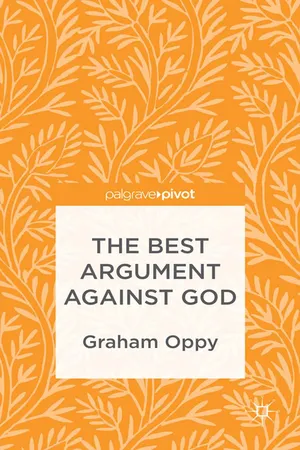
The Best Argument against God
About this book
Information
Topic
PhilosophySubtopic
Christian Theology1
Preliminary Matters
Abstract: We characterise theism and naturalism, and provide an account of the method that we use to provide a comparative assessment of them. In particular, we discuss theoretical virtues – simplicity, goodness of fit, explanatory breadth and predictive fruitfulness – and their role in the assessment of the comparative virtues of theories; and we also consider the role that the theoretical virtues might play in an argument for the conclusion that one theory dominates another on the available evidence. We conclude with a brief account of the properties of successful arguments.
Keywords: argument; dominance argument; Naturalism; successful argument; Theism; theory; theoretical virtue
Oppy, Graham. The Best Argument against God. Basingstoke: Palgrave Macmillan, 2013. DOI: 10.1057/9781137354143.
Theism
Theism says that there are gods: supernatural beings or forces that have and exercise power over the natural world but that are not, in turn, under the power of any higher-ranking or more powerful category of beings or forces.
Polytheism says that there is more than one god. Many ancient religions were polytheistic: consider, for example, the pantheons of Norse, Greek and Roman gods. Contemporary indigenous religions are also often said to be polytheistic, though there is room for debate about whether, for example, ancestral spirits are properly taken to be gods.
Monotheism says that there is exactly one god: God. Judaism and Islam are uncontroversially monotheistic religions. Christianity is also typically claimed to be a monotheistic religion, even though the doctrine of the Trinity might be thought to muddy the waters a bit. There is more serious debate about whether Hinduism is polytheistic; we shall not attempt to enter into that debate here. Hereafter, by ‘theism’, we shall mean ‘monotheism’ (unless context demands a wider interpretation).
On a natural ‘minimal’ conception, God is the source, or ground, or originating cause of everything that can have a source, or ground, or originating cause. In particular, on this ‘minimal’ conception, God is the cause of the existence of the natural world, and the source or ground or origin of most – if not all – of its significant features.
On ‘standard’ conceptions, God possesses a range of further attributes: for example, most theists agree that God is supremely powerful (‘omnipotent’), supremely wise and knowledgeable (‘omniscient’) and perfectly good (‘omnibenevolent’). While there are puzzles that can be raised about these attributes on particular ways of filling them out – for example, ‘can an omnipotent being make a rock that it is unable to lift?’, ‘can an omniscient being be modest?’, ‘can a being be both perfectly merciful and perfectly just?’ – we shall not attempt to investigate those kinds of puzzles in what follows.
There are many further attributes that some theists attribute to God. Contested ‘generic’ attributes include, among others: simplicity, infinity, impassibility, personality, consciousness, freedom, perfection, necessity, eternity and agency. And contested ‘specific’ attributes include, among others: having become incarnate, having atoned for our sins, loving every human being, having performed particular miracles and so forth. In the following discussion, we restrict our attention to the ‘minimal’ and ‘standard’ conceptions of God. There are many questions that can be raised about the attribution of further generic and specific properties to God, but we shall not attempt to canvass any of those questions here.
Naturalism
Naturalism says that causal reality is natural reality: the domain of causes is nothing more nor less than the natural world.
Atheism says that there are no gods; in consequence, atheism says that there is no God. Naturalism entails atheism: if causal reality is natural reality, then there is no (supernatural) cause of natural reality, and, in particular, there is no God. But atheism does not entail naturalism: to deny that there are gods is not to insist that causal reality is natural reality. Atheists who believe in ghosts, or demons, or pixies, are not naturalists.
Supernaturalism says that causal reality outstrips natural reality: there are supernatural causes. In consequence, theism entails supernaturalism: if God exists, then God is a supernatural cause. But supernaturalism does not entail theism: to hold that there are non-natural causes is not to insist that there is a God. Supernaturalists who believe in ghosts, or demons, or pixies, but who deny that God exists, are not theists.
This ‘minimal’ conception of naturalism relies on a prior understanding of the distinction between the natural and the supernatural (as did our ‘minimal’ conception of theism). We shall proceed on the assumption that we do understand this distinction well enough. If we come to have doubts about whether we do understand this distinction well enough, then we can return to give it more careful consideration.
‘Minimal naturalism’ admits of elaboration in many different – mutually inconsistent – ways. Any suitably elaborated naturalism will hold that some features of the natural world are primitive – not susceptible of further explanation – whereas other features of the natural world are fully explained in terms of those primitive features. Thus, for example, some naturalists suppose that all of the primitive features of the natural world are physical features – i.e. features that lie in the proper domain of the discipline of physics. Other naturalists suppose that there are features of the natural world – for example, the psychological states of human beings – that cannot be fully explained in terms of the fundamental physical properties. The key point to note is that all naturalists suppose that there are no supernatural causal properties – and so, in particular, there are no fundamental supernatural causal properties. Debates between naturalists about which are the fundamental natural properties will play no role in our subsequent discussion.
Method
The main question that we wish to address is whether there is reason to prefer theism to naturalism (or vice versa). We shall begin by considering the question whether there is reason to prefer minimal theism to minimal naturalism (or vice versa). Later, we shall turn to consider the question whether there is reason to prefer standard theism to a suitably elaborated naturalism (or vice versa).
Our method will be to address, one by one, a range of considerations that have been supposed to give support to one or other of the two views under assessment. Often, the considerations in question have been encoded in arguments for one or other of the views. As we go along, we shall note the consequences of our comparative assessment of the two views, against the considerations in question, for those arguments.
There is an assumption implicit in our method. We shall be assuming that a successful argument for one or other of the views in question would be an argument that appealed to considerations that favour one of the views over the other. This seems like a pretty uncontroversial assumption.
Theoretical virtues
When we compare two views – or hypotheses, or beliefs, or theories – in order to determine which one is most favoured by certain considerations, we need to have a set of criteria that we can appeal to in carrying out our comparisons. The most significant criteria that we shall be taking into account in the coming investigation are:
(a)Simplicity: If everything else is equal, we should prefer the more simple theory to the less simple theory. If everything else is equal, we should prefer the theory that postulates fewer (and less complex) primitive entities. If everything else is equal, we should prefer the theory that invokes fewer (and less complex) primitive features. If everything else is equal, we should prefer the theory that appeals to fewer (and less complex) primitive principles.
(b)Goodness of Fit: If everything else is equal, we should prefer the theory that makes the best fit with the data. There are complexities here. In many cases, we know that our data are imperfect: our data contain errors, or noise, or the like. The ‘best fit’ with the data may itself involve some kind of trade off between simplicity and what we might call ‘direct fit’ with the data.
(c)Explanatory Breadth: If everything else is equal, we should prefer the theory that explains more. There are two dimensions to this. On the one hand, all else being equal, we should prefer the theory that leaves less unexplained. (This is closely related to the idea that, if everything else is equal, we should prefer the theory that invokes fewer primitive entities and features.) On the other hand, all else being equal, we should prefer the theory that ‘unifies’ the wider domain of features. (Again, this is also related to the idea that, if everything else is equal, we should prefer the theory that invokes fewer primitive entities, features and principles.)
(d)Predictive Fruitfulness: If everything else is equal, we should prefer the theory that makes the most accurate predictions of future data. If everything else is equal, we should prefer the theory that prompts the most fruitful future inquiry – that is, the theory that suggests the more fruitful avenues for future investigation.
While these criteria are not very controversial, they are also quite limited: they do not always tell us how to proceed when we have differences along more than one dimension (so that ‘everything else’ is not equal). In particular, for example, these criteria give us no guidance in cases in which one theory makes a better fit with the data, but leaves more things unexplained. However, these criteria will be of use in any case in which one theory does better than another on some of these criteria, and no worse than that other theory on all of the remaining criteria.
Arguments
An argument is a collection of sentences – or thoughts, or claims, or beliefs, or propositions or what have you – one of which is identified as the conclusion, and the rest of which are the premises. Here is an example of an argument:
1Some things are caused. (Premise)
2Things do not cause themselves. (Premise)
3There are no circles of causes. (Premise)
4There are no infinite regresses of causes. (Premise)
5There is no more than one first cause. (Premise)
6If there is exactly one first cause, then that first cause is God. (Premise)
7(Hence) God exists. (Conclusion, from 1–6)
Warning: The word ‘argument’ is also sometimes used to denote a chain of reasoning or inference that takes you from premises to conclusions. We shall not be much interested in that sense of ‘argument’ in what follows. (Perhaps you can see an acceptable chain of reasoning that takes you from the premises to the conclusion in our example. A ‘first cause’ is something that causes other things, but that itself has no cause.)
We are interested in the role that arguments might play in debate. So, imagine that Theist and Naturalist are debating the existence of God. The conclusion of an argument that Theist might put to Naturalist will be ‘God exists’, or ‘Probably, God exists’ or ‘More likely than not, God exists’; and the conclusion of an argument that Naturalist puts to Theist will be ‘God does not exist’ or ‘Probably, God does not exist’ or ‘More likely than not, God does not exist’.
What properties should an argument have in order for it to count as successful? We shall suppose that there are just two. First, the conclusion of the argument should be supported by the premises: perhaps the conclusion is a logical consequence of the premises, or perhaps the conclusion is made probable by the premises, or perhaps the conclusion is made more likely than not by the premises etc. Second, the premises of the argument should all be believed by the opponent in the debate. Thus, if Naturalist is trying to convince Theist that God does not exist by appealing to an argument, then the argument in question should have as its premises only claims that Theist ...
Table of contents
- Cover
- Title
- Introduction
- 1 Preliminary Matters
- 2 Some Big Ideas
- 3 Minimal Theism and Naturalism
- 4 Standard Theism and Naturalism
- Conclusion
- Index
Trusted by 375,005 students
Access to over 1.5 million titles for a fair monthly price.
Study more efficiently using our study tools.
Frequently asked questions
Yes, you can cancel anytime from the Subscription tab in your account settings on the Perlego website. Your subscription will stay active until the end of your current billing period. Learn how to cancel your subscription
No, books cannot be downloaded as external files, such as PDFs, for use outside of Perlego. However, you can download books within the Perlego app for offline reading on mobile or tablet. Learn how to download books offline
Perlego offers two plans: Essential and Complete
- Essential is ideal for learners and professionals who enjoy exploring a wide range of subjects. Access the Essential Library with 800,000+ trusted titles and best-sellers across business, personal growth, and the humanities. Includes unlimited reading time and Standard Read Aloud voice.
- Complete: Perfect for advanced learners and researchers needing full, unrestricted access. Unlock 1.5M+ books across hundreds of subjects, including academic and specialized titles. The Complete Plan also includes advanced features like Premium Read Aloud and Research Assistant.
We are an online textbook subscription service, where you can get access to an entire online library for less than the price of a single book per month. With over 1.5 million books across 990+ topics, we’ve got you covered! Learn about our mission
Look out for the read-aloud symbol on your next book to see if you can listen to it. The read-aloud tool reads text aloud for you, highlighting the text as it is being read. You can pause it, speed it up and slow it down. Learn more about Read Aloud
Yes! You can use the Perlego app on both iOS and Android devices to read anytime, anywhere — even offline. Perfect for commutes or when you’re on the go.
Please note we cannot support devices running on iOS 13 and Android 7 or earlier. Learn more about using the app
Please note we cannot support devices running on iOS 13 and Android 7 or earlier. Learn more about using the app
Yes, you can access The Best Argument against God by G. Oppy in PDF and/or ePUB format, as well as other popular books in Philosophy & Christian Theology. We have over 1.5 million books available in our catalogue for you to explore.