- English
- ePUB (mobile friendly)
- Available on iOS & Android
eBook - ePub
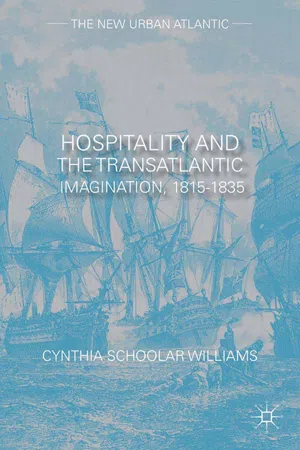
Hospitality and the Transatlantic Imagination, 1815–1835
About this book
Hospitality and the Transatlantic Imagination, 1815-1835 argues that a select group of late-Romantic English and American writers disrupted national tropes by reclaiming their countries' shared historical identification with hospitality. In doing so, they reimagined the spaces of encounter: the city, the coast of England, and the Atlantic itself.
Information
1
KEEPING HOSPITALITY
When Odysseus finally awakens on the coast of his homeland, he fails to recognize the place: “to the king himself all Ithaca looked strange.”1 The paths, the coves, the cliffs, and trees—Pallas Athena has “showered mist over all,” and Odysseus is agonized by his confusion.2 Not for the first time, he also feels betrayed. Didn’t the Phaeacians promise they would set a course for his native country? Yet here he is, on what seems to be another foreign shore: “Man of misery, whose land have I lit on now?/What are they here?” Odysseus cries. Will they be “friendly to strangers, god-fearing men?”3
Yes and no. Eumaeus plays the consummate host when Odysseus appears at his hut in a humble garb. With only modest fare on offer, the swineherd meets every expectation a Homeric traveler might carry with him to the threshold of an unknown dwelling. Even without knowing who the stranger is, Eumaeus enacts the familiar sequence of welcome with a simplicity that belies the very real danger such ritual is designed to blunt.
Soon thereafter, rejuvenated by the swineherd’s generosity, Odysseus approaches his own palace. To recross the threshold after an absence of 20 wandering years, he dons an even deeper disguise and enters his estate as a beggar. There Odysseus is subjected to the taunts and cruelty of guests who have set themselves up as masters of his household. Eventually, of course, after a lengthy denouement, the punishment he metes out is thorough and uncompromising. Excessive, perhaps, as a scene of revenge, the destruction of the suitors achieves a broader social order and reinstalls Odysseus as host of his own domain.
These two contrasting scenes—that of Eumaeus, poor but generous, alert to the possibility that the unassuming stranger might be a god, and that of the usurpers, who make a mockery of welcome, hurling chairs at the “beggar” rather than offering him a seat—together bear many of the characteristics of hospitality as it will appear in the readings that follow. Odysseus’s transformative homecoming has begun in failure, displacement, and isolation. His welcome is encoded through a series of formulaic elements that both respectfully recognize the mystery of the outsider and seek to socialize him. It acknowledges the asymmetries of power that define any hospitable encounter, for host and guest (or host and stranger) do not stand at either side of the threshold as equals, regardless of whether their vulnerability might feel comparable. Pared down to their essentials (threshold, disguise, meal, and revelation), these two scenes also evoke other ancient stories housed in the archive of our dominant culture: not just the Greek tradition, with its elaborate rules for feeding and lodging a guest, but the Old Testament story of Abraham, whose welcome of disguised angels secured his place as patriarch, and the question Jesus of Nazareth put to his audience, “Who then is your neighbor?” Much more recently—and on the margins of dominant culture—exigency has added to this lore. In the United States, for example, during the Great Depression as hundreds of thousands of men set out on roads and railways looking for work, they developed their own ideograms to indicate welcoming homes along their route.
Hospitable encounters connect the ancient with the modern, the mythic with the historical, because they address a problem every culture and every household has had to solve, namely, what to do when interrupted by a knock at the door. In this sense, hospitality seems transhistorical or, dare I say, universal. Shared characteristics lend it an almost structural sameness. At the threshold, however, issues of obligation, possession, and self-possession come into play, and therefore, despite similarities that seem to announce themselves in fables and practices across the globe and throughout time, hospitable encounters are culturally inflected. Thus, hospitality is an experience and a discourse of paradox. Scenes of welcome evoke, suspend, and defy many of our most powerful binaries.
“Suspend,” that is, in the sense of “holding in abeyance,” for an important function of hospitality in the classical world was to hold off violence for the duration of a visit; in other words, a host and guest whose people were at war could live in peace for the time of sheltering. Moreover, in the Homeric tradition, no questions about identity or lineage could politely be posed until after a meal had been shared. This capacity to suspend (time, meaning, and identity) will come to the foreground in chapters that follow; here, it recognizes our own tendency to think of hospitable ritual as being somehow out of time.
For all its being shrouded in the mists of antiquity, this ancient tradition nonetheless emerges with particular force and influence at a specific moment in the making of modernity. If The Odyssey offers a series of threshold encounters that form an end to a long and bloody war, so, too, do the texts gathered in this study. Decidedly more marginal in comparison with Homer’s epic, these texts nonetheless put hospitable discourse at the center of the crises of representation that agitated transatlantic culture in the late Romantic period. Politically efficacious parables, they reanimate hospitable discourse at the moment when the legacy of Enlightenment cosmopolitan ideals collided with the reality of precisely drawn borders in the aftermath of war.
With the Battle of Waterloo, England was brought to the threshold of an invigorated imperialism. Great Britain emerged from the defeat of Napoleon the largest empire the world had ever known, and yet the 1820s were years of pervasive fatigue. “The outbreak of peace precipitated a severe slump in agriculture, trade, and manufacturing” in what Linda Colley has called a period of “profound but generalised uncertainty,” one that put tremendous pressure on the category of citizen.4 So while England basked in the glory of victory, a number of writers explored the shadows. They unsettled the triumphalism of the moment and questioned the implications for subjectivity, affiliation, and national identity, which they accessed through the practices and discourse of hospitality. In the first decades of the nineteenth century, as political theorists debated what constitutes a nation, a people, or a culture, Romantic writers brought heightened sensitivity to the status of the strange, to movement across borders both domestic and political. They took up the aesthetic challenge of representing the nation at a time when representation and reform were, in fact, the key political issues of the day. If part of the cultural project of this period was to reforge a national identity, hospitality was a means of disrupting the tropes of organicism. In their stead, the tropes of hospitality (host, guest, alien, intimate, coast, door, circles, walls) informed a versatile aesthetics through which Mary Shelley, James Fenimore Cooper, Washington Irving, and Felicia Hemans asked a series of questions about displacement and the nation: How does one claim to belong? What are the limits of welcome? Is the nation a mediated construct, an aesthetic endeavor? Will there always be an England?
Focusing on the period between the Battle of Waterloo and the ascension of Victoria—roughly the period Benedict Anderson has called the era of high nationalism—this study queries estrangement, belonging, and nation-building in an Anglo-American context.5 The texts gathered together explore the domestic implications when a nation (here, England) exceeds its own boundaries and when emigration between England and America becomes a form of self-encounter. They take as a given the proposition that the other does not always bear the marks of exotic culture but is, at times, strangely familiar. If, as Jacques Derrida and Emmanuel Lévinas have opined, the hospitable encounter is the root of all ethical behavior, thresholds designating the self and other richly reward scrutiny, for how they are constituted and disrupted raises questions that go to the very heart of whether the other can ever truly be welcomed.6
At root, hospitality is an ethics of vulnerability. We will see this most poignantly, perhaps, in Shelley’s Lodore, through the alienation Ethel experiences when she returns from America to London. However, this note of risk sounds throughout the texts under consideration and resonates with what Jacques Khalip and David Collings have recently described as Romanticism’s sense of disaster.7 In adopting the term, they refer not to a “referential event,” but to “an undoing of certain apparently prior categories of dwelling [that] forces us to contemplate living otherwise.” For Shelley, Cooper, Irving, and Hemans, hospitality—as a set of social practices and as a principle of representation—is the means for responding to this unsettling paradigm shift. Reconfiguring the relations between host and guest, inside and outside, public and private, they construct a series of thresholds at which they meditate on how individuals come to be connected in a collective identity. In these texts, alienation and the nation are intimately bound up in each other—not surprisingly, given the mobility and agitation that characterized the period. Emigration, imperial expansion, and return from military service: these developments sundered the close association between location and identity.
In such a context, the Atlantic is particularly evocative, for as a fluid matrix of overlapping systems of exchange, it contends with the persuasive meta-narrative of national identity formation offered by scholars such as Colley and Anderson. Here, the Atlantic world is variously conceived: Scotland, for example, exerts a powerful eccentric influence that disrupts paradigms of center and periphery. This is particularly the case with the Waverley Novels, which, through staging hospitable rituals in the Scottish borderland, make those practices available for representing “England” and the nineteenth-century nation per se. Likewise, Liverpool distinguishes itself from London in Hemans’s publishing history and in Irving’s sketches, while in Cooper’s The Pilot, the open ocean is evoked in explicit contrast with a remote coastal zone where systems of meaning and belonging are undone. As a medium for emigration, escape, and repatriation, the Atlantic becomes a narrative space for exploring the power of estranged intimacy. If, as Julia M. Wright has said, nationalism exerts its influence so that “all who belong to that nation will be comfortably familiar,” these works posit the familiar as strange.8 Together, then, they suggest that an ethics of vulnerability operates not only in more obviously marked spaces of empire, but also among alienated familiars arrayed along a strong Anglo-American axis.
That transit will be my own as I trace selected texts of Shelley, Cooper, Irving, and Hemans back and forth across the Atlantic, but the central concern will always be the construction of England, rather than the equally interesting, and perhaps more commonly encountered, engagement with transatlanticism for what it can tell us about American history, American literature, or the influence of British letters in America. In some sense, then, I am like the sailors in The Pilot, taking the battle home to Britain. Partly this rhythm derives from the “importance of feeling English” that Leonard Tennenhouse has described, the late eighteenth- and early nineteenth-century notion that being “American” did not override British identity. Americans, he argues, following the work of historian Gordon S. Wood, wanted to write as Englishmen.9 However, there is also a distinctly poignant element to Cooper’s and Irving’s representations of the country from which their own republic became estranged.
The texts I have chosen manifest a shared preoccupation with how belonging is established and threatened in both the personal and political registers, for if the home is where one may regulate the access of others, domestic thresholds and political borders function as homologous structures that become particularly freighted during this period. Engaging, too, with the te...
Table of contents
- Cover
- Title
- 1 Keeping Hospitality
- 2 Mary Shelley at the Threshold: Displacement and Form in Lodore
- 3 A Sailor’s Welcome: James Fenimore Cooper’s The Pilot and Hospitality in the Coastal Zone
- 4 Hospitable History: Washington Irving’s Bracebridge Hall and the Uses of Merry Old England
- 5 England as Centrifuge: Felicia Hemans and the Threshold Foreclosed
- Coda
- Notes
- Bibliography
- Index
Trusted by 375,005 students
Access to over 1.5 million titles for a fair monthly price.
Study more efficiently using our study tools.
Frequently asked questions
Yes, you can cancel anytime from the Subscription tab in your account settings on the Perlego website. Your subscription will stay active until the end of your current billing period. Learn how to cancel your subscription
No, books cannot be downloaded as external files, such as PDFs, for use outside of Perlego. However, you can download books within the Perlego app for offline reading on mobile or tablet. Learn how to download books offline
Perlego offers two plans: Essential and Complete
- Essential is ideal for learners and professionals who enjoy exploring a wide range of subjects. Access the Essential Library with 800,000+ trusted titles and best-sellers across business, personal growth, and the humanities. Includes unlimited reading time and Standard Read Aloud voice.
- Complete: Perfect for advanced learners and researchers needing full, unrestricted access. Unlock 1.5M+ books across hundreds of subjects, including academic and specialized titles. The Complete Plan also includes advanced features like Premium Read Aloud and Research Assistant.
We are an online textbook subscription service, where you can get access to an entire online library for less than the price of a single book per month. With over 1.5 million books across 990+ topics, we’ve got you covered! Learn about our mission
Look out for the read-aloud symbol on your next book to see if you can listen to it. The read-aloud tool reads text aloud for you, highlighting the text as it is being read. You can pause it, speed it up and slow it down. Learn more about Read Aloud
Yes! You can use the Perlego app on both iOS and Android devices to read anytime, anywhere — even offline. Perfect for commutes or when you’re on the go.
Please note we cannot support devices running on iOS 13 and Android 7 or earlier. Learn more about using the app
Please note we cannot support devices running on iOS 13 and Android 7 or earlier. Learn more about using the app
Yes, you can access Hospitality and the Transatlantic Imagination, 1815–1835 by Cynthia Schoolar Williams in PDF and/or ePUB format, as well as other popular books in Literature & Literature General. We have over 1.5 million books available in our catalogue for you to explore.