Alvin J. Schexnider is the president of Schexnider & Associates, LLC. He previously served as the president of Thomas Nelson Community College and as the executive vice president and interim president of Norfolk State University.
- English
- ePUB (mobile friendly)
- Available on iOS & Android
eBook - ePub
About this book
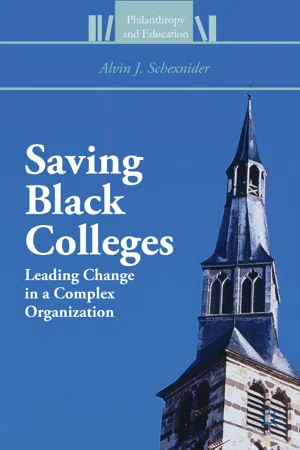
Saving Black Colleges makes clear the challenges, opportunities, and prospects for change historically black colleges and universities now face. Schexnider, the former chancellor of Winston-Salem State University, details what he could and could not accomplish, examines how these issues affect other HBCUs, and outlines a practical way forward.
Information
Topic
EducationSubtopic
Education Administration1
Discovery
There can be no progress without struggle.
—Frederick Douglass
It is hard to fully appreciate a situation that you have never experienced on a personal level. Each of us sees the world around us from the unique vantage point of our own cave. Sometimes we venture outside our cave to explore but depending upon the circumstances, we may not get a complete picture of what we find. On the other hand, we may discover things in our explorations that may shock and cause pain and disillusionment in the process. Regrettably, this was my experience at Winston-Salem State. I was mortified by what I discovered. Frankly, I had been in another cave for most of my professional career and could not have imagined in my wildest dreams what was awaiting me.
For much of my career my professional goal was to lead a black college, preferably a small one with less than 5,000 students. To a large extent this was based on my experiences at Grambling College where I was a student from 1964 to 1968. Its enrollment then was around 4,000 students, the vast majority of whom were Louisiana natives like myself. Most of us were the first in our family to college and we were, generally speaking, serious students, highly motivated to succeed. Our lives, or so it seemed at the time, had meaning and purpose beyond getting a degree. In no uncertain terms, our perspectives on life and our career ambitions were shaped by the pervasiveness of the Civil Rights Movement.
In many respects, these were Grambling’s halcyon days. It was a period that coincided with civic protest and antiwar sentiment. Grambling’s athletics program, especially football, was at its zenith and it was commonplace to see outstanding players signing with professional teams and cruising the campus in brand new Chevrolet Malibu Super Sports, Buick Rivieras, and Oldsmobile Toronados. James “Shack” Harris, the first black quarterback in the National Football League, was a next door neighbor in the dormitory my senior year. Ralph Garr of the Atlanta Braves had been my freshman roommate.
To be sure, Grambling had its problems then, but as a student my world revolved around my studies, a few extracurricular activities like the debate team and the Newman Club, and mapping out a career in the private sector. To me, as to most students, things looked pretty good at the time, despite the racially segregated society that engulfed us.
Of course, there were long registration lines that we didn’t like having to stand in—some as long as three days, and like most students, food services and financial aid left much to be desired. The Vietnam War, brought into our dormitory rooms daily, was as disturbing as the violence visited upon Dr. Martin Luther King and his followers as they marched and demonstrated across the south. Yet for the most part, life on this campus nestled in the red clay hills of northern Louisiana was nearly idyllic. Or so it seemed.
The college administration seemed to get the job done although frankly, I thought it odd at the time that in an institution of several hundred faculty and staff and four thousand students, President R. W. E. Jones personally signed each check irrespective of the amount. A few years after I graduated information about Grambling’s financial management problems became public. Some observers maintain that even with changes in Grambling’s leadership since Dr. Jones’s retirement in the 1970s, many of the same problems persist to this day.
Still, as a student, I was unaware of what leading a black college was all about. I only knew what things appeared to be like, and from the limited vantage point of a student at that.
When I completed graduate school in the early 1970s I wanted very much to teach in a black college. In fall 1973 I was hired by Southern University, Baton Rouge, Louisiana; several leading white universities were interested in me but my heart and my head were at Southern where I had taught in the summer of 1972.
My adviser and department chairman, Dr. David Minar at Northwestern University could not understand my interest in working at a black college, and frankly, I had a difficult time explaining it to him and other faculty save out of some kind of cultural loyalty based primarily on my experiences at Grambling.
My faculty appointment at Southern lasted one year, 1973–74. My first semester there convinced me that I would not be able to pursue my research and maintain the heavy-teaching load required of faculty. The department chair, Dr. Jewel Prestage was sympathetic and arranged a reduced-teaching load but that caused some of my colleagues to look upon me with mild disdain. Here again, even as a member of the faculty, I was fairly removed from the vagaries of administration and could not begin to appreciate what leading a black institution was like.
For over two decades, between 1974 when I left Southern University for Syracuse University and 1996 when I left Virginia Commonwealth University to assume the chancellorship at Winston-Salem State University (WSSU), I kept alive the dream of leading a black college. I was utterly astounded at what I found when I finally got my chance.
Someone has remarked, “Be careful what you ask for, lest you get it.” Well, at Winston-Salem State I got what I asked for and more. Let me hasten to acknowledge that my discoveries at Winston-Salem State pertain to that institution. While I suspect that my experiences there are generalizable or comparable to other Historically Black Colleges and Universities (HBCUs), no empirical support for this hunch is offered. What I do know is that the state of the administrative organization at Winston-Salem State was characterized by a lack of standard operating procedures, a lack of internal fiscal controls, and a strong resistance to doing things differently than they had been done for years. I have not experienced anything quite like WSSU before or since. Here is some of what I found upon my arrival in January 1996.
Throughout my career I had prided myself on contributing to the professionalism of the organization. Raising the bar was my mantra. My leadership style tended to be formal and businesslike and I expected employees to be hardworking professionals as well. I was therefore chagrined to find that it was commonplace at Winston-Salem State for the telephone to ring six or seven times before it was answered. Then, when it was answered, the person receiving the call might transfer the caller to three or four offices before the correct information was provided. Hiring a manager of quality improvement during my first year and bringing in a consultant to train staff on customer service helped but even after three years of aggressive training it remained a tough culture to overcome. Old habits die hard. Winston-Salem State had its share of old-timers who had seen chancellors come and go. They would see to it that sooner rather than later I would be gone, too.
I was startled also to find the copy machine in the reception area of the chancellor’s office, but that was easier to correct than changing attitudes where too many employees seemed not to care about making things better for students, faculty, and staff and the various publics we served. In fact, the prevailing attitude among some faculty and staff was that they were doing students a favor by simply being there. We tried to convey the notion that in an era of integration students tended to vote with their feet. Today’s students, we reasoned, had lots of options and if they didn’t like what they experienced at Winston-Salem State they could, if their grades permitted it, transfer to another institution. In point of fact, I was to discover that this is precisely what had been happening. Worse, some students never even got to first base at Winston-Salem State because bad news travels fast and since students are the best recruiters, those with options, that is, the best students, I suspect, didn’t even bother to apply there.
I discovered that the mail service was unreliable and that WSSU owned its own telephone system, which, for some reason malfunctioned when it rained. I suspected that the telephone system was not only unreliable but was compromised as well. In 1996 I had my office inspected by the State Bureau of Investigation for bugging devices since confidential information seemed to leak. Although no bugs were found, for the remainder of my tenure at WSSU I was very guarded in my conversations on or off the telephone.
Winston-Salem State had some hardworking employees who were dedicated to its mission; it had to, otherwise nothing could get done. Yet, there were far too many who did not pull their share of the load and seemed almost not to care. Some employees showed up to work whenever they wanted to with impunity. The notion of accountability was almost nonexistent and some people in supervisory roles seemed unwilling or unable to manage employees who reported to them. For some, there was a “stick your head in the sand mentality” on the presumption that problems ignored would eventually go away. Of course, my efforts to instill accountability in the system did little or nothing to boost my popularity on the campus or in some areas of the local black community.
There was no e-mail, no voice mail, and staff in business affairs had been slow to to implement a State-mandated software system designed to enhance accounting and fiscal operations. Similarly, some clerical staff refused training on new computers simply because they resisted change. Thus, the institution had a history of audit findings and a history of not paying its bills on time. Although a part of the University of North Carolina System, it seemed that for years Winston-Salem State had not been held to the same standard as white institutions in the same system. My boss, President C. D. Spangler, Jr. expected me to correct this situation and supported me in the changes that needed to be made (as long as he was there, however).
The athletic program was experiencing difficulty in meeting its fiscal obligations. This was not surprising because many National Collegiate Athletic Association (NCAA) Division II programs are not profitable. What did surprise me though was the fact that the team physician was a chiropractor, something I learned during my first year on the job and quite by accident. I shudder at the thought of having had to deal with a medical malpractice suit because of this. The chiropractor was soon replaced by a board-certified physician and further changes were made in athletics.
Equally disconcerting was being called upon during my first semester to look into the harassment of physical plant workers by students in one of the men’s dormitories. One of the physical plant workers came to my office to complain that students in a multistory dormitory building had a practice of throwing bags filled with urine on workers below. Also, glass bottles were thrown on the lawn in an attempt to injure groundskeepers as they mowed grass. This same dormitory was reputed to be a haven for drug dealing, hence, when a new police chief was hired its cleanup was on the top of our list. The new chief also confronted a campus seemingly without regard for parking regulations and a lax attitude toward enforcing campus security.
In view of the foregoing it should come as no surprise that employee morale was low. Years upon years of limited resources, mounting challenges brought on by increasing competition for students, and a lack of attention to keeping pace with change had taken its toll on the most dedicated of WSSU’s faculty and staff. There was also a fair amount of cynicism directed at anyone who sought to change things as well as at the University of North Carolina General Administration and whites in general. Analyzing the problem would be small compared to what it would take to correct it.
These are the conditions under which I began an earnest, if not naїve attempt to lead Winston-Salem State. I was soon to learn what a tall challenge this was, that is, being a leader of a historically black institution in a community suspicious of leaders, especially one viewed as an outsider. Moreover, I was a Roman Catholic in a community where most African-Americans were Protestant, our children went to a Catholic school and I talked and dressed in a manner that caused a local black member of the North Carolina House of Representatives to refer to me as an “Oreo” in the local newspaper.
Possibly, in general, my experiences are not unique and other HBCU presidents have had experiences similar to mine. Most, I am sure are motivated by a desire to do well and to succeed against insuperable odds. As I found, the obstacles are formidable and many problems seem to defy solution. The journey does not end, however, as HBCU presidents dress for battle each day in what seems at times an interminable war of Olympian proportions. The title of this book is intended to reflect the magnitude of the mission. Saving Black Colleges is in many respects not unlike Saving Private Ryan.1
In the movie, Captain John Ryan and a squad of soldiers are dispatched by Washington officials to rescue a paratrooper missing in action. The urgency of this mission is underscored by the fact that this soldier has lost three brothers in the war and returning him safely nearly rises to the level of protecting the national interest.
Captain Ryan and his men have been assigned something on the order of “mission impossible.” It does not stretch credulity to assert that many presidents of black colleges face a similar scenario.
Perhaps because many have been in existence for over 100 years, we forget the fact that black colleges were created because blacks could not be admitted to white colleges. The vast majority of black colleges began as normal or industrial schools with limited charters and modest means. That over 100 of these institutions remain in existence today is a testament to the dedication, ingenuity and resourcefulness of African-Americans, white philanthropists,2 and others who have supported their mission.
Now, in an era of expanded access to educational opportunities we confront the issue of not only Saving Black Colleges, but ensuring their sustainability. This book aims to address this concern.
Private Black Colleges
There are 105 HBCUs. Nearly half are small private institutions. Some have fewer than 1000 students and many are underfunded, located in rural areas, possess small endowments, and many lack the basic infrastructure (i.e., facilities, technology, scholarships) to compete for students who are academically prepared for college study. Many of these students enroll with academic deficiencies which, if identified at the outset can be remediated.3 Regrettably, some HBCUs lack the resources to provide remedial support. Contrariwise, some white universities have developed successful intervention strategies to recruit and retain African-American undergraduate students. While at Virginia Commonwealth University I learned firsthand that providing academic support to black students in math, English, and science in the first two years enabled them to improve their graduation rate and compete successfully with their white peers for jobs and admission to graduate and professional schools. African-American students and their parents are taking note of these developments. The competition for talented, motivated African-American students shows no sign of letting up.
Public Black Colleges
Public black colleges on the other hand tend to have larger enrollments and because of taxpayer support, are not as vulnerable to fiscal problems as the private colleges. They are not invincible, however.
As is true for private HBCUs, the budgets of public black colleges are enrollment-driven. This heightens the competition for students who are critical to their ability to succeed. Unlike private HBCUs however, public black colleges receive taxpayer support along with the political clout African-American legislators can muster on their behalf. These conditions may be necessary but not sufficient to ensure their success. It would be foolhardy to believe that their futures are secure on the basis of their public support.
In the segregation era, public black colleges had a monopoly on black students but today that is no longer the case. Currently, four out of every five African-American college students are enrolled in a white college or university. Publicly supported black colleges must compete with publicly supported white colleges in the same state and sometimes in the same city for what is sometimes a small applicant pool.
Perhaps to a greater degree than their white counterparts, black colleges are playing a game of catch up. In the 1960s and 1970s when white colleges opened their doors to black students, several HBCUs understandably became mired in racial politics and found the transition from segregation to integration very difficult.
In a fascinating book entitled The Tipping Point, Malcolm Gladwell argues that changes that occur every day in life may be thought of as epidemics. He points to the notion that ideas, products, messages, and behaviors spread in the same manner as viruses. According to Gladwell, “the name given to tha...
Table of contents
- Cover
- Title
- 1 Discovery
- 2 Learning the Ropes
- 3 Leading Change
- 4 The Plot Thickens
- 5 The End of a Short-Lived Era
- 6 Black Colleges in the Post-Brown Era
- 7 The HBCU Presidency: Challenges and Opportunities
- Appendix 1: Strategic Framework for Change
- Appendix 2: Key Accomplishments
- Notes
- Bibliography
- Index
Trusted by 375,005 students
Access to over 1.5 million titles for a fair monthly price.
Study more efficiently using our study tools.
Frequently asked questions
Yes, you can cancel anytime from the Subscription tab in your account settings on the Perlego website. Your subscription will stay active until the end of your current billing period. Learn how to cancel your subscription
No, books cannot be downloaded as external files, such as PDFs, for use outside of Perlego. However, you can download books within the Perlego app for offline reading on mobile or tablet. Learn how to download books offline
Perlego offers two plans: Essential and Complete
- Essential is ideal for learners and professionals who enjoy exploring a wide range of subjects. Access the Essential Library with 800,000+ trusted titles and best-sellers across business, personal growth, and the humanities. Includes unlimited reading time and Standard Read Aloud voice.
- Complete: Perfect for advanced learners and researchers needing full, unrestricted access. Unlock 1.5M+ books across hundreds of subjects, including academic and specialized titles. The Complete Plan also includes advanced features like Premium Read Aloud and Research Assistant.
We are an online textbook subscription service, where you can get access to an entire online library for less than the price of a single book per month. With over 1.5 million books across 990+ topics, we’ve got you covered! Learn about our mission
Look out for the read-aloud symbol on your next book to see if you can listen to it. The read-aloud tool reads text aloud for you, highlighting the text as it is being read. You can pause it, speed it up and slow it down. Learn more about Read Aloud
Yes! You can use the Perlego app on both iOS and Android devices to read anytime, anywhere — even offline. Perfect for commutes or when you’re on the go.
Please note we cannot support devices running on iOS 13 and Android 7 or earlier. Learn more about using the app
Please note we cannot support devices running on iOS 13 and Android 7 or earlier. Learn more about using the app
Yes, you can access Saving Black Colleges by Alvin J. Schexnider in PDF and/or ePUB format, as well as other popular books in Education & Education Administration. We have over 1.5 million books available in our catalogue for you to explore.