- English
- ePUB (mobile friendly)
- Available on iOS & Android
eBook - ePub
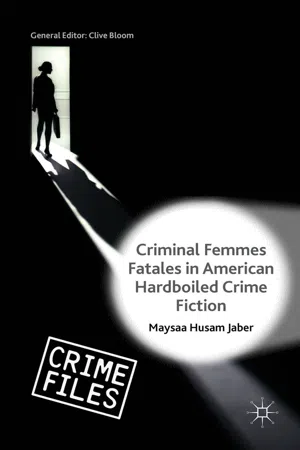
Criminal Femmes Fatales in American Hardboiled Crime Fiction
About this book
This book fills a gap in both literary and feminist scholarship by offering the first major study of femme fatales in hardboiled crime fiction. Maysaa Jaber shows that the criminal literary figures in the genre open up powerful spaces for imagining female agency in direct opposition to the constraining forces of patriarchy and misogyny.
Information
1
The “Mad-Bad” Criminal Woman
In the period between the start of the Great Depression in 1929 and the aftermath of World War II, the United States underwent a large number of social, political, and cultural changes. One manifestation of these changes was the redoubled effort to fight crime through a rather draconian policing ideology in response to an increase in urban crime, gangsterism, and corruption.28 This trend was intimately related to the emergence of hardboiled crime fiction in general and to the prevalence of the criminal woman in this genre as a figure who communicated an anxiety about security and maintaining order. Moreover, the social structure of American society was undergoing important changes, including shifts in prevailing attitudes towards gender roles and familial relationships. Broadly speaking, the shifts in gender roles that grew out of the efforts of the women’s movement to gain political rights were translated in different ways that range from the hard-won gains that the “New Woman” seemed to enjoy in the 1920s; to the rescinding of this freedom during the Depression of the following decade; to women’s subsequent involvement in the wartime economy and an unprecedented rate of women’s employment during World War II; and, finally, to a return to a more repressive ideology towards women in the 1950s.29 Responding to dramatic social changes, hardboiled crime fiction was in dialogue with these different facets of the complicated American scene. Yet the question of the representation of women as dangerous and criminal extends beyond historical factors, important as they are, to broader criminological and medical discourses. This chapter addresses the tension between literary and criminological discourses, shedding light on the question of gender and crime and how established conceptions of gender and gender roles contribute to the construction of women’s criminality in American culture at large. The examination of criminological texts, views, and theories of female criminality all serve to shed light on various aspects of this issue, and thereby lay the groundwork for the analysis of women in crime fiction to be developed later in this study. An understanding of the trajectory that covers a wide range of studies and theories of female criminality is important to the exploration of how perceptions of women’s crime have developed over time and how this change is reflected in the representation of women in hardboiled crime fiction.
The image of the nonaggressive woman
Criminological scholarship shows that the image of criminal women in crime literature is no less a construction than that found in fiction, and this construction is based on the entrenched view that women are passive. It is often assumed that women are less criminal than men.30 The widespread acceptance of gender differences in crime can be attributed in part to a long history of consigning women to submissive, nonviolent, and dependent gender roles. This view is affirmed in similarly prevalent assumptions about a gender gap in criminal behavior. A large number of scholars working in the field of criminology have maintained that women commit fewer crimes than men. For example, Darrell and Renee Steffensmeier state that women are “not catching up with males in the commission of violent, masculine, or serious crimes”31 but acknowledge that there is more parity with respect to larceny and white collar crime (1980: 80, original emphasis).32 Allison Morris points to the fact that statistics in various jurisdictions suggest that recorded crime is “overwhelmingly a male activity” (1987: 19–20); Ann Campbell likewise notes that women’s aggression “takes place less often than men’s” and that the former is often “unrecognized and frequently misunderstood” (1993: 1).
Although criminology is still a male-dominated discipline in both its subject-matter (focusing disproportionately on male crime) and its researchers (who are disproportionately male),33 feminist criminologists have nonetheless instigated a shift in perspectives and methodologies pertaining to the study of women’s crime. Downplaying the issue of the gender gap, some argue that women are as capable of committing crimes as men, and that they are as culpable as men in the commission of these acts. For example, in “Deconstructing the Myth of the Nonaggressive Woman: A Feminist Analysis,” Jacquelyn White and Robin Kowalski argue that women have the same potential as men to commit violent acts. White and Kowalski examine various factors that have contributed to the construction of women as nonaggressive, which in their estimation, is
a myth perpetuated by sociohistorically rooted cultural attitudes and values, reified by data based on statistical and methodological biases and flaws … because of opportunities, recourses, and socialization pressures, the situations in which women will display aggressive behaviors appear to be more circumscribed. (1994: 492)
Although White and Kowalski do not go as far as associating women’s criminality with agency, such theorization about the capacity of women to commit criminal acts suggests, especially from a feminist standpoint, an effort to destabilize the construction of the criminal woman as simply “evil” or “bad,” and untangle the complex sociocultural factors that contribute to this construction. In the light of the assertion that women are nonaggressive, one can say that in hardboiled crime fiction, confining female agency to the negative dimension of criminality may demonstrate that this criminal milieu is the only discursive space that allows women to have such power. Hence, the criminal space itself becomes a means that gives the writers of this genre the freedom to explore the limits and possibilities of that agency. In demonstrating characteristics such as financial and social independence, decision making, calculated planning and accomplishment of their goals, they also succeed in inviting a reading that resists sociocultural expectations and established gender norms that define women in terms of passivity and domesticity. With criminal femmes fatales positioned both at the center of the narratives and at the same time at their circumference, they push against generic boundaries to create a space to re-imagine women’s roles.
The criminal woman: Victim or agent?
Gender and cultural stereotypes influence law enforcement policies and color the way that the issue of women’s crime is dealt with. Violent women are consequently judged, especially in the criminal justice system, as “incoherent” or “discontinuous” inasmuch as they fail to conform to normative gender patterns (Gilbert 2002: 1274). Criminal women often cross gender boundaries by entering the masculine domain of crime, and hence are also rendered “discontinuous” by destabilizing the norms of gender roles. The criminal femmes fatales in hardboiled crime fiction go even further by combining transgressive hyper-feminine sexuality with what are socioculturally viewed as “masculine” ruthless crimes. The transgression of the criminal women in the narratives may indeed render a so-called “discontinuity” reading possible, especially given the various narrative attempts to control and regulate the woman to make her conform, such as the myriad instances when she is killed or “punished” towards the end of the story. However, the position of the woman as “discontinuous” or “other” is in fact challenged in a large number of hardboiled narratives. This is accomplished mainly through complicating the totality of the power of the male characters. The detective in early hardboiled crime fiction, as for example in Chandler’s and Hammett’s narratives, is satirized and ironized, usually by the criminal femmes fatales, who undercut his power. The detective is also presented as caught up in a dark world of crime in which he is more deeply involved and implicated than he would like to acknowledge, and which he, therefore, fails in his attempts to control. In post-war crime fiction, male protagonists are situated against a world full of the paranoia and anxieties of the Cold War so they often feel entrapped in their relationships to women. The female body becomes a direct source of threat to the masculinity of the protagonist, and is the site where the battle to assert power lies.
The discipline of criminology tells us that the “female criminal” is a woman who commits unlawful acts and is reported to the criminal justice system. Criminological literature, especially in the less biased accounts of women’s crime that tend to emanate from a feminist perspective, suggests that women offend mostly in response to abusive treatment by male partners.34 In general, criminological literature suggests that women tend to commit homicide against family members (husbands, lovers, or relatives), whereas men are additionally inclined to kill strangers or close friends.35 On the whole, women’s lawbreaking behavior seems to involve less serious acts such as theft and shoplifting. Yet while most studies indicate that violent crimes, especially murder in the United States, are only rarely perpetrated by women, it may still be the case that “the choice of victim and the modus operandi of the offence” are, as Carol Smart in one of the key texts in feminist criminology, Women, Crime and Criminology: A Feminist Critique, argues, “still in keeping with the ‘feminine’ stereotype’” (1977: 16).36
Interestingly, the crimes committed by women in hardboiled crime fiction do not reflect the picture presented in the criminological data. Women in this genre do not usually kill abusive partners in a domestic context. Rather, they commit crimes in mostly urban spaces, and they do kill strangers. This departure from criminological literature can be partly accounted for by looking at the timeline and context in which hardboiled crime fiction was produced. The genre became popular before feminist criminology, which represented the first real breakthrough in the study of women’s criminality and did not happen until the 1970s, focusing mainly on the female criminal as victim. At the same time the popular images of the criminal woman and the discourses on female criminality contemporary with hardboiled crime fiction in the early part of the twentieth century relied, as I argue below, on stereotyped and distorted images of criminal women. Thus, hardboiled crime fiction can be said to carry an oppositional or even transgressive potential as a body of texts that provides sociocultural and political critique of the dominant ideologies under which medico-legal discourses fall.37 Indeed, it is this critical function that allows the genre, in Lee Horsley’s words, to be a “natural generic home for many different types of protest writing” (2005: 69).
As far as the question of the motives for women’s crime is concerned, some scholars such as Carlen et al. (1985) think that women derive the same kind of excitement and pleasure from committing crimes, especially white-collar crimes, as do men. Other criminologists, however, suggest that poverty, rather than psychological satisfaction, may be the principal motivation for women’s engagement in theft.38 Smart describes how women’s motives, or more accurately lack of motives, influence their treatment in the criminal justice system. She notes that when a woman is “unable to offer a seemingly rational or reasonable account for her motivation it may appear that rational motivation is absent and the action is produced by forces beyond the control of the offender” (1977: 110). The lack of a “rational account” that conforms to the norms and expectations of existing social control institutions is by no means an indication that the criminal woman does not have a valid explanation for her behavior.39
In a further departure from criminological literature, poverty does not appear as one of the motives behind women’s crime in hardboiled crime fiction. Some of the criminal women in this genre come from a high socioeconomic class (for example, some of Raymond Chandler’s female characters), and the motivation for their crimes is related to their involvement in a world of gangsters and corruption rather than pressing economic need. Even more evidently in James Cain’s work, women’s crimes are motivated by a blind ambition to climb the social ladder. Greed, the pursuit of power, and participation in organized crime appear to be the main factors that drive women to criminality. Early hardboiled crime fiction was written at a time when criminal women were not quite visible in the criminological literature; the few studies of traditional theories of female criminality contemporary to the fiction dismissed criminal women as an anomaly. The narratives, moreover, came at a moment in American history when organized crime and gangsterism were booming in the urban space. Therefore, crime by women became a way to break the social control and policing ideology that became more rooted and pervasive during the Depression, through a re-envisioning of female roles. In the post-war period, the criminal woman became part of greater anxieties and more complicated discourses on legality and law. With enemies from beyond the borders, and a more rigid and radical policing agenda, the criminal woman became more dangerous but more entrapped within the contradictions that surrounded American society then.40 On the whole, the narratives of this genre were a platform in popular culture that not only portrayed visible images of criminal women, but also more generally offered critiques of the ideologies of control and containment of women.
Is there, then, a typical female criminal? If one wants to answer the question from a feminist criminological perspective, the answer would be “no,” despite the fact that stereotypes of women criminals clearly exist. Anne Worrall suggests that there are a number of female lawbreakers who defy description and challenge what she calls the “gender contract” according to which criminal women are represented in terms of their domestic, sexual, and pathological characteristics. They are women “on the margins of categories – never sufficiently this or that … they remain ‘nondescript’ – out of reach and untouchable” (1990: 31). In an effort to respond to this question and see its implications for the representation of women in hardboiled crime fiction, this study stresses the “nondescriptiveness” (32) of women in general and criminal women in particular, avoiding the stereotyping and narrow categorization of women that is often present in conventional analyses of women’s criminality.41
The stereotyping of the criminal woman
At the heart of the discussion of women’s criminality is the question of what it means to be “female.” Women’s experiences of being female are “mediated by their bodies, their minds and their social interaction,” as well as the ways in which discourses that inform women’s experiences are “constituted by sets of relationships which cluster around notions of domesticity, sexuality and pathology” (Carlen and Worrall 1987: 2).42 Social stereotypes of criminal women have been perpetuated via various channels, including science, the media,43 and popular culture, as well as through the field of criminology itself.44
This criticism of the present body of scholarship on women’s criminality reveals the unreliability of the field of criminology and how it both feeds into and, at the same time, recreates popular images of the criminal woman as “mad” or “bad.” In this context, Etta Anderson notes the construction of the image of the criminal woman through what she calls the “chivalry proposition,” which refers to the view, held by a number of criminologists, that women receive a more “lenient” and/or “chivalrous” treatment in the criminal justice system than do their male counterparts (1976: 350). She argues that the chivalry proposition is undergirded by three basic stereotypes of women’s criminality: the female as “the instigative offender,” “the sexualized offender,” and “the protected offender.” The notion of chivalry is either explicitly or implicitly presumed in all of these constructions – in each, the man is enjoined to “do the job” for the woman, who is consigned to the role of manipulative seductive instigator. Such iconic images of masculinity and femininity have a long history of dissemination in various channels. Mid-twentieth-century criminological studies such as William I. Thomas’s (1967 [1923]) The Unadjusted Girl and Otto Pollak’s (1961 [1950]) The Criminality of Women, which are considered the most important works about women’s crime prior to the modern period of criminological scholarship, present images of manipulative women who use their sexual charms to persuade men to commit crimes. One of these stereotypes that Anderson discusses is the “sexualized offender,” whose ambitions are entirely sexual in nature. Indeed, the “female criminal’s behavior is explained in sexual terms, which include such notions as penis envy, female promiscuity, and the physiological inferiority of women” (Anderson 1976: 352). Finally, the chivalry proposition is manifest in the “protected female offender,” an offender in need of special treatment by the criminal justice system. The conceptualization of women as reliant upon such “chivalrous” protection is a myth that has been employed to sexualize women and rob them of agency. Conventional criminological ...
Table of contents
- Cover
- Title
- Copyright
- Contents
- Acknowledgments
- Introduction
- 1 The “Mad-Bad” Criminal Woman
- Part I Pre-War Criminal Femmes Fatales
- Part II Post-War Criminal Femmes Fatales
- Conclusion
- Notes
- Bibliography
- Index
Trusted by 375,005 students
Access to over 1.5 million titles for a fair monthly price.
Study more efficiently using our study tools.
Frequently asked questions
Yes, you can cancel anytime from the Subscription tab in your account settings on the Perlego website. Your subscription will stay active until the end of your current billing period. Learn how to cancel your subscription
No, books cannot be downloaded as external files, such as PDFs, for use outside of Perlego. However, you can download books within the Perlego app for offline reading on mobile or tablet. Learn how to download books offline
Perlego offers two plans: Essential and Complete
- Essential is ideal for learners and professionals who enjoy exploring a wide range of subjects. Access the Essential Library with 800,000+ trusted titles and best-sellers across business, personal growth, and the humanities. Includes unlimited reading time and Standard Read Aloud voice.
- Complete: Perfect for advanced learners and researchers needing full, unrestricted access. Unlock 1.5M+ books across hundreds of subjects, including academic and specialized titles. The Complete Plan also includes advanced features like Premium Read Aloud and Research Assistant.
We are an online textbook subscription service, where you can get access to an entire online library for less than the price of a single book per month. With over 1.5 million books across 990+ topics, we’ve got you covered! Learn about our mission
Look out for the read-aloud symbol on your next book to see if you can listen to it. The read-aloud tool reads text aloud for you, highlighting the text as it is being read. You can pause it, speed it up and slow it down. Learn more about Read Aloud
Yes! You can use the Perlego app on both iOS and Android devices to read anytime, anywhere — even offline. Perfect for commutes or when you’re on the go.
Please note we cannot support devices running on iOS 13 and Android 7 or earlier. Learn more about using the app
Please note we cannot support devices running on iOS 13 and Android 7 or earlier. Learn more about using the app
Yes, you can access Criminal Femmes Fatales in American Hardboiled Crime Fiction by Maysaa Husam Jaber in PDF and/or ePUB format, as well as other popular books in Literature & Literature General. We have over 1.5 million books available in our catalogue for you to explore.