- English
- ePUB (mobile friendly)
- Available on iOS & Android
eBook - ePub
About this book
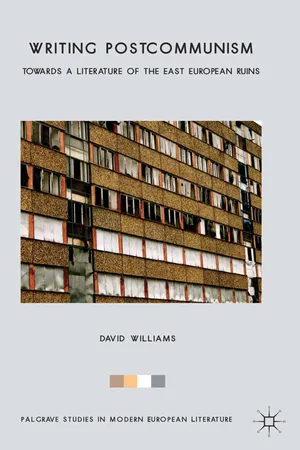
Moving through the elegiac ruins of the Berlin Wall and the Yugoslav disintegration, Writing Postcommunism explores literary evocations of the pervasive disappointment and mourning that have marked the postcommunist twilight.
Trusted by 375,005 students
Access to over 1.5 million titles for a fair monthly price.
Study more efficiently using our study tools.
Information
1
‘The Citizen of a Ruin’
Poets and hangmen
Writing in 1994, Dubravka Ugrešić remarked that the east European writer now lives
without a firm roof over his head, his literary house (whatever that meant) has been destroyed, and with it his personal and literary biography. … He is a representative of a world which no longer exists, a tragi-comic being, a tightrope-walker overburdened with mental baggage, the citizen of a ruin, an eternal exile, neither here nor there, homeless, stateless, a nostalgic, a zombie, a writer without readers, a travelling salesman selling goods either nibbled by moths or peppered by shells. … He is a loser, a seller of souvenirs of a vanished epoch and vanished landscapes, an incompatible being, both despairing and deceiving at the same time, former, from every point of view.1
How the east European writer became, post-1989, ‘the citizen of a ruin’ is a long story, yet one that requires at least the briefest sketching here. As a starting point, Andrew Wachtel’s provocative suggestion that ‘Eastern Europe is that part of the world where serious literature and those who produce it have traditionally been overvalued’2 is a revealing one. As Wachtel compellingly outlines, inspired by the Herderian triad of language, nation and (eventual) state, the majority of the modern east European nation states are frequently thought to have been – figuratively speaking – invented by writers; imagined into being by national poets on the basis of shared language (codified by ‘patriotic linguistics’3) during the national awakenings or revivals beginning in the 1830s. Thus, the idea of the writer as the ‘founding father of the nation’ (who apparently managed to procreate alone) became a pervasive one in east European thought – one that widely endures among philologists, literary scholars, and even some historians. The declaration of a Slovenian scholar that ‘the Slovenes, both as individuals and as a people, cannot be conceived of without Prešeren’,4 the national poet whose statue today towers over the main square in Ljubljana, is thus in no way atypical. Neither is the bald rhetorical question formulated by distinguished historian Hagen Schulze, who asks ‘would we now have a Slovakian state without the Grammatica slavica of the Catholic priest, Anton Bernolak, which appeared in 1790’?5
It is, however, well worth examining the above claims and several attendant issues more closely. Firstly perhaps, it should be stressed that a writer cannot ‘invent’ a real existing country any more than a poet can ‘imagine’ one into being. Actual state formation is, in the end, always a political, bureaucratic and legislative act. The matter at hand is that in the modern period, nation building in central and eastern Europe was dominated by processes relating not to institutions, constitutions, popular sovereignty and human rights in the manner of western Europe, but the Romantic idea of the nation as constituted by history, language and culture.6 As Schulze maintains, the modern nation states in the European north-west were generally founded on ‘the subjective, political view of the French Revolution’, while those in central and eastern Europe were inspired by ‘the objective, cultural view of German Romanticism’.7
As Wachtel indicates, with the exceptions of Russia and Montenegro, in the year 1800, none of the contemporary east European states were independent, but rather controlled by one of three empires.8 Thus east European writers did indeed have the potential to become ‘founding fathers’. Whether Hungarian monarchies existed before Sándor Petőfi or medieval Polish kingdoms existed before Adam Mickiewicz is not the question at hand. And what of the oft-repeated view that a particular (east European) writer expresses ‘the soul of the nation’? Wachtel cites a Polish scholar who draws the following comparison between Adam Mickiewicz and Abraham Lincoln:
‘To get a glimpse of the full measure of his influence it is probably necessary to go beyond the limits of literature and recognize Mickiewicz’s spiritual significance for the Polish people, as well as the myth which he created, as being equivalent to that posthumous influence which Abraham Lincoln constantly exerts upon the American soul: one must compare with the legend of the great poet who was also a political leader, the legend of the great statesman who in the Gettysburg Address produced a literary masterpiece.’9
Mickiewicz’s role is directly compared not to that of a fellow poet, such as Walt Whitman (to whom he might well have been compared), but to that of a statesman, Abraham Lincoln. And if we look to England, as Wachtel reminds us, while Shakespeare might be the national poet, no ‘serious person has made the claim that without Shakespeare there would have been no Englishmen and no Great Britain’.10
Moving forward to the communist period, from their roles as founding fathers east European writers slipped quickly into the role of ‘engineers of human souls’,11 their work disseminated by litero-centric education systems. This ‘soul engineering’ was undertaken by the Staatsdichter (state poet) and the dissident in equal measure, the former tasked with inspiring the relentless optimism of a (perpetually delayed) brighter future, while the latter set himself up in opposition – presenting the often much bleaker defeatism of lived and present reality. As Kundera once put it, the communist period was one in which ‘the poet reigned along with the hangman’.12 And if the anecdote about Stalin’s phone call to Pasternak seeking his opinion on Mandelstam is true, it was a time in which poet could also be hangman.13 With the writer enjoying this multiplicity of roles to greater or lesser extents throughout eastern Europe, literature, as Wachtel contends, functioned as a basic ‘motor of meaning creation’14 in society. Indeed, in the post-war chaos of the former Yugoslavia, Bosnians of all three ethnic groups pressed me to read Ivo Andrić’s The Bridge on the Drina (1945, Na Drini ćuprija) in order that I might learn the ‘truth’ about their dismembered homeland. It was as if Andrić’s tale of the construction of the Mehmed Paša Sokolović Bridge in Višegrad and its constant destruction and reconstruction was the only suitable narrative to convey the present and historical tragedy of the Balkans.
There is, however, another particular reason why writers and literature have historically been very important in eastern Europe: with the exception of Russia, eastern Europe is made up of ‘small nations’. (Chamberlain’s infamous reference to Czechoslovakia in 1938 as ‘a far away country of which we know very little’ is a useful descriptor.) In an essay entitled ‘The Provincialism of Small Nations’, Kundera elucidates the problematic nature of the relationship between writers from small nations and their homelands:
The small nation inculcates in its writer the conviction that he belongs to that place alone. To set his gaze beyond the boundary of the homeland, to join his colleagues in the supranational territory of art, is considered pretentious, disdainful of his own people. And since the small nations are often going through situations in which their survival is at stake, they readily manage to present their attitude as morally justified.15
Citing a passage from Kafka’s Diaries (from which Deleuze and Guattari would extrapolate the collective enunciation tenet in their seminal definition of a ‘minor literature’), Kundera then indicates the connection with politics:
A small nation, he [Kafka] says, has great respect for its writers because they provide it with pride ‘in [the] face of the hostile surrounding world’; for a small nation, literature is ‘less a matter of literary history’ than ‘a matter of the people’, and it is that exceptional osmosis between the literature and its people that facilitates ‘the literature’s diffusion throughout the country, where it binds with political slogans’.16
The end result of this osmosis is that the writer from a small nation is never simply just a writer, but a national representative – a position, it is fair to say, that historically many appear to have quite enjoyed, and in our time, one in which many still take pleasure. The difficulty is for those who didn’t then, and those who don’t now. As Kundera maintains, while Nietzsche was able to maul the German character and Stendhal get away with preferring Italy to his French homeland, ‘if a Greek or a Czech dared to say the same thing, his family would curse him as a detestable traitor’.17
‘Something Is Over’
In conversation with Ivan Klíma in the early 1990s, Philip Roth suggested that the importance of east European writers in their societies led to
a certain amount of loose, romantic talk in the West about ‘the muse of censorship’ behind the Iron Curtain. I would venture that there were even writers in the West who sometimes envied the terrible pressure under which you people wrote and the clarity of the mission this burden fostered: in your society you were virtually the only monitors of truth. In a censorship culture, where everybody lives a double life – of lies and truth – literature becomes a life preserver, the remnant of truth people cling to.18
In 1981, the towering figure of George Steiner came close to the ‘loose talk’ Roth perhaps had in mind, intoning that in ‘the studios, cafes, seminars, samizdat magazines and publishing houses, chamber-music groups, itinerant theatres, of Krakow and of Budapest, of Prague and of Dresden’ lay ‘a reservoir of talent, of unquestioning adherence to the risks and functions of art and original thought on which generations to come will feed’.19 For his part, Wachtel cites the introduction to the English translation of Kundera’s The Farewell Party, which begins ‘The Farewell Party attests to the longevity of political oppression in Czechoslovakia by never mentioning it’20 as an absurd example of how Cold War-era east European literature was milked in the West for its extraliterary appeal.
In an essay from 1980, Danilo Kiš satirically explicated the apparent division of labour in the literary republic, noting that ‘Yugoslovaks and other Hungarians’ are always assigned the role of Homo politicus and required to ‘give up literature and stick to … politico-exotico-communistski themes’. Western European writers on the other hand, those ‘pure in heart and mind’, get to be Homo poeticus and retain franchise on everything from metaphysical obsessions and the human condition, to childhood and sunsets.21 And in a 2004 essay the Slovene Andrej Blatnik, whose own short stories of urban losers owe more to rock ‘n’ roll than any tradition of the writer as ‘voice of the people’, ironically imagines the post-1989 diktat of the western literary marketplace: ‘Dear writer from the East, if you weren’t ever imprisoned in your home country, your writing really can’t be important.’22
There is much evidence to suggest that in the post-1989 period, in the head-on collision between what Roth contrasted as ‘the protected high culture of Eastern Europe’ and ‘the world of Total Entertainment’,23 east European writers came off a distant second-best. In this respect, Roth points to the irony that while totalitarianism may have protected east Europeans from the best works of their own and foreign culture, it had nevertheless also protected them from the worst excesses of mass culture. Massively reduced print runs, emasculated national budgets for culture, the deluge of translated pulp literature, and the citizenry’s dramatically lower purchasing power, all suggest east European literature’s post-1989 fall from grace. Indeed, east European writers have themselves been very productive in both declaring (and often bemoaning) a kind of post-1989 ‘End of Literature’. With a 1991 essay resolutely entitled ‘Something Is Over’, György Konrád was one of the first out of the blocks, declaring that ‘an age in the history of literature has come to an end’,24 and that
literature as we knew it under socialism – that is, literature as a national institution – has ceased to exist. Gone are our cheap books: the state no longer has an interest in whether its citizens read what its writers have to say. We writers are no longer high priests, but we are no longer heretics either. Nor was political dissent ever really the domain of literature proper: when criticism can be heard in parliament or read in the dailies, it does not need to play hide-and-seek between the covers.25
Yet in the wake of the Yugoslav wars, literature from Bosnia, Croatia and, to a lesser extent, Serbia was translated and published abroad as never before. And in terms of societal ‘relevance’, in a 2004 interview, Bosnian-American writer Aleksandar Hemon went as far as to say that ‘the golden age of Bosnian literature was during the war, because people in Sarajevo and elsewhere thought that writing and publishing was a form of resistance’.26 Both Jasmina Lukić and Slavenka Drakulić have noted that the militant nationalism of the Yugoslav wars turned many of the disintegrating country’s writers into dissidents and internal and external emigrants at the very time that the fall of the Berlin Wall had all but erased these writerly models elsewhere in eastern Europe.27 As Lukić lucidly observes, ‘the war put writers from the former Yugoslavia in the very pos...
Table of contents
- Cover
- Title
- Copyright
- Contents
- Series Editors’ Preface
- Acknowledgements
- Introduction: Exercises in Polysemy
- 1 The Citizen of a Ruin’
- 2 Unconditional Surrender and the Ruins of Berlin
- 3 Aporias, Impasses and Ostalgia
- 4 Trümmerliteratur Redux
- Epilogue: ‘The Future Has No Future’
- Notes
- Select Bibliography
- Index
Frequently asked questions
Yes, you can cancel anytime from the Subscription tab in your account settings on the Perlego website. Your subscription will stay active until the end of your current billing period. Learn how to cancel your subscription
No, books cannot be downloaded as external files, such as PDFs, for use outside of Perlego. However, you can download books within the Perlego app for offline reading on mobile or tablet. Learn how to download books offline
We are an online textbook subscription service, where you can get access to an entire online library for less than the price of a single book per month. With over 1.5 million books across 990+ topics, we’ve got you covered! Learn about our mission
Look out for the read-aloud symbol on your next book to see if you can listen to it. The read-aloud tool reads text aloud for you, highlighting the text as it is being read. You can pause it, speed it up and slow it down. Learn more about Read Aloud
Yes! You can use the Perlego app on both iOS and Android devices to read anytime, anywhere — even offline. Perfect for commutes or when you’re on the go.
Please note we cannot support devices running on iOS 13 and Android 7 or earlier. Learn more about using the app
Please note we cannot support devices running on iOS 13 and Android 7 or earlier. Learn more about using the app
Yes, you can access Writing Postcommunism by D. Williams in PDF and/or ePUB format, as well as other popular books in Literature & Eastern European History. We have over 1.5 million books available in our catalogue for you to explore.